An orange item with Legendary Potential, another with Weaver’s Will, and a green piece of equipment may look like comparable options, but they follow different upgrade paths. Knowing which one to keep depends on the effects your build needs and what each item can still become.
Crafting in Last Epoch combines materials, limited potential, and special operations. As in other equipment- and build-focused ARPGs, rarity helps identify an item’s possibilities but never replaces examining its modifiers. This guide follows an item from its base and affixes through Legendary crafting, Reforged Sets, Primordial items, and corruption.
Revised October 20, 2026. This article uses Season 5: Rage of the Frostborn, launched October 1, as its reference. Hotfix 1.5.2.1, published October 9, was the latest official patch note identified by the editorial cutoff. Rage of Morditas is the encounter system introduced with this Season update.
For broader context on the campaign, endgame, and the ARPG’s evolution, see our Last Epoch overview. Here, the focus is on identifying, preparing, and improving equipment.
Nesta matéria
Legendary Potential, Weaver’s Will, and green items: the short explanation
Legendary Potential (LP) determines how many affixes from an Exalted item a Unique normally receives through the Eternity Cache. Weaver’s Will (WW) represents tiers developed through experience on certain Uniques. Forging Potential (FP) is the resource spent on conventional Forge operations. Green Set Items unlock bonuses by combining pieces. Similar-sounding names do not make these systems interchangeable.
How does equipment work in Last Epoch?
Equipment accounts for a large share of a character’s power in Last Epoch.
It can improve defenses, increase damage, modify skills, or enable a build to work in an entirely different way.
Characters equip weapons, helmets, body armor, gloves, boots, belts, amulets, two rings, and relics. Depending on the class and weapon, an off-hand item such as a shield, Catalyst, or Quiver may also be available. Two-handed weapons occupy the relevant slots and rule out certain combinations.
There is also an Idol system: items placed in dedicated slots that grant extra modifiers and, in special variants, additional progression options. Each equipment type has its own bases.
What is an item base?
A base is an equipment subtype that determines its implicit modifiers. Two pairs of gloves with similar affixes can offer different inherent defenses or advantages. Before investing materials, compare their implicit values and compatibility with your main skill. A suitable base avoids wasting potential trying to compensate for an inherently poor fit.
Implicit and explicit modifiers
Implicit modifiers belong to the item’s base. They appear independently of ordinary affixes and vary by item type.
Explicit modifiers are the properties displayed on equipment. On ordinary craftable items, many of these modifiers are categorized as affixes. The base determines what an item can provide inherently, while affixes let you develop it more deliberately.
Prefixes and suffixes
A conventional item can have two prefixes and two suffixes, for four unsealed affixes in total. Each modifier belongs to a category and can appear only on compatible equipment types. If both prefix slots are filled, adding another prefix requires freeing one through an appropriate operation; an empty suffix slot does not solve that restriction.
Item level and equip requirements
An item’s required level and class restrictions do not measure its quality. The level of the area where it drops and its base also influence the properties available. A low-level Unique may remain essential because of its effect, while a higher-level item still needs useful modifiers.
Every item rarity and color
Colors help identify what kind of equipment lies on the ground or in your inventory.
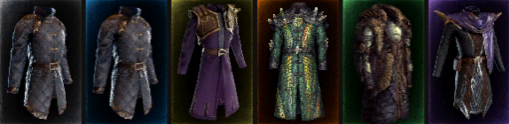
Color | Rarity | Main characteristic |
|---|---|---|
| White | Normal / Common | No conventional affixes |
| Blue | Magic | One or two affixes |
| Yellow | Rare | Three or four affixes |
| Purple | Exalted | At least one T6 or T7 affix |
| Orange | Unique | Its own special properties |
| Green | Set | A set piece with additional bonuses |
| Red | Legendary | A Unique developed with additional affixes |
Normal items
Normal items are starting points for adding affixes. Their usefulness depends on the base and remaining potential, especially during the campaign; they lack the special modifiers found on Uniques.
Magic items
These are partially developed pieces that can gain more affixes and increase in rarity through the Forge. They let you address immediate needs without waiting for an item that drops with everything already in place.
Rare items
Rares offer flexibility to fill conventional stat requirements up to T5. A useful combination of modifiers can be more valuable than a Unique effect that does not work with your build.
Exalted items
A T6/T7 affix exceeds the normal upgrade ceiling for Shards. You can preserve it while preparing the other affixes or use the item as a donor for Legendary crafting. Special tier-redistribution operations are not equivalent to normally upgrading T5 into T6.

Unique items
A Unique’s signature effects can change how skills and entire builds work. Uniques do not accept conventional crafting like Rares; LP, WW, and special transformations offer specific paths when the item is eligible.
Set items
Besides their own attributes, Set Items contribute to bonuses earned by combining pieces. Traditional Sets and Reforged Sets have different crafting possibilities, covered later.
Legendary items
Legendary items combine Unique effects with additional affixes, either through LP or WW development. Their usefulness still depends on the outcome and the item’s role in a build.
What are affix tiers?
Affixes have power levels called tiers, usually shown as a T followed by a number. Higher tiers generally increase the modifier’s potential within its corresponding range.
Conventional crafting can upgrade an affix to Tier 5 (T5). Tier 6 and Tier 7 affixes are Exalted and normally come from drops or specific systems. The game also includes special equipment with even higher modifiers.
T1 to T5: ordinary crafting tiers
Affix Shards add a T1 affix or raise an existing affix up to T5. A T2 resistance can become T3, T4, then T5 if you have the materials, a compatible item, and enough potential. The tier determines a range of values; the particular roll within that range is another consideration.
T6 and T7: what makes an Exalted item special?
These Exalted tiers normally appear on drops, not through the ordinary sequence of Shard upgrades. A useful T7 can justify preparing the other affixes. Rune of Havoc and Rune of Redemption alter eligible items in specific ways but cannot freely produce any combination you want.
Tier 8 and Primordial items
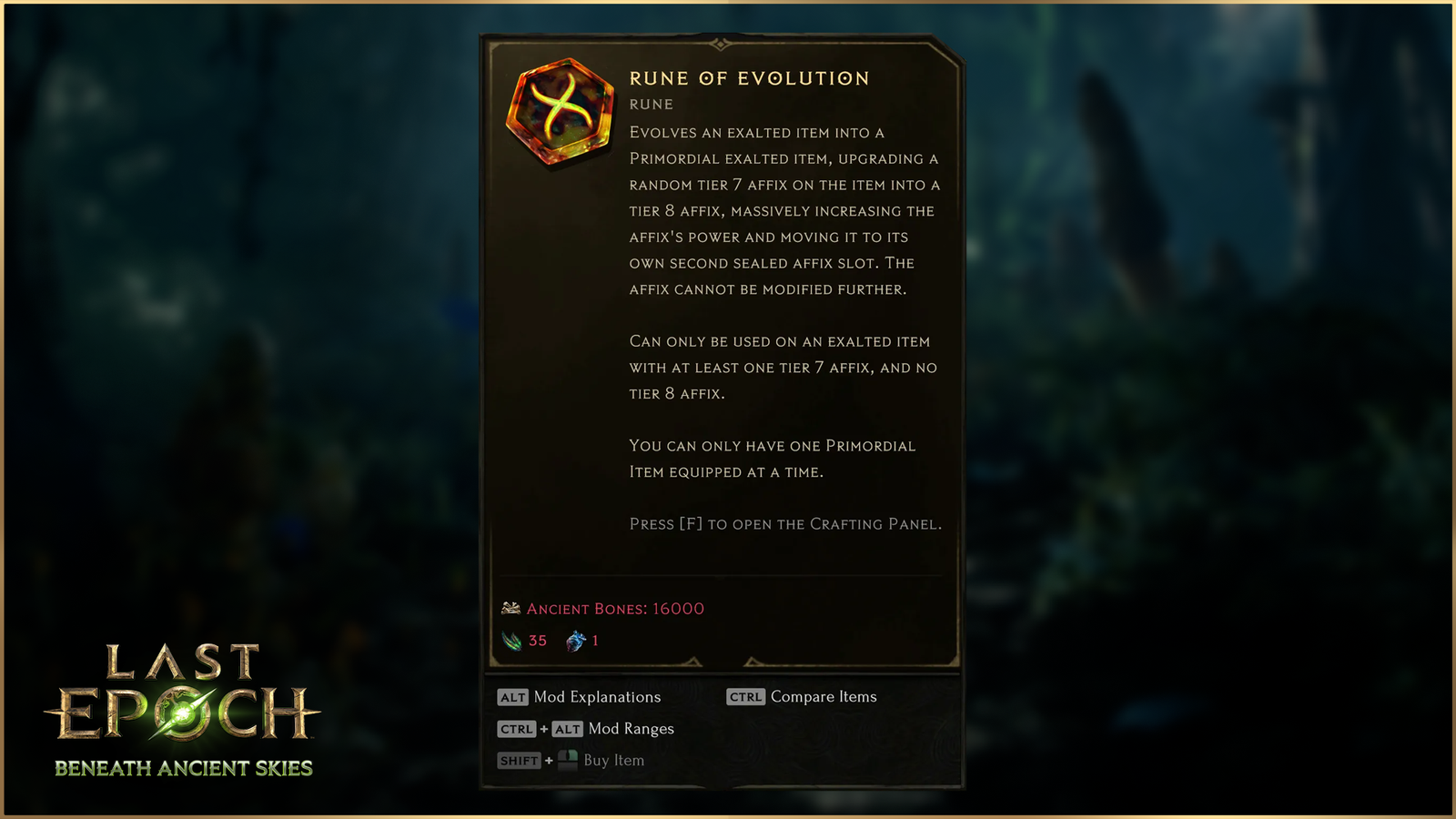
The Rune of Evolution requires an eligible Exalted item with at least one T7 and no T8. It randomly selects a T7, raises it to T8, and moves it to the Primordial Sealed Affix slot, separate from ordinary sealing. In the best case, a piece may have four regular affixes, one conventional sealed affix, and its T8. That T8 cannot be upgraded normally or transferred through the Eternity Cache. Primordial Uniques may have LP and become Legendary.
The restriction of one equipped Primordial is shared between Unique and Exalted versions.
What are Sealed Affixes?
Sealing moves an affix to an additional slot and frees its original prefix or suffix slot. Glyph of Despair offers a chance to seal an affix, greater under certain conditions; sealing is not guaranteed. A sealed affix cannot continue receiving normal upgrades. The ordinary sealed slot is separate from the Primordial slot. For the Eternity Cache, donor items still need four unsealed affixes; sealed ones are not included in the selection.
How does crafting work in Last Epoch?
On PC, the Forge opens with F by default. Eligible Normal, Magic, Rare, and Exalted items can be crafted throughout the adventure. The interface shows the available materials, affix slots, and potential cost before you confirm an operation.

How to add or upgrade an affix
- Place the item in the Forge and inspect its base, existing affixes, and remaining FP. Transfer collected materials from your inventory into crafting storage with the appropriate button.
- Choose an empty prefix or suffix slot to add a compatible T1 affix, or select an existing affix to raise its tier. You need the matching Affix Shard.
- Add a Glyph if you want to modify the operation, and read the possible FP cost. Confirming consumes the relevant materials; cost and special effects depend on the operation.
- Inspect the result and decide what to do next. Ordinary upgrades stop at T5. Having more materials does not remove potential limits or item restrictions.
A Critical Success adds an upgrade to a random affix alongside the normal operation. When this occurs, the operation consumes no materials or FP and does not exceed T5. This is different from a Critical Success during Legendary crafting, discussed below.
Runes: main effects and limitations
| Rune | What it does | What to check |
|---|---|---|
| Shattering | Destroys an item and returns Shards from its affixes. | The number of Shards per affix is random, from one up to its tier; recovering every tier is not guaranteed. |
| Removal | Removes a random affix and returns Shards equal to its tier. | It may remove the modifier you wanted to keep. |
| Refinement | Rerolls explicit values within their current tiers. | Does not increase tiers; some values can get worse. |
| Shaping | Rerolls implicit values. | Does not change the base or affixes. |
| Discovery | Adds random T1 affixes to empty slots. | Consumes no FP, but requires FP above zero. |
| Ascendance | Transforms an eligible item into a Unique or Set of the same type. | Does not preserve previous properties or produce exclusive drops such as many boss items. |
| Creation | Duplicates an item. | Sets FP on both the original and its copy to zero. |
| Havoc | Redistributes tiers among four unsealed affixes on an eligible Exalted. | Does not modify sealed affixes and cannot target the affix that receives a particular tier. |
| Redemption | Replaces unsealed Exalted affixes with other compatible ones. | Preserves tiers and the roll’s relative position; cannot freely choose the replacement. |
| Evolution | Upgrades a random T7 and seals it as Primordial T8. | Requires an eligible Exalted with T7 and no T8; respect the Primordial equip limit. |
| Weaving | Uses a random amount of WW or Weaver’s Touch to develop affixes. | Accelerates progression without letting you choose the result. |
| Corruption | Applies unpredictable changes and ends that item’s development. | Can ruin the item and removes its potential; see corruption below. |
Glyphs: how they affect crafting
| Glyph | Effect | Important limitation |
|---|---|---|
| Hope | 25% chance that the operation costs no FP. | Does not guarantee preserving potential on every attempt. |
| Chaos | Upgrades an affix and rerolls it into another compatible modifier. | Prefixes remain prefixes; suffixes remain suffixes. |
| Order | Preserves the roll’s relative position within its range when upgrading a tier. | Does not automatically create the maximum value. |
| Despair | Gives a chance to seal an affix instead of upgrading it. | Lower tiers and item conditions affect the chance; not guaranteed. |
| Envy | Changes the item subtype when adding or upgrading an affix. | Keeps the same class requirement; confirm that the new base suits your build. |
The official Rune and Glyph documentation details these operations. Before using a rare material, check the current description and eligibility in the Forge. Random effects are not recipes for a perfect item.
Forging Potential: what does FP mean?
Forging Potential (FP) determines an item’s capacity for conventional Forge operations. Higher-rarity equipment tends to drop with more FP, but FP is not a fixed number of attempts: each action may consume a random amount within its displayed range. Glyphs and critical successes can affect that cost.

Understanding FP consumption
A Rare with 30 FP might spend four on one upgrade and drop to 26; if the next action costs six, 20 remain. These are illustrative numbers, not a predicted sequence. Even a small amount of FP may permit another eligible action, but costs should not be treated as fixed.
At zero FP, an item remains usable. What ends are conventional operations that require potential—not the item itself or its existing affixes. A finished item may still be valuable as equipment or as an eligible Legendary donor.
When to stop investing
Address the build’s essential needs first. Spending your last potential on a secondary stat could prevent you from fixing a vital resistance. Evaluate the base, the Exalted affix’s value, and material costs. High FP on an unsuitable base is not a reason to craft it.
Ice and Blood Forging Potential
Introduced with Rage of Morditas in Season 5, these potential types appear on encounter rewards. Ice has a chance to be preserved during crafting; Blood increases the chance of Critical Success. Frozen Ritual steers Rare and Exalted rewards toward Ice FP, while Bloody Ritual steers them toward Blood FP. Neither guarantees a perfect result or works like LP.
Corruption: a final decision
The Rune of Corruption can add modifiers, increase or decrease values, change rarity or subtype, or even make an item unusable. It removes FP, LP, WW, and Weaver’s Touch, preventing further upgrades. Finish your intended modifications first and accept the risk before confirming. The recovery exception is Shattering, if that item could already be destroyed using that method without corruption.
Monolith Corruption is a different system, governing difficulty and rewards, not an irreversible condition applied to an item.
Legendary Potential: how are Legendary items created?
Legendary Potential is the property of a Unique that determines how many affixes it normally receives from an Exalted item when combined. LP does not inherently improve the Unique’s attributes; it creates the possibility of adding donor affixes. This requires preparing a donor and completing Temporal Sanctum.
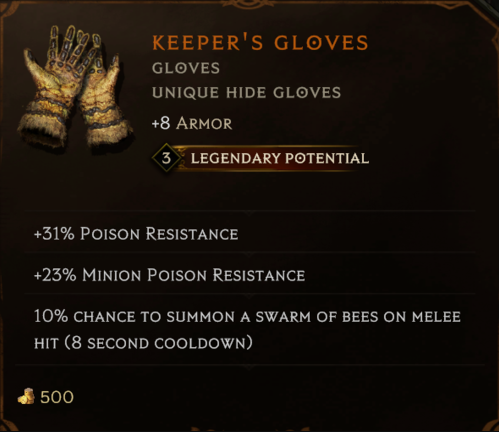
Legendary Potential | Normal combination outcome |
|---|---|
| LP 0 | Cannot use the normal Eternity Cache combination |
| LP 1 | Transfers one affix |
| LP 2 | Transfers two affixes |
| LP 3 | Transfers three affixes |
| LP 4 | Transfers four affixes |
Preparing the Unique and Exalted items
Choose a Unique with LP 1–4 and an Exalted of the same item type with exactly four unsealed affixes. Gloves combine with gloves; a helmet cannot receive sword affixes. The exact base may differ if the item type is compatible. Neither item may be corrupted.
An Exalted donor can have another sealed affix, but it will not transfer. The same applies to Primordial T8, which is excluded from the Cache’s selection. Upgrading your only T7 to T8 does not create a donor capable of transferring T8; check that it still meets the Exalted and four-unsealed-affix requirements. A Primordial Unique with LP, on the other hand, can receive affixes and become Legendary, subject to the one-Primordial-equipped restriction.
Using the Eternity Cache
The Cache is located beyond Chronomancer Julra in Temporal Sanctum. Bring the dungeon key and choose a Tier compatible with your Unique: higher difficulties accept higher-level requirements. Dungeon Tier is not the tier of an affix. Do not assume every difficulty accepts every Unique.

- Complete the dungeon, reach the Eternity Cache, insert your prepared Unique and Exalted, and confirm that the interface accepts the pairing.
- At Tier 2 or above, choose one Exalted affix to guarantee its transfer. This option is unavailable at Tier 1. Other affixes needed for LP 2 or LP 3 are still chosen randomly.
- Review your items and confirm the combination as instructed. Use the dungeon’s time-travel ability and the Cache instructions to retrieve the result in the other era.
- Collect the Legendary and inspect its added affixes. Both components are consumed; the original donor cannot be recovered afterward.
Full example: gloves with LP 2
Imagine Unique gloves with 2 LP and compatible Exalted gloves with four unsealed affixes: T7 maximum health, T5 fire resistance, T4 attack speed, and T3 mana. These are illustrative values. Your aim is to preserve the Unique’s effect while adding health.
In Temporal Sanctum Tier 2+, guarantee the T7 health affix. The normal outcome contains the Unique’s effects, T7 health, and one randomly selected affix from the remaining three. LP 2 does not guarantee every useful modifier. With LP 4, all four unsealed affixes transfer; there is no selectable fifth affix from the donor.
Critical Success and LP changes
Season 2 introduced a small chance of a Critical Success in the Cache, allowing more transferred affixes than the LP would normally permit, within the four eligible affixes. Its probability relates to the Unique’s chance of dropping with higher LP. An LP 1 item could receive a second affix, but you should not plan your crafting around that possibility.
Special systems can also change potential before the combination. An eligible Unique without LP or WW may replace an Egg of the Forgotten during a Nemesis encounter. In the Farsight Turtle Woven Echo, a Transmuting Gem rerolls the LP of Uniques that already have at least 1; it may raise, lower, or erase LP. Neither method is a conventional FP upgrade.
Ultimately, LP measures capacity rather than absolute quality. A critical LP 1 Unique might be better for your skill than an LP 3 whose effect does not fit. Prepare your donor for the role the item needs to fulfill instead of chasing the largest number.
Weaver’s Will: how do items evolve as you play?
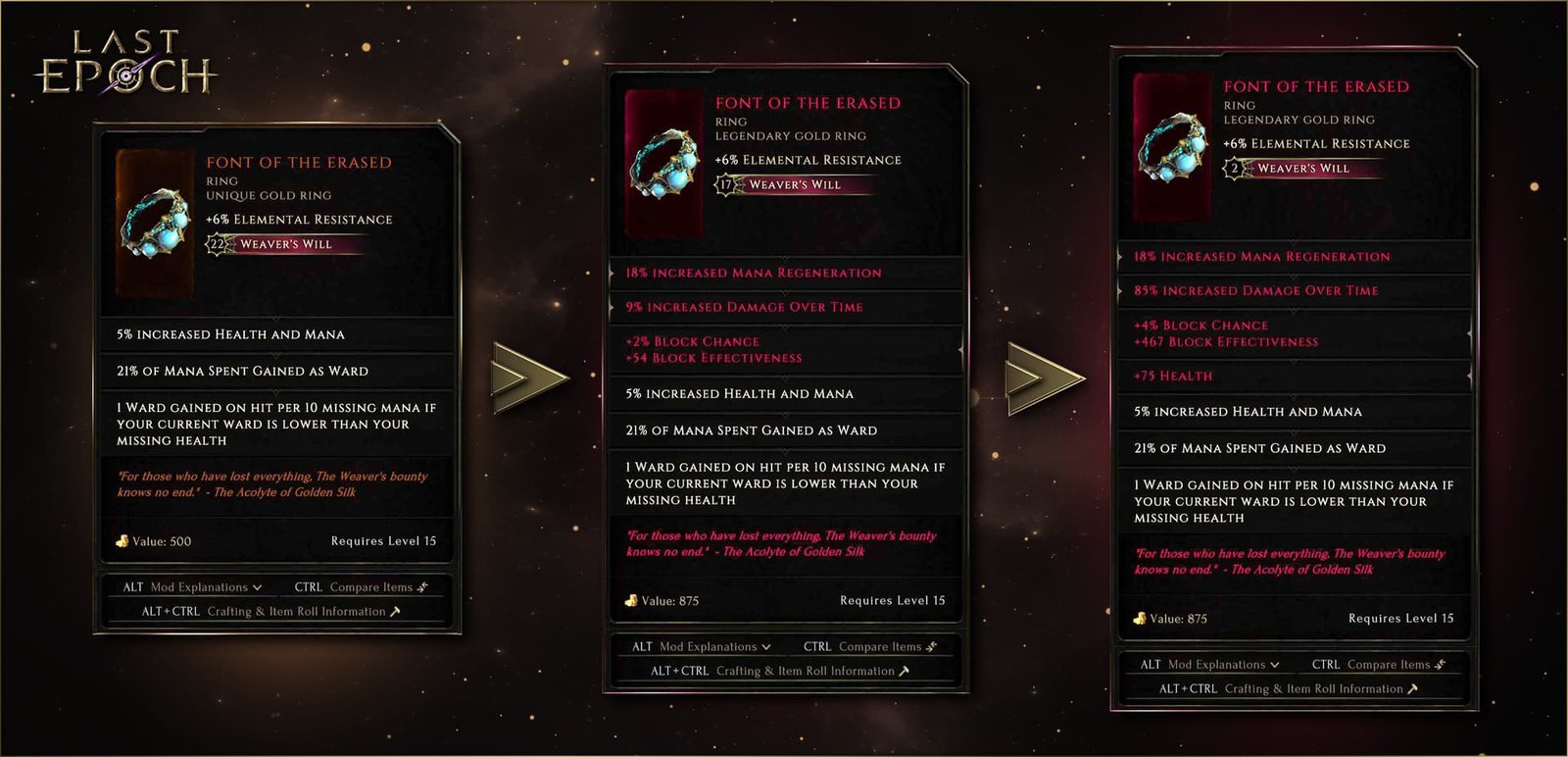
Weaver’s Will (WW) appears on particular Unique families, such as Font of the Erased and Ambitions of an Erased Acolyte. Equip the Unique and kill enemies to develop extra affixes through experience, without consuming an Exalted or completing the Eternity Cache.
Reading the number and tracking progress
Each progression step consumes potential to add a new T1 affix or raise an existing developed affix by one tier. The conventional cap is four additional affixes, up to T7. WW is the total number of tiers available, not the number of new affixes: WW 20 does not mean 20 new modifiers.
The system determines which affixes are created and how upgrades are distributed. You choose the Unique and whether to develop it, but do not prepare every modifier as you would with an Exalted donor. The maximum of 28 WW corresponds to four T7 affixes without defining which modifiers they will be.
Numerical example: WW 16
A Unique with 16 WW might finish with four compatible affixes distributed as T5 + T4 + T4 + T3 = 16. One affix first appears at T1, with later steps creating others or increasing existing tiers. This illustrates how potential could be distributed, not a prediction of the actual modifiers. Different tier combinations can consume the same total.
After all WW is consumed, the added modifiers remain and progression ends. The result is the Unique’s Legendary version with those affixes; an additional Exalted is unnecessary. Copies of the same Unique can begin with different WW values.
Rune of Weaving
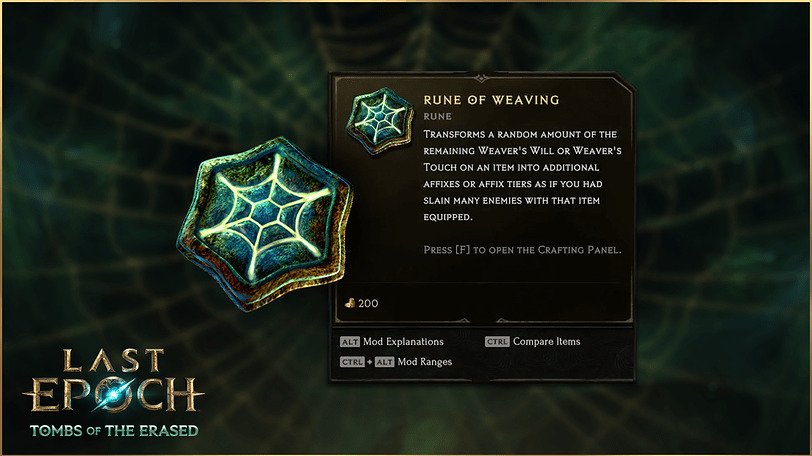
Rune of Weaving consumes a random amount of remaining WW and progresses affixes as if experience had been earned. It speeds up development without allowing free choice of affixes or turning WW into ordinary crafting. In version 1.5.2, EHG fixed WW progression when killing enemies during the Rage of Morditas gauntlet. That activity should not be described as incompatible with the current system.
WW, Weaver’s Touch, Weaver Tree, and The Woven
Weaver’s Touch is a development resource attached to other objects, such as enchanted Heretical Idols. Rune of Weaving may use WW or Touch depending on the object, but the properties are not identical. Weaver Tree modifies the Monolith and belongs to The Woven, an endgame faction that coexists with your Item Faction. It is not a third mutually exclusive alternative to CoF and MG.
WW Uniques follow an alternative path to LP. Do not expect to develop four WW affixes and transfer four more through LP onto the same copy; the conventional systems do not stack that way.
Legendary Potential versus Weaver’s Will
| Feature | Legendary Potential | Weaver’s Will |
|---|---|---|
| Starting item | Unique with LP | Specific Unique with WW |
| Requires Exalted | Yes | No |
| Main location | Eternity Cache | Experience-based progression |
| Displayed number | Number of affixes transferred | Total tiers to develop |
| Control over affixes | Partial, with a guaranteed affix at Tier 2+ | Affixes selected by the system |
| Conventional maximum | LP 4 | WW 28 |
| Outcome | Legendary with Exalted affixes | Unique developed into Legendary |
| Main advantage | Allows a prepared Exalted donor | Progresses during gameplay |
| Main limitation | Requires materials and a dungeon | Less control over the affixes |
The choice depends on the Unique’s effect and the affixes that actually help. LP lets you prepare a donor; WW grows through experience. This comparison does not declare one universally better for every build.
Green items: how do Set Items work?
Set Items are green. Each piece has its own modifiers and contributes to set bonuses, usually across two to four items. Read the description lines indicating how many pieces are needed for each benefit; wearing one item does not automatically grant a whole set’s bonuses.

Evaluating a set combination
Imagine an illustrative set with a helmet, gloves, and boots. Equipping two pieces triggers the two-piece benefit; adding the third may unlock another. Compare the combined gains with the alternatives you give up in those gear slots. A single piece can be useful for its own stats, but the full set bonus should be evaluated as a package.
Sets and Legendaries involve different costs in gear slots and modifiers. A traditional Set cannot receive conventional crafting like a Rare or Exalted. Reforged Sets allow you to carry the set’s identity onto another base and continue developing affixes. Do not assume every green item is either useless or mandatory.
Reforged Set Items: the major change to sets
Introduced in Season 2 in April 2025, Set Reforging lets you apply the identity of a Set piece to another compatible base. The result remains a Set Item, including for filtering and stash priorities.
Obtaining Set Shards and creating the item
- Enter the Woven Echo The Great Bridge and use its Forge of Shattering. Destroy traditional Set Items there to obtain Set Shards specific to those pieces. This specialized station is different from an ordinary Rune of Shattering.
- Select a compatible conventional item in the Forge. Its item type must match the original Set piece: a ring Set Shard can be applied to another ring base, not to a helmet.
- Apply the Set Affix while respecting its slot and the Forge’s conditions. Your item becomes a Reforged Set Item and counts as the corresponding set piece for bonuses. This does not automatically grant every piece’s bonuses.

Continuing crafting while respecting restrictions
Reforged items remain craftable within their rules. Set Affixes can be upgraded to T5; Havoc can redistribute an Exalted tier onto them in eligible cases, enabling T6/T7. Each item allows only one type of Set Affix. Despair can seal one, but its outcome and eligibility remain subject to that operation’s rules.
Because it remains classified as a Set, a Reforged item cannot take the place of a conventional Exalted donor in the Eternity Cache. Its flexibility lies in combining a set bonus with a base and other affixes that support the build. It does not turn the Set into a Legendary donor or eliminate every set restriction.
How do you find better equipment?
Understanding rarities and crafting is only part of the process: you also need good places to look. Last Epoch offers many loot sources, each with different uses.
Monolith of Fate
Timelines and Echoes provide targeted rewards, materials, and opportunities to find useful bases. Timeline bosses have their own drops and Blessings. Choose sources for the equipment you are looking for; not every Unique drops from every boss.
Empowered Monoliths
These raise the challenge and let you develop Monolith Corruption, which affects rewards. Area level has the strongest influence on LP rolls on drops, with a smaller contribution from Corruption; neither guarantees LP 4 or WW 28. Item Rarity is not an LP multiplier. Monolith Corruption is not the same as applying Rune of Corruption to a piece of equipment.
Dungeons and bosses
Dungeons such as Temporal Sanctum have their own mechanics and rewards. Bosses may drop exclusive Unique or Set Items. Some pieces require specific sources and cannot simply be created using Rune of Ascendance.
Nemesis
During a Nemesis encounter, you can banish, challenge, or empower the encounter and its rewards. Egg of the Forgotten accepts an eligible Unique without LP or WW, offering a progression opportunity outside ordinary Forge crafting. Choose based on the item and risk involved; a specific LP result is not guaranteed.
Woven Echoes
These provide tools such as Set Reforging in The Great Bridge and LP rerolling in Farsight Turtle. Each activity has its own entry requirements and mechanics; the name Woven Echo does not imply identical rewards. They complement advanced item crafting instead of replacing careful item preparation.
Season 5: Rage of the Frostborn and Rage of Morditas
Interacting with Blood Crystals starts encounters in the campaign and Monolith. Bloodrage Charges let you remove or modify rewards through rituals: Frozen Ritual favors the selected type and Ice FP, while Bloody Ritual excludes the sacrificed type and directs Rare/Exalted rewards toward Blood FP. There are exclusive bases and Uniques. Season 5 introduced this content, and patch 1.5.1 enabled Pinnacle Morditas in Legacy and Offline too. It should not be described as exclusive to the seasonal server. This does not promise anything about future season formats.
Circle of Fortune or Merchant’s Guild: which faction should you choose?
Last Epoch offers two Item Factions, which change how you find or trade equipment. They are mutually exclusive as your character’s main item allegiance, but the choice is not permanent.
Access normally begins in Chapter 9 of the campaign, while subsequent characters sharing progression may unlock it earlier.
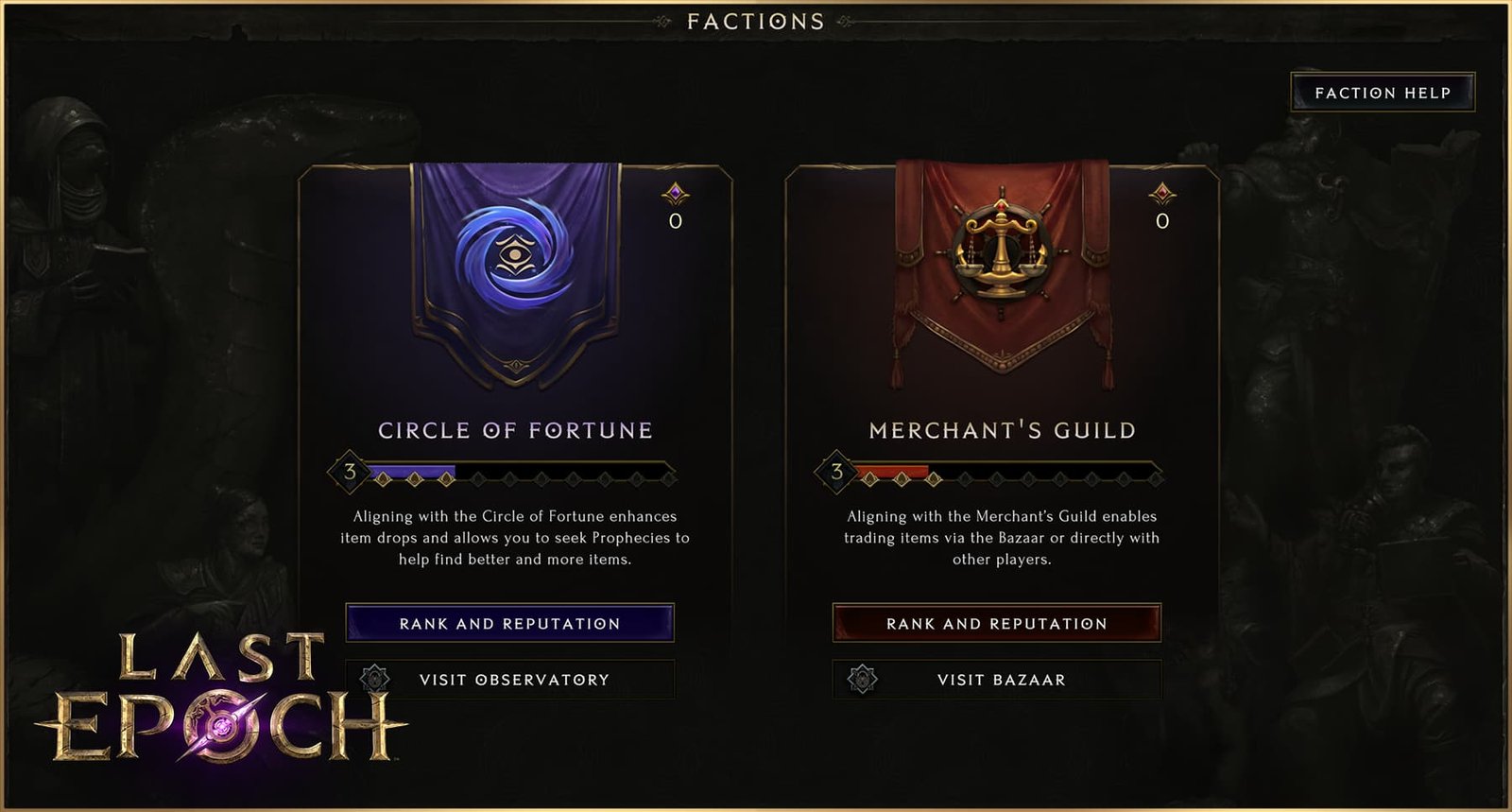
Circle of Fortune
Circle of Fortune (CoF) emphasizes obtaining items through drops. In Season 5, you select rewards in Prophecy slots, which gain charges as you earn Favor; fulfilling one of that slot’s conditions spends charges and grants loot. You no longer need to reroll Prophecies as described in older guides. Lenses modify charging or reward traits, such as affixes and LP. Slots, rewards, and lenses unlock through progression, without guaranteeing perfect items.
Merchant’s Guild
Merchant’s Guild (MG) enables player-to-player trading in the Bazaar. Since Season 5, membership allows purchases of all equippable item types without the former rank-based category locks; ranks instead give other benefits such as material bags or keys. The interface offers suggestions based on previous sales and an optional automatic price reduction with a seller-defined floor. These are aids and references, not a guarantee of sales or fixed value.
Favor, Reputation, and Rank
Favor is earned through activities and spent on faction services. Reputation increases your rank and its benefits. Season 5 revised both Item Factions’ rewards and organization while maintaining the distinction between pursuing drops with CoF and buying gear through MG trading.
Pay attention to item restrictions
Read the item’s bindings and faction requirements before buying, transforming, or changing allegiance. Switching from CoF to MG or vice versa does not automatically unlock all previous gear. Items earned through CoF bonuses and Bazaar gear follow their own usage and trading rules. Class and level restrictions still matter.
Loot Filters: how do you find important items?
A Loot Filter controls what appears on the ground, allowing you to show, hide, or emphasize important equipment. This matters when large amounts of loot begin dropping.
Instead of checking every piece individually, you can create rules that highlight bases, rarities, and relevant modifiers. By default, the interface opens with Shift + F.

What can you configure?
A Loot Filter can create rules based on:
- Equipment type;
- rarity;
- base;
- affixes and their tiers;
- Legendary Potential;
- Weaver’s Will;
- class requirements;
- other currently supported filter properties.
A filter can contain up to 75 rules. Higher rules take priority over those below. This allows exceptions: a rule near the top may highlight important Uniques while a later rule hides less useful ordinary equipment.
How to highlight a useful Exalted
If your build uses Intelligence, create a rule that highlights compatible Exalted gear and looks for high-tier Intelligence affixes. This reduces the need to inspect every purple drop. You can also highlight specific bases with implicit modifiers useful for future crafting.
How to avoid hiding valuable gear
One of the biggest risks of copying someone else’s filter is hiding a valuable item because their build does not use it. Before importing a filter, check that it fits your class and needs. You can temporarily disable filtering by holding X, the default shortcut.
Early on, less restrictive rules are generally better. Your filter should help you find equipment, not make every value judgment for you.
Stash search: useful commands
The official stash search documentation, updated October 16, 2026, confirms the commands below. They search stored items; they are not Loot Filter rules.
| Command | What it finds |
|---|---|
LP2+ | Uniques with at least 2 LP. |
WW18+ | WW-system items with 18 or more WW remaining. |
FP20+ | Craftable equipment with at least 20 FP. |
ReforgedSet | Reforged Set Items only. |
How do you know whether equipment is actually good?
Before storing, buying, or spending materials on a piece, run through six checks. These help distinguish gear for your character, a Legendary donor, and a base worth developing:
- Base and implicits: do they suit your weapon, defenses, and main skill?
- Affixes: how many actually benefit the build, and which slots still need fixing?
- Tiers: is that T6/T7 valuable on this item type or merely eye-catching because it is purple?
- FP and costs: is there enough room to correct the item, and are the materials worth using?
- LP or WW: does it have an eligible progression path, and do you have a donor or accept random affix development?
- Restrictions: do class, level, set, faction, corruption, and the Primordial limit let you use the final result?
A weapon with T7 melee damage may be irrelevant to a spell build. Another item with lower tiers but modifiers that actually support your skill could perform better. Judge an item by its function on your character, not by rarity alone.
Common mistakes beginners make
The systems above establish the limits of LP, FP, WW, and Sets. Before committing expensive materials, avoid three planning errors:
- Using materials on the wrong item. Separate donors, works in progress, and equipment you intend to wear before using Shattering, Removal, Havoc, or corruption. The cost is not just the material: you may lose the modifier or item you wanted to preserve.
- Discarding items without considering their role. An Exalted can be a useful donor; a traditional Set may provide the Set Shard needed to reforge a better base. Think about its purpose before filtering or selling.
- Copying a filter without adjusting it. A rule that hides unwanted drops for one build could hide your next upgrade. Check rule priority and review your filter as you progress.
Understanding items changes how you play Last Epoch
Good equipment begins with the role it needs to fill. Identify its base and modifiers, verify eligible operations, and choose between Forge upgrades, preparing a Legendary, developing WW, or taking advantage of a set. These paths solve damage, defense, and skill needs in different ways.
Investing makes sense when you know what you want to preserve, what can still change, and which possible losses you accept. That understanding turns LP, WW, FP, and item colors into practical decisions without requiring every piece to end up perfect.
About the Author