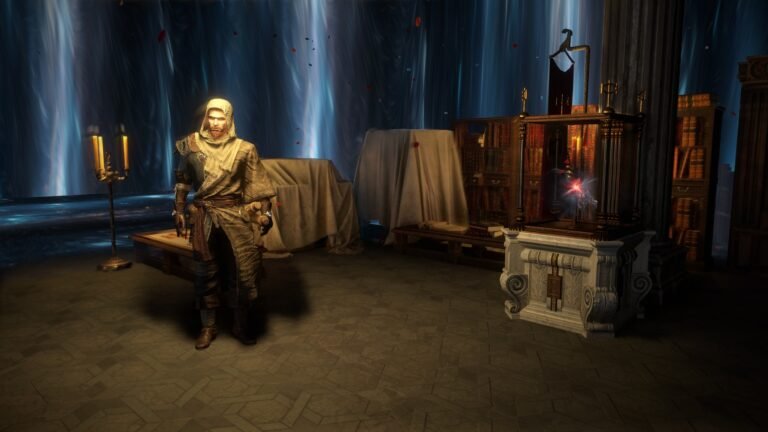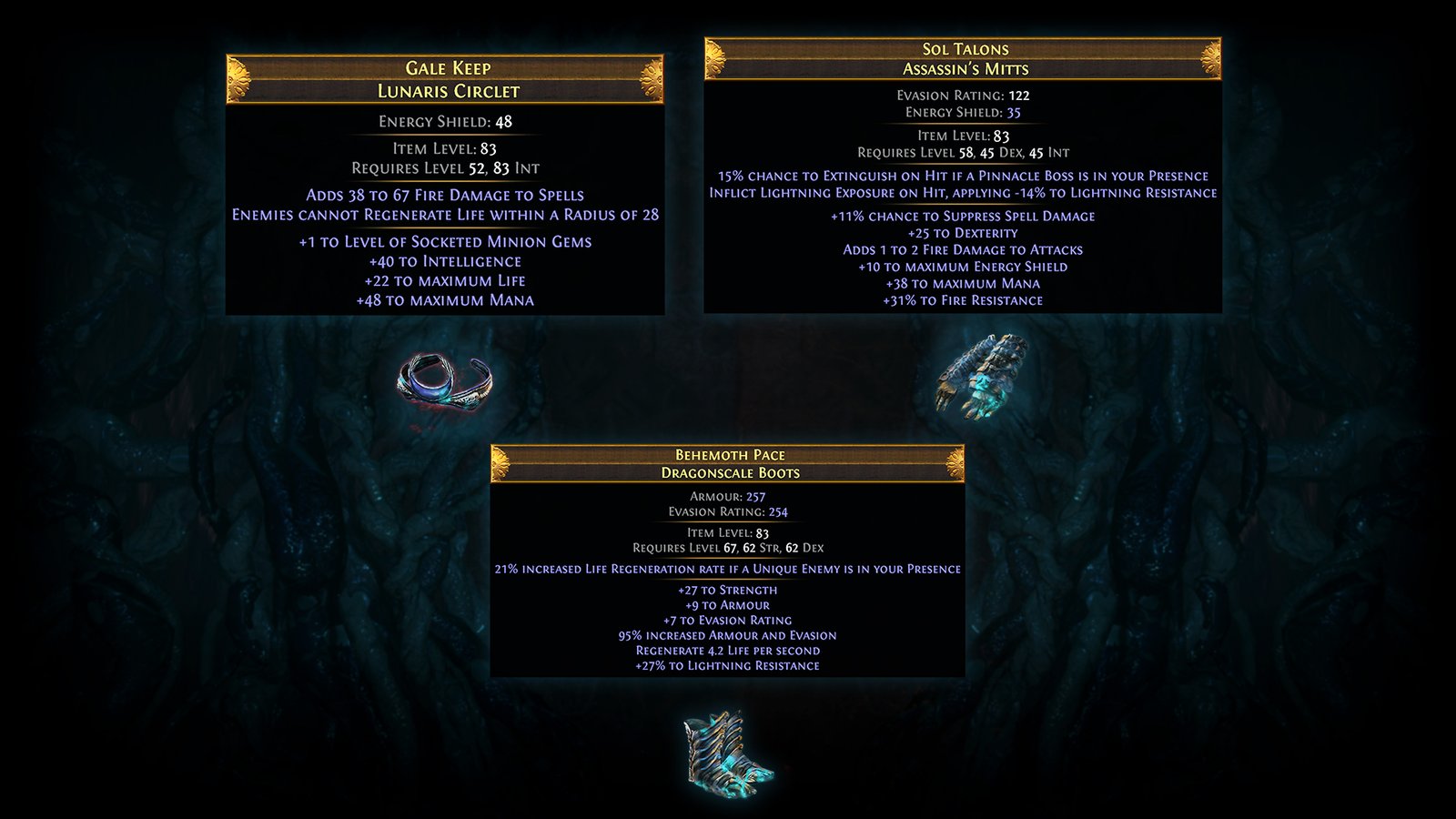
PoE 3.17 (2022): três equipamentos com Eldritch Implicits. Divulgação histórica: GGG.
You find two Rare body armours: one has Fractured Fire Resistance; the other has Shaper Influence. Combining the locked resistance with a Shaper-exclusive affix sounds reasonable, but current conventional methods do not simply combine these properties. The obstacle isn’t necessarily Item Level or the amount of currency you own: it’s compatibility.
Choosing a base comes before choosing a crafting method. This Path of Exile special bases guide explains how to identify each system, find its source, and check whether it permits the item you intend to make. For an introduction to rarity, prefixes, and suffixes, see our equipment, bases, and modifiers guide.
Revised October 27, 2026, for Path of Exile 1, 3.29 — Curse of the Allflame. The official patch index was checked through 3.29.3b. Seasonal rules belong to this version and should not be assumed to remain unchanged in later expansions. The examples are instructional; ZAUS.GG does not claim to have personally tested the crafting procedures.
Nesta matéria
How to identify a base, item state, and modifier
Base Type means the fundamental item type: Vaal Regalia, Hubris Circlet, Amethyst Ring, Stygian Vise, or Pearlescent Amulet. It determines category, requirements, base damage or defences, possible implicits, and some modifier-generation conditions. State is a separate condition, such as Influenced, Fractured, Corrupted, or Mirrored, that changes what can be done to an item. Modifier is a property on the item: prefix, suffix, implicit, Crafted, Veiled, or Elevated.
A Rare Vaal Regalia with Shaper Influence remains a Vaal Regalia. The influence unlocks a possible affix pool; actually having a Shaper affix is a different fact. Two items with the same base and ilvl may therefore serve different projects. Item Level isn’t the level required to equip the item, either: don’t substitute one for the other.
To inspect an item on PC:
- Open your inventory and hover over the item. Read the Base Type beneath the Rare or Unique name.
- Enable Advanced Mod Descriptions in the settings if necessary, and hold Alt with the default controls. Check ilvl, prefix/suffix groups, and displayed tiers.
- Distinguish implicits from explicit affixes. Identify any Fractured affix, influence symbols, and Enchantments.
- Check for Corrupted, Mirrored, and other restrictions; then verify the intended modifier against current data for that item category.
Symbols and colors can help identify systems, but how a Unique looks does not prove it carries one of the six traditional influences. Counting tooltip lines is not a reliable affix count, either: a hybrid modifier may describe several effects.
The six traditional influences and where to get them
Influenced Items can roll additional affix pools according to category, influence, ilvl, and modifier groups. Being influenced does not mean the item already has the desired exclusive affix. A Shaper Vaal Regalia may be eligible for a modifier that a conventional version cannot roll, but may still require crafting to obtain it.
| Influence | Associated boss | Corresponding currency |
|---|---|---|
| Shaper | The Shaper | Shaper’s Exalted Orb |
| Elder | The Elder | Elder’s Exalted Orb |
| Crusader | Baran | Crusader’s Exalted Orb |
| Hunter | Al-Hezmin | Hunter’s Exalted Orb |
| Redeemer | Veritania | Redeemer’s Exalted Orb |
| Warlord | Drox | Warlord’s Exalted Orb |
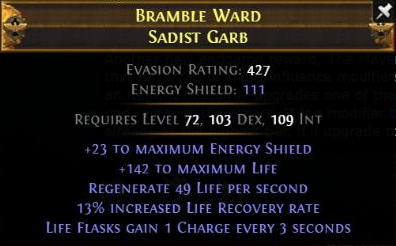
In the historical tooltip above, Bramble Ward is the Rare item name and Sadist Garb is the base. The two matching symbols at either end of its name indicate Warlord, not two different influences. The screenshot does not show ilvl, tiers, or advanced descriptions, so it cannot establish that an affix is Elevated or that the item qualifies for every 3.29 recipe.
Sources include the associated bosses and Guardians, Conquerors, eligible maps and rewards, influence-specific currency, and trade. In SSF, you must plan around accessible content; in a trade league, you can buy a prepared base. Ordinary Scouring removes eligible affixes, not the influence state itself.
The six Exalted Orbs in the table add the corresponding influence and an influence modifier to an eligible, high-level, uninfluenced Rare item. You need an available affix slot and no incompatible state. They do not freely add influence to Fractured, Synthesised, Corrupted, Mirrored, or incompatible Eldritch projects. They do not let you choose the affix or guarantee its tier.
The four Conqueror Orbs relate to their respective Elderslayers; Shaper’s and Elder’s versions were introduced in 3.26. Linking an orb to a boss in the table does not mean that boss drops one on every kill. Currency tooltips do not state a numerical item ilvl requirement: separately verify application restrictions and the ilvl required by your target affix. The currency’s Drop Level is not the item’s required level.
Hunter is not automatically better for every Chaos character, and having two symbols does not necessarily make an item better than an ordinary base.
Dual Influence, Elevated mods, and two orbs you must not confuse
Dual Influence puts two traditional influences on one item. Awakener’s Orb can combine two compatible items, destroying the donor and reforging the target with both influences and modifiers selected by the operation’s rules. The target supplies the final base; the donor and orb are consumed. It does not transfer every affix or preserve an entire item. Our advanced crafting and metacrafting guide covers how to plan the inputs.
For a Hunter + Redeemer project, check both affixes’ categories, required ilvl, Mod Groups, and whether they can coexist before buying either item.
Elevated Modifiers are stronger versions of some Influenced affixes. The Orb of Dominance tooltip requires a Rare with at least two Influenced modifiers and allows Body Armours, Boots, Gloves, and Helmets. It removes one Influenced modifier and upgrades another. When the upgraded affix is already at its highest conventional tier and has an elevated equivalent, it becomes Elevated. Attempting to upgrade an already Elevated modifier rerolls its values.
You cannot freely choose which affix is removed. Two influence symbols alone are insufficient: you need eligible affixes, and not every affix has an Elevated version. Assess the risk of losing an essential property and respect Corrupted, Mirrored, and other restrictions. Elevated describes certain affixes, not a new Base Type or a seventh influence.
Orb of Dominance works with traditional influence affixes. Orb of Conflict adjusts the strength of Eldritch Implicits. Despite their related-sounding purposes, they are not interchangeable.
Fractured: one locked affix, not an entirely protected item
A Fractured Modifier remains fixed through various compatible crafting operations. Boots with Fractured Fire Resistance can be worked toward life, Movement Speed, and other suffixes without normally removing that resistance. But the locked resistance still occupies a suffix and its Mod Group: it is not a free extra slot. Other affixes remain subject to rerolls and removal. An unsuitable or low resistance value isn’t valuable just because it is Fractured.
A Fracturing Orb locks one random eligible modifier on a Rare item with at least four modifiers. You cannot select the target affix. It does not ordinarily apply to an already Fractured or Influenced item. Historical Synthesised bases also remain excluded even though the literal warning was removed from some currency descriptions in 3.29. If only one affix matters, you must accept the possibility of fracturing a different one; compare the cost with purchasing an already-Fractured base.
Fractured Fossil changed in 3.29: it now fractures a random modifier and does not accept Fractured or Influenced items. It belongs to the Resonator system and has its own eligibility rules. Do not assume every Fracturing Orb requirement applies automatically. Its former duplication process no longer describes its current purpose; see the official 3.29 notes.
Sources include eligible rewards, these tools, certain Bestiary recipes, and trade. The current recipes that fracture one or two Talisman affixes are specific to Talismans—not general methods for all equipment. Fractured may coexist with Eldritch on an eligible base, but conventional methods do not freely add Shaper, Elder, or Conqueror influence to it.
Eldritch: implicits, Dominance, and replacing the base implicit
Eldritch Embers apply Searing Exarch implicits, while Eldritch Ichors apply Eater of Worlds implicits. Standard application supports eligible Helmets, Gloves, Boots, and Body Armours without incompatible traditional influence. One implicit from each side can coexist. Item category alone does not ensure eligibility: standard currencies do not freely accept Unique, Corrupted, Mirrored, or incompatible states. Elder Influence is a separate system from Eldritch.
Dominance belongs to the side with the stronger implicit. Equal strengths do not establish a dominant side for operations that require one. The Eldritch Chaos, Eldritch Exalted, and Eldritch Annulment tooltips establish these effects:
| Dominant side | Chaos | Exalted | Annulment |
|---|---|---|---|
| Searing Exarch | Rerolls prefixes | Adds a prefix | Removes a prefix |
| Eater of Worlds | Rerolls suffixes | Adds a suffix | Removes a suffix |
Orb of Conflict can raise one Eldritch implicit’s strength and lower the other’s according to its rules. It does not elevate a traditional influenced affix. Decide which implicit you can afford to replace before using currency on a base.
Applying Eldritch currency may replace the ordinary implicit that made a special base attractive. Ritual boots chosen for their special inherent effect lose that benefit if it is overwritten. Eldritch cannot simply be stacked on every existing implicit. Conversely, Fractured locks an explicit affix and may coexist with both Eldritch Implicits on an eligible item.
There are documented exceptions beyond the usual four armour slots, such as Ukatoa’s Ducat for amulets in the Allflame league. This does not give every amulet unrestricted access to Embers, Ichors, and all other Eldritch currency: the exception applies to that specific operation.
Synthesised: what can still be obtained in 3.29
Synthesised describes Synthesis implicits, not locked explicit affixes. Version 3.29 removed normal acquisition of non-Unique Synthesised items, with a documented exception involving corrupting Synthesis Uniques into Rares. Such an outcome is not a clean Rare base freely available for every crafting sequence.
The Harvest recipe that synthesised items was removed. The Bestiary recipe that rerolls a Synthesis Implicit now only accepts eligible Uniques. Fracturing Orbs, Fractured Fossils, and Reflecting Mists still cannot be used on historical Synthesised Standard bases covered by those restrictions.
Seeing an older Rare Synthesised item in Standard does not prove it can be recreated in the current league. Verify its league, state, and source before using an old tutorial. “Buy a Rare base and synthesise it through Harvest” is not an available 3.29 step, regardless of the materials listed in older guides.
Heist, Ritual, Delve, and Expedition: what makes a base special
Heist Experimented Bases can have properties unlike those of ordinary bases. Current examples include Psychotic Axe, which grants 5 Rage on Melee Hit, and Apex Cleaver, whose hits ignore Enemy Physical Damage Reduction. The latter does not mean ignoring every defence or universally increasing damage over time.
To obtain one, run an eligible Grand Heist, prepare the Blueprint’s wings, reach its Curio Displays, examine the rewards, choose a base, and escape. Then inspect ilvl and properties. Even a useful implicit must be weighed against base damage, attack speed, requirements, and possible affixes. A special effect does not guarantee the weapon outperforms an ordinary alternative for your skill.
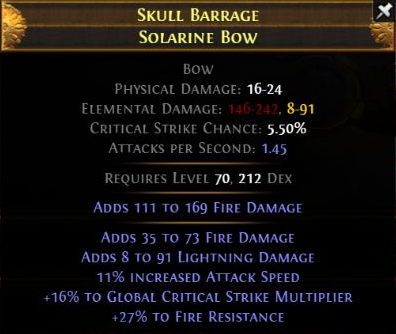
The historical Solarine Bow from the Heist announcement demonstrates an Experimented Base: its inherent fire damage is separate from the Skull Barrage affixes. The image is from 3.12, with historical values, and should be used to understand item layers—not as a list of current rolls. The Psychotic Axe and Apex Cleaver examples above use data checked for this guide’s version.
Another noteworthy exception is the Astrolabe Amulet: its own implicit grants Shaper, Elder, and all four Conqueror influences and prevents its implicits from being modified. This is not an ordinary six-orb sequence or unlimited Dual Influence. The special base opens affix pools, but ilvl, groups, and available slots still determine which combination is possible.
Ritual Bases can appear in eligible Ritual rewards. Some exchange a benefit for a penalty. The Sorrow Mask, for example, grants +2% to maximum Chaos Resistance and You are Crushed. Crushed reduces Physical Damage Reduction by 15 percentage points. Increasing maximum resistance does not automatically fill your actual Chaos Resistance: determine whether the build benefits from the higher cap while handling the physical penalty.
Other Ritual Helmets, Gloves, Boots, and Rings have distinct properties. Don’t apply Sorrow Mask’s benefit to an entire family of bases.
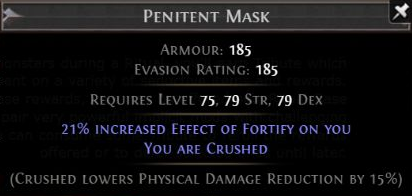
The historical Penitent Mask screenshot combines a Fortify-related effect and Crushed. The current Penitent Mask grants +4% to maximum Chaos Resistance, while still applying Crushed; the current Sorrow Mask discussed above grants +2%. These are different bases. Do not copy a 2021 screenshot’s bonus when judging a 3.29 item—read the actual listing or item tooltip.
Delve-only Modifiers originate from specific sources in the Azurite Mine. They are not the same as everything any Fossil can generate. Check item category, reward source, mine node, and patch. A Fossil reroll does not reproduce an acquisition-only affix merely because both features relate to Delve. Preserve valuable exclusive affixes when planning later steps.
Ward Bases associated with Expedition include Runic Crown, Runic Gauntlets, and Runic Sabatons. Ward is distinct from Armour, Evasion, and Energy Shield. In its basic operation, Ward absorbs damage from a hit up to its available value, breaks, and recovers after its own delay. It is not a second Energy Shield bar or continuously active protection against every hit while broken.
Compare Ward amount, recovery, requirements, and flask interactions. Without synergy, swapping a good defensive base merely because it is Runic may weaken your character. The system was introduced in the official Expedition announcement.
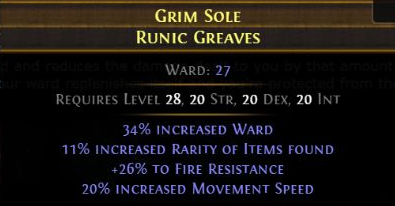
The Expedition screenshot shows Runic Greaves, another Runic base with Ward displayed as a defensive stat. The 27 Ward shown belongs to that historical 2021 item; it is neither a universal number for Runic boots nor the current stats of Runic Sabatons. Its usefulness depends on your build’s defensive setup.
Abyss and Breach: Stygian Vise, Jewels, and Grasping Mail
Stygian Vise is a belt base with the implicit Has 1 Abyssal Socket. The socket accepts an Abyss Jewel, so compare the belt with its jewel, not just its empty affixes. A well-rolled Leather Belt may outperform a Stygian with weak affixes or an unsuitable jewel.
Searching Eye, Murderous Eye, Hypnotic Eye, and Ghastly Eye are Abyssal Jewel types with distinct modifier pools. They support different builds and can occupy appropriate Abyssal Sockets in eligible items and compatible passive-tree sockets. Check the conditions and modifiers that actually benefit your character.
The 3.29 Abyss overhaul made Abyss the normal exclusive source of Abyssal Jewels and Stygian Vises. The official exception allows Abyssal Jewels to rarely appear in Abyss Biomes in Delve; it does not automatically extend that exception to Stygian belts. Some jewel modifiers also changed or were removed. Older drop or affix lists may not represent current availability.
Grasping Mail is a Breach-related hybrid Body Armour whose value may depend on a special Breachlord modifier. Such modifiers cannot all be reproduced by ordinary Chaos rerolls: removing the unique-to-source affix can eliminate the reason to own the item.
The current PoEDB vendor recipe table lists an unidentified Rare Grasping Mail in exchange for 60 rings: 10 Cryonic, 10 Enthalpic, 10 Formless, 10 Fugitive, 10 Organic, and 10 Synaptic Rings. Do not omit Formless Ring. The page separately records an old recipe using 60 Breach Rings; do not mistake those historical rings for the six current types introduced by the Breach changes.
Before gathering rings, check the vendor’s recipe and output. For a target affix, verify its source pool and the actual recipe rules; no arbitrary ring combination guarantees an arbitrary modifier. Compare the gamble with buying an identified Grasping Mail already carrying the affix you need.
Talismans, Vestigial, and Foulborn: three different choices
Talismans were redesigned in 3.29. Their special effects changed from Implicits to Enchantments, and new Talismans are not Corrupted by default. They cannot receive Anointments, and the special Enchantment cannot be removed with the ordinary Crafting Bench option. Being uncorrupted opens some previously unavailable compatible operations, but does not turn a Talisman into an ordinary amulet.
Under normal rules, current sources include Red Beasts, Bestiary Bosses, cards granting Talismans, and specific Thane Jorgin rewards. Talisman types relate to particular creatures. Unique Talismans were removed from the core drop pool; they can come from Bestiary Bosses or a new Talisman-creation recipe requiring The Black Mórrigan.
Ruthless has distinct rules: patch notes describe Beastcrafting in the Menagerie rather than Red Beast drops. Do not apply normal league source rules to Ruthless without qualification.
Bestiary also offers recipes to fracture one modifier on a Rare Talisman with at least four modifiers, or two modifiers on one with at least six. These are Talisman-specific, not unrestricted amulet fracturing. If the build needs an Anointment, compare that lost functionality with the Talisman’s Enchantment. Older Standard copies may behave differently.
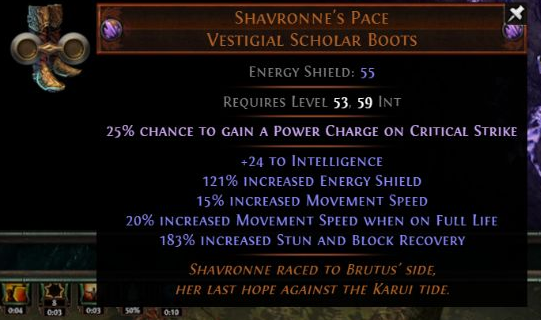
Vestigial Uniques, introduced with the Legion overhaul in 3.29, use a different process. Enshrouding Crystals prepare eligible Unique armour. Place the Enshrouded Item in a Crystal of Permutation in the Domain of Timeless Conflict; killing monsters charges it. Once complete, you can obtain a different Unique of the same class with a Vestigial Implicit derived from the original. Enshrouding Crystals may come from Generals in map areas, not from Generals inside the Domain itself. This is neither Fracturing nor Dual Influence, and it does not allow unrestricted choice of the final Unique.
Foulborn Uniques replace a modifier from a conventional Unique with another. The official Keepers of the Flame presentation documented the transformation of Uniques grown in the Genesis Tree. Breach became core content with changes in 3.28, and specific rewards—such as It That Fled’s trapped stash in Transportation—can also grant Foulborn Uniques. Check the 3.28 patch notes; don’t assume every rule from the original Keepers league remains unchanged.
Compare the ordinary Unique, the lost modifier, and its replacement. Vestigial adds an implicit through Legion’s transformation system; Foulborn replaces a modifier through a different system. Neither label means an item is universally more powerful.
Conventional bases changed in 3.29
Even bases without a special state can change between patches. Check these official updates before buying an older copy:
| Base | Current rule and historical comparison |
|---|---|
| Pearlescent Amulet | New base with an implicit granting +(8–10)% to all Elemental Resistances. |
| Moonstone Ring | Implicit is now 7–10% increased Cast Speed, previously Maximum Energy Shield; existing copies were not automatically updated. |
| Demon’s Horn, Opal Wand, and Tornado Wand | Increased Spell Damage implicits replaced added Damage; earlier copies were not changed. |
| Daggers with former 30% Global Critical Strike Chance implicit | New range: 40–45%. |
| Daggers with former 40% Global Critical Strike Chance implicit | New range: 50–55%. |
| Daggers with former 50% Global Critical Strike Chance implicit | New range: 60–65%. |
For the affected Daggers, the notes allow existing items to be updated using a Blessed Orb. This is not a universal conversion rule for every Legacy base. Two items with the same Base Type may retain different implicits when one is an old copy. Verify the text and patch-specific upgrade method before using any currency.
Compatibility: which combinations allow your project?
This table summarizes conventional selection rules. Historical Standard exceptions should not be presented as current-league recipes.
| System | Layer / function | Compatibility decision |
|---|---|---|
| Influenced / Dual Influence | State; traditional affix pools | Conventional combinations require compatible inputs and do not freely accept Eldritch. Astrolabe is a base-specific exception. |
| Elevated | Upgraded Influenced affix | Orb of Dominance on eligible Rare items of the four armour categories with at least two Influenced affixes; not Orb of Conflict. |
| Fractured | Locked explicit affix | Occupies a prefix/suffix and group; can coexist with Eldritch on eligible bases, but traditional influence cannot simply be added. |
| Eldritch | Exarch / Eater implicits | Depends on item category and state; may overwrite the very implicit that made a special base desirable. |
| Synthesised | State and Synthesis implicits | Non-Unique acquisition restricted in 3.29; affected historical bases remain excluded from the cited fracturing tools. |
| Experimented / Ritual | Base and inherent special properties | Check full benefit and drawbacks; changing the implicit may remove the reason to choose the base. |
| Ward / Runic | Special base defence | Ward isn’t an influence: category, affixes, and additional states must still be compatible. |
| Delve-only | Source-exclusive modifier | Acquisition source is not the generic Fossil pool; losing the affix may make it impossible to reproduce. |
| Stygian / Grasping Mail | Base; socket or special-source affix | Evaluate the belt with its jewel and preserve the body armour’s exclusive affix. The base alone is no guarantee. |
| Current Talisman | Special Enchantment | Cannot receive Anointments; new copies aren’t Corrupted by default. Fracturing recipes are specific. |
| Vestigial Unique | Transformation-derived implicit | Follows Legion eligibility and item class; not a Fractured affix. |
| Foulborn Unique | Modifier replacement | Evaluate the lost and gained properties; neither a universal upgrade nor a Vestigial process. |
Three projects fail before spending anything: conventional Eldritch Implicits on Hunter boots; Fracturing Orb on a Shaper-Influenced item; and synthesising a Rare using the removed Harvest recipe. An unusual historical item listed for sale does not make those sequences currently available.
Three examples for choosing your build’s base
Boots needing Life, Movement Speed, Spell Suppression, and resistances. Start with the defences and requirements the build can support. For Spell Suppression as a conventional affix, check boots with an Evasion component and the required ilvl. Do not buy a pure Armour base assuming every boot modifier can appear on every base. Compare an ordinary base, one with a useful Fractured modifier, and the option to use Eldritch.
The locked resistance simplifies some later steps but still occupies a suffix. Check room for Suppression and other desired affixes. An ordinary Hunter base does not follow the same Eldritch crafting route.
When Hunter is mandatory. If the goal is a Hunter-exclusive affix, verify it belongs to the correct category, required ilvl and tier, and Mod Group. Check it against your other required properties, then find an eligible Hunter base. Do not select Hunter solely because the build uses Chaos, or assume a “Hunter” trade filter means a useful Hunter modifier is already present. More currency cannot resolve two affixes belonging to incompatible groups.
Body Armour with one essential affix and useful implicits. Consider a Fractured base, an ordinary Eldritch-ready base, or an eligible Fractured base with Eldritch. These options are not necessarily mutually exclusive. Compare fracture tier, base defences, requirements, remaining slots, and the cost of complementary affixes. If you need a traditional Influenced affix, the project takes a different route. If you chose a base for its special implicit, include its possible replacement in the comparison.
The best item is the one that meets the build’s needs—not the one that carries the most system names.
Researching Craft of Exile, PoEDB, and the Trade Site
On Craft of Exile, choose PoE 1 and confirm the patch. The tool shows Allflame 3.29 data and recommends its new interface for full functionality. Choose item category and base, enter ilvl, enable the relevant influence or state, and locate your affix. Open tiers, weights, Groups, and Tags; compare an ordinary item to understand why an influenced affix appears. If a result is missing, recheck category, ilvl, and source before assuming the game is wrong.
Use PoEDB to inspect current base/currency tooltips, affix pools, and conditions. Distinguish current data from historical or community descriptions elsewhere on a page. An option appearing in an affix tool does not prove it can coexist with every other one selected—or that the actual crafting operation accepts that item.
PoE Wiki provides concepts, history, and exceptions. Cross-check community explanations against tooltips and official patch notes. Craft of Exile helps plan generation, PoEDB exposes data, the Wiki provides context, and Trade displays offers—not proof that any particular recipe is compatible.
On the official Trade Site, search in this order:
- Select the correct league and item category, then specify the target Base Type.
- Under equipment filters, set the minimum required Item Level and any desired influence.
- Check Fractured, Corrupted, Mirrored, and Synthesised filters as appropriate, explicitly excluding unwanted states.
- Search for the specific affix and minimum value. For a Fractured roll, use its Fractured stat filter, not only the ordinary explicit version of the same text.
- Inspect the result’s tooltip for base, actually locked affix, implicits, influence, ilvl, and restrictions.
- Compare equivalent offers and availability; inspect the item again during the trade.
The “Fractured” filter doesn’t select the locked affix; “Hunter” doesn’t guarantee a useful Hunter modifier. A listing is not a completed sale, either. To compare the prices of equivalent items, see our item appraisal, pricing, and selling guide. Our trade, Faustus, and economy guide expands on trading. To assess benefits for your character, use Path of Building with consistent build configurations.
Legacy items, costly mistakes, and a pre-purchase checklist
Legacy Items retain properties from earlier patches. A historic Rare Synthesised item or Moonstone Ring with Energy Shield in Standard doesn’t prove it is obtainable now. Old Heist and Talisman bases can differ as well. “This item exists” and “this item can be crafted in this league” are different questions.
Don’t assume a Divine Orb changes every old implicit into a new one. The appropriate currency and update scope depend on the specific patch change: the affected Daggers allow Blessed Orb, while existing Moonstone Rings were not automatically converted. Read each change rather than inventing a universal rule for Legacy items.
| Planning mistake | How to prevent it before spending |
|---|---|
| Mixing up base, influence, and affix; ignoring ilvl | Separate the layers and check the desired modifier tier. |
| Confusing Elder with Eldritch or planning ordinary Hunter + Eldritch | Choose the system compatible with the mandatory affix. |
| Treating Fractured as influence or freely selecting the fracture | Verify the locked property and the tool’s restrictions. |
| Following old Fractured Fossil duplication or Harvest Synthesis guides | Use current 3.29 functions and recipes. |
| Ignoring a Heist/Ritual implicit or base drawback | Assess the complete effect and possible implicit replacement. |
| Assuming Fossils generate any Delve-only affix | Check the modifier’s actual source. |
| Evaluating Stygian without a jewel or following outdated Abyss sources | Compare the complete setup and current drop rules. |
| Buying a Talisman for Anointments or assuming Foulborn is always better | Compare the gained effect with the lost capability. |
| Copying a Legacy project or purchasing before checking compatibility | Confirm league, patch, and the entire crafting sequence. |
Before you buy, check:
- ☐ I identified what the build needs and the affix or implicit that satisfies it.
- ☐ I selected the category and Base Type, checked requirements, and checked the needed modifier tier’s Item Level.
- ☐ I identified the state, influence, modifier layers, Mod Groups, and actually available slots.
- ☐ I confirmed compatibility and source: does the method exist in 3.29, and does it accept this particular item?
- ☐ I compared the cost, risk of losing key modifiers, and ready-made or crafted alternatives.
- ☐ I compared equivalent listings and reread the tooltip before buying.
Start with the modifier your character needs, then choose a base that can actually provide it. This prevents spending on an unusual item whose special property either doesn’t help the build or blocks the finishing step you intended.
Image credits: official Grinding Gear Games (GGG) materials, individually credited in the image captions. Faithful historical screenshots; no item values or quantities altered. No open image license is claimed. Screenshots from older versions document what was visible at that time, not current 3.29 rolls.
About the Author