The Legend of Zelda: Ocarina of Time is returning in a completely rebuilt version for Nintendo Switch 2. Originally released for Nintendo 64 in 1998, the classic arrives on November 5, 2026, with rebuilt graphics, modernized gameplay, free camera control, manual jumping, voiced cutscenes, expanded dialogue, and orchestral music.
Although “Ocarina of Time Remake” is a natural way to distinguish this release from the original, Nintendo officially retains the name The Legend of Zelda: Ocarina of Time.
This article covers the features confirmed by Nintendo, including the announcements made on October 14. The game had not yet been released as of this article’s revision date, October 19, 2026.
In this article
Did Ocarina of Time Really Get a Remake?
Yes. The announcement took place during the June 2026 Nintendo Direct. During The Legend of Zelda’s 40th anniversary presentation in September, Nintendo showed gameplay and detailed how the 1998 adventure had been rebuilt.
This is a remake, not a remaster: its graphics, controls, and presentation have been reconstructed rather than simply upscaled. It is also a separate production from Ocarina of Time 3D (2011), which was released for Nintendo 3DS.
When Will It Release, on Which Console, and at What Price?
The remake of The Legend of Zelda: Ocarina of Time launches on November 5, 2026, exclusively for Nintendo Switch 2. No version has been announced for the original Nintendo Switch or any other platform.
As of October 19, 2026, Nintendo’s Brazilian communications and digital pre-order listing indicated a price of R$329.90 in Brazil. The price is subject to change and should not be mistaken for the price of a physical or collector’s edition. Nintendo’s official October 14 announcement directs players to pre-order the game or add it to their wishlist.
What Has Changed About the Graphics?
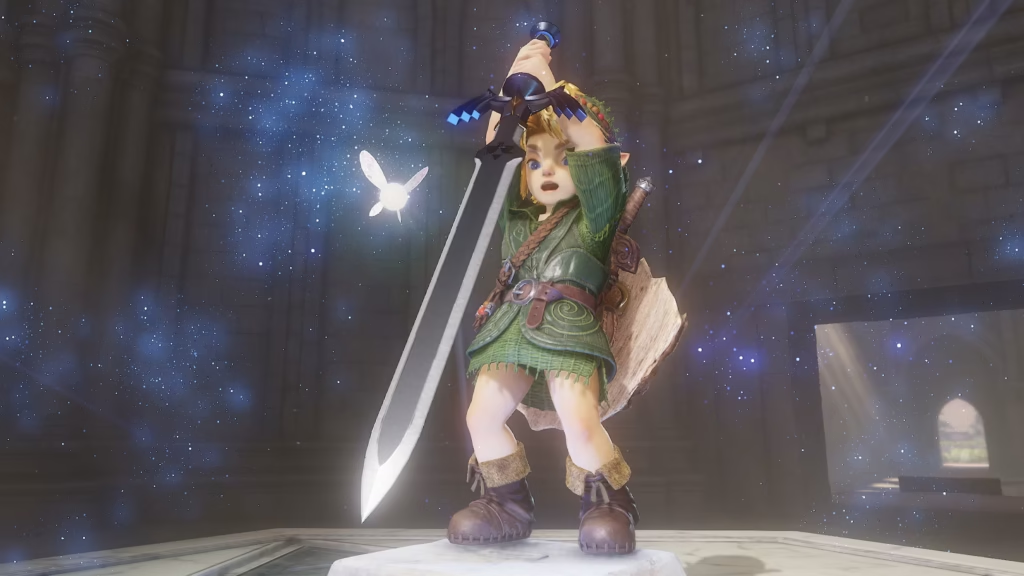
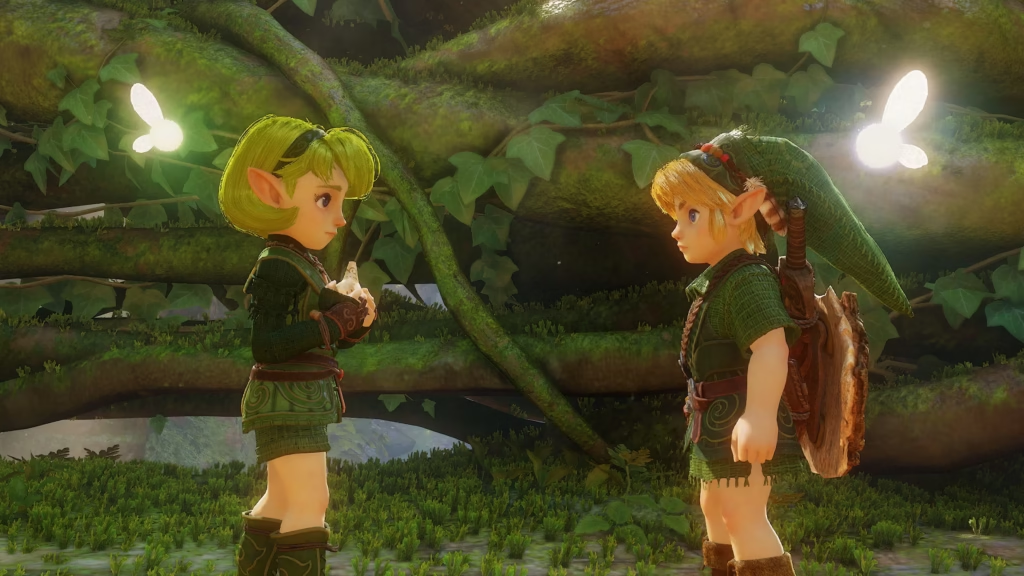
Characters, environments, materials, and lighting have been rebuilt. Nintendo also promises faster loading times, more responsive actions, and smoother gameplay, without specifying the resolution or frame rate for each play mode.
How Has Ocarina of Time’s Gameplay Changed?
The changes affect exploration and how players control Link, as well as the game’s visual presentation. The official gameplay details include:
- Manual jumping and dashing: New controls allow Link to jump over obstacles and move faster using a dash. In the original Nintendo 64 game, many jumps happened automatically when Link reached a ledge.
- Free camera control: The right analog stick lets players look around Hyrule from different angles while exploring.
- Day and night: Time continues to pass even in towns, and certain characters and enemies may appear after nightfall.
- Equipment and aiming: Weapons and items can be switched more quickly, while motion controls help with aiming the slingshot, bow, and other tools.
Dungeons, Puzzles, and the Hall of Fallen Heroes
Temples and dungeons combine combat, environmental obstacles, and logic-based challenges. Ocarina of Time is an action-adventure game in which puzzles are part of progression, rather than a pure Puzzle game. Our feature on the evolution of Puzzle games explains the difference between a genre and mechanics incorporated into an adventure.
The October 14 presentation revealed the Hall of Fallen Heroes. There, players can look up information about enemies and take part in timed rematches against powerful opponents. The announcement did not detail rewards or provide a complete list of available battles.
The Ocarina Has New Control Options Too
Music remains a central part of the adventure.
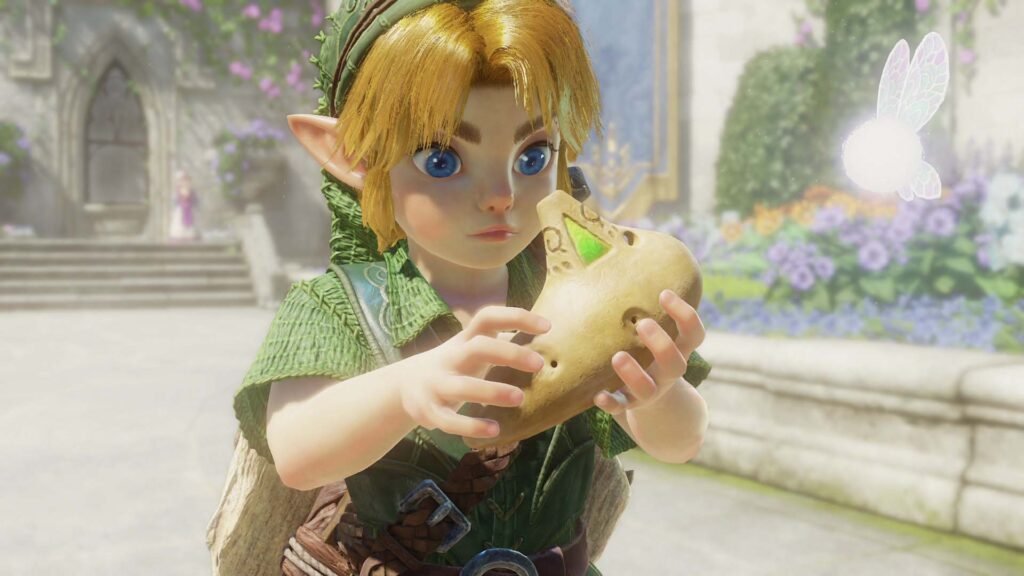
In addition to the traditional method of playing songs with buttons, the remake will allow players to hum melodies near the Nintendo Switch 2 microphone.
When the system recognizes a song Link has learned, he will be able to play it on his in-game ocarina.
Nintendo says the feature can also recognize notes played on real instruments.
What Is Threads of Time?
The remake adds a system called Threads of Time.
It allows players to track their story progress, check their next objective, and view a tapestry that gradually fills in as Link’s journey unfolds.
The idea is to help players who return after spending some time away from the game and may not remember exactly where they left off.
Threads of Time is part of the game itself and should not be confused with ZELDA NOTES, which works through Nintendo’s mobile app for phones and tablets.
Will the Remake Have Voice Acting and New Dialogue?
Yes. Nintendo has confirmed voiced cutscenes and expanded dialogue. The original relied primarily on text boxes, sounds, and brief vocalizations.

Nintendo’s Brazilian game listing includes Brazilian Portuguese, Latin American Spanish, Japanese, Korean, German, Italian, Dutch, Russian, Polish, Simplified and Traditional Chinese, as well as American and British English, European Spanish, and Canadian and European French.
However, the list of supported languages does not separately specify which ones will include voice acting. Therefore, the presence of Brazilian Portuguese in the listing should not be presented as confirmation of Brazilian Portuguese voice acting.
The story remains centered on Link’s journey across two eras of Hyrule as he attempts to stop Ganondorf from claiming the Triforce. The expanded dialogue does not mean the 1998 script will be reproduced word for word, and the extent of any additional scenes or storylines has not yet been detailed.
Has the Soundtrack Been Remade?
The remake will feature a refreshed soundtrack with symphonic orchestral music.
This is particularly important in Ocarina of Time, where music is not only part of the atmosphere but also plays a role in progressing through the adventure.
Nintendo has not yet detailed whether every track from the original game has received a new arrangement or how the entire soundtrack was recorded.
What Is ZELDA NOTES?
ZELDA NOTES is available through the Nintendo Switch App on compatible phones and tablets. It is a companion service, separate from the Threads of Time system built into the game.
- Today’s Record: Displays a chronological record of the day’s accomplishments and statistics, such as the number of enemies defeated.
- Gossip Quest: Uses an image as a clue to help players find a location in the game. Points earned can be used to obtain sheet music for Play Ocarina.
- Play Ocarina: Provides a virtual ocarina on a phone or tablet screen. Players can perform freely, follow guides, listen to automatic playback, and create sheet music that can be shared through QR Codes.
- Ocarina of Time Quiz: Features more than 2,000 questions, including image-based challenges. Players can take the quiz once per day, with additional attempts available by spending rupees earned in the game.
The app’s virtual ocarina is not the same as the console’s microphone-based melody recognition: these are two separate features. Using ZELDA NOTES requires a Nintendo Account, an internet connection, and a compatible device. A Nintendo Switch Online membership is not required.
How Will amiibo Work?
The remake will support amiibo figures from The Legend of Zelda series.
Existing amiibo figures will be able to grant in-game items.
Nintendo has also announced two new amiibo specifically related to Ocarina of Time:
Both are scheduled for release in 2027.

Using these figures will unlock special masks for Link featuring a retro visual style.
Because the new amiibo figures are not scheduled to arrive until 2027, they will not be available at the remake’s launch.
File Size and Other Technical Details
According to the Brazilian game listing, checked on October 19, 2026, the estimated download size is 27 GB. This is an estimate of the required storage space, subject to revision, and should not be treated as a guarantee of the final size after any updates.
- Players: One player on a single console.
- Play modes: TV, tabletop, and handheld.
- Display: HDR and VRR on compatible TVs, according to the Brazilian listing.
- Audio: Linear PCM surround sound.
- Save data: Cloud save support through Nintendo Switch Online.
HDR and VRR support do not confirm a specific resolution or frame rate. These figures and any potential graphics modes have not yet been detailed in the sources consulted.
What Remains the Same as the Original Ocarina of Time?
The adventure retains Link as the Hero of Time, the threat posed by Ganondorf, and the exploration of Hyrule across two eras. Official materials show familiar locations and elements, including Hyrule Field, Kokiri Forest, Epona, and temples featuring puzzles.
Classic equipment also remains part of the game’s identity: the Kokiri Sword and Deku Shield, slingshot, bombs, boomerang, Deku Sticks, and Deku Nuts, along with the ocarina and its songs. Some items are only available to Link in one of the two eras. These familiar elements preserve the original game’s identity without promising that every location and challenge will work exactly as they did in 1998.
What Do We Still Not Know?
As of October 19, 2026, the sources consulted had not fully detailed the following:
- Adventure structure: The extent of changes to dungeon layouts, puzzles, and bosses, along with any additional areas or side quests.
- Story and audio: The scope of additional cutscenes and dialogue, the voice cast and supported voice languages, and whether the entire original soundtrack has received new orchestral arrangements.
- Performance: Resolution, frame rate, and possible graphics modes.
- Other content: Post-launch plans and which specific features from Ocarina of Time 3D have been incorporated.
The Hall of Fallen Heroes has already been announced, so it should no longer be treated as an unknown feature. However, this does not confirm new campaign temples or rewards that Nintendo has not described.
Is the Remake Worth Following Even If You Played the Original?
For newcomers, the remake offers a new entry point into the adventure. For those familiar with the Nintendo 64 game or the 3DS version, the appeal lies in discovering how the updated controls and presentation work alongside the classic structure. Evaluating that combination will require the complete game.
Watch Nintendo’s official presentation released on October 14, 2026, which includes the Hall of Fallen Heroes:
About the Author