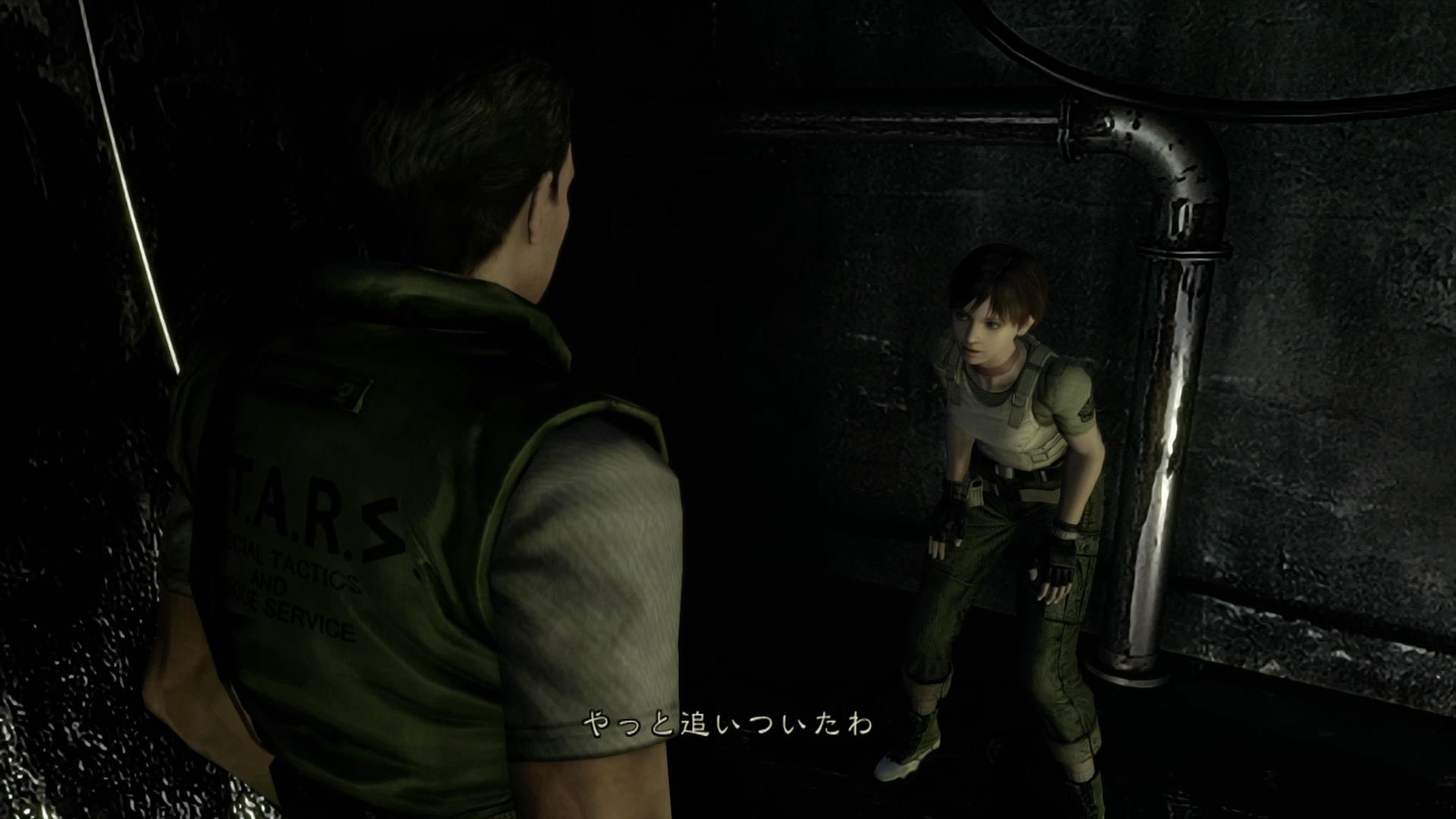
Chris Redfield meets Rebecca Chambers in a dark corridor in the Resident Evil remake. Credit: Capcom.
Spoiler warning: This article contains complete spoilers for Resident Evil (1996), including the traitor’s identity, character deaths, the Tyrant, and every ending.
In July 1998, an investigation in the Arklay Mountains leads S.T.A.R.S. officers to a mansion concealing Umbrella’s biological experiments. What begins as a search for missing officers ends with the discovery of a conspiracy, Albert Wesker’s betrayal, and an escape that changes the survivors’ lives.
Here, we tell the story of the original 1996 Resident Evil, distinguishing Chris Redfield’s and Jill Valentine’s routes. For the game’s development, controls, and editions, see our technical retrospective of the first Resident Evil. Our main Resident Evil series overview traces the evolution of every installment.
On this page
What happened before Resident Evil (1996)?
In the weeks leading up to the incident, the outskirts of Raccoon City see violent deaths and reports of attacks blamed on unknown creatures. The authorities call on S.T.A.R.S., the local police department’s special unit, to investigate the Arklay mountain region.
Bravo Team sets out first. Communication with its members then breaks down. Alpha Team is sent to find them under Captain Albert Wesker, accompanied by Chris Redfield, Jill Valentine, Barry Burton, Joseph Frost, and pilot Brad Vickers. Capcom’s official chronology dates the Mansion Incident to July 24, 1998.
Bravo Team’s helicopter is discovered in the forest, but the rescue mission quickly becomes a fight for survival. Savage dogs attack the officers; Joseph Frost is killed, and Brad takes off in panic, leaving the others stranded. Unable to fight the pack in the open, the survivors run toward a seemingly abandoned property: the Spencer Mansion.
Arriving at the Spencer Mansion
The mansion appears to provide shelter, but that sense of safety does not last. The group separates under circumstances that depend on the chosen protagonist. In Jill’s campaign, Chris disappears near the beginning and Barry helps with the first searches. In Chris’s campaign, Barry is absent for most of the playable events. Wesker also keeps appearing and disappearing without convincing explanations.
This split matters: the 1996 Resident Evil does not have a single campaign in which Chris and Jill explore every room together. It offers two alternative versions of the incident, each with its own encounters, dialogue, and consequences.

The first zombie and the secrets hidden in the mansion
While investigating noises from a room near the main hall, the protagonist sees the image that defines the beginning of the horror: a human-like creature with decaying skin feeding on a corpse. The victim is Kenneth Sullivan, a member of Bravo Team. The attacker turns toward the officer, confirming that the reports of murderous creatures were no exaggeration.
From this encounter onward, the mansion is no longer a refuge. Zombies roam the corridors, doors are locked, traps lie in wait, and there are signs that others tried to fight back. As the player progresses, notes left by employees and researchers come to light, including the famous Keeper’s Diary. Rather than explaining everything at once, the entries reveal a worker’s gradual decline: itching, wounds, lost lucidity, and an increasingly disturbing hunger.
These documents help reconstruct what happened before S.T.A.R.S. arrived. Something had spread among the estate’s workers and escaped the control of those running the facility. Communications were cut off, staff became infected, and the survivors lost control of the experiments. The monsters were not there by chance; they were the result of a biological disaster.
At that point, Chris and Jill still do not know the full extent of Umbrella’s involvement. The game discloses the connection little by little as the protagonists move from the residential rooms into concealed research areas.

What happened to the members of Bravo Team?
The investigation gradually reveals the fate of the missing officers. Besides Kenneth, the group finds Forest Speyer dead in an outdoor area of the mansion, surrounded by signs of a crow attack. In the original game, his body mainly serves as evidence of the slaughter; a version of Forest that rises as a zombie appears in certain later editions, not in the standard 1996 campaign.
Another member, Richard Aiken, is found severely injured and poisoned after an encounter with an enormous snake called Yawn. The player can obtain serum, but Richard dies in the 1996 original; some scenes in which he survives longer and sacrifices himself against other creatures belong to the 2002 remake. The distinction matters so the two narratives are not mixed together.
Bravo Team captain Enrico Marini survives longer in the underground passages. When the player finds him, he already suspects that the operation was a setup and that a traitor is among the S.T.A.R.S. members. Before he can identify the culprit, Enrico is shot by someone out of sight. His death confirms that the danger does not come solely from the infected: a human operative is trying to control what can be uncovered.
They were not just zombies
The mansion, courtyard, and nearby facilities hide other threats: infected dogs, aggressive crows, the serpent Yawn, the mutant plant Plant 42, sharks known as Neptune, and later the fast-moving Hunters. Each encounter expands the meaning of the discovery: an organized scientific operation lies behind the variety of altered organisms.
Bravo Team did not fail because it was facing ordinary criminals. Its members entered an area where biological experiments had spun out of control and, as the story will reveal, they were being observed as part of a deliberately manipulated operation.

Did Chris and Jill experience the same story?
Not exactly. Both protagonists investigate the same conspiracy, but their campaigns are alternatives. The mansion’s layout and major revelations are shared; the allies they meet, certain choices, conversations, and the people who survive can differ.
Chris Redfield’s route: Rebecca and Jill’s disappearance
In Chris’s campaign, one of his most important allies is Rebecca Chambers, a rookie Bravo Team member with medical training. Depending on how exploration unfolds, he may find her tending to Richard or in a support room. Rebecca plays a part in critical moments, including a sequence involving a piano and situations where her assistance becomes indispensable.
At one point, Rebecca is threatened by a Hunter. The player’s decisions and response time can determine whether she survives. She is therefore more than a character who simply appears for dialogue: her fate affects the conclusion of Chris’s route.
Meanwhile, Chris searches for Jill, who vanished during the operation. In the underground complex, he may find her locked in a cell. Freeing her depends on actions taken during the investigation and directly affects who leaves the estate alive.
This campaign puts Rebecca at the center of events that involve Barry in the alternative route. It also changes the final confrontation with Wesker and the circumstances that lead to the laboratory’s self-destruction.

Jill Valentine’s route: Barry and increasingly suspicious help
In Jill’s campaign, Barry Burton repeatedly comes to her aid. He provides support in dangerous situations, knows the equipment, and seems concerned about the team’s fate. Yet he starts behaving strangely: disappearing without explanation, avoiding certain questions, and sometimes appearing to follow orders Jill knows nothing about.
Encounters with Barry can unfold differently. In one sequence, for example, he must return with a rope after Jill descends into an underground area. Waiting for him or leaving affects the characters’ relationship and may have later consequences. Farther on, in the caves, deciding whether to keep Barry close also changes his fate.
These choices do not create an entirely different story, but they reinforce the campaign’s central tension: Barry may be a valuable ally, yet Jill does not know how far she can trust him. Enrico’s murder, right after his warning about a traitor, makes that distrust even more serious.
As Jill moves through the courtyard and exterior facilities, it becomes clear that the mansion is a facade for deeper installations. Her discoveries bring her investigation closer to Chris’s, although the two versions never merge into a third playable campaign.

Umbrella’s secret laboratory
After passing through the courtyard, auxiliary buildings, and underground galleries, the protagonist reaches the structure hidden beneath the property. Access to the Arklay laboratory makes the operation’s scale clear: this was not merely a home being used for clandestine research, but a facility dedicated to developing biological weapons, the so-called B.O.W.s.
Records and equipment point to the Umbrella Corporation and its experiments with the t-virus. The infectious agent is linked to the appearance of the zombies and the disaster that overtook the estate’s personnel. Other organisms were altered or developed as part of the research. The staff lost control of the outbreak and could no longer stop creatures from escaping.
The investigation also reveals detention areas and a program for gathering combat data. The protagonist finds evidence connecting Albert Wesker to the installation long before the S.T.A.R.S. mission. The captain’s presence there is neither a coincidence nor a discovery made during the search: Wesker already knew the location and its purpose.
The player may also find the other protagonist imprisoned. In Jill’s route, Chris can be freed; in Chris’s route, the prisoner may be Jill. That decision is part of the differences between the endings, not a scene in which all four main characters explore the laboratory together.
Albert Wesker: why did he betray S.T.A.R.S.?
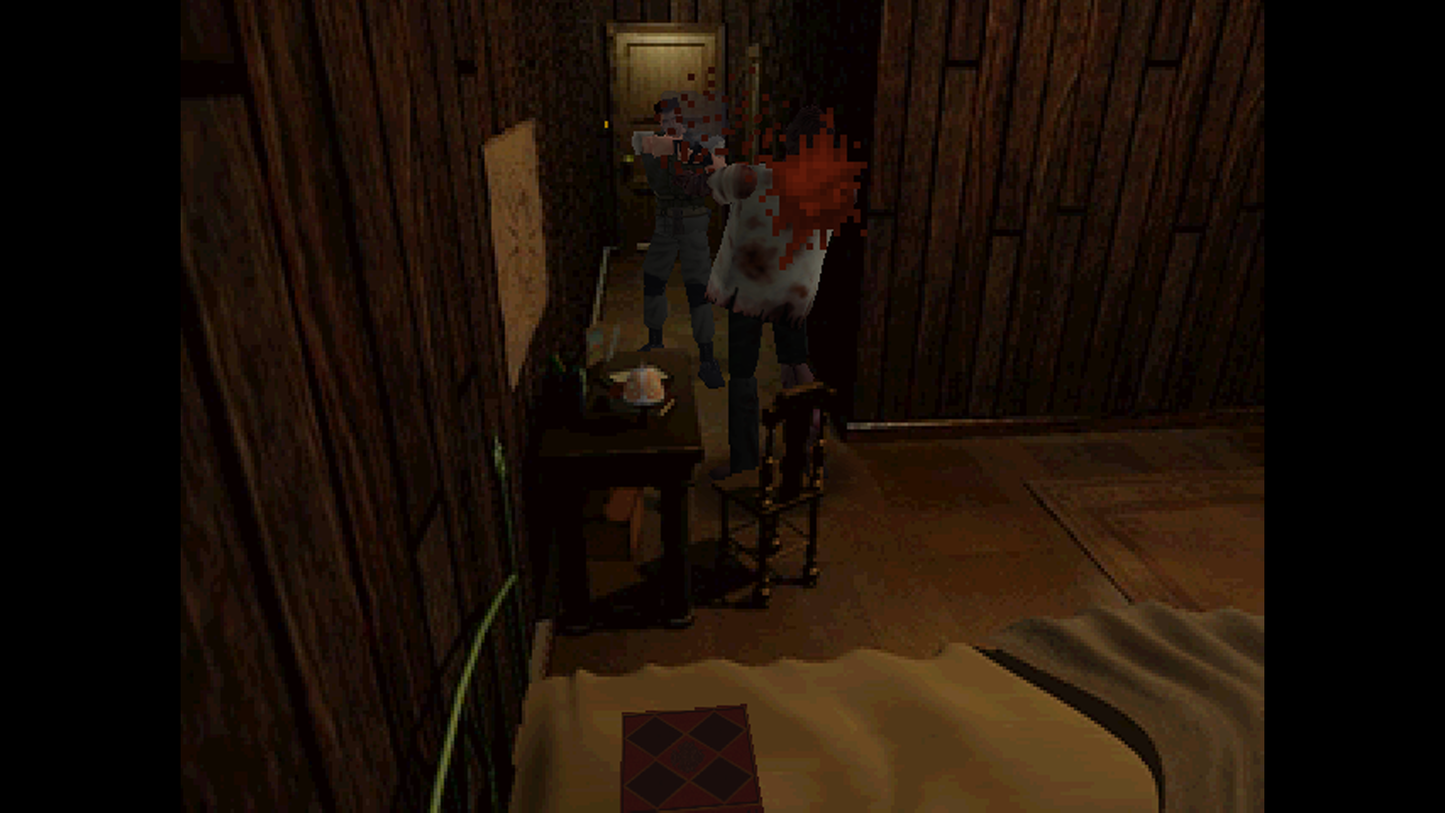
The investigation’s climax exposes the lie behind the entire mission. Wesker is an infiltrator tied to Umbrella who used his own team to reach the laboratory, test how effectively its creatures could fight trained officers, and facilitate the recovery of research and samples. His colleagues’ deaths were not simply an accident beyond his control: the mission had been manipulated to serve hidden interests.
In Chris’s campaign, the confrontation also reveals that Wesker intends to act for his own benefit rather than remain completely loyal to Umbrella. When Rebecca is present, he shoots her; her protection means the shot is not necessarily fatal. The sequence underscores his willingness to eliminate witnesses and teammates to complete his plan.
Why did Barry Burton help Wesker?
In Jill’s campaign, Barry’s behavior is explained alongside the traitor’s revelation. Wesker blackmailed him by threatening his wife and daughters. Barry cooperated out of fear for his family, not because he willingly shared the plan to wipe out S.T.A.R.S.
That does not erase the consequences of his actions, but it changes how the character should be understood: Barry is a coerced ally, torn between protecting his loved ones and saving Jill. Depending on the choices made during the campaign, he can break with Wesker and help in the confrontation—or die before the end.
What is the Tyrant T-002?
Deep within the laboratory, Wesker unveils the Tyrant T-002, an enormous humanoid biological weapon kept in a tank. It embodies Umbrella’s ambition: creating an organism that can serve as a combat weapon, far beyond the zombies roaming the estate.
Wesker expects the creature to demonstrate his superiority, but he loses control. In the route where he remains beside the tank, the Tyrant can turn on the captain and impale him with its claws. The protagonist must then survive the first battle. The 1996 game presents Wesker as apparently dead at this point; the explanation for his appearances in later installments comes from continuity developed afterward, not an explanatory scene in the original.
Escaping the mansion: who survives?
After the fight in the laboratory, the protagonist tries to leave the estate and reach the helipad. Pilot Brad Vickers, who fled at the beginning of the incident, remains their chance of rescue. A flare can attract his attention, but the final sequence depends on what has happened to the companions.
When Barry survives in Jill’s route, or Rebecca survives in Chris’s, the self-destruct system can be activated. In these endings, the Tyrant returns for one last battle on the helipad. Brad drops a rocket launcher, enabling the creature to be defeated before the escape while the installation is destroyed.
Other endings do not feature the same self-destruction sequence or the same helipad fight. The helicopter may leave with fewer survivors and the mansion still intact. It would therefore be wrong to describe the explosion as something every player is guaranteed to see in every ending.
What are the endings of Resident Evil (1996)?
The endings vary mainly according to two factors: whether the campaign’s ally survives and whether the other protagonist is rescued. The combinations can be summarized as follows:
| Campaign | Who can escape | What changes |
|---|---|---|
| Jill — best ending | Jill, Barry, and Chris | Barry survives and Chris is rescued; the complete route includes the final Tyrant sequence and destruction of the facility. |
| Jill — alternate endings | Jill and Barry; Jill and Chris; or Jill alone | Depend on Barry’s fate and Chris’s rescue; some do not include the mansion’s destruction. |
| Chris — best ending | Chris, Rebecca, and Jill | Rebecca survives and Jill is rescued; the complete route includes the final battle and destruction of the facility. |
| Chris — alternate endings | Chris and Rebecca; or Chris alone | Vary depending on Rebecca’s survival and Jill’s rescue; some leave the mansion intact. |
This summary groups the outcomes rather than describing every small variation in the scenes. The essential point is that neither campaign’s best playable ending shows Chris, Jill, Barry, and Rebecca together in the same helicopter: in each route, one of the four plays a different narrative role or remains outside the events shown.

What is the true ending of Resident Evil 1?
This is the question that causes the most confusion about the timeline. The best ending of Jill’s campaign saves Jill, Barry, and Chris. The best ending of Chris’s campaign saves Chris, Rebecca, and Jill. Each ending shows only some of the possible survivors, never all four reunited.
However, later continuity recognizes Chris Redfield, Jill Valentine, Barry Burton, and Rebecca Chambers as survivors of the Mansion Incident. It also treats the destruction of the facility as part of the historical outcome. The accepted result in the franchise is therefore a synthesis of events, not a secret ending in the original game where all four are seen escaping together.
The same distinction applies to Wesker. His apparent fate in the laboratory is what the 1996 game shows; later revelations in the series reframe the character. Scenes from Resident Evil 0, the 2002 remake, or subsequent games should not be inserted as though they appeared on the original PlayStation. For comparisons between versions of the story, the documented narrative chronology for the 1996 edition distinguishes the events and endings, while Capcom officially dates the incident to July 1998.
What happened after the Mansion Incident?
The officers who escape carry evidence that a pharmaceutical corporation was conducting clandestine research and developing biological weapons in the mountains near Raccoon City. The discovery places Umbrella at the heart of what follows, but it does not immediately resolve the entire conspiracy.
What happened at the Spencer Mansion becomes the starting point for larger conflicts. Subsequent stories in the franchise expand the investigation, introduce new protagonists, and show how the crisis reaches Raccoon City. Those events belong in articles about Resident Evil 2, Resident Evil 3, and other games; they do not need to be told in advance here.
The first Resident Evil thus ends with two complementary truths: the 1996 campaigns have alternate endings, while later continuity retains the four central survivors. Understanding that difference prevents Chris, Jill, Barry, and Rebecca’s stories from being reduced to a single route that never existed in the original game.
About the Author