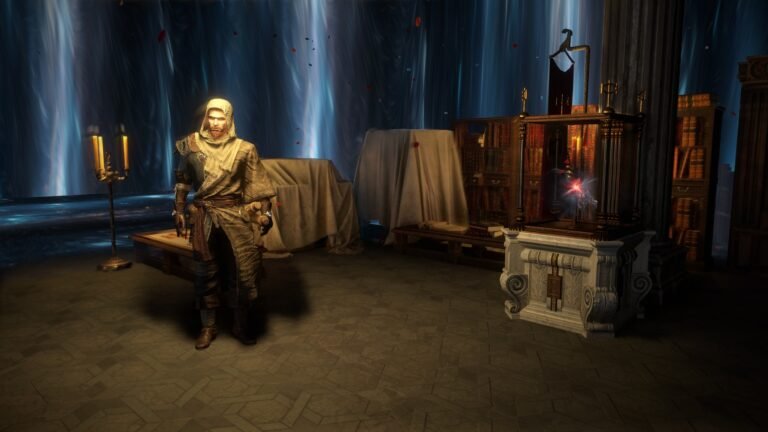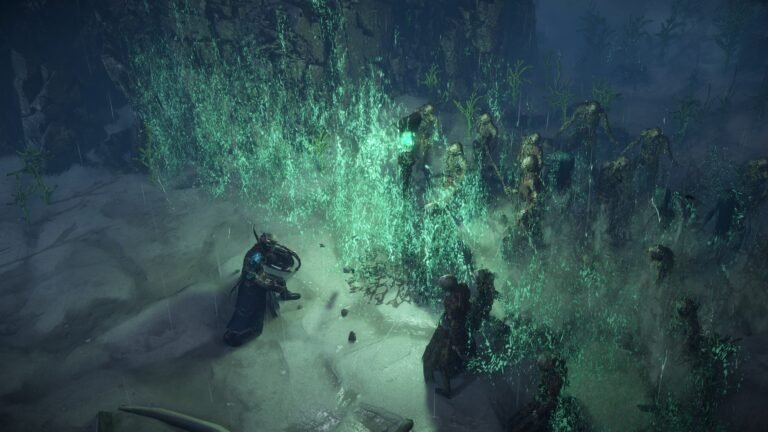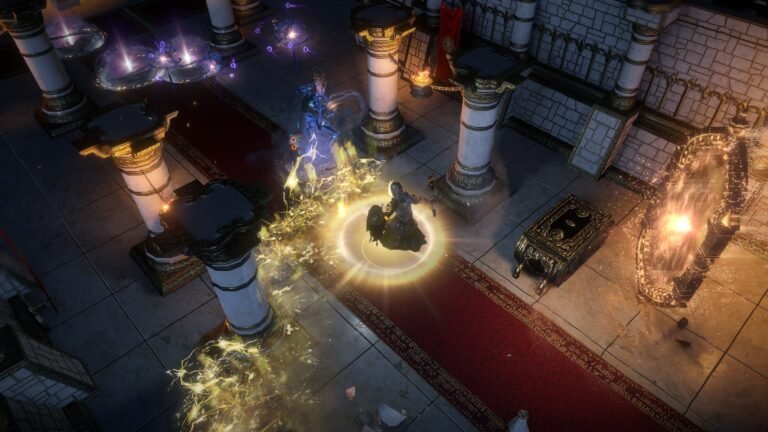
Path of Exile stopped being just “that free ARPG similar to Diablo” a long time ago.
Officially launched in 2013, Grinding Gear Games’ title has accumulated over a decade of expansions, leagues, systems, overhauls, and new ways to build characters. Killing monsters and finding equipment remain the foundation, but that foundation now supports an enormous range of possibilities.
Many skills come from equipped Skill Gems. All classes share an enormous passive skill tree. Equipment can be modified using various types of currency. A new league can reshape the entire economy. And finishing the campaign is only the gateway to an endgame with its own progression.
For someone opening Path of Exile for the first time, that can sound overwhelming. But understanding the game doesn’t require learning every system at once. The first step is seeing how the pieces fit together.
Nesta matéria
What Is Path of Exile?
Path of Exile is a free-to-play online action RPG set in Wraeclast, a dark fantasy continent scarred by ruins, corruption, wars, religions, fallen empires, and thoroughly unfriendly creatures.
You play an exile sent to Wraeclast who starts with next to nothing. From there, you fight hordes of enemies, defeat bosses, find equipment, and gradually turn your character into something far more powerful.
That cycle of combat, loot, and progression is central to the genre. Our article on the history and evolution of ARPGs explains how that tradition emerged and where Path of Exile fits into it.
The difference lies in just how much freedom players have to decide how their characters become powerful.
Path of Exile has seven base classes, but choosing one doesn’t give you a fixed list of skills. Your class determines important aspects of character development—especially where you start on the passive tree and which Ascendancy options you can access. Much of everything else comes from combining passives, skills, Support Gems, equipment, attributes, and different defensive and damage mechanics.
One Witch can follow a completely different path from another Witch.
A Marauder doesn’t have to exist solely to hit enemies with an enormous weapon.
And two builds using the same skill can work in very different ways.
That freedom is central to Path of Exile’s identity—and one of the reasons the game has a reputation for being complicated.
How Path of Exile Began
Path of Exile’s story began years before its release.
Grinding Gear Games was founded in Auckland, New Zealand, in November 2006 by a small group of players and developers who wanted to create the kind of action RPG they themselves would enjoy playing.
The project grew over several years and went through testing periods before reaching a wider audience.
As the official retrospective of its early releases records, Path of Exile entered Open Beta in January 2013. It left beta on October 23, 2013, officially reaching version 1.0.
The game was much smaller back then.
At launch, the campaign ended in Act 3, Dominus became its final boss, and the Scion was introduced as the seventh playable class.
What came next would transform the game completely.
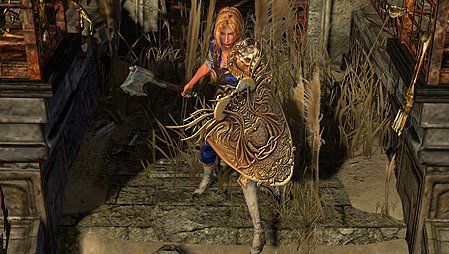
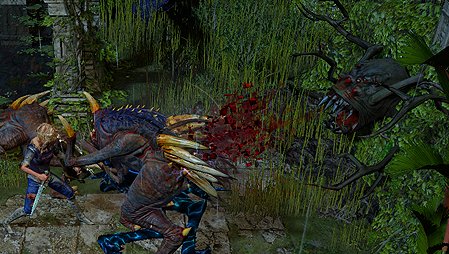
From 2013 to Today: How Did Path of Exile Get So Big?
Path of Exile didn’t grow simply by adding more maps, monsters, and equipment.
Grinding Gear Games spent years adding new layers to how the game itself works.
Some updates fundamentally changed its structure.
In 2015, The Awakening added Act 4, introduced Jewels for the passive tree, and marked an important technical change with Lockstep mode.
In 2016, Ascendancy created specialized subclasses and the Labyrinth, adding another layer to how builds are defined.
Later that year, Atlas of Worlds expanded the concept of Maps and established a much broader endgame structure.
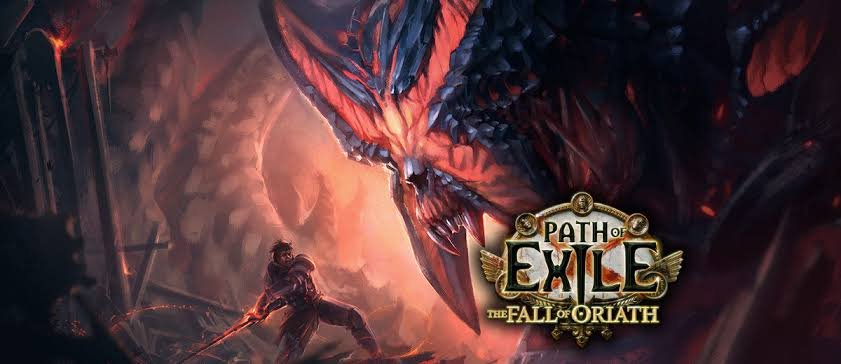
In 2017, The Fall of Oriath brought one of the biggest changes in the game’s history: it added Acts 5 through 10 and removed the old requirement to replay the campaign at different difficulty levels. Path of Exile now had one continuous ten-act campaign.
2018 — Delve and Betrayal: Delve opened an independent progression path deep in the Azurite Mine, with routes, darkness, upgrades, and crafting materials such as Fossils and Resonators. Betrayal reorganized the masters and introduced the Immortal Syndicate investigation. Players now had activities beyond replaying the campaign or opening conventional maps.
2019 — Conquerors of the Atlas: Endgame progression was reorganized around the Conquerors, Sirus, and Watchstones. The official explanation of subsequent changes illustrates how this system affected Atlas regions and encounters. These are the rules of that historical period, not the current system.
2021 and 2022 — Specializing your own endgame: Echoes of the Atlas brought the Maven and regional passive trees in 2021. In 2022, Siege of the Atlas replaced those with a unified Atlas passive tree and added the Searing Exarch and Eater of Worlds. Beyond choosing a build, players gained more direct control over which activities they encountered in maps.
2024 — Settlers of Kalguur: Update 3.25 introduced Kingsmarch, with workers, production, and trade expeditions, along with Gold and the Currency Exchange. Resource management began to accompany combat, and trading supported materials gained its own tool. Kingsmarch would join the core game in 2025, with changes from the original league’s town-building mechanics.
2025 — New memories, customization, and trading: Secrets of the Atlas (3.26) expanded Zana and Eagon’s story with Memory Threads and new bosses, alongside the Mercenaries of Trarthus league. Later, Keepers of the Flame (3.27) reworked Breach, introduced Bloodlines as an additional customization layer, and brought asynchronous trading through Merchant’s Tabs. Those developments affected both encounters and how players build characters and trade.
2026 — Old systems under new rules: Mirage (3.28), released in March, separated area selection from the Map Item and redesigned the Atlas. July’s Curse of the Allflame (3.29) took its league mechanic underwater and reworked sockets, Abyss, Legion, and other systems. These changes help explain why an old guide can describe the same game while teaching rules that no longer apply.
That history doesn’t mean every league mechanic survives unchanged. Some join the core game, others are modified, and others leave the main structure. What grew was the number of possible paths—not a collection in which every season remains available exactly as it launched.
How Do Path of Exile Leagues Work?
Challenge Leagues are central to Path of Exile’s cycle.
When a new league begins, players can create characters in a fresh environment with its own economy and progression starting from zero.
Items accumulated in the previous league aren’t waiting in your stash there: the economy has to develop again. Players return to the campaign, try different builds, and encounter the new mechanic designed for that season.
That doesn’t mean all account progress is erased or that you must abandon existing characters.
Standard remains a permanent environment, while Challenge Leagues offer parallel fresh starts. When a league ends, its characters and items are normally transferred to the corresponding permanent league.
This fresh start is a major reason veteran players keep returning.
At the beginning of a league, everyone is once again chasing equipment, currency items, and progression. At the same time, new mechanics, balance changes, and items may cause familiar skills to work in different ways.
So starting over doesn’t necessarily mean repeating exactly the same experience.
How Does the Campaign Work?
Path of Exile’s current campaign has ten acts.
It takes players through various areas of Wraeclast and Oriath, introducing characters, bosses, towns, and many fundamental game systems.
Along the way, characters gain levels, passive tree points, new skills, and access to systems that become increasingly important.
The campaign is also where a build begins to reveal whether its foundation works.
Damage matters, but surviving requires attention to life, resistances, and other defensive layers. Resistance penalties after the Kitava encounters make it necessary to reassess your gear. Quests that award passive points are also part of building a character: leveling up isn’t the only source of those points.
Even so, finishing Act 10 isn’t the end of Path of Exile.
In practice, that’s when another part of the game begins.
Path of Exile’s Enormous Build System
Few images communicate Path of Exile’s reputation as quickly as its passive skill tree.
Shared by all seven base classes, it contains an enormous network of attributes, bonuses, specializations, Masteries, Jewel Sockets, and special passives that can fundamentally change a character’s rules.
Your class determines where you start and which specializations you can choose. Marauder begins on the Strength side, Ranger on the Dexterity side, and Witch on the Intelligence side. Duelist, Templar, and Shadow start in hybrid areas, while Scion occupies the center. This affects pathing costs and access to passives; freedom of skill choice doesn’t make the classes equivalent.
Smaller nodes connect paths and grant bonuses; Notables provide more specific effects. Masteries let players choose effects within certain groups, Jewel Sockets hold Jewels, and Keystones change fundamental rules. You don’t have to travel across the entire tree: every allocated point should contribute to what the build is trying to do.

The tree is only one part of a build.
A base class is the starting point, an Ascendancy is a specialization, and a build is the full combination. It includes:
- Class;
- Ascendancy;
- Attributes;
- Skill Gems;
- Support Gems;
- Equipment;
- Item modifiers;
- Jewels;
- Resistances;
- Life, Energy Shield, or other defenses;
- Ways to recover resources;
- Damage type;
- Critical strike chance;
- Speed;
- Synergies between different effects.
The final result comes from how those pieces interact.
A skill that appears ordinary by itself can become something completely different with the right supports, a particular Ascendancy, specific equipment, and a planned route through the passive tree.
That ability to create something of your own is why many players spend more time planning characters than simply picking a “strong class.”
Ascendancy: Class Specialization
Ascendancies specialize the base classes. Their smaller passive trees offer powerful effects and help establish a build’s identity. The system arrived in 2016 alongside the Labyrinth and has continued to evolve.
That’s why choosing Ranger doesn’t tell the whole story of the character you’re creating. Ascendancy, along with equipment, skills, and passives, can take the same class in very different directions. In version 3.29, Scion also has the Luminary option, linked to permanently recruiting Mercenaries.
There’s a separate layer as well: Bloodlines, introduced in 2025, are secondary specializations unlocked on a per-character basis by defeating certain endgame bosses. They can be combined with an Ascendancy and share its pool of Ascendancy points. They are neither an eighth base class nor a PoE 2 system.
Skills and Support Gems
Another thing that sets Path of Exile apart from many ARPGs is how its skills work.
Rather than unlocking every skill from a class-specific skill tree, many Path of Exile skills exist as Skill Gems.
Socketing one of those gems into equipment grants access to the corresponding skill.
Support Gems modify compatible skills when they are placed in the same group of linked sockets. Placing gems anywhere in your gear isn’t enough: links still matter.
A skill might gain extra projectiles, change its area, apply additional effects, interact with certain conditions, or receive substantial changes to how it deals damage.
This creates a modular system of sorts.
The skill is the foundation.
Supports help define what it becomes.
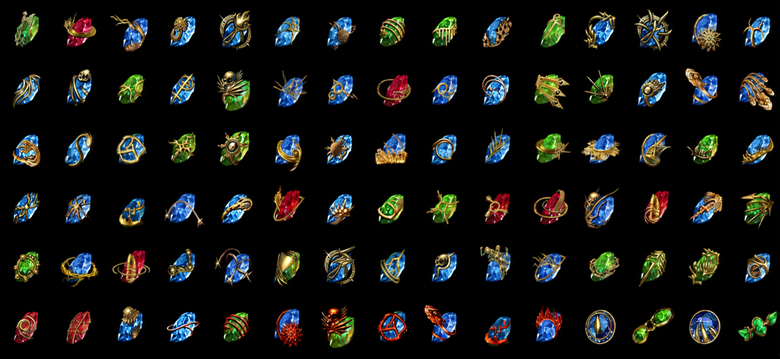

This system has also changed over the years. According to the official 3.29 patch notes, gems can now go into any equipment socket, even when the colors don’t match. When a gem matches a red, green, or blue socket, it gains +10% Quality. Sockets are white by default, with colored sockets possible under item rules.
Color therefore no longer blocks socketing, but this doesn’t remove links, attribute requirements, or Support Gem compatibility restrictions. The bow image preserves a historical example of gems and sockets; its colors should not be interpreted as a current socketing requirement. This is still PoE 1’s system of gems in equipment—not PoE 2’s skill system.
Items and Crafting
Items are central to almost everything in Path of Exile. Its basic rarities are Normal, Magic, Rare, and Unique. These indicate different modifier structures, not a ranking in which every Unique is better than every Rare.
Equipment can drop at different rarities, and its modifiers determine much of its value and usefulness to a build.
Magic and Rare items can have combinations of modifiers: Magic items hold fewer affixes, while Rare items allow larger combinations. Prefixes and suffixes are groups of explicit affixes, distinct from a base item’s implicit properties. They can grant life, resistances, attributes, damage, speed, and a huge range of other effects.
Unique items follow a different logic.
They have specific properties that can, in some cases, completely change how a build works.
This makes evaluating gear in Path of Exile very different from merely asking which item has the highest “power” number.
An apparently simple Rare can be excellent for a particular build.
A rare Unique might be useless for another.
And some gear only becomes truly interesting after it’s modified.
Crafting Isn’t Just Making an Item
Path of Exile’s crafting is deeply connected to its currency items.
Many items used as currency also modify equipment.
Depending on the currency type and system, they may add, remove, reroll, or change properties.
Mechanics introduced over the years have also created their own ways of manipulating equipment.
So “crafting” in Path of Exile can mean anything from a simple change at the Crafting Bench to complex, multi-step processes.
Understanding all of that deserves a guide of its own.
For now, the important thing is knowing that equipment isn’t just something that drops fully finished on the ground.
You can work on it, too.
Path of Exile’s Unusual Economy
Historically, Path of Exile built its economy around currency items rather than a universal coin for every transaction.
Orbs and other items can have two kinds of value at once:
They modify equipment, and they have economic value in player-to-player trading.
That creates a constant decision.
Should you use a currency item to try to improve your equipment or save it to trade for something else?
Today’s game also uses Gold for certain systems, so simply claiming “Path of Exile has no gold” no longer tells the whole story.
But Gold hasn’t replaced the economy’s core structure.
Gold cannot be traded directly between players: it pays for services, fees in trading tools, and Kingsmarch operations. Chaos Orbs and Divine Orbs, meanwhile, are tradable currency items with their own functions: Chaos Orbs reroll modifiers on a Rare, while Divine Orbs change numerical modifier values. Their relative prices fluctuate with the economy.
Path of Exile also supports player trading, giving each league’s economy a life of its own.
At the start of a season, supply and demand are different.
A few weeks later, the number of items on the market has changed.
The economy itself therefore becomes part of each league’s experience.
For players who would rather avoid that market, Solo Self-Found variants also exist. Trading and grouping with other players aren’t available there, so progression depends on items you find or craft yourself.
For a closer look at how trading works today—including Faustus, the Currency Exchange, Merchant’s Tabs, and the player market—read our complete guide to Path of Exile trading, Faustus, and the economy.
The Endgame and the Atlas of Worlds
After the ten acts, the Atlas of Worlds organizes much of the endgame. The Atlas is the structure of areas and progression; Map Items are consumables used to open many of those encounters. Like equipment, they can receive modifiers that change difficulty and rewards.
The 3.28 — Mirage overhaul changed that relationship. Ordinary Map Items are no longer tied to a specific area. Players choose an area on the Atlas and use an item with a compatible Tier: its Tier must be at least as high as the area’s. Special locations, including Unique Maps and fragment-accessed encounters, retain their own requirements.
Exploration now starts at the Atlas center, with four Voidstone slots in the corners. The former Tier 17 maps were reworked into Nightmare Maps, now Tier 16 and primarily tied to Uber Boss access. Arcane Astrolabes create Shaped Regions, sequences of objectives that can lead to Memory Vaults. These systems broaden progression without replacing combat within maps.
The Atlas passive tree is separate from the character’s tree. It specializes endgame activities and rewards rather than directly increasing your build’s life or damage. League mechanics are encounters and activities found along the way; endgame bosses are separate challenges with specific access routes and rewards.
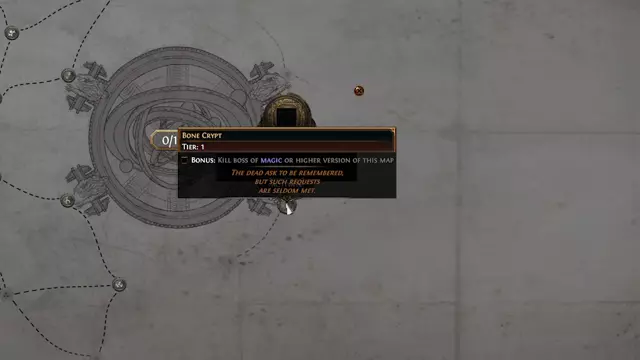
Two people can therefore play the same PoE 1 and organize their endgame differently. One prioritizes certain encounters in maps; another alternates between bosses and independently progressing activities such as Delve. A build needs to survive the dangers you choose, not merely reach a higher Tier.
To explore these activities without turning this introduction into a strategy manual, see the main Path of Exile farming methods, from the Atlas to Delve, Heist, Sanctum, and bosses.
Why Does It Seem Complicated, and How Can You Start Today?
Path of Exile combines two different challenges: complexity, because its systems interact, and the sheer volume of content accumulated over the years. Players who followed each expansion learned these parts gradually; newcomers encounter many of them at once.
You can start without mastering everything. During the campaign, focus first on a well-supported main skill, useful equipment, consistent passives, resistances, and survival. Other systems can be learned as they appear and become relevant to progression.
Update 3.29 added keywords and expandable information to make certain terms easier to look up in the interface. This lowers part of the terminology barrier, but doesn’t replace understanding how your build fits together. When consulting a guide, check that it covers PoE 1 and the current version: familiar names can hide rules that have changed.
Your initial goal doesn’t have to be understanding the entire tree, every crafting system, or the whole economy. Identify your character’s next problem and learn enough to solve it, expanding your options as you gain experience.
What Is Path of Exile Like Right Now?
As of October 19, 2026, Path of Exile 1 is on the 3.29 update series, Curse of the Allflame, released in July 2026.
The Challenge League sends players alongside Captain Valerie in search of submerged treasures. Charts found during progression allow expeditions to the ocean floor, which can be connected into larger Voyages.
But update 3.29 went far beyond the league mechanic.
It also changed or reworked older systems, including Abyss and Legion, integrated Mercenaries of Trarthus into permanent content, added a new Ascendancy option for the Scion, and changed how gem sockets work.
The next expansion already has a date. In the official schedule published October 12, GGG scheduled 3.30 for November 13, 2026 (PST). Its details will be presented at ExileCon 2026 on November 7–8, New Zealand time. Curse of the Allflame is set to end November 9 at 1 p.m. PST.
At this article’s revision date, 3.30 was still in the future. A confirmed date alone does not reveal the league name, mechanics, or rewards; those should not be confused with content already available in 3.29.
PoE 1 and PoE 2: Separate Games, Ongoing Development
Path of Exile 2 is a separate game, not an update that automatically replaced the original. Its Early Access began on December 6, 2024. Both games share Wraeclast and part of the franchise’s identity, but have separate systems, balance, and development paths.
PoE 1 continues to receive development: Mirage, Curse of the Allflame, and the announced 3.30 schedule are concrete examples. That doesn’t make the two games’ builds, gems, or progression interchangeable.
To understand the second game and follow its development without mixing up the systems, read our dedicated article on Path of Exile 2, from its original concept to the game available today.
What Makes Path of Exile Path of Exile?
Path of Exile’s identity comes from how its choices connect: skills, passives, and equipment shape the character, while leagues and endgame systems provide different ways to put that character to the test. Its history explains why so many options exist, but nobody has to use them all.
This article is an overview of PoE 1. Our trading and farming guides explore specific paths in more detail; new specializations can be learned when they become relevant to your character. Understanding this structure is a more useful starting point than trying to memorize an entire decade of systems before exploring Wraeclast.
About the Author