Path of Exile — Curse of the Allflame (2026): personagem enfrenta criaturas de Abyss em uma área subterrânea. Captura oficial de gameplay do press kit da 3.29: Grinding Gear Games.
You defeat Kitava, reach your first maps, and keep dying even though your main skill clears packs quickly. Sometimes a single hit empties your life; at other times it drains steadily. To improve your defenses in Path of Exile, identify the damage you’re taking, the protection that actually works against it, and how you recover afterward. This guide walks through that diagnosis without requiring every defensive layer on the same build.
Reviewed October 26, 2026. Scope: Path of Exile 1, patch series 3.29 — Curse of the Allflame. The official patch index consulted for the original listed 3.29.3b as its latest patch. These are conventional PoE 1 mechanics, not assumptions about PoE 2 or Ruthless. Numerical examples are hypothetical. ZAUS.GG’s own Path of Building screenshots use an incomplete setup to locate fields; they are not gameplay tests or evidence of a tested build.
Nesta matéria
How does survival work in Path of Exile?
An enemy attacks. You may move out of the way, evade the hit, or block it; if damage gets through, applicable mechanics reduce it and your available resources absorb the rest. Recovery then needs to prepare you for the next hit. These functions complement one another; this is not a universal, exhaustive order of damage calculation.
| Function | Mechanics | Practical example |
|---|---|---|
| Avoid | Evasion | An eligible attack misses |
| Block | Attack Block and Spell Block | In the conventional case, a successfully blocked eligible hit deals no damage |
| Mitigate | Resistances, Armour, Suppression | Some damage is reduced |
| Withstand | Life, Energy Shield, Ward | Your resources absorb what passes the applicable defenses |
| Recover | Regeneration, Leech, Recoup, Flasks | Lost resources are restored |
| Prevent effects | Ailment Avoidance and Immunity | A dangerous condition isn’t applied |
| Position | Movement and movement skills | Move away from dangerous areas |
High offensive damage shortens exposure, but resilient bosses, multiple phases, and lingering effects mean DPS alone is not enough protection. Your combination should match the content: evading numerous attacks doesn’t remove the need to survive hits that connect.
Damage types, hits, and damage over time
Before choosing defenses, establish which type of damage you’re receiving. PoE has five main damage types.
| Type | In-game term | Examples of protection |
|---|---|---|
| Physical | Physical | Armour, additional Physical Damage Reduction and other mechanics |
| Fire | Fire | Fire Resistance |
| Cold | Cold | Cold Resistance |
| Lightning | Lightning | Lightning Resistance |
| Chaos | Chaos | Chaos Resistance and special mechanics |
Fire, cold and lightning are elemental damage; chaos is not. Physical damage has no ordinary resistance equivalent to elemental resistance: Armour and additional Physical Damage Reduction are distinct mechanics.
An enemy skill can combine several damage types, convert part of its physical damage to elemental damage, or use other mechanisms. The visual appearance of an attack therefore does not necessarily reveal every risk.
A hit is a discrete damage event, such as a weapon strike or spell explosion. Damage over Time (DoT) deals damage over a period, including Ignite, Poison, Bleeding, harmful ground and other debuffs. Damage type and damage delivery are two separate questions.
Ordinarily, Armour mitigates the physical part of hits, Evasion avoids eligible attacks, and Block blocks eligible hits. None is a general-purpose defense against an already-applied DoT. Resistances can reduce hits and DoT of their respective types, according to each effect’s rules.
Consider a physical attack that applies Bleeding. Armour may mitigate the initial hit, but not the ensuing Bleeding directly. For that second threat you need applicable physical DoT reduction, Bleeding prevention or removal, and recovery. One animation can require more than one defensive response.
Resistances: effective value, maximum, overcap, and chaos
Fire, Cold and Lightning Resistance reduce their corresponding elemental damage. Their ordinary maximum is 75%, subject to modifiers. If a raw hit deals 1,000 fire damage, and resistance is the only defense:
| Effective Fire Resistance | Damage taken |
|---|---|
| 0% | 1,000 |
| 25% | 750 |
| 50% | 500 |
| 75% | 250 |
The simplified calculation is damage × (1 − resistance). Going from 50% to 75% cuts the damage left over from 500 to 250, a 50% reduction of the previous remainder. For most conventional builds, capping all three elemental resistances is a priority during progression; special setups require their own assessment.
Effective, maximum, and uncapped resistance
Effective resistance is used after the cap; maximum is the cap; uncapped is the amount before applying it. At 105% uncapped resistance and a 75% maximum, ordinary effective resistance remains 75%. The extra 30 percentage points do not reduce damage further by themselves, but can help against resistance reductions from curses or Exposure.
Penetration works differently. Overcapping your uncapped resistance does not automatically counter penetration. Evaluate the resistance actually used in the hit calculation. A modifier that lowers maximum resistance also needs a distinct response.
Raising maximum resistance isn’t the same as stacking uncapped excess. With enough resistance, increasing your maximum from 75% to 80% reduces a 1,000-damage hit from 250 to 200—20% less of the damage that remained. Passives, gear and skills can increase the maximum, subject to the conventional hard cap of 90%. Prioritize the investment only when it solves a more important problem than its alternatives.
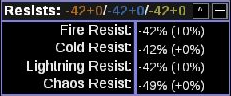
In PoB → Calcs → Resists, the partial example shows 42% fire, cold and lightning resistance and −49% chaos resistance. These are calculated values for an illustration, not targets. Having some defensive equipment doesn’t necessarily cap your resistances. Review the maximum and sources in the calculation details after replacing gear.
What about chaos resistance? It has its own value and a default maximum of 75%. Modifiers that grant only elemental resistances do not raise Chaos Resistance. Chaos threats include hits, Poison, ground effects, and other sources.
Must chaos be capped at 75% before your first map? Not necessarily. Improving it matters as you advance, but the urgency depends on the build and the threats you face. Fixing the three elemental resistances is often more immediately important; that is not a reason to ignore chaos indefinitely.
Kitava: check the penalty and fix your gear
Defeating Kitava in Act 5 applies −30 percentage points to resistances. Act 10 applies another −30, for a total of −60, including chaos. Our Acts 1–10 campaign guide covers both fights.
With 75% cold resistance before the cap, no overcap, and unchanged gear and passives:
| Stage | Effective Cold Resistance |
|---|---|
| Before Act 5’s penalty | 75% |
| After Act 5 | 45% |
| After Act 10 | 15% |
Existing overcap would change the effective outcome. The penalty reduces resistance values, not their normal 75% maximum. Without other effects, reaching 75% after −60 requires 135 percentage points from positive sources.
Gear, passives and crafting can offset the loss. Rings, belts and boots are possible fixes; rebuilding the entire character isn’t always necessary. In 3.29, the Crafting Bench is present in towns from Act 2, according to the official 3.29 notes. Not every recipe is automatically unlocked: check the recipe, cost, and available compatible modifier space first.
For instance, a character showing 75% fire, 38% cold, and 55% lightning is particularly exposed to cold. Compare rings, belt, boots, and other slots before chasing an offensive upgrade.
- Open the Defence panel and note effective and maximum elemental resistances.
- Identify the biggest deficit and equipment that can fix it without losing attributes, links, or essential interactions.
- Check bench recipes, costs and available crafting space; use PoB to assess a potential replacement.
- Apply a viable fix, reopen the panel, and ensure you haven’t created a new deficit.
The post-campaign starter guide provides context for this check. An isolated resistance deficiency often needs a targeted fix, but the replacement must still meet your other requirements.
Life and Energy Shield: different resources, different rules
After mitigation, your remaining resources must withstand the damage. Maximum Life, gained from gear, attributes and passives, is central to many builds. High life without mitigation can disappear in one blow; strong mitigation without recovery can fail under repeated attacks. There is no universal life threshold for every first map or boss: build structure and content matter.
Energy Shield and its recovery
Energy Shield (ES) normally takes damage before life. Equipment, passives and Intelligence can increase it. Since 3.28, Intelligence grants 1% increased Maximum Energy Shield per 10 Intelligence, rather than the older value per five. Having 2,000 Life and 1,500 ES means two resources operating under different rules, not simply 3,500 ordinary life. Against damage that doesn’t bypass ES, the shield is consumed first.
Chaos Damage normally bypasses Energy Shield and hits life directly. A character with considerable ES but very little life can die to chaos while the shield still appears intact. Exceptions exist but must be explicitly present in the build.
Ordinary ES recharge begins roughly two seconds after damage that interrupts it stops; both delay and rate can be modified. It is different from ongoing regeneration or Energy Shield Leech, which requires compatible sources and hits. If incoming damage continually interrupts recharge, simply raising maximum ES may not solve sustain.
Life, ES and specialized resource builds
The league starter guide and passive tree, Masteries and Jewels guide help frame these decisions. A life build relies mainly on life; an ES build on ES and sustain mechanics; a hybrid combines both; Low Life uses interactions that work with reduced unreserved life.
The Chaos Inoculation Keystone sets maximum life to one and grants immunity to chaos damage. It profoundly changes a build and isn’t a casual way to compensate for negative chaos resistance. Blood Magic removes mana and makes skills cost and reserve life instead. Plan the whole resource structure rather than copying isolated Keystones.
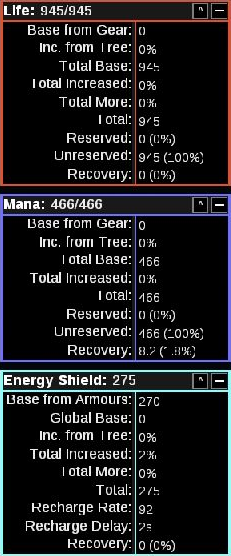
A dThe incomplete PoB example shows 945 Life and 275 ES, with ES Recharge Rate 92 and Recharge Delay 2s. A zero Recovery line does not turn recharge into regeneration; they are different mechanics. These are deliberately incomplete demonstration values, not recommended mapping stats.
Armour and Evasion: mitigate or avoid the hit
Armour normally reduces the physical component of hits, with effectiveness depending on damage size. It is not a fixed reduction applied to any impact. With 5,000 Armour and no other layers:
| Raw physical hit | Armour reduction | Remaining damage |
|---|---|---|
| 1,000 | 50% | 500 |
| 5,000 | ≈16.7% | ≈4,167 |
Hypothetical calculation. Reduction = Armour / (Armour + 5 × physical hit damage). For 1,000: 5,000 / (5,000 + 5 × 1,000) = 0.5. For 5,000: 5,000 / (5,000 + 5 × 5,000) ≈ 0.1667. Multiply raw damage by the fraction not prevented. The PoB Community calculation implements the relationship.
Armour did not change, but the larger hit demanded more protection. That explains why a build can shrug off small attacks and struggle with one huge hit. The character sheet’s estimated physical reduction assumes an incoming hit size; it is not a promise against every enemy.
Ordinary Armour does not reduce fire, cold, lightning, chaos or Bleeding, which is physical DoT. Mitigating the hit that applied it does not mitigate the subsequent bleed. Special interactions can change Armour’s coverage if they are explicitly present in your setup. This limitation shows why complementary defenses matter.
Evasion versus Armour
Evasion can prevent eligible attack hits, based on the defender’s Evasion Rating and the attacker’s Accuracy. If the attack is evaded, its hit damage doesn’t apply normally; when an attack connects, Evasion does not reduce its size.
PoE uses an entropy system that tracks hit and evade checks, producing more regular results than independent coin flips. This does not guarantee safety on the next attack. Ordinary Evasion does not avoid Spell Hits or remove existing DoT. Estimated evasion chance against one enemy cannot describe every opponent.
| Criterion | Armour | Evasion |
|---|---|---|
| Purpose | Mitigate the physical component of hits | Avoid eligible attack hits |
| Physical attacks | Reduce damage when they connect | May avoid the hit |
| Elemental attacks | Usually no mitigation of the elemental part | Can avoid the attack |
| Spell Hits | May mitigate eligible physical components | Doesn’t conventionally avoid them |
| Physical DoT | Doesn’t directly mitigate it | Doesn’t avoid already-applied DoT |
| Limitation | Relatively less effective on large hits | Connecting hits must still be survived |
Neither is universally superior. You can combine them if your equipment, passives and resources permit, while still accounting for spells, recovery and persistent damage.
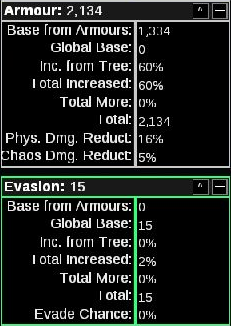
In the example, PoB displays 2,134 Armour and 15 Evasion in separate fields, with 0% estimated evasion chance under its selected conditions. Its 16% estimated physical damage reduction describes that configured hit, not the hypothetical 5,000-Armour calculation or every real hit.
Block and Spell Suppression: different protections
Attack Block is the chance to block attack hits; Spell Block applies to spell hits. Conventionally, a successful block prevents the eligible hit’s damage. Block chance is not a constant percentage removed from every instance of damage.
For example, 65% Attack Block and 10% Spell Block are different chances, not 65% against everything. Each ordinarily caps at 75%, with modifiers potentially raising the maximum to a hard cap of 90%. Possible sources include shields, particular weapons, passives, Ascendancies, gems and specialized items.
Block doesn’t solve already-applied DoT. Interactions involving being hit, block stun or taking part of blocked damage require attention. You may block some hits while relying on Armour, resistances and other layers for the ones that pass.
Glancing Blows is an important exception: it doubles Attack and Spell Block chance, subject to caps, but causes blocked hits to deal 65% of their damage. Block Recovery shortens the block animation’s recovery when it occurs; it doesn’t boost your block chance or damage prevented.
Spell Suppression: chance versus prevention
Spell Suppression, commonly accessible around Dexterity/Evasion paths, gives a chance to prevent part of eligible Spell Hit damage and ailments from those hits. The current default effect is 40%, following the official 3.27 change and reflected by PoB Community constants. Do not use the obsolete 50% default for 3.29.
At 100% effective suppression chance, eligible events are suppressed—but their damage does not vanish. In a simplified example, 1,000 eligible damage after relevant earlier steps has 400 prevented and 600 remaining. That is the calculation for an event actually suppressed, not a guarantee for a build with less than 100% chance.
Chance and amount prevented are different. Chance controls how often suppression happens; effect controls how much it prevents when it does. Other modifiers can change that second value. A 100% chance does not mean 100% damage prevention.
| Mechanic | Conventional result |
|---|---|
| Spell Block | Can prevent the damage of an eligible Spell Hit |
| Spell Suppression | Prevents some eligible damage when triggered |
Its ailment interaction does not grant blanket immunity to Ignite or Poison, and independent DoT—such as some ground effects—does not acquire universal protection from the stat.
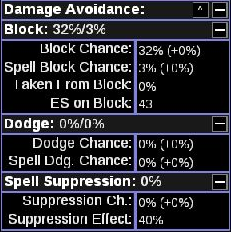
PoB separately displays Block Chance 32%, Spell Block Chance 3%, Suppression Chance 0% and Suppression Effect 40%. Showing the default 40% effect does not grant a chance to suppress. This sample build has no Suppression chance under those conditions.
Endurance Charges, Fortification, and Ward
Additional Physical Damage Reduction differs from Armour’s calculated reduction and can come from passives, gear and buffs. Under the current rules, each active Endurance Charge provides 4% additional physical damage reduction and 4% additional elemental damage reduction to a player. Three charges therefore contribute 12% in the applicable categories, subject to limits and modifiers.
The official 3.25 change replaced the older elemental resistance bonus with elemental damage reduction. Charges therefore don’t directly cap a low cold resistance—they supply a different layer. The additional physical reduction combines with Armour’s applicable physical reduction under the relevant cap; elemental resistances and elemental damage reduction belong to different calculation stages. Don’t simply add all percentages as if they were one stat. Check whether the build can actually generate and maintain its charges.
Fortification grants 1% less Damage taken from Hits per stack, with a default maximum of 20. Maintaining 20 stacks means 20% less from applicable hits; this multiplicatively affects remaining damage rather than all DoT. You need a suitable source such as a support, passive, skill or Ascendancy: merely attacking in melee doesn’t automatically grant Fortification.
Stacks and uptime depend on the setup. In PoB, only enable 20 stacks or maximum charges if your character sustains them in the content being analyzed. A bonus that stays up against packs may disappear against a boss. Fortification’s base duration is six seconds, modifiable; hit-based sources depend on hit strength and target rules, and individual instances expire. One weak hit does not guarantee 20 stacks. See our classes and Ascendancies guide when checking specialization-specific benefits.
Ward: protection that breaks and returns
Ward absorbs damage from an eligible hit before it affects other resources, then normally breaks even when the Ward amount exceeded the hit. Any leftover damage continues through applicable rules. Standard restoration occurs after two seconds, subject to modifiers; GGG changed the interval in 3.25. While broken, it does not offer ordinary protection, and it doesn’t continuously absorb DoT.
Ward is optional. Advanced interactions such as Wardloop rely on specialized exceptions and mechanics; one borrowed item doesn’t reproduce an entire build’s defenses.
Damage Taken As: changing damage type before mitigation
A modifier such as Physical Damage from Hits taken as Fire Damage shifts some incoming physical damage to fire before mitigation. Conceptually, a raw 1,000 physical hit with 20% taken as fire becomes 800 physical + 200 fire.
Fire resistance applies to the elemental portion; physical defenses address the remaining 800 physical. Don’t calculate Armour against all 1,000 first and only then shift the fraction: Armour must use the actual remaining physical portion.
This does not automatically remove 20% of damage. Whether it helps depends on defenses against both the originating and destination types. A modifier limited to from Hits must not be applied to DoT. Defensive damage shifting is not an endlessly chained version of offensive conversion: reapplying type-shift modifiers to already-shifted damage will give the wrong answer. Read the exact wording, source type and limits.
Recovery and flasks: prepare for the next hit
Surviving one blow and restoring resources before the next are different problems. Even large pools can run out under sustained attacks if recovery is insufficient.
| Mechanic | Operation and relevant limit |
|---|---|
| Regeneration | Ongoing recovery dependent on sources and modifiers |
| Leech | Recovery tied to compatible hits/damage, with rates and caps |
| Recharge | Typical ES recovery after its start delay, which can be interrupted |
| Recoup | Returns part of hit damage over time without preventing the original hit |
| Recovery on Hit | Restores resources when eligible hits connect |
| Recovery on Kill | Restores resources on kills, potentially absent against solo bosses |
| Flasks | Recovery or temporary effects limited by duration and charges |
Leech
Dealing damage doesn’t automatically grant Leech; you need a compatible source for the relevant resource and hit type. An attack-only or physical-only source cannot necessarily leech for a spell. Ordinary DoT does not generate Leech by itself. Recovery usually follows instances, rates and caps, not unlimited instant healing; special effects can modify the process.
Recoup
Ordinary Recoup returns the specified percentage over four seconds, unless modified. With a 1,000-damage hit after mitigation and 40% recouped as Life, that means 400 over four seconds, or 100 per second in this isolated example. Additional hits can create additional Recoup instances, while maximum life still caps the resource restored.
Recoup does not mitigate the first hit and cannot save you from a hit that kills you outright. Recovery on Kill may excel in mapping and fail against a lone boss. Ask whether the resource works in the actual fight.
Conventional Leech also has total per-second recovery limits: by default 20% of maximum life for Life Leech and 10% of maximum ES for ES Leech, before modifiers. Rate, duration and per-instance cap are separate concepts. An instant-Leech modifier affects its eligible portion; it doesn’t make all Leech limitless and instant.
Flask bases, modifiers and charges
Life Flasks recover life, Mana Flasks recover mana and Utility Flasks offer temporary effects such as Armour, Evasion or resistance. Read base level, requirements, recovery, duration, charge cost, modifiers and activation conditions. An effect-removal source must actually cover the effect you want removed or prevented.
A flask from Act 1 may provide too little recovery by your first maps. Compare higher bases and how they gain charges. Packs can replenish charges, while isolated bosses may not. There is no universal five-flask setup and no guarantee of permanent uptime.
Auras and Guard Skills: effect, reservation, availability
PoE offers defensive skills with different requirements. Some stay active through resource reservation; others require manual activation or specific triggers.
| Skill | General function |
|---|---|
| Determination | Aura granting Armour and an Armour multiplier |
| Grace | Aura granting Evasion and an Evasion multiplier |
| Discipline | Aura granting ES and recharge speed |
| Purity of Elements | Elemental resistances and immunity to elemental ailments |
| Purity of Fire | Fire resistance and increased maximum at appropriate gem levels |
| Purity of Ice | Cold resistance and increased maximum at appropriate gem levels |
| Purity of Lightning | Lightning resistance and increased maximum at appropriate gem levels |
| Tempest Shield | Spell Block and Shock immunity; requires a shield |
| Steelskin | Temporarily absorbs some hit damage up to a limit; Bleeding immunity during its effect |
| Molten Shell | Armour and temporary hit absorption limited in relation to Armour |
| Immortal Call | Temporary physical/elemental damage reduction; can consume Endurance Charges |
These descriptions follow PoB Community skill data. Gem level, quality, supports and modifiers affect exact values; the table does not suggest running everything together. Guard Skills provide temporary protection with duration, a shared cooldown, and activation conditions. Enabling one in PoB does not prove permanent uptime in combat.
Can you activate all the auras? No. Resource-reserving skills must fit available mana or applicable alternatives. You must also retain resources for your other skills. Our skill gems, supports and links guide explains these setups.
Ailments, Corrupted Blood, Stun, and prevention
Survival is not just about damage totals. Some effects hamper movement, increase incoming damage or apply DoT. Many of these are ailments.
| Effect | Main consequence |
|---|---|
| Ignite | Fire damage over time |
| Chill | Slows action speed |
| Freeze | Prevents actions while it lasts |
| Shock | Increases damage taken according to effect strength |
| Poison | Chaos damage over time |
| Bleeding | Physical damage over time |
| Scorch | Reduces elemental resistances according to effect strength |
| Brittle | Increases base chance to receive critical strikes |
| Sap | Reduces affected target’s damage dealt |
Scorch, Brittle and Sap are alternative elemental ailments. Shock can make later hits more dangerous, while Freeze can prevent you from reacting in hazardous ground. Capped elemental resistance is not the same as ailment immunity. Ignite and Poison may keep draining resources after the first hit, particularly if recovery and type-specific mitigation are lacking.
Bleeding, Corrupted Blood, and Poison are not the same
Bleeding is a physical DoT ailment with specific interactions involving movement. Corrupted Blood is a different debuff that can stack and inflict physical DoT; the fact that both deal ongoing physical damage does not make their rules identical. Poison inflicts chaos DoT and calls for mechanics that address chaos damage and that ailment.
When a modifier grants Bleeding protection, don’t assume it automatically grants immunity to every Corrupted Blood effect. Read the exact removal or prevention wording.
Preventing, reducing, removing, or being unaffected
| Mechanic | Meaning |
|---|---|
| Avoidance | Chance for the covered effect not to apply |
| Immunity | Immunity to the covered effect while the condition holds |
| Reduced Effect | Lowers effect intensity according to its rules |
| Reduced Duration | Shortens duration, not necessarily intensity |
| Removal | Removes an existing effect without necessarily preventing a new application |
| Unaffected | Can allow the effect to exist without suffering the covered consequences |
Removing Freeze once does not prevent the next hit from freezing you again. Not every debuff or harmful ground is an ailment, so ailment protection is not universal DoT protection.
In 3.29, sources of Avoid all Damage from Hits chance began stacking with sources that avoid damage from particular hit types, and GGG fixed sources that incorrectly exceeded the 75% cap. This concerns hit damage avoidance, not a shared chance for Evasion, Block and Ailment Avoidance or a blanket 75% ailment-avoidance cap. Check the official notes.
Stun interrupts actions. Stun avoidance attempts to avoid it; Stun recovery reduces interruption time; immunity can require a condition. These don’t conventionally reduce the hit’s damage. Movement skills help escape hazards but don’t replace resources, resistances or mitigation. If you cannot react, investigate interruptions alongside damage defenses.
The Defence panel: where to start investigating
On PC, C opens the character sheet by default unless keys were customized. Open Defence and review Life/ES, Armour, Evasion Rating, fire/cold/lightning/chaos resistances, Attack and Spell Block, and Spell Suppression chance. Check current versus maximum life at the resource globe when needed.
Start with obvious gaps: negative resistance, elemental resistance below its cap, too little main resource, or an expected defensive mechanic missing. Recheck after gear swaps and expiring buffs.
The sheet does not model every combat situation. Its physical damage reduction is an estimate, and avoidance related to enemy Accuracy varies by attacker. Use the panel to form a hypothesis; investigate the actual damage type and attack intensity afterward.
The in-game character sheet and PoB are different interfaces. Screenshots below show PoB labels, not screenshots of the game’s Defence tab. The game displays what is active on your character; the planner exposes sources and hypothetical conditions.
Path of Building: conditions, Maximum Hit, and EHP
PoB Community 2.67.2, the most recent release identified during the original article’s review, lets you compare defenses with explicit settings on the 3.29 tree. Our complete Path of Building guide covers installation and imports; here we’re diagnosing survival.
| Indicator | What to check |
|---|---|
| Life / Energy Shield | Resource pools and their use |
| Armour | Physical mitigation relative to hit size |
| Evasion | Chance to avoid attacks under the selected assumptions |
| Resistances | Protection for each damage type |
| Block | Separate attack/spell chances |
| Spell Suppression | Chance and prevention effect |
| Maximum Hit Taken | Estimated largest sustainable hit by type |
| Effective Hit Pool | Estimated survival under configured conditions |
| Recovery | Sources, rates, and availability |
- Import or open the build and save a copy. Check equipment, passives, gems, levels and links.
- Under Configuration, set the resistance penalty, enemy and content. Enable only reproducible flask effects, charges, Fortification and buffs. Also compare conditions with those bonuses absent.
- Under Calcs, check resistance caps, Armour/Evasion, both Block chances, Suppression chance/effect and Life/ES.
- Inspect Maximum Hit Taken by damage type, EHP and recovery. Expand individual calculations to identify sources.
- Change one thing at a time, holding conditions constant and checking lost attribute requirements against the saved build.
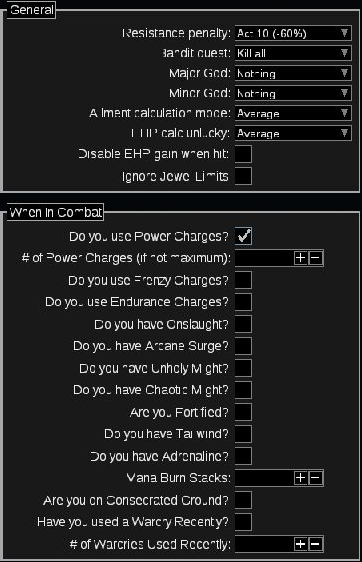
In this PoB screenshot, the Act 10 penalty (−60%) is selected; Endurance Charges and Fortified are unchecked, while Power Charges are enabled. The configured foe is level 84, Guardian/Pinnacle, with no specific skill selected. This incomplete configuration is not claimed to survive that content; it illustrates settings and vulnerabilities.
Maximum Hit Taken is not the same as EHP
Maximum Hit Taken estimates how large a hit the character can take, separated by damage type and assumptions. EHP estimates broader survival and can account for Evasion, Block and recovery on being hit. A build may evade many attacks and show high EHP yet still die to a very large hit that actually lands. Read both, along with enemy settings, temporary buffs and recovery; neither is an immortality score.

Nesta configuração parcial, o PoB exibe EHP 1.109, máximo físico 1.554, elemental 841 e caos 674. A captura preserva as colunas separadas. Esses números pertencem ao modelo selecionado, com reservas e eThis partial PoB build displays EHP 1,109; physical max hit 1,554; elemental max hit 841; chaos max hit 674. The screenshot keeps these figures in separate columns. They are results for its incomplete model, not combat tests, minimum recommended values, or predictions for every encounter.
Why do I die with 75% elemental resistances?
Capping the three elemental resistances solves just one part of survival. Without observing the attack, status effects and conditions, the cause of a death cannot be identified with certainty.
| Symptom | Possible cause | First check |
|---|---|---|
| One hit empties your resource pool | Hit exceeds survivable size; insufficient mitigation or resources | Damage type, Life/ES and matching Maximum Hit |
| Repeated attacks overwhelm the build | Recovery is slow or buffs have gaps | Regeneration, Leech, Recoup and actual uptime |
| Spell Hits feel especially dangerous | Poor defense against spells or their damage type | Resistances, Spell Block and Suppression chance/effect |
| Life keeps dropping after a hit | Ignite, Poison, Bleeding or another DoT | Debuff, damage type, removal and recovery |
| Stacking ongoing physical damage | Bleeding, Corrupted Blood or another source | Exact effect and targeted protection, not Armour alone |
| You cannot act or react in time | Freeze, Chill, Stun or positioning | Effect icons, prevention/removal and interruptions |
| Damage rises during the fight | Shock, curse, Exposure or lost condition | Applied effect, effective resistance and maximum |
| One area is much harder than another | Dangerous or incompatible map modifiers | Map item and enemy mechanics |
| Packs are manageable, bosses aren’t | Recovery on Kill, flasks or charges stop working | Sustain without kills and buff durations |
| PoB looks durable but gameplay doesn’t | Wrong settings or outdated import | Configuration, equipped gear and temporary effects |
Don’t buy a popular defense without identifying the threat. More conventional Armour doesn’t directly stop ongoing chaos damage from Poison; removing Freeze may be helpful without solving a physical one-shot.
Maps and bosses: when the conditions change
Map tier alone does not define difficulty. Read modifiers to resistance and maximum resistance, monster damage/criticals, ailments, regeneration and Leech. If you rely on regeneration, the wrong map modifier may remove your main defense even against otherwise familiar enemies.
In 3.29, older percentage-based map reflection modifiers were replaced with Physical or Elemental Thorns granted to rare monsters. A corresponding damage hit activates a five-second window, with another activation at most once every ten seconds. While active, it reflects a fixed amount per eligible hit, and you can receive it no more than once every 0.1 seconds. In red maps, the notes specify 800 physical or 1,500 elemental; the elemental type follows the triggering hit’s largest elemental component.
Thorns damage can be mitigated by Evasion, Block, Armour and resistances according to their normal rules and the damage type. This rework does not mean every other source of reflect in PoE became Thorns. Read the content’s wording. See our maps, modifiers and Scarabs guide for further detail.
For bosses, compare sustain without frequent kills: on-kill recovery, flask refills and charge generation may be absent. Consider large hits, lingering ground, ailments, immunity phases, movement and periods without a Guard Skill or buffs. No universal minimum stat replaces knowing the fight; Hardcore makes the consequences of a defensive mistake more serious.
Two defensive setups: compare without declaring a winner
Hypothetical Build A combines Life, resistances, Armour, Endurance Charges, recovery and ailment protection. Build B combines Life, resistances, Evasion, Spell Suppression, mobility and recovery. One focuses more on mitigating certain hits; the other avoids eligible attacks and limits Spell Hit damage. Their effectiveness depends on actual values and conditions.
| Scenario | Build A | Build B |
|---|---|---|
| Smaller physical attacks | Armour may mitigate them well | Evasion may avoid many hits |
| Very large physical hits | Must account for Armour’s actual effectiveness | Must survive attacks that connect |
| Spell Hits | Depends on other layers | Suppression may help |
| Damage over Time | Needs distinct protection and recovery | Also needs specific responses |
| Longer fights | Relies on sustained recovery | Relies on recovery and available mitigation |
| Mobility | Varies by skills and gear | May be an important feature |
Both must withstand hits that get through and deal with DoT and ailments. Armour and Evasion can be combined when the cost and build make sense. Don’t copy an isolated layer without understanding how it fits your skill, resources, and sustain.
Post-Kitava example and improvement checklist
Imagine a hypothetical character just finishing Act 10 with 75% Fire, 42% Cold, 63% Lightning, −25% Chaos, modest Life and weak recovery. These are teaching values, not ZAUS.GG gameplay.
- Locate the deficit. Cold is the most visible elemental gap, while lightning is also below 75%. Record chaos and relevant threats without inventing a universal requirement for the first map.
- Compare gear. Consider rings, belt and boots with helpful resistance and crafting space; preserve attributes, gems and vital interactions.
- Fix and recheck. Address the weakness without creating another one. A costly unique isn’t automatically the first answer.
- Review resources and mitigation. Check Life/ES, physical hits, attacks and spells; seek gear or passives that address your actual weakness.
- Test sustain. Review regeneration and other recovery, flasks, auras, free resources and temporary effect durations.
- Compare in PoB and make one change. Maintain the original copy and matching settings, then check your resistance and requirements in game before progressing.
An item that grants 3% more DPS may be less useful right now than one fixing an extremely low resistance. The best upgrade depends on the diagnosed problem and its real cost; see how to improve your build without wasting currency. In SSF, use available drops and crafts rather than assuming a trade purchase.
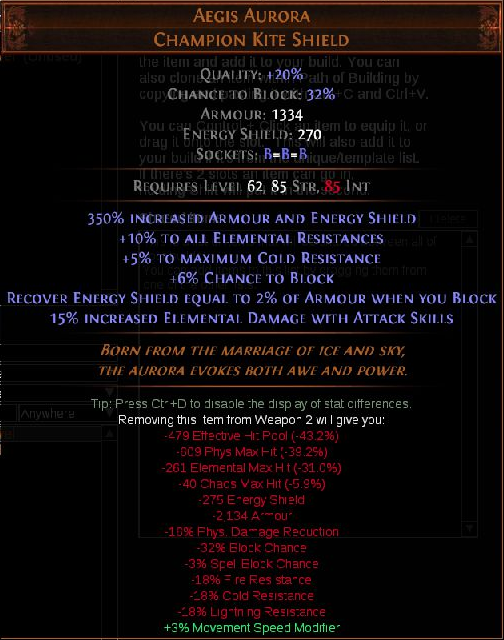
The real Aegis Aurora tooltip illustrates what to examine in an item comparison: Armour, ES, Block, resistances and ES restored on block equal to 2% of Armour. PoB calculates losses when removing it from this setup. This shield is not a universal post-Kitava recommendation. With no eligible blocks, that recovery source does not trigger; a maximum-resistance bonus also requires enough resistance to use it.
Checklist before a difficult area
- Resistances: check fire, cold, lightning, chaos, maximums, and Kitava penalties.
- Resources: Life/ES/Ward suited to the damage type and exceptions in your build.
- Hits: relevant responses to physical hits, attacks and spells, using Armour/Evasion and Block/Suppression where appropriate.
- Sustain: recovery and flasks that still work without enemies to kill.
- Effects: relevant protection against ailments, Bleeding, Corrupted Blood and Stun.
- Conditions: realistic aura reservations, charges, and Guard Skill availability.
- Area: check modifiers, bosses and movement before launching content.
- Plan: identify your biggest weakness and compare one upgrade under equivalent PoB conditions.
You don’t need every defensive layer. The point is to make one improvement that answers the threat, retains sufficient recovery, and functions in the encounter you intend to face.
Image and software credits: Cover from the official Curse of the Allflame press kit (3.29), © Grinding Gear Games. ZAUS.GG’s own screenshots: PoB Community 2.67.2, 3.29 tree, incomplete level-70 Juggernaut demonstration. The software is under the MIT license; PoE assets belong to GGG. Click the images to view the original resolution. These do not represent gameplay footage or a recommended build.
Technical references: official 3.29, 3.28, 3.27, 3.25 patch notes; PoB defensive calculations and community Fortification documentation. The mathematical examples assume the stated conditions and don’t replace observing combat.
About the Author