Bairros e redes de circulação conectam diferentes partes da cidade em Cities: Skylines II. Imagem oficial: Paradox Interactive. Desenvolvimento original: Colossal Order; desenvolvimento atual: Iceflake Studios.
Imagine building a new residential neighborhood in your city.
You choose a spacious area, lay out streets, assign plots, and watch the first houses appear. The population grows, businesses flourish, and tax revenue improves. Everything seems to work—until residents start struggling to get to work.
Traffic builds up, public services become overloaded, and an area that seemed ideal suddenly needs new solutions. Perhaps you need to widen an avenue, introduce a transit route, or distribute jobs more evenly. A simple building decision has affected several other systems.
That relationship between planning, growth, and consequences is one of the defining features of city builders, or city-building games. In this genre, players build, develop, and manage a city, community, or settlement through connected systems such as infrastructure, population, resources, services, and the economy.
SimCity and Cities: Skylines helped shape modern urban simulation; Anno emphasizes production and logistics; Banished and Frostpunk link community development to survival, each with its own priorities. There is no single formula. Some games let you build modern metropolises, while others put you in charge of medieval villages, space colonies, or cities threatened by extreme conditions.
What unites them is not merely the ability to place buildings on a map, but the need to make those structures function together as a community. This feature explores the origins, main mechanics, and evolution of city-building games. Updated October 21, 2026.
Nesta matéria
What defines a city builder?
The English expression city builder literally means a game about building cities. In video games, it describes experiences in which creating and managing a settlement are central activities. Players generally organize buildings, use resources, and respond to the needs of a population or community.
Depending on the game, that may involve roads, zoning, electricity, water, and public transit. Elsewhere, the challenge may be to secure food, firewood, homes, and enough workers for the winter. The setting and scale change, but buildings do not work entirely in isolation. Homes depend on services, industry needs workers and raw materials, commerce may require distribution routes, and population growth creates demands the city is not yet prepared to meet.
Is building structures enough to make a game a city builder?
No. In Minecraft, players can create entire cities, but urban construction need not involve the traditional management of population, services, and finances. In Age of Empires, houses and bases support real-time strategy: producing units, managing an economy, and competing against opponents. In Cities: Skylines, urban development itself is the central experience.
The presence of buildings does not define the genre. What matters is the role that community construction and management play in the gameplay.
Does every city builder have taxes and traffic?
Not at all. Taxes and road networks matter in modern urban simulations but are not universal requirements. Banished organizes its economy around workers and resources. Anno focuses on production, trade, and population needs. Frostpunk combines community management with survival. City builder is a broad category covering very different environments and societies.
How did city-building games begin?
The genre’s history predates SimCity. Early computers supported games and simulations involving economic decisions, territorial administration, and population growth. Their interfaces differed radically from today’s detailed neighborhoods: players commonly worked with figures, text commands, and resource information.
Santa Paravia en Fiumaccio and its predecessors
A notable early example is Santa Paravia en Fiumaccio, developed by George Blank and published as a TRS-80 program in the December 1978 issue of SoftSide, preserved in the digitized original magazine. It put players in charge of a fictional city-state, using information and decisions to manage its population, resources, and economy rather than the visual city planning popularized later.
Earlier experiments such as The Sumerian Game, developed in the early 1960s to teach students economic principles, already connected harvests, grain reserves, population, and unforeseen events. The Strong National Museum of Play’s archive documents the educational project. It was a precursor to digital management, not a modern visually constructed city.
Utopia and the strategy of territorial management
Another important precursor was Utopia, developed by Don Daglow for the Intellivision in the early 1980s. Daglow’s own retrospective associates it with 1981, while a Smithsonian oral history describes its presentation at the January 1982 CES. These references concern different development and commercial milestones and should not be flattened into one date.
The game combined territorial administration, economic activities, and strategy. Players developed their island while confronting needs and threats. Such games anticipated important concepts without necessarily combining all the systems later associated with city builders. The recognizable modern commercial formula would be consolidated by SimCity.
SimCity and the establishment of city builders
In 1989, Maxis released Will Wright’s SimCity. The studio’s official timeline distinguishes the original from SimCity 2000 (1993), SimCity 3000 (1999), and SimCity 4 (2003).
Players took responsibility for developing a city. Instead of directly controlling every resident or following a linear sequence of levels, they organized urban space and observed the consequences. Roads, residential, commercial, and industrial zones, public services, electricity, and other facilities interacted. An industrial district might create jobs but also pollution; a larger population might increase revenue while putting pressure on infrastructure. These interconnected systems became a hallmark of the genre.
What made SimCity so different?
One of its most important qualities was freedom to experiment. Winning did not necessarily mean defeating an opponent or finishing a traditional campaign. You could build, see what happened, and change the city. A poor decision might produce a problem to solve rather than automatically ending the game. Urban growth generated its own challenges.
That does not mean its systems perfectly simulated actual cities. They were simplifications designed to make a playable game.
How did SimCity evolve?
SimCity 2000 (1993) introduced an isometric presentation and expanded construction and management. SimCity 3000 (1999) continued that evolution. SimCity 4 (2003) added tools for regional development, allowing connected cities and more ambitious infrastructure and transport planning.
SimCity Societies, released November 13, 2007 and developed by Tilted Mill Entertainment, explored a different approach emphasizing the social qualities of cities rather than reproducing every system from earlier games.
SimCity (2013) introduced new simulation and regional interactions, but its launch was criticized for connectivity problems and its original always-online requirement. In March 2014, Update 10 added a single-player offline mode, after the downloads and installation needed to access it. EA’s support documentation distinguishes online and single-player modes. Offline play was added later; it was not available at the 2013 launch.
Across its iterations, SimCity explored different scales, infrastructure systems, and degrees of freedom.
Caesar, Pharaoh, and the building of historical cities
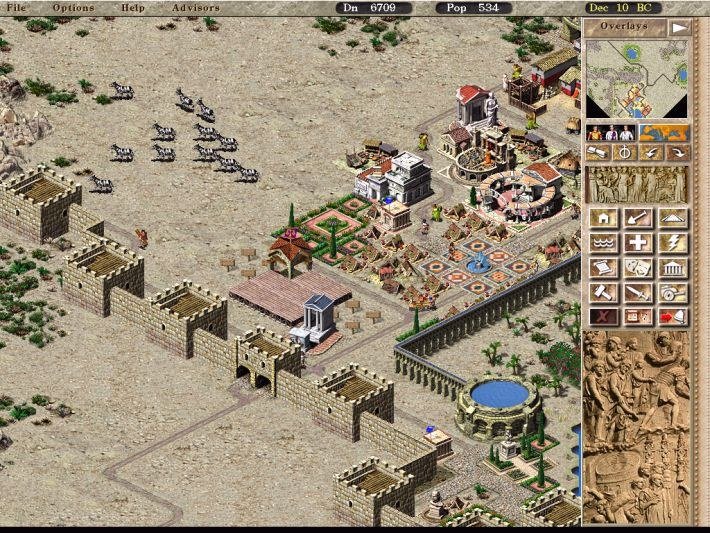
While SimCity explored modern urban planning, other games focused on historical settlements. Impressions Games began its Caesar series in 1992, followed by Caesar II (1995) and Caesar III (1998). These games combined housing, resources, services, workers, and population needs, but they were not simply SimCity with ancient buildings. Service access and how workers moved through streets followed their own rules.
How did services and workers operate?
In Caesar III and related games, agents traveled along roads to provide services or carry out tasks. This tradition is often called walker-based city building. A house might need certain services to advance, yet building a service facility did not automatically cover every home. Road layout and the paths traveled by agents influenced who received help.
Planning therefore involved more than deciding where a building should go: players had to work out how its services would reach the population. Rules varied between titles and editions.
Pharaoh and production chains
Impressions Games released Pharaoh in 1999, drawing on ancient Egypt. Housing, agriculture, commerce, public services, and monuments were tied into city development. The expansion Cleopatra: Queen of the Nile followed. Other games in this tradition include Zeus: Master of Olympus (2000) and Emperor: Rise of the Middle Kingdom (2002), each inspired by different historical or mythological settings and offering its own campaigns.
In Pharaoh, a monument requires more than available space. You need workers, materials, production, and distribution while the rest of the city still needs food, housing, and services. The game’s economy must support the project.
A historical setting should not be confused with historical accuracy. Caesar and Pharaoh adapt recognizable civilizations into entertainment systems; they do not fully reconstruct how those societies worked.
Anno: when cities depend on production, trade, and logistics

The Anno series developed another major city-building tradition. Its first game, Anno 1602 (1998), combined settlement construction with resources, trade, exploration, and economic development. Growing populations demanded new goods, buildings, manufacturing systems, and distribution routes. Growth depended not just on housing space but on the ability to supply the people living there.
How do production chains work?
Imagine residents need a particular product. You may have to obtain a raw material, turn it into another item, and deliver the finished goods. Every stage uses buildings, workers, and infrastructure. A shortage at one point disrupts the entire chain. A town full of homes can struggle if those needs go unmet.
As population groups advance, demand for more complex products appears. Players must determine where to manufacture, how to transport goods, and when expansion makes sense. These interdependencies are fundamental to Anno.
From Anno 1404 to Anno 1800
Anno 1404 (2009) became a notable example of construction, production, and commerce. Anno 2070 (2011) moved to a futuristic setting with distinct environmental and economic conditions. Anno 1800 (2019) used the industrial era, introducing production chains and industrial facilities as cities grew and expanded into other regions.
These games show how one design tradition can adapt to different periods and environments.
Anno 117: Pax Romana and the cities of the Roman Empire
Released November 13, 2025, Anno 117: Pax Romana puts players in the role of governors of Roman provinces. Developed by Ubisoft Mainz and published by Ubisoft, it combines urban construction, resources, population needs, economics, politics, and strategic decisions.
The game includes Latium, linked to Roman traditions, and Albion, featuring Celtic communities, wetlands, and choices about Romanization. Retaining local customs or adopting Roman practices changes development options and population needs, not merely the visuals. The development team’s explanation discusses Celtic deities and marsh drainage as a way to make space for growth.
On April 30, 2026, Prophecies of Ash added a large volcanic island, obsidian, and the deity Vulcan to colonization in Latium, according to Ubisoft’s official Year 1 plan. This was a Latium expansion, not the introduction of the later Egyptian province.
On August 20, 2026, the paid expansion The Hippodrome added a monumental venue and chariot races. The free Update 2.0 launched alongside it with separate improvements: its content did not all require buying the DLC.
As of the October 21, 2026 editorial update, Dawn of the Delta, adding a province inspired by Egypt, was still forthcoming. The official roadmap anticipated support for it in the November 5 Update 3.0. That future release must not be confused with Prophecies of Ash‘s already-available expansion in Latium.
Anno illustrates how city building can combine urban growth, logistics, history, and real-time strategy.
Cities: Skylines and modern urban planning
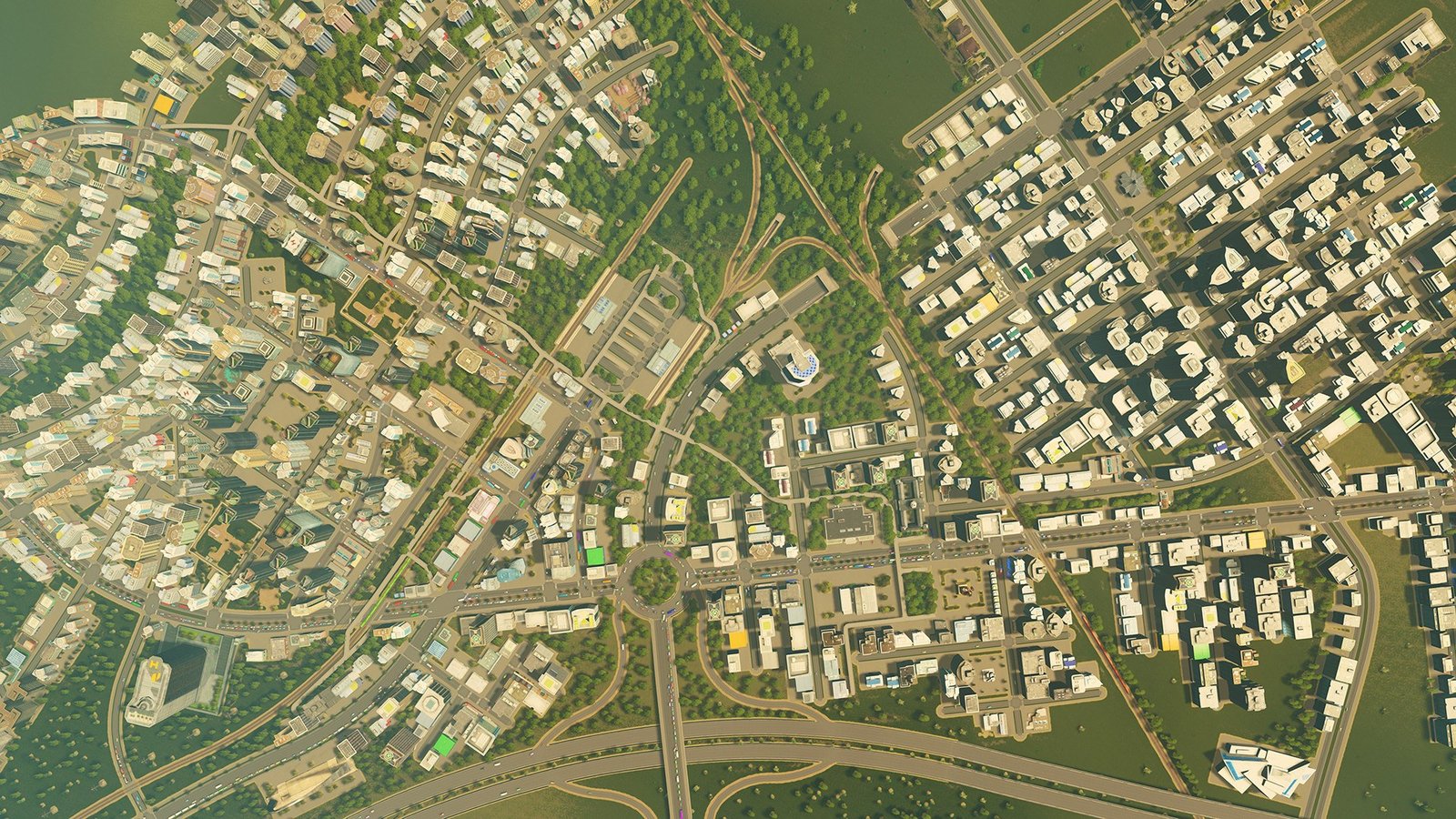
On March 10, 2015, Colossal Order released Cities: Skylines, published by Paradox Interactive. It revisited modern city building with tools for neighborhoods, infrastructure, and transportation networks.
Players zone residential, commercial, and industrial areas, build roads, provide power and water, and organize public services. One especially recognizable part of the experience is how urban growth interacts with mobility.
Why does traffic matter so much?
Imagine a large residential district on one side of the map and most industrial jobs on the other. If many residents take the same roads, those connections become congested. That can hinder both commuters and deliveries. Building extra roads may not help if the city still funnels trips through a few locations.
Alternative connections, mass transit, and spreading activities more evenly can improve matters, depending on the simulation’s rules. The central idea is that transport links the city’s different systems. People need access to jobs and services, while goods move between neighborhoods.
Zoning and growth
Cities: Skylines uses zoning to designate land for different activities. Housing can appear in residential zones when conditions support it; commercial and industrial development answer other demands. Growth depends on access, demand, and infrastructure as represented by the game.
This differs from Anno and Banished, which have their own building and progression structures. Zoning is common in some city builders, but it is not required across the genre.
The importance of the community
Cities: Skylines also developed an active community of mods and custom content. Players created maps, buildings, tools, and other adjustments, widening the possibilities for customization. Community-made modifications are not necessarily official features, however, and compatibility may change with versions and updates.
Cities: Skylines II and the challenges of developing a sequel
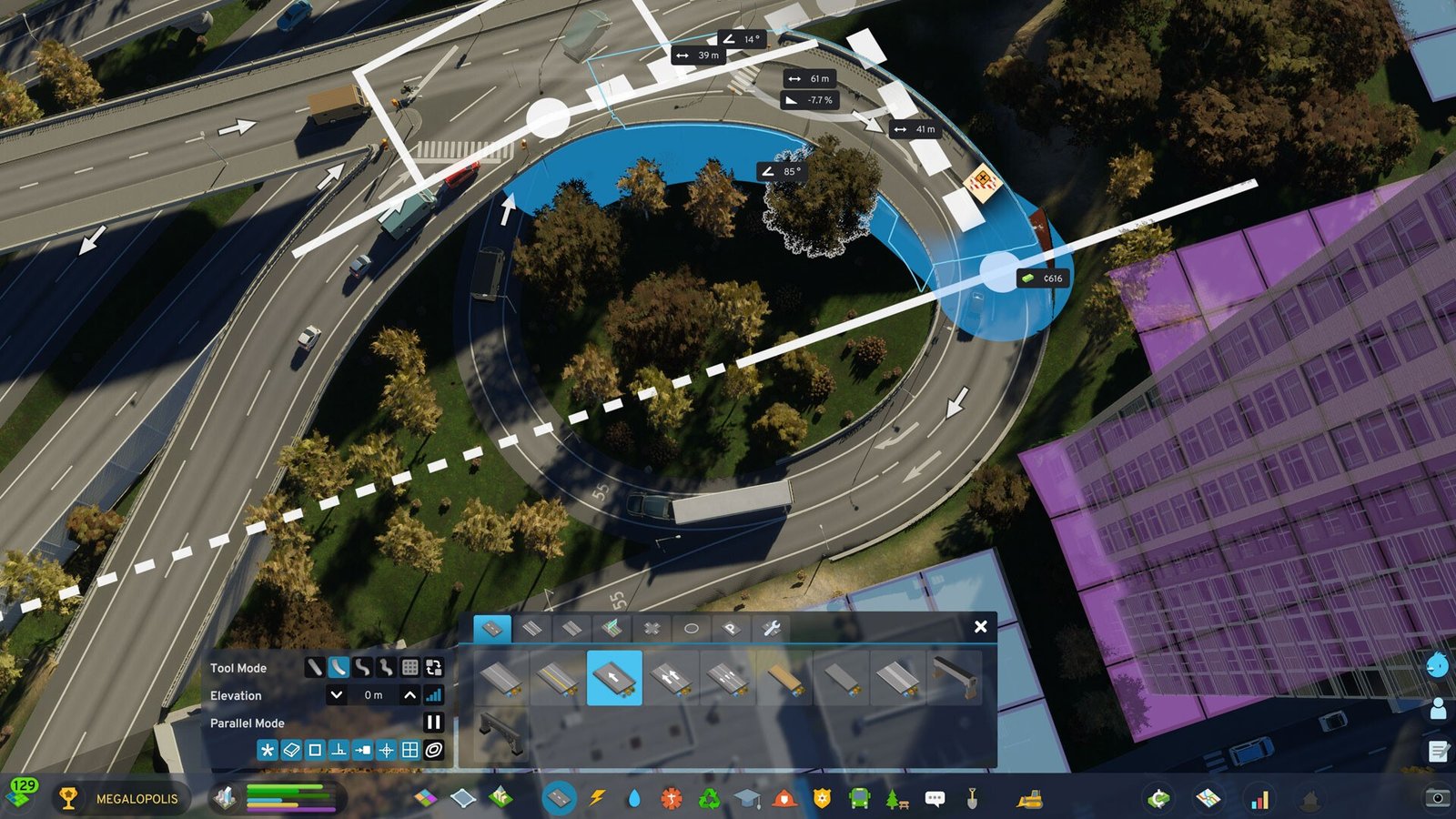
Cities: Skylines II launched on PC on October 24, 2023. Originally developed by Colossal Order and published by Paradox Interactive, it aimed to expand road tools, infrastructure, the economy, city services, and the simulation of residents. It also drew criticism for performance and technical problems at launch.
Those issues are part of its history, but the game’s 2023 condition should not be treated as if nothing changed afterward.
What changed in development?
On November 17, 2025, Paradox announced a change of developer. Its partnership with Colossal Order would end, and Iceflake Studios would take over Cities: Skylines II in 2026, including updates, add-ons, and creation tools.
During 2026, Iceflake delivered simulation and interface changes. The free First Frost update on February 18 revised population behavior, the main interface, and visual presentation. Autumn Breeze, on September 15, continued improvements to gameplay, presentation, and usability. These were released changes, not proof that every problem was fixed.
Also on September 15, the paid Expansion Pass 2 offered immediate access to the Downtown Market Set, including commercial elements and another map. Buying the pass did not instantly unlock its future expansions. As of October 21, the official schedule still listed Park Adventures for Q4 2026 and City Vacations for Q2 2027. These are paid releases, separate from free updates, and PC dates should not be automatically applied to consoles.
The sequel highlights the technical challenges of scaling a city builder with large environments and many interdependent systems.
How does a city develop in a city-building game?
Although each game uses its own rules, many city builders connect planning, construction, and management. A simplified cycle is:
Plan → Build infrastructure → Develop housing and population → Meet needs → Sustain the economy → Expand → Solve new problems.
These activities do not necessarily follow a fixed order. While one neighborhood is being built, others keep operating and generate new decisions. The challenge is understanding how their systems depend on one another.
Planning and location
Available space shapes growth. A site near raw materials may be ideal for production, while homes far from services may require new connections. Rivers, hills, and other natural barriers change how streets and buildings fit together.
Imagine an attractive residential area across a river from the rest of the city. It offers plenty of room, but may require bridges or other costly links. Geography creates both opportunities and constraints.
Population and needs
Residents are important in many city builders, but games represent them in different ways. In Cities: Skylines, individuals are simulated through housing, work, services, and travel. In Anno, population groups gain new requirements as settlements grow. Banished tracks a community dependent on available resources. Frostpunk represents collective needs and societal decisions.
One game may model individual citizens while another relies on more abstract groups or indicators. These are not interchangeable systems.
Infrastructure and services
Modern cities may need electricity, water, sewage, waste collection, transportation, healthcare, education, and security. Historical settlements can have very different needs, such as food distribution, markets, and special service buildings.
More homes can bring more income while also increasing the demand for infrastructure. Sufficient capacity depends on each game’s rules and the actual services available—not simply on the number of buildings placed.
Economy, production, and maintenance
Buildings cost resources and often require upkeep. Some games organize finances through taxation and public budgets; others use workers, production, and trade. A building may provide benefits but incur recurring expenses.
You might have to choose between a new service that solves an immediate shortage and more production that helps sustain future growth. That relationship between investments and consequences makes economics fundamental to many city builders. There is, however, no single mandatory economic model.
Problems that emerge from the city itself
Some of the most interesting challenges emerge naturally from the interaction of systems, without being scripted missions. An industrial area provides jobs but can overload freight roads. Insufficient farming causes food shortages; successful industry can shift the bottleneck to shipping.
Players have to identify which system is currently limiting the city, rather than mindlessly repeating the last solution. Observation and adaptation are central to the gameplay.
Banished: building a community also means surviving
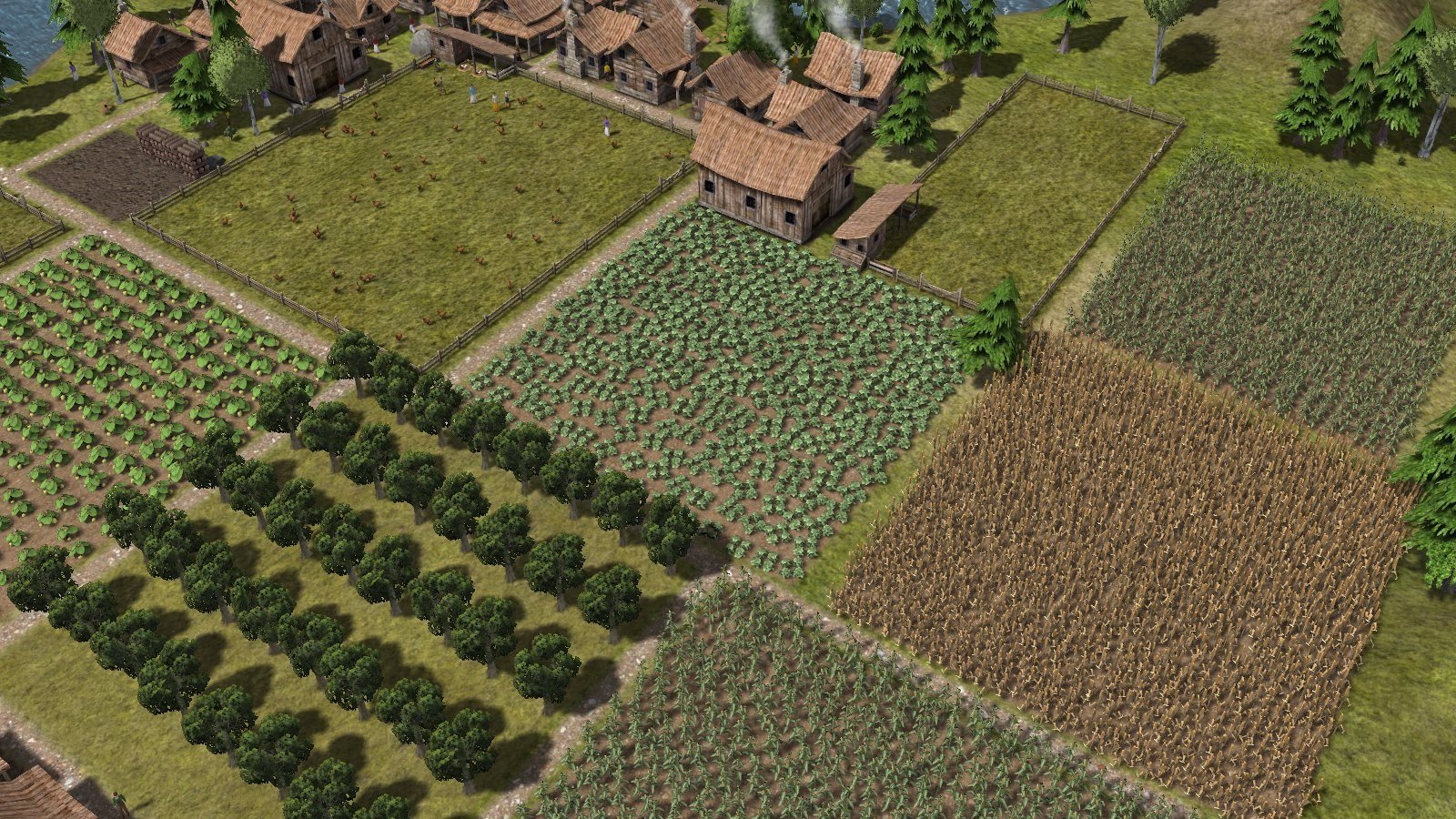
Released in 2014 by Shining Rock Software, Banished is a city builder focused on a small community’s survival. Players must create a settlement, produce food, gather materials, build homes, and distribute workers. Climate and the seasons influence planning.
Why can growth be dangerous?
Imagine a village producing enough food for its current population. You build several houses, more residents move in or families grow, and eventually food production fails to keep up. Expansion was possible but not necessarily sustainable.
Workers must also be allocated between farming, construction, and other necessary tasks. Assign too many people to build structures and essential production can suffer. This connection between labor, resources, and survival distinguishes Banished from modern urban simulations.
It is an important survival city builder, but not the sole inventor of city building combined with survival mechanics.
Frostpunk and Frostpunk 2: cities under extreme conditions
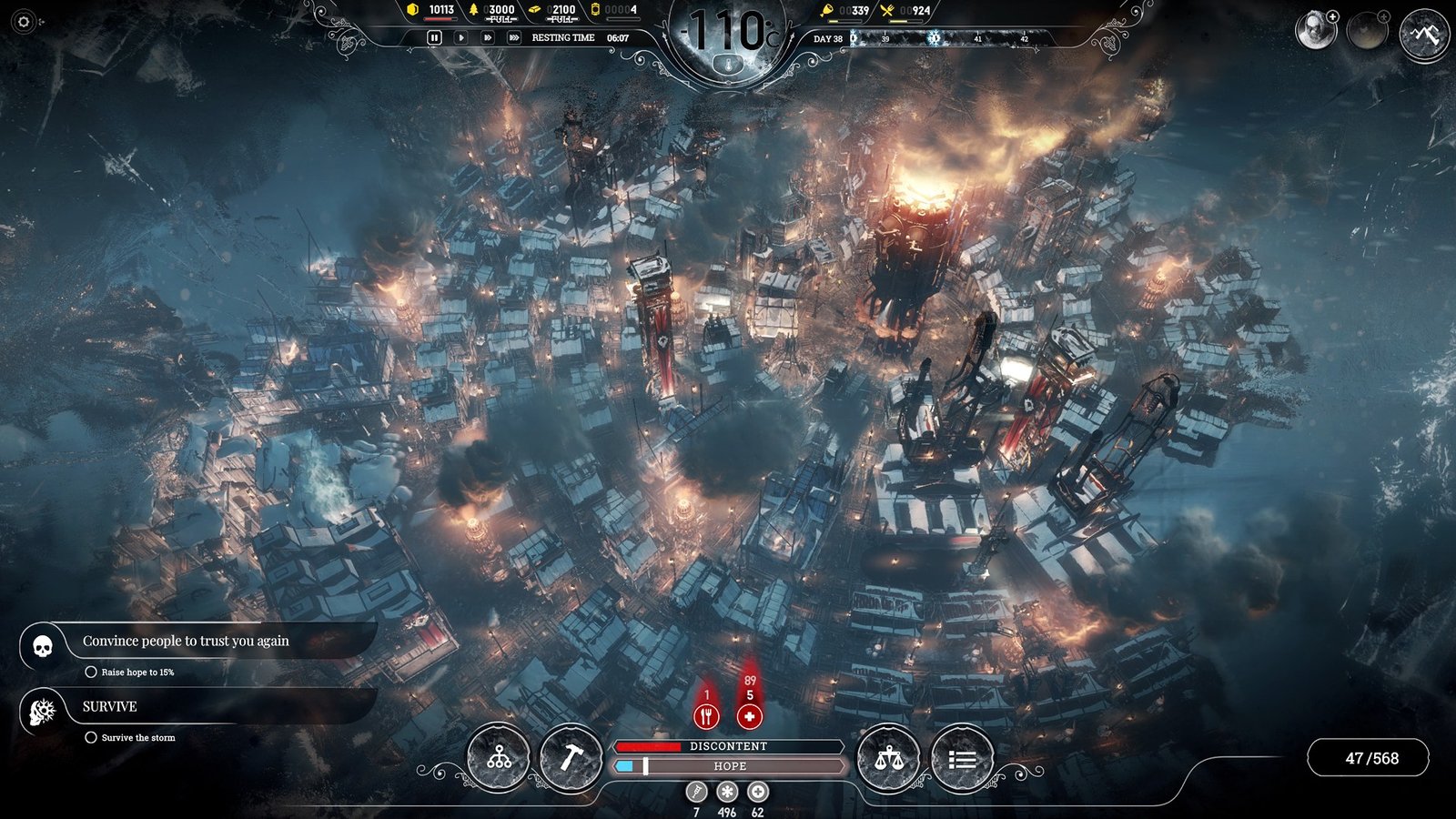
In 2018, 11 bit studios released Frostpunk, about a society struggling to survive extreme cold. The player builds a city, manages supplies, and provides heat, food, and other necessities. Crucially, management decisions also shape the community’s social organization.
Manage resources or make difficult choices?
If fuel is running low as temperatures fall, increasing production may demand workers and materials that other activities need. Some operations may have to be reduced to keep the generator running. Laws and rules can also change how people live.
The challenge is not just where to place buildings, but how a community should function under severe constraints. Frostpunk develops this idea through scenarios about collective survival; it is not simply a conventional city builder with snow added.
Frostpunk 2: a change of scale

Frostpunk 2 launched on PC on September 20, 2024. Instead of focusing entirely on direct management of a small community around a generator, it expands the scale to larger urban districts and more complex political relationships.
Factions and social groups pursue competing interests, while Council decisions and struggles over society’s direction shape the city. Resources and infrastructure still matter, but political balance becomes more important.
By the October 21, 2026 editorial update, the paid Breach of Trust DLC had been released on June 23, 2026. Its story features New Edinburgh, geothermal power, and an unstable nearby volcano. That paid content is distinct from base-game updates. Fractured Utopias, another expansion, arrived in December 2025, not 2026.
The two Frostpunk games do not use identical construction or management systems, even though they share a focus on societal survival.
Manor Lords and the organization of medieval settlements

Developed by Slavic Magic and published by Hooded Horse, Manor Lords entered Early Access on April 26, 2024. It combines medieval settlement building, economics, and military strategy.
Players create villages, plan production, and respond to their inhabitants’ needs. A recognizable feature is its organic layout: rather than relying exclusively on a rigid grid, players can shape lots and houses along irregular paths and terrain.
Building and the medieval economy
Manor Lords uses resources, farming, production, workers, and distribution. Building locations and roads can affect efficiency. Territorial expansion and combat also appear, linking the game to broader strategy traditions, but settlement development remains central.
As of October 21, 2026, Manor Lords was still in Early Access according to its official Steam listing. Experimental updates and September hotfixes were not equivalent to a full version 1.0 release.
The presence of military systems does not mean it should be classified exclusively as an RTS. Its design combines construction, management, and strategy.
Fantasy city builders, colonies, and hybrid experiences
The genre also includes games beyond historical or contemporary cities. Surviving Mars (2018), for example, focuses on developing a Martian colony, where resources, environmental conditions, and infrastructure determine whether settlers can survive. Water and energy may play very different roles from those in a modern Earth city.
Against the Storm: building several cities rather than one
Developed by Eremite Games and published by Hooded Horse, Against the Storm entered Early Access on the Epic Games Store in 2021, as the developer’s announcement records. Steam Early Access followed on November 1, 2022, and the full release arrived on December 8, 2023. Therefore, 2022 should not be described as its first availability on any store.
It blends settlement construction with roguelite elements. Rather than devoting the entire experience to one permanent city, players lead expeditions that establish different communities. Each settlement has different needs and challenges. Some progression carries over between expeditions, even after a specific community is no longer used.
This changes the relationship between construction and continuity. A conventional city builder may ask players to keep expanding the same city; Against the Storm makes the founding of new settlements part of a larger progression cycle.
Timberborn, Foundation, and other approaches
Timberborn, by Mechanistry, centers its engineering on water, terrain, and production. Beaver communities build dams, reshape the environment, and store water to endure alternating wet and dry periods. After entering Early Access in 2021, it reached full release on March 12, 2026.
Foundation, from Polymorph Games, emphasizes organic medieval growth without a rigid grid. Modular buildings, labor assignments, production, trade, and village layout shape its identity, without necessarily reproducing the military systems of Manor Lords. Version 1.0 was released on January 31, 2025.
Farthest Frontier, from Crate Entertainment, focuses on frontier survival: gathering, hunting, fishing, and farming secure food, while raw materials become goods used for consumption, trade, and defense. Its economy must remain sustainable despite environmental threats. The game entered Early Access in 2022 and launched in full on October 23, 2025.
All three had received full releases by the editorial date, unlike Manor Lords. Together they illustrate how city builders can emphasize environmental engineering, fantasy, and communities under difficult conditions. There is no mandatory model of city, resource, or objective.
City Builder, Simulation, 4X Strategy, and Grand Strategy: what are the differences?
These categories may overlap, but they describe different centers of gameplay.
| Category | Central characteristic | Examples |
|---|---|---|
| City Builder | Build and manage a city or community | SimCity, Cities: Skylines |
| Simulation | Represent activities and systems through interactive rules | Microsoft Flight Simulator, The Sims |
| 4X Strategy | Explore, expand, and develop empires while competing with other powers | Civilization, Master of Orion |
| Grand Strategy | Manage states and powers at a political, economic, and military scale | Europa Universalis, Victoria |
| RTS | Real-time strategy, often with direct unit control and economic management | Age of Empires, StarCraft |
| Survival | Stay alive amid needs and threats | The Long Dark, Valheim |
| Sandbox | Structure emphasizing experimentation and self-directed goals | Minecraft, free-building modes in Cities: Skylines |
City Builder and Simulation
SimCity can be called an urban simulator because it models city systems. Simulation also includes activities that do not involve settlements, such as flying in Microsoft Flight Simulator or driving trucks in Euro Truck Simulator 2. Many city builders are simulators, but not every simulator is a city builder. Our guide to Simulation Games explores that broader classification.
City Builder and 4X Strategy
The main difference concerns scale and objectives. In Civilization, city construction is one aspect of developing an entire civilization, as explained in our 4X Strategy feature. Players must also explore, expand, develop resources, handle diplomacy, and compete with other powers.
In Cities: Skylines, organizing a city is the core experience. City builders can still include strategy and territorial expansion—Anno combines construction with production, trade, and other strategic decisions—but the categories are not identical.
City Builder and Grand Strategy
Grand Strategy usually involves political, economic, diplomatic, and military decisions about states or other major powers. Europa Universalis operates at a broad territorial and political scale; a city builder focuses on developing a community or settlement.
A grand strategy game may feature cities and infrastructure without making urban construction its primary activity. Similarly, Frostpunk 2 can explore complex politics without reproducing the structure of Europa Universalis.
City Builder and RTS
In Age of Empires, building bases and managing an economy support real-time strategy, military competition, and unit control. In a city builder, community construction and administration are important in their own right.
Hybrid games exist: Manor Lords has settlement management as well as military systems. The distinction lies in how these elements organize the experience, not simply whether buildings or real-time activity appear.
City Builder, Survival, and Sandbox
Banished and Frostpunk combine settlement building with survival. Keeping people alive and supplied matters as much as expansion. Sandbox describes a structure offering freedom to experiment and set personal goals, something associated with SimCity and Cities: Skylines, especially in free-building modes.
Not every city builder is open-ended. Frostpunk offers structured scenarios, and Against the Storm progresses through multiple settlements. City Builder identifies the focus on construction and management; Survival and Sandbox describe other qualities that may overlap with it.
The games that shaped the evolution of city builders
The following selection includes early precursors and influential representatives of different branches of the genre. It is not a ranking of the best games.
| Game | Year | Importance or defining characteristic |
|---|---|---|
| Santa Paravia en Fiumaccio | 1978 | Early economic and territorial management |
| Utopia | Early 1980s | Strategy and territorial development on consoles |
| SimCity | 1989 | Establishment of modern urban building and simulation |
| Caesar | 1992 | Development of historical city-building traditions |
| SimCity 2000 | 1993 | Broader urban construction and management |
| Caesar III | 1998 | Services, population, and road planning |
| Anno 1602 | 1998 | Settlements combined with trade and production |
| Pharaoh | 1999 | Egyptian cities, production chains, and monuments |
| SimCity 4 | 2003 | Urban administration and regional development |
| Anno 1404 | 2009 | Production, needs, and commerce developed further |
| Banished | 2014 | Communities with limited resources |
| Cities: Skylines | 2015 | Modern urban planning, traffic, and customization |
| Frostpunk | 2018 | Collective survival and social decisions |
| Anno 1800 | 2019 | Industrialization, logistics, and production chains |
| Cities: Skylines II | October 24, 2023 — PC | New tools and urban simulation systems |
| Against the Storm | December 8, 2023 — full release; Early Access: Epic 2021, Steam 2022 | Settlement expeditions with roguelite elements |
| Manor Lords | April 26, 2024 — Early Access | Organic medieval settlements and strategy |
| Frostpunk 2 | September 20, 2024 — PC | Large-scale urban survival and political conflict |
| Anno 117: Pax Romana | November 13, 2025 | Building and managing Roman provinces |
| Timberborn | March 12, 2026 — full version 1.0 | Environmental engineering and water management in beaver communities |
Some entries are precursors, others conventional city builders or hybrids. Full releases and Early Access must be distinguished, and these dates mark particular milestones rather than universal release dates for every platform and region.
Why are city builders engaging—and what makes them challenging?
The appeal is watching a place transform. Empty land can become a village, metropolis, or colony supporting thousands of inhabitants, shaped by decisions about structures, resources, and administration.
Large cities also require monitoring many systems at once. Congestion, shortages, and growing costs can make expansion complicated. Some games put heavy demands on computer hardware to represent large cities and many residents. Others provide few explicit goals, which may be less motivating for players who prefer directed campaigns.
For many people, however, that freedom is precisely the attraction. Choosing between open-ended urban planning, logistics, survival, different settings, or structured scenarios depends on individual preferences—not on one supposedly ideal design for everyone.
A city builder is about building a community and learning how to sustain it
As cities grow, their problems change. A settlement that once needed more residents may later need better employment distribution, reorganized services, or a more resilient supply network.
Construction becomes meaningful when players can observe those changes and respond. The most interesting result is not merely a map full of buildings: it is a community whose organization reflects the choices made to keep it running.
About the Author