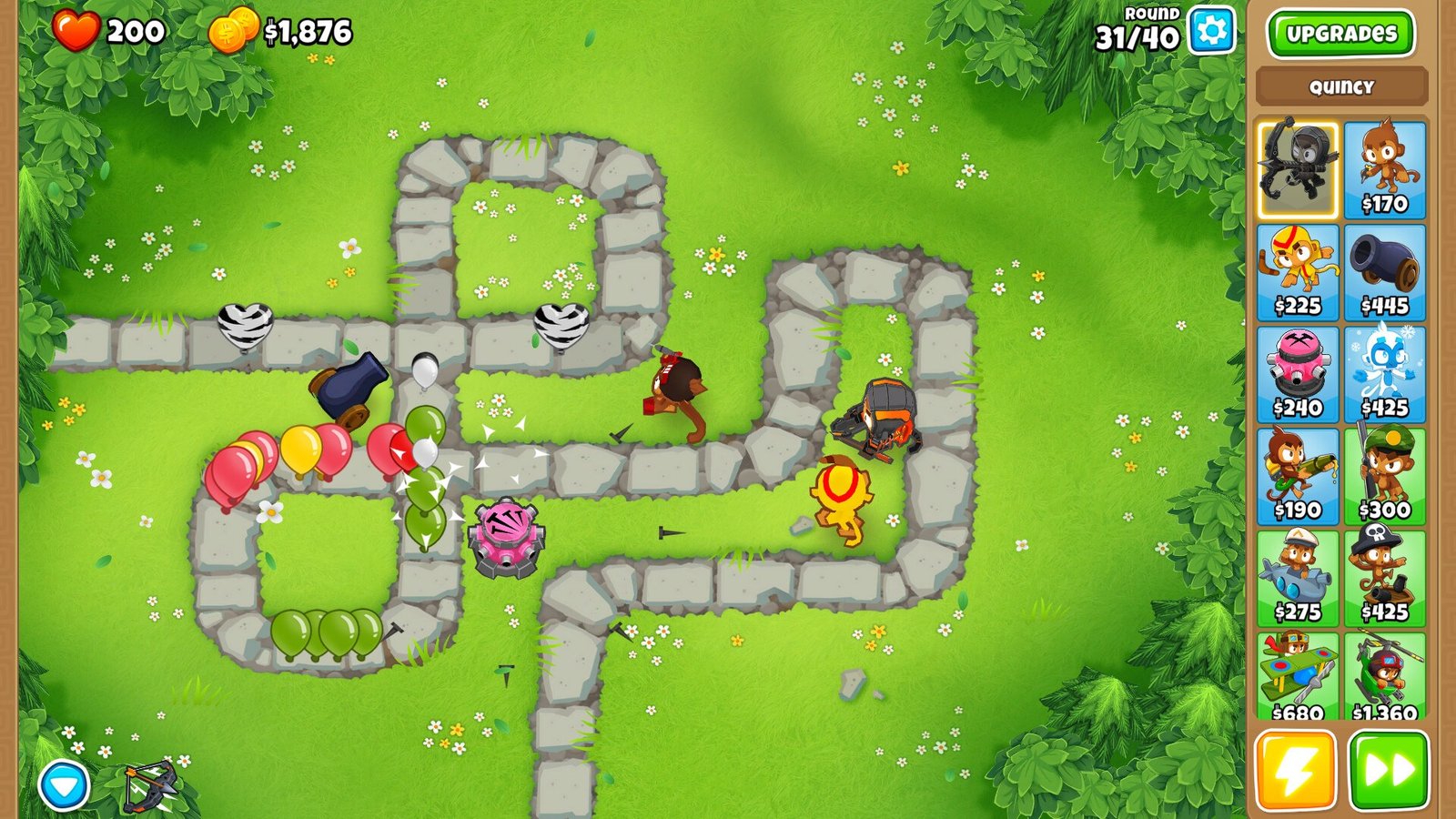
Posicionamento, recursos e tipos de inimigos orientam as decisões em Bloons TD 6. Captura oficial. Imagem: Ninja Kiwi.
Imagine several enemies trying to follow a path to reach your base. You have enough resources to build two defenses. One attacks quickly but has limited range. The other covers a wider area, although its attacks are slower.
At first, enemies arrive in small groups and seem easy to defeat. After a few waves, however, tougher creatures begin moving forward. Soon, fast opponents appear, capable of passing your defenses before every attack can be delivered.
Now you have to decide: build new towers, upgrade existing ones, or rethink your strategy? This relationship between preparation, positioning, and adaptation lies at the heart of tower defense games. Tower defense is a strategy genre in which players protect an objective from enemies, usually by placing defensive structures or units and improving their capabilities throughout the battle.
In Bloons TD, monkeys armed with different weapons and abilities must prevent balloons from traveling along the paths.
Plants vs. Zombies turns plants into defensive units that protect a house against zombies. Kingdom Rush combines towers, soldiers, and heroes in fantasy campaigns. Desktop Tower Defense, meanwhile, allows the arrangement of structures to affect the routes enemies follow. These games share an idea without following exactly the same rules.
The genre also has important ties to real-time strategy games, particularly the custom maps made for StarCraft and Warcraft III. In this feature, we explore its origins, how defenses work, and how different games turned protecting an objective into a strategic challenge of its own.
Updated October 20, 2026.
Nesta matéria
What defines a tower defense game?
The name refers to defending with towers, but the defensive elements do not necessarily have to look like towers. A tower defense game typically presents an objective that must be protected and enemies attempting to reach it. Players place defenses with distinct characteristics to stop their advance. Some attack directly. Others slow down, block, or weaken opponents. Available resources determine what can be built and when upgrading becomes worthwhile.
In many games, enemies follow predefined paths and arrive in successive waves.
But these characteristics can vary.
Does every tower defense game need towers?
No. In Plants vs. Zombies, the defenses are plants.
In Orcs Must Die!, players use traps and participate directly in combat. In Dungeon Defenders, characters have their own abilities and equipment, while defensive structures remain important. The essential feature is not a stone or metal tower. It is how much preparing and organizing defenses matters in preventing enemies from achieving their goal.
Does every tower defense game have endless waves?
Not at all. Many titles feature levels with a set number of waves and a clear victory condition. Others offer extended endurance modes in which enemies keep coming until defeat or a particular limit. Some allow construction during attacks; others separate preparation from combat.
These differences change the pace without removing the genre’s identity. A top-down camera, entirely automatic attacks, multiplayer, and uninterrupted real time are not universal requirements either. What matters is the role of defensive organization: a tower attacking enemies does not, by itself, make any game a tower defense title.
How did tower defense games begin?
Protecting a position against threats is an idea much older than modern video games. Board games, military simulations, and different electronic games already featured territorial defense, fortifications, or important structures. Yet these predecessors did not necessarily use the formula associated with today’s tower defense games. The combination of defensive construction, advancing enemies, and positioning decisions developed gradually.
An important milestone arrived in arcades in 1990.
Rampart: build, defend, and repair
Released by Atari Games for arcades in 1990, Rampart combined strategy, action, and defensive construction. The original Atari Games manual, copyrighted in 1990, documents its building and combat phases. Later computer and console conversions have their own release dates and features.
Players had to protect castles with walls and cannons.
Walls were assembled from differently shaped pieces, requiring careful organization of the available space. During battles, cannons fired at enemy ships or opposing fortifications, depending on the mode. After an attack, players repaired damaged walls and reorganized their defenses. This created a cycle of three activities: building, fighting, and rebuilding.
Poorly arranged defenses could make repairs more difficult after an assault. Rampart is often recognized as a precursor to tower defense games. However, it did not use exactly the later formula of automated towers along enemy paths. Its significance lies in bringing spatial planning and objective defense together, not in single-handedly inventing every defining feature of the genre.
StarCraft and Warcraft III: when communities began making their own defenses
The evolution of modern tower defense games is also tied to real-time strategy (RTS) games. Traditional RTS games often involve resource management, base construction, and controlling different units in battle. Some also provide creation tools that allow their rules to be transformed entirely.
An experience originally focused on managing armies could therefore become a challenge about protecting paths and structures.
StarCraft and custom maps
Released in 1998, Blizzard Entertainment’s StarCraft included tools for creating scenarios unlike traditional campaign or competitive maps. The expansion Brood War, also released in 1998, extended the game’s life and community. Custom maps included experiences known as Turret Defense and Sunken Defense, using defensive buildings to fight computer-controlled opponents.
Instead of running a complete military economy and commanding armies on several fronts, players concentrated their decisions on defending a particular area. The concept brought construction, positioning, and enemy waves together. These maps circulated in multiple versions and were modified by communities, making it difficult to attribute their entire development to one creator.
StarCraft therefore represents a major chapter in the genre’s history, but should not be called the sole inventor of tower defense games.
Warcraft III and the variety of community experiences
In 2002, Blizzard released Warcraft III: Reign of Chaos. Its expansion The Frozen Throne followed in 2003. Editing tools made it possible to create maps and modes using different units, structures, and rules from the conventional campaigns. Tower defense became an important part of this creative culture.
On some maps, players protected paths from successive waves. On others, they combined tower types, built mazes, or defended cooperatively. The community experimented with many ways to organize these matches.
Element TD, Wintermaul, and Gem Tower Defense
One recognized example from this tradition is Element TD. The development team’s official history credits Brian “MrChak” Powers as its creator and records Element TD Survivor 2.0 in February 2006. The reference to June 2006 concerns Evan “Karawasa” Hatampour contacting Brian to develop a subsequent version; it is not the creation date of the entire concept.
Because retrospective accounts differ in their chronology of early versions, this should be treated as a documented stage of collaboration, without inventing an exact inaugural release date.
The game uses elements that can be combined into different defensive structures.
This adds another strategic dimension to tower selection: players must consider which combinations they want to develop. Wintermaul became associated with experiences where constructing and arranging defenses affected enemy movement. Gem Tower Defense explored its own systems for creating and combining towers, using gems as part of its identity. These projects do not share identical rules, and each had different versions over time.
Their importance lies in showing how the Warcraft III community used editors to develop distinctive tower defense formats. The history of these maps must also be distinguished from that of MOBAs. Both styles have important connections with StarCraft and Warcraft III communities, but they evolved in different directions. In MOBAs, controlling heroes, progression, and team objectives developed their own identity.
In tower defense games, organizing structures and protecting against enemies remained central.
The Flash era and the popularization of tower defense
During the 2000s, the genre moved beyond RTS communities and reached a wider browser audience.
Games developed using Adobe Flash could be published on pages accessible directly from a computer.
Many used relatively simple controls, usually a mouse to select and position defenses. This allowed people to discover tower defense without buying a large strategy game. Developers could also experiment with new mechanics, visuals, and rules. One of the most important examples from this period was Desktop Tower Defense.
Desktop Tower Defense and building pathways
Created by Paul Preece of HandDrawnGames and released in 2007, Desktop Tower Defense featured visuals resembling drawings on a desktop. The creator’s Kongregate page preserves its authorship and the premise of positioning towers to stop enemies crossing the area; a portal upload date should not automatically be mistaken for the original debut.
The objective was to prevent enemies from getting across the available space.
Players bought and positioned towers, using their attacks to defeat threats. But there was a key difference from games with completely fixed routes: the arrangement of defensive structures could influence the paths enemies took.
What is mazing?
Maze building, or mazing, means arranging structures to change or extend enemy routes whenever the game’s rules allow it. Imagine an enemy unit that could cross an open area in a straight line.
By placing towers in specific positions, you might force it to make several turns before reaching the exit. The longer journey creates more opportunities for your defenses to attack. Structures normally still have to comply with placement and pathing rules, however. Not every game permits complete path blocking or this kind of rerouting.
Desktop Tower Defense helped popularize the relationship between placement and path building, but it was neither the first defensive game outside RTS nor the absolute inventor of mazing. It also showed how a visually simple experience could offer sophisticated strategic challenges.
Bloons Tower Defense and the evolution of towers and upgrades
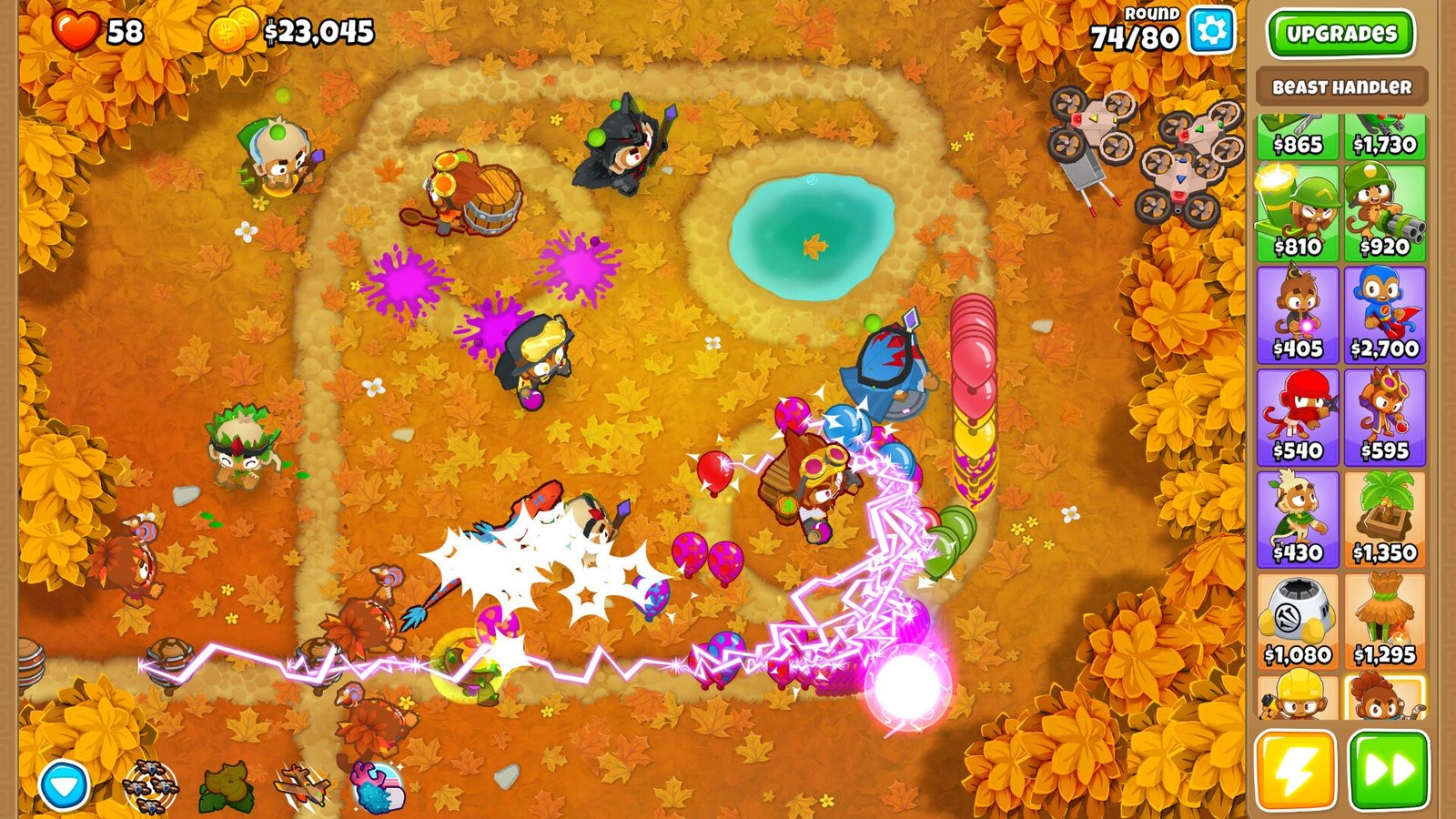
In 2007, Ninja Kiwi launched the Bloons Tower Defense franchise. The studio’s original browser game is still documented on Kongregate. The premise looked simple: prevent balloons, known as Bloons, from traveling along the map’s paths.
Players achieved this by placing monkeys armed with different attacks. Over time, the series expanded its range of towers, enemies, and available upgrades.
What began as a relatively straightforward experience developed into a system with many ways to combine abilities.
How do Bloons TD towers work?
Each unit has distinctive characteristics.
Some towers attack quickly.
Others offer long range, area damage, or particular effects. Some defenses and abilities can also support other units. Bloons have different traits according to type, so players must consider which attacks can handle each threat. A strategy effective against ordinary enemies may struggle when tougher balloons or special properties appear.
This makes combining defenses important rather than simply selecting the tower that seems to deal the most damage.
Bloons TD 6 and upgrade paths
First released on mobile devices in June 2018 and on PC/Steam on December 17 that year, Bloons TD 6 expanded the franchise with three-dimensional graphics, heroes, and different progression systems. The December date on its Steam store page applies to that edition, not its first mobile availability.
One of its most important features is the upgrade-path system.
Regular towers use three upgrade paths with different specializations. This should not be confused with hero progression or the special rules for Paragons. Depending on choices, a unit might strengthen particular attacks, extend its range, or gain new effects.
These paths also restrict which upgrades can be combined. A player cannot simply select every upgrade for the same tower.
Choosing the specialization that offers the greatest value for the current strategy is essential.
Heroes and supporting strategies
Bloons TD 6 also features heroes, special characters with their own abilities who develop during a match.
They complement ordinary towers and introduce different possibilities.
The right choice depends on the map, enemies, and conditions. Cooperative modes and varied activities are also available. On October 8, 2026, Update 57.0 added S.P.I.D.E.R. Monkey, the Sniper Monkey Paragon, not a separate hero. This special evolution features powerful shots, a conditional firing-speed increase, targeting commands for other Snipers, and support abilities, including execution of a powerful target.
The update also revamped the Insta Monkeys collection, including offers featuring identified units and gameplay objectives, and added the community-created Advanced map Ship Capture by MrRoostee. These additions describe the update available on covered platforms in October; console editions had separate schedules and did not automatically receive all new content simultaneously.
The announcement also described Update 58 as a future release, so its plans must not be counted among features available on October 20, 2026. Version 57.0 on PC does not imply the same-day update on Xbox, PlayStation, or Switch.
This development shows how the Bloons TD formula continues to expand without abandoning positioning, waves, and upgrades.
Plants vs. Zombies and lane-based defense
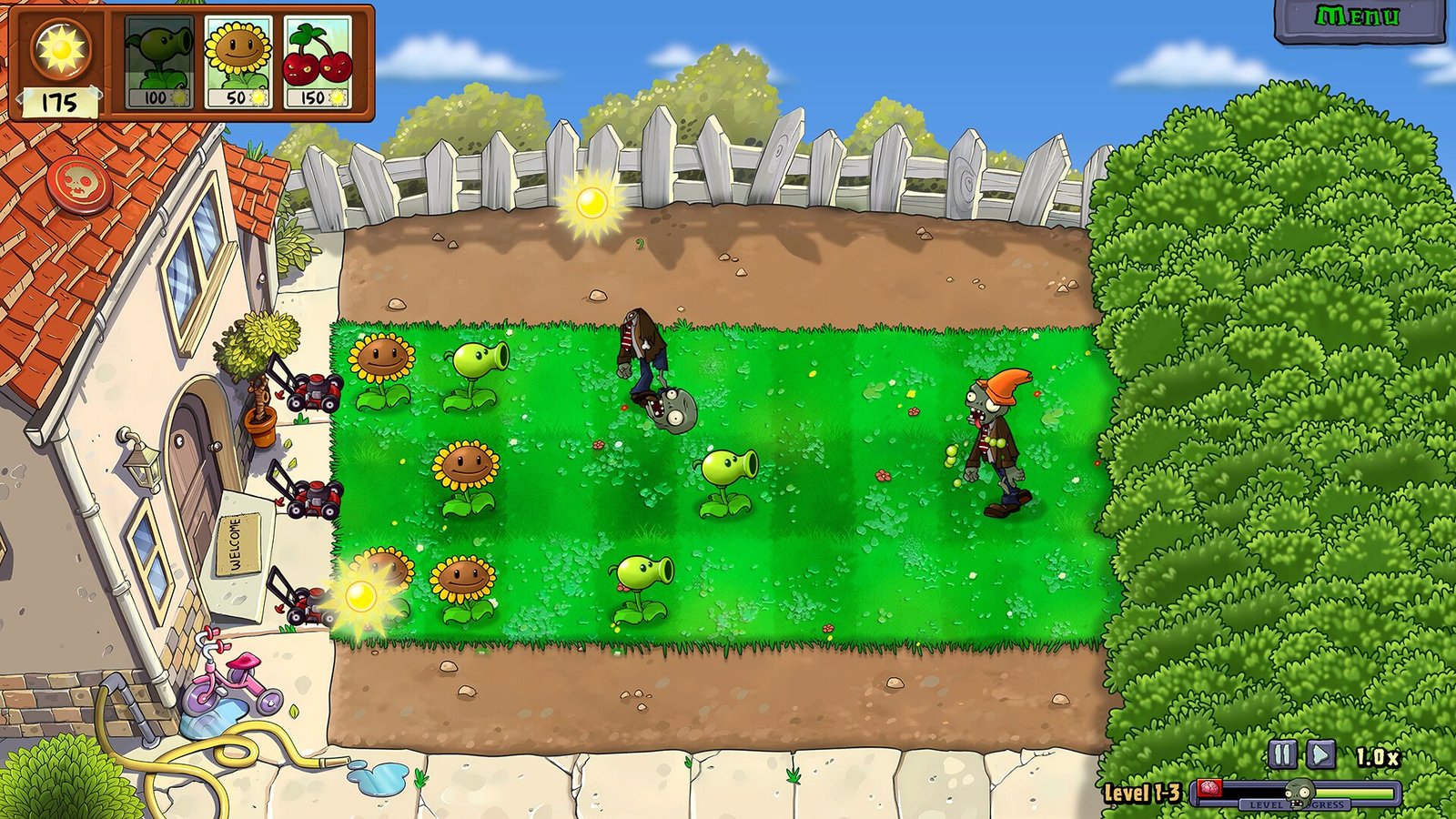
In 2009, PopCap Games released Plants vs. Zombies. This date refers to the original game: the GOTY edition, adaptations, and later remaster did not independently originate the formula. The game introduced an especially recognizable take on tower defense.
Instead of placing towers beside a road, players arrange plants in different lanes of a garden. Zombies advance toward the house as plants attempt to stop them.
Each plant has a specific function. Some attack directly; others block movement, deal area damage, or create special effects.
Sun as a construction resource
One of the game’s most important features is its sun economy, used to purchase additional plants during levels. Certain plants, including Sunflowers, help produce this resource.
This creates a connection between economy and defense. Imagine having little sun while multiple zombies approach. You could spend it immediately on an offensive plant, or invest in additional sun production to strengthen your economy for subsequent threats.
The best decision depends on the situation. Producing resources offers future benefits, but may leave current defenses exposed.
Why does lane-based defense work?
Positioning in Plants vs. Zombies requires watching which threats appear in each lane. One lane may be well defended while another has few units.
Certain enemies also have features that demand specific counters. The approachable art style therefore does not remove the need for planning.
The difficulty arises from the interaction between resources, timing, placement, and enemy types.
Plants vs. Zombies: Replanted
On October 23, 2025, Electronic Arts released Plants vs. Zombies: Replanted, a remaster of the original game developed by PopCap Games and The Lost Pixels.
The new edition brings back the classic experience in high definition and adds modes and other content.
Replanted must be distinguished from the 2009 original: the remaster did not create the underlying formula. Nor does it make every Plants vs. Zombies game a tower defense title. Garden Warfare and Battle for Neighborville, for example, primarily focus on character-based shooters.
The franchise has consequently come to encompass multiple genres.
Kingdom Rush and Defense Grid: campaigns, heroes, and routes
Two games show how standalone tower defense titles developed distinct approaches to progression, maps, and defense systems.
Kingdom Rush: towers, soldiers, and abilities
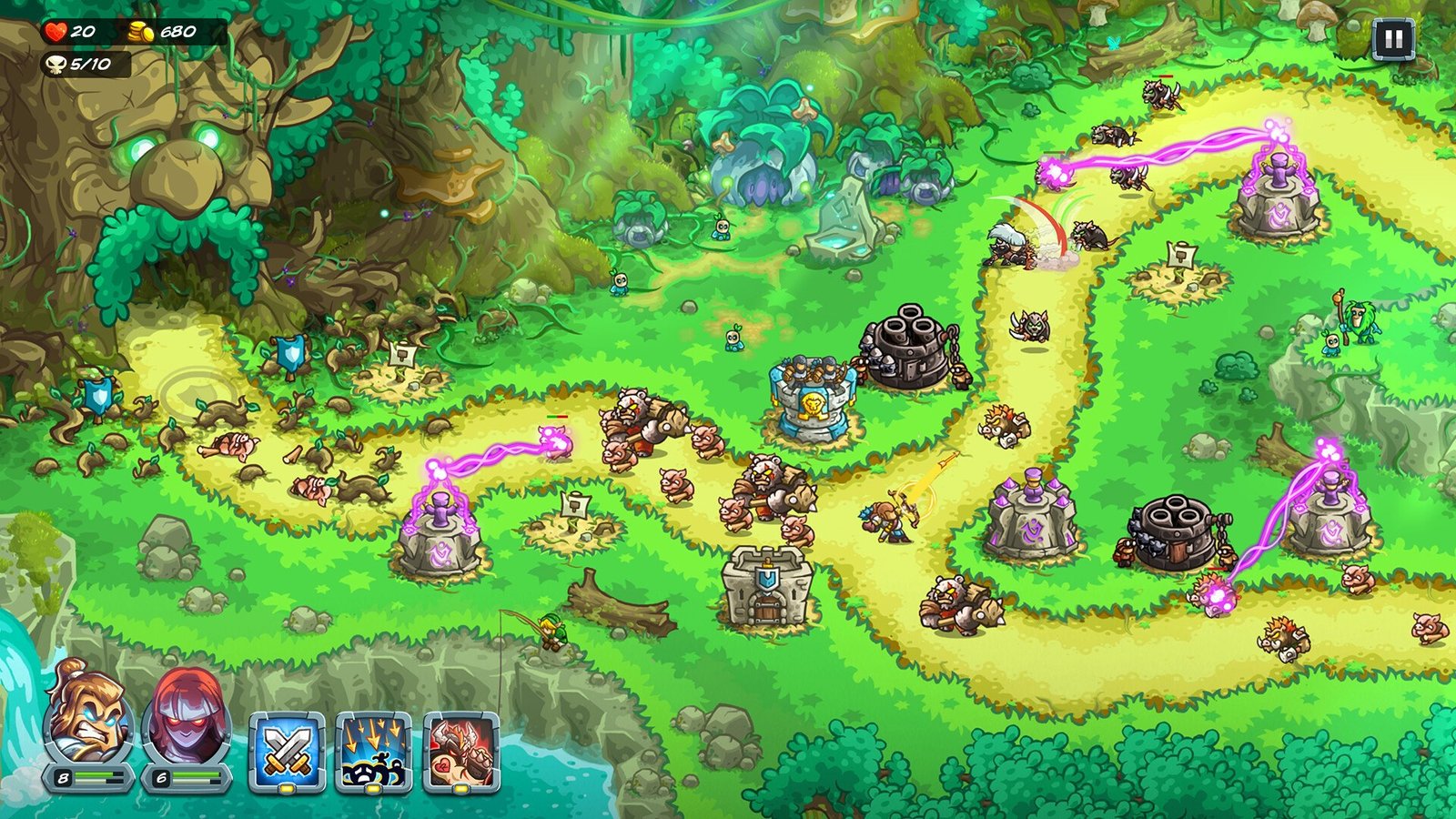
First released on Armor Games on July 28, 2011, Ironhide Game Studio’s Kingdom Rush built a fantasy campaign around enemy routes, specialized towers, and level-based progression. Ironhide’s own retrospective distinguishes this browser debut from the iPad version of December 19, 2011, and the Steam version released in January 2014.
Players must stop creatures from moving past the defenses and reaching their goal.
Towers are not the only available tools, however. Depending on the game, the franchise also uses soldiers, special abilities, and heroes. Some structures provide ranged attacks; others deploy units into direct combat and help hold back the enemy.
This creates decisions about controlling space, not just dealing damage.
How has the franchise evolved?
Kingdom Rush Frontiers (2013) introduced new towers, enemies, and possibilities within the formula. Kingdom Rush Origins (2014) developed another campaign with its own units and abilities.
Kingdom Rush Vengeance, released in 2018, changed the narrative perspective by putting forces traditionally associated with villains in the spotlight. Kingdom Rush 5: Alliance arrived on July 25, 2024. A major addition was the ability to control two heroes during the same level, expanding combinations and placement choices. This means controlling two characters in a single-player battle, not a cooperative mode for two players.
The series continued with Kingdom Rush 6: Genesis, released September 24, 2026, by Ironhide Game Studio for Steam, Google Play, and the App Store. Time travel takes the campaign back to Linirea in an attempt to prevent the corruption of young Vez’nan. The numbered entry is a new game in the series; its return to the past is part of the story chronology, not a remaster of the first Kingdom Rush or another name for Alliance.
Towers, paths, heroes, and spells still define defensive strategy, with specializations offering ways to combine roles. The official Genesis press kit describes a renewed upgrade system for towers, heroes, and spells, as well as two heroes per level. That feature is confirmed for this title and should not automatically be attributed to all previous entries.
The example shows how the series revisits its setting while extending decisions within the path-defense formula.
The roadmap published September 28, 2026 plans mini-campaigns for November and December, each with three levels, a tower, a hero, and a spell. Both remained future content as of October 20, 2026; the announcement alone does not establish whether they will be free or paid.
Another branch is Kingdom Rush Battles, launched globally on October 9, 2025 for Android and iOS. This is a separate competitive tower defense game featuring heroes, towers, card-based compositions, and arena progression. Player-versus-player competition defines its design; it is neither a co-op mode nor DLC for Kingdom Rush 5: Alliance.
The franchise illustrates how campaigns, characters, and varied defenses can expand the genre while preserving its identity.
Defense Grid: The Awakening and route planning
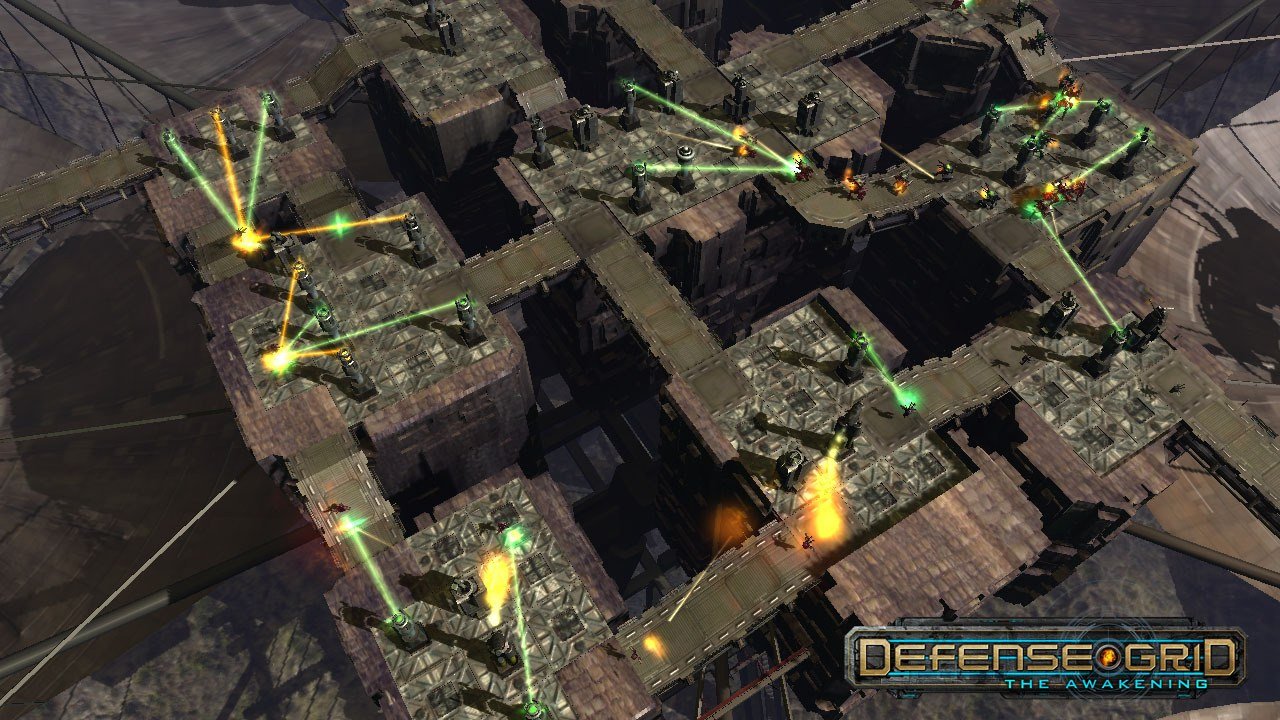
Released on PC on December 8, 2008, Hidden Path Entertainment’s Defense Grid: The Awakening presented a science-fiction experience about protecting objectives against enemy waves. Players build towers with different attacks to stop invaders from stealing power cores, as described in the official manual.
An enemy can pick up a core and try to carry it back out: protecting it means observing both approach and escape.
Placement affects how long towers can attack passing enemies. On certain maps, construction may also change possible routes, making the organization of structures particularly important.
Defense Grid 2 (2014) continued this approach with new maps and systems. The franchise is significant because it demonstrates how paths and towers create strategic challenges without depending on heroes or player-controlled combat.
How does a tower defense match work?
A traditional structure can be represented by this simple loop: Analyze the map → Place defenses → Face waves → Earn resources → Upgrade units → Adapt your strategy → Protect the objective.
This is not a mandatory sequence. Some titles allow building during combat; others provide specific preparation phases.
A level may also begin with structures already in place or impose special conditions. The important point is understanding how the systems affect one another.
Positioning and range
Imagine two identical towers. The first sits beside a short straight section of path.
The second is placed near a bend, allowing its attack area to cover enemies both before and after they turn. Depending on the rules for range and movement, the second tower could engage them for longer.
This shows why positioning may be as important as firepower. Crossroads on some maps let defenses cover several routes. On others, limited space demands careful decisions about which towers receive the best locations. There is no universally superior position.
Every game has its own rules for range, obstacles, and movement.
Fixed routes, mazes, and lane defense
Tower defense games use different spatial layouts.
| Structure | How it works | Example |
|---|---|---|
| Predefined paths | Enemies follow routes laid out by the map | Bloons TD, Kingdom Rush |
| Adjustable routes | Buildings can influence enemy movement | Desktop Tower Defense |
| Lane-based defense | Opponents advance through specific lanes | Plants vs. Zombies |
| Defense with direct action | Traps and structures are combined with player combat | Orcs Must Die! |
These arrangements require different decisions.
With a fixed route, the player chooses the best spots to take advantage of defensive range.
When routes can be modified, controlling enemy movement becomes another challenge. In lane defense, allocating resources across different lanes is particularly important.
Waves and enemy types
Waves organize escalating threats. A level may begin with slow, fragile enemies.
Later, faster, armored, or defense-evading opponents may appear. Some titles add flying units, special enemies, and bosses.
Others include resistance and immunity rules that weaken certain attacks. Imagine a strategy built around slow, powerful shots. If the next wave contains many fast enemies, the towers may not hit every target before it gets past them. The problem is not necessarily insufficient total damage.
It may instead be the inability to apply that damage against the current threat, encouraging the player to adapt defenses as enemies change.
Resources and opportunity costs
Building a tower usually requires a resource; upgrades may also consume part of the budget. Imagine choosing between three basic defenses or spending everything on a single advanced tower. The more powerful tower might excel against one threat but leave other routes exposed.
Basic towers may cover more ground yet struggle against stronger enemies. This is an opportunity cost: using resources for one choice means they are unavailable for another. Economic investments create the same trade-off. The earlier sun-production example illustrates the choice between future returns and immediate defense.
Other games award resources for defeating enemies or completing waves. There is no single universal economy.
Upgrades and specializations
Upgrades can improve range, attack speed, or damage. They can also transform a tower’s role. A unit initially designed for one target might gain a way to attack groups. Another might acquire effects that slow or control enemy movement.
Bloons TD 6 illustrates this through upgrade paths. Kingdom Rush offers different forms of progression and abilities linked to defensive structures. Such choices create distinct compositions. Upgrading every tower in the same way is not necessarily efficient.
Synergies between defenses
Synergy occurs when different defenses work better together. Imagine a slowing tower next to another that deals heavy damage. If enemies spend more time in the area, the offensive tower has more opportunities to attack. Another combination might pair area damage with defenses specialized against tough enemies.
Effectiveness depends on each game’s rules. Some enemies resist certain effects; others require particular attacks. Tower defense is therefore not simply a competition to build the tower with the highest damage statistic. It is also about finding capabilities that complement each other.
Heroes, traps, and tower defense with direct combat
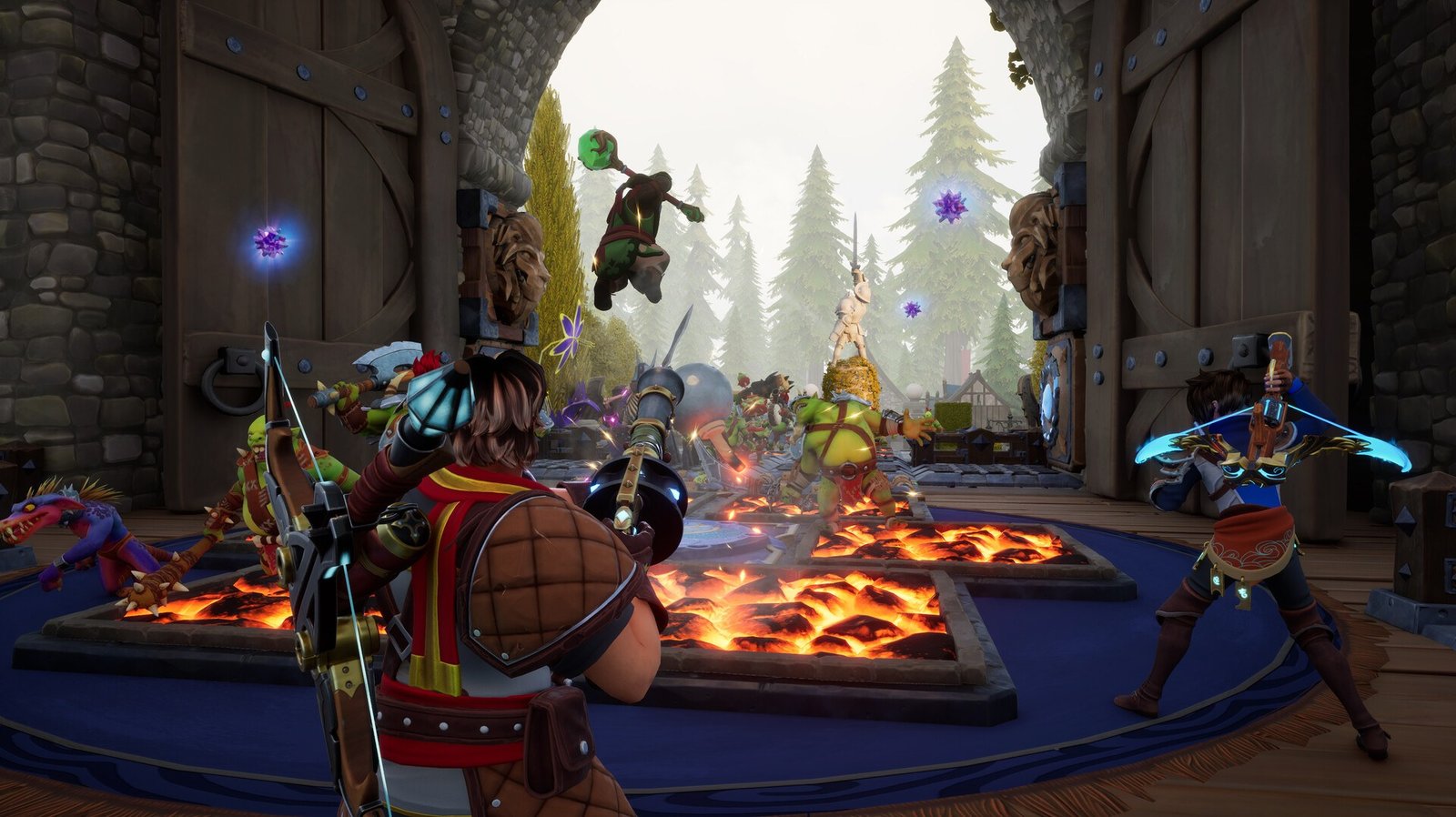
Traditional tower defense games often feature automatically attacking towers. Some titles, however, have introduced direct player participation during battles.
Orcs Must Die!: defense and third-person action
Released in 2011, Robot Entertainment’s Orcs Must Die! combined objective defense, traps, and direct third-person combat. Players can place structures that attack enemies and use their own weapons and abilities to help defend the objective.
This makes defense both a planning and an execution challenge. Choosing where to build is not enough.
Players must also fight, react to threats, and use available tools. Orcs Must Die! Deathtrap, launched on January 28, 2025 for PC and Xbox Series X|S, developed the formula with solo play or co-op for up to four players and progression featuring roguelite elements. The PlayStation 5 release came later, in September 2025; these platforms did not all launch simultaneously.
Its design uses different modifiers and choices between encounters, increasing replay variety.
Dungeon Defenders and character progression
Dungeon Defenders (2011) also combines objective defense with characters possessing different abilities. Players use skills, equipment, and structures to survive enemy waves. Character progression plays a larger role than in many traditional tower defense titles. This shows that tower defense can coexist with RPG elements and cooperative play.
Sanctum and first-person combat
Coffee Stain Studios’ Sanctum (2011) offered another interpretation. It combines objective defense and strategic construction with first-person combat. The FPS perspective complements defense planning rather than replacing it.
Players actively fight with weapons while defensive structures help handle threats. Camera perspective alone therefore does not determine genre.
Tower defense can use top-down, first-person, or third-person views depending on the game’s design.
Tower Defense, RTS, and Auto Battler: what are the differences?
Tower defense belongs to the broader strategy family but has a distinct structure.
| Category | Main focus | Examples |
|---|---|---|
| Tower Defense | Protect objectives through positioning and defensive structures | Bloons TD, Kingdom Rush |
| RTS | Manage and control forces in real time, often with an economy and base building | StarCraft, Warcraft III |
| Auto Battler | Arrange units and combinations for largely automated battles | Teamfight Tactics, Dota Underlords |
| Survival | Stay alive despite threats and needs | The Long Dark, Valheim |
| City Builder | Build and manage cities or settlements | SimCity, Cities: Skylines |
Tower Defense vs. RTS
StarCraft and Warcraft III custom maps were important to the development of modern tower defense games.
That does not mean the genres are equivalent.
In a traditional RTS, players may gather resources, build bases, train units, and command multiple military operations. Tower defense usually centers decisions on protecting objectives and preparing against threats. Both can unfold in real time; the difference lies mainly in their structure and the role of each decision.
Hybrid games also exist, combining elements from both genres.
Tower Defense vs. Auto Battler
This comparison requires care because both formats can use automatically attacking units. Their goals, however, usually differ. In tower defense, players stop enemies advancing along paths or reaching a protected area. In auto battlers, preparation usually involves arranging a composition of units for battles resolved largely by the game systems.
Positioning, combinations, and resources matter in both styles. Yet automatic attacks do not make every tower defense title an auto battler. Defending objectives against waves is a separate tradition.
Tower Defense vs. Survival and City Builder
In many survival games, building a base helps protect resources and the player from threats. That does not mean the whole experience revolves around enemy waves and defensive positioning.
Similarly, some city builders allow players to erect walls or military structures. Managing a community also involves population, economics, infrastructure, and services. Defensive buildings alone do not define the genre. ZAUS.GG explores these mechanics in its feature Survival: What It Is, Its Origins and Evolution.
Competitive, cooperative, and new forms of tower defense
Tower defense does not have to be a solo experience. Some titles offer cooperation, allowing players to divide responsibilities or build defenses together. Bloons TD 6 has cooperative modes. Orcs Must Die! Deathtrap combines teamwork with direct combat.
Other games adopt competitive rules. Bloons TD Battles lets two participants manage their defenses while competing for the match result. Bloons TD Battles 2 continues this branch with its own rules. In Kingdom Rush Battles, the composition of cards, towers, and heroes must account for the opponent’s choices.
The October 14, 2026 patch notes adjust heroes and towers, including Vez’nan, to balance dominant compositions and improve the usefulness of less popular options. This competitive balancing differs from two players cooperating to defend the same objective.
The genre can therefore support competition without requiring direct control of traditional armies.
Tower defense on mobile devices
The spread of mobile devices also benefited the genre. Selecting a defense, choosing its location, and upgrading it are actions that can work well with touch controls.
Bloons TD, Plants vs. Zombies, and Kingdom Rush all have significant mobile histories. This does not mean that mobile tower defense games are necessarily simpler.
Differences depend on each title’s systems, and some provide extensive upgrades, maps, and enemy types.
Cards, roguelites, and different campaigns
The genre has also mixed with other formats.
Rogue Tower (2022) combines path defense with choices and roguelite progression.
Isle of Arrows (also 2022) uses tiles and decisions that influence how paths and defenses are built. Such hybrids can feature variable runs, modifiers, and progression choices. Not every game with waves or random choices becomes a roguelite, however: the relationship between repeated attempts and progression systems matters too, as explained in the ZAUS.GG feature on roguelikes and roguelites.
Element TD 2, by Element Studios, carried on the custom-map tradition with elemental combinations and competitive and cooperative modes. Its official press kit distinguishes the February 28, 2020 Early Access launch from the full release on April 2, 2021.
These experiences did not replace the classic formula. They offer different ways to explore planning, resources, and threats.
Games that shaped tower defense’s evolution
The selection below brings together predecessors, community maps, and titles that developed different interpretations of the genre. It is not a ranking of the best tower defense games.
| Game or project | Year | Contribution or defining feature |
|---|---|---|
| Rampart | 1990 | Precursor combining fortifications, cannons, and repairs |
| StarCraft defense maps | Late 1990s and early 2000s | Community experiences with towers and paths |
| Warcraft III | 2002 | Editing tools that helped expand custom maps |
| The Frozen Throne | 2003 | Continued community-created modes |
| Element TD | 2006 — Survivor 2.0 in February; extended collaboration in June | Combining elements to create different towers in Warcraft III maps |
| Desktop Tower Defense | 2007 | Popularized browser-based path building |
| Bloons Tower Defense | 2007 | Defending paths against balloons with monkey units |
| Defense Grid: The Awakening | 2008 | Science fiction, routes, and defensive positioning |
| Plants vs. Zombies | 2009 | Lane-based defense and a sun economy |
| Kingdom Rush | 2011 — browser debut; iPad the same year | Campaigns with towers, units, and special abilities |
| Dungeon Defenders | 2011 | Blending tower defense with characters and gear |
| Orcs Must Die! | 2011 | Traps and direct third-person combat |
| Bloons TD 6 | 2018 — mobile in June; Steam in December | Upgrade paths, heroes, and expanded strategy |
| Element TD 2 | 2020 — Early Access; 2021 — full release | Standalone evolution of the elemental formula |
| Kingdom Rush 5: Alliance | 2024 | Using two heroes in level defense |
| Orcs Must Die! Deathtrap | 2025 — January on PC/Xbox; September on PS5 | Cooperative defense with action and roguelite elements |
| Kingdom Rush Battles | October 9, 2025 | Standalone PvP tower defense with card compositions |
| Plants vs. Zombies: Replanted | October 23, 2025 | Remaster of the 2009 classic |
| Kingdom Rush 6: Genesis | September 24, 2026 | New time-travel campaign set in Linirea with tower, hero, and spell upgrades |
Community maps should not be treated as commercial releases equivalent to the other titles.
Dates also distinguish original games from their sequels, reinterpretations, and later versions.
Tower defense history did not unfold through one formula replacing another. Path defense, maze building, direct action, and cooperative experiences continue to coexist.
What makes tower defense engaging — and what are its challenges?
One of the genre’s main strengths is the relationship between rules that are easy to understand and decisions that can become complex. In many games, the objective is simple: stop enemies from crossing a path.
Achieving it, however, may require evaluating range, attacks, resources, positions, and future threats. An apparently difficult level may become more manageable once the player discovers a better defensive combination.
That encourages experimentation. At the same time, repeating waves or replaying maps after a loss can become tiresome for those who prefer greater variety of movement. Some titles also demand detailed knowledge of enemies and towers to overcome advanced challenges. Difficulty varies widely.
Lane defense, extensive specializations, hero-based campaigns, maze construction, and direct combat offer different rhythms and demands. The genre can appeal both to players who enjoy planning and to those who want to participate in fights.
There is no single ideal experience for everyone.
Tower defense turns positioning into strategy
Modern tower defense grew from a combination of territorial defense, strategic construction, and community-made experiences within strategy games. From organizing fortifications to custom routes and browser games, different designs connected preparation with defense. Campaigns featuring heroes, lane defense, and action hybrids expanded the possibilities without eliminating earlier formulas.
What defines tower defense is not merely building the greatest number of towers, but understanding how defenses, paths, enemies, and resources interact. The variety of maps, systems, and forms of participation keeps that relationship between space, resources, and threats open to new ideas. New releases and revisions of classic games may change how players participate, but strategy continues to emerge from preparing responses and adapting to what happens.o da capacidade de preparar respostas e adaptá-las ao que está acontecendo.
About the Author