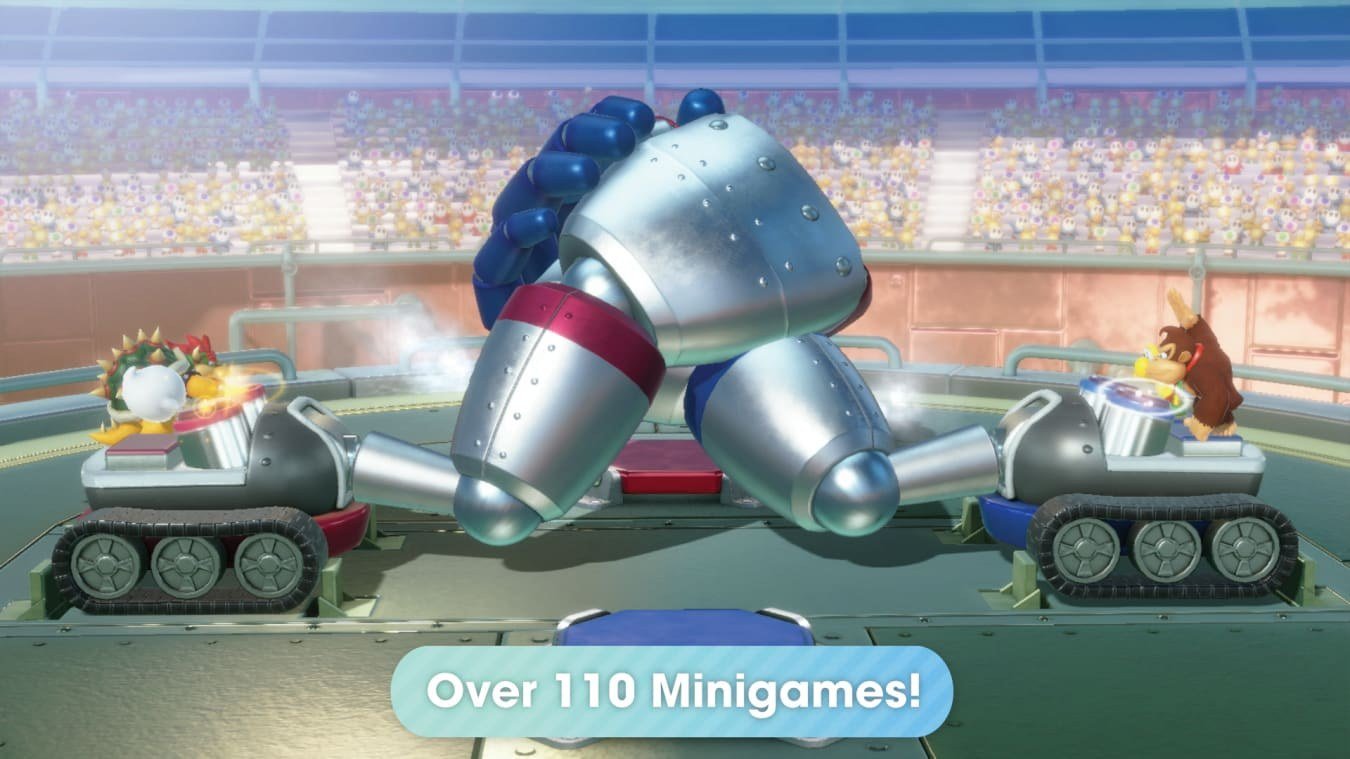
Super Mario Party Jamboree (2024): minijogo em material oficial de divulgação. Imagem: Nintendo.
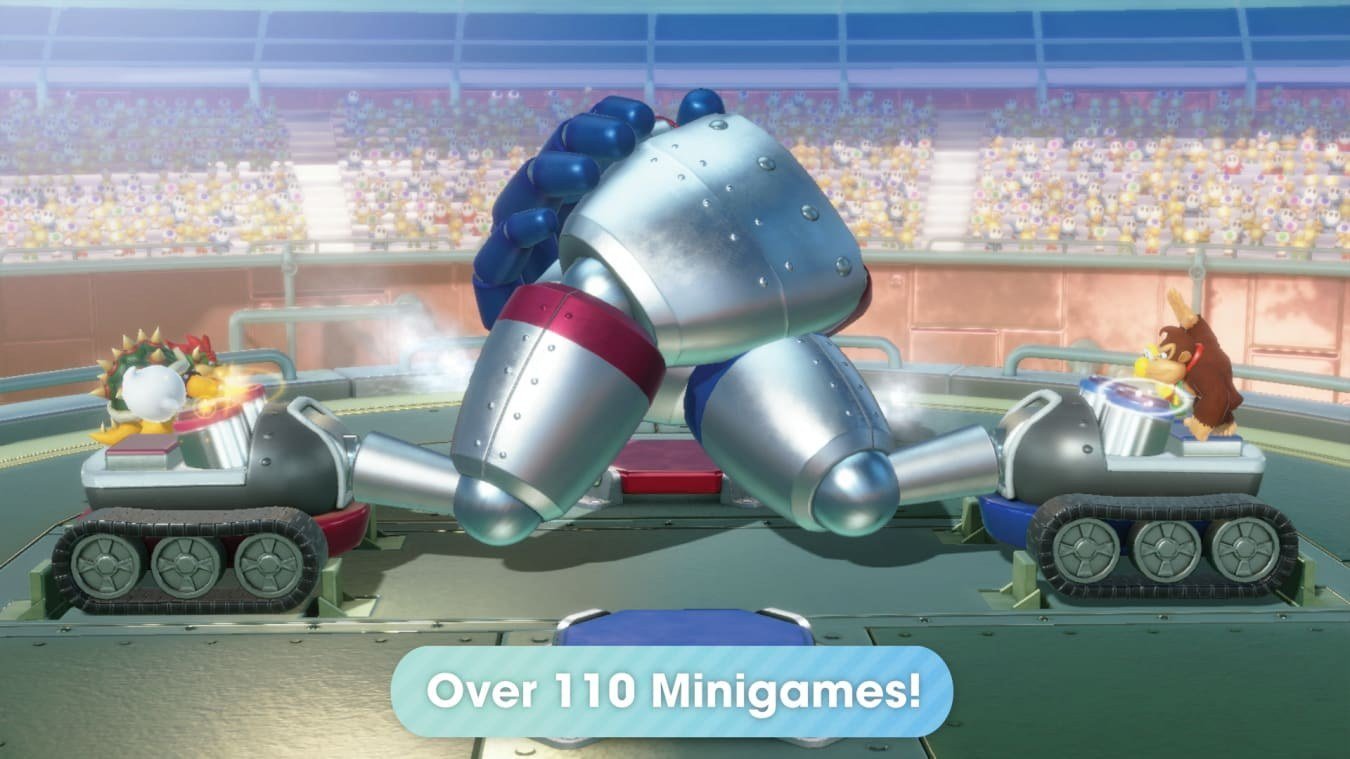
Imagine bringing four friends together to play. One knows the controller inside out; another hardly ever plays; the others want to compete, chat, and laugh. The first round tests reflexes, the next tests memory, and another puts everyone on the same team. Someone who started ahead may struggle with the next challenge, while a less experienced player finds an activity in which they shine.
This variety helps explain party games. Mario Party combines boards and minigames; WarioWare asks players to understand tasks in seconds; Jackbox uses words, drawings, and personal devices; Overcooked turns simple cooking actions into collective coordination. They are not variations of a single mechanic: what connects them is how they organize shared entertainment.
A party game is a category primarily intended to encourage entertainment and social interaction through competitive, cooperative, or creative activities. Accessible rules and short challenges are common, but not compulsory. Its history follows changes in controllers, shared televisions, and opportunities to bring people together from a distance.
Updated October 22, 2026.
Nesta matéria
A party game is not simply any multiplayer game
Multiplayer means more than one person can participate. Party game describes the entertainment concept organizing that participation. Counter-Strike, League of Legends, and Diablo IV can bring friends together, but their core systems concern tactical shooting, arena competition, and action-RPG progression respectively. Chatting during a match does not automatically change its genre.
Party-game rules often create opportunities for collective reactions: comparing answers, switching teams, tackling a challenge everyone can quickly understand, or completing a task that depends on the others. Social enjoyment comes in part from how the game is designed, not merely from having several people in the room.
Not every party game uses minigames or boards. Gartic Phone revolves around interpretations passed between participants; Gang Beasts features arena confrontations; Overcooked structures cooperative stages. Single-player modes and computer-controlled opponents may also exist. These options do not necessarily erase a product’s social identity, but they must be checked for each edition.
Being easy to understand does not mean requiring no skill. Staying on a platform is a clear objective, yet mastering movement, timing, and positioning takes practice. An approachable starting point, depth, and differences in experience can coexist. Varied tasks create different ways to participate without guaranteeing perfectly equal results.
Category boundaries are flexible. Mario Kart, Super Smash Bros., and Wii Sports work well at gatherings while retaining their identities as racing, fighting, and sports games. Explaining the primary activity and social structure is more useful than forcing every title into one exclusive label.
From parlor games to the shared television
Board games, quizzes, physical activities, and group games existed long before video games. They already used scores, turns, chance, and shared objectives to organize gatherings. Digital games automated administrative tasks: calculating results, moving pieces, introducing challenges, and changing scenes without someone having to track every consequence by hand.
That automation also lets a board game interrupt play with an accuracy test or temporarily transform the route. Sounds and animations introduce the event while each person uses a controller to react. It is not just putting traditional pieces on a screen: the type of activity can change during one session.
Pong, released by Atari in arcades in 1972, was a forerunner of local electronic competition. Two paddles returned a ball in a table-tennis-inspired contest. Its clarity encouraged participation, but it does not automatically make it a modern party game with diverse challenges and party-focused organization. Atari’s history provides context for this period.
Home consoles expanded the culture of playing in front of the same television. Friends and families competed simultaneously or took turns at the controller in sports, racing, and action games. This established conditions for new social designs, without retroactively labeling every multiplayer title of the 1970s and 1980s a party game.
The category gradually consolidated, especially through recognizable collections and formats in later decades. No one individual invented all electronic social entertainment. Boards, quizzes, and physical controls followed parallel paths that would meet again in very different products.
Mario Party: boards, luck, and skill in one session
Mario Party debuted in Japan in 1998 on Nintendo 64, followed by other regions in 1999. Developed by Hudson Soft and published by Nintendo, it combined familiar characters, dice, coins, stars, and minigames for up to four participants. Nintendo’s official Wii Party developer interview documents Hudson’s involvement with the series from the beginning.
Dice affect movement on the board, but decisions are not limited to the number rolled. Star locations, available paths, events, and coins all shape planning. Reaching an objective may require resources earned elsewhere in the match.
Minigames change the relationships among players. Someone behind on the board can earn coins in a reflex challenge and improve their options. Someone else might excel at every activity but encounter unfavorable events. The combination of execution, decisions, and chance means that none of these factors alone explains the outcome.
There are free-for-all, team-based, and one-versus-three formats. Cooperating temporarily during a minigame does not mean sharing the board’s final victory. Switching arrangements reshuffles alliances and attention within a longer competition.
Mario Party did not invent short challenges. It popularized a continuous formula where a board connects different activities and gives their results consequences. Winning a challenge is no longer an isolated event when it can affect the possibilities in the next round.
Sequels and changes to movement
Mario Party 2, first released in 1999, expanded the boards and activities; Mario Party 3 continued the formula. GameCube entries developed additional events and systems, and Mario Party 8 explored Wii features. That evolution does not mean every rule remained unchanged.
Mario Party 9 and 10 used characters traveling together in a shared vehicle in some board modes. That changes planning compared with classic individual movement: one player’s move also changes the group’s position. Later games returned to highlighting other arrangements.
Super Mario Party (2018) introduced Joy-Con-based modes and minigames. Mario Party Superstars (2021) revisited Nintendo 64 boards and a selection of classic activities. They are distinct products with different contents and concepts, not alternative names for the same edition.
2024’s Jamboree and 2025’s Jamboree TV

Super Mario Party Jamboree, released for Nintendo Switch on October 17, 2024, features more than 110 minigames and seven boards. Its traditional mode retains four participants, turns, coins, and stars. Other modes must be distinguished individually rather than assigning the same participation limit to the entire product.
Bowserathlon is an online competition for up to 20 players based on performance in dedicated challenges. Bowser Kaboom Squad has eight characters cooperating; people can play alone alongside computer-controlled characters or join online under the mode’s conditions. Nintendo describes these differences, including specific limits and requirements.
Super Mario Party Jamboree – Nintendo Switch 2 Edition + Jamboree TV, released July 24, 2025, adds activities and features particular to the new system. Joy-Con 2 mouse controls, the built-in microphone, and a compatible USB camera enable different interactions. It is not simply a graphics upgrade to the 2024 release.
CameraPlay displays participants’ images in compatible modes, while other activities use voice, sound, or movement. The camera is sold separately and is not required for every mode. Owning the earlier game does not automatically grant all the expanded content: there is an upgrade pack for Nintendo Switch owners.
Nintendo’s official Jamboree TV presentation distinguishes these possibilities. With local GameShare, a Switch 2 running that edition can share a board session with up to four participants on compatible Switch or Switch 2 systems. This neither unlocks every mode nor transfers a permanent game copy. Choosing how to play means checking hardware, accessories, participation rules, and online requirements.
The board’s player count alone does not explain how a camera activity or a larger online contest works.
WarioWare: understanding and acting in seconds
WarioWare, Inc.: Mega Microgame$!, released for Game Boy Advance in 2003, developed a succession of extremely brief tasks called microgames. A short instruction appears and the player must understand the situation before time runs out. Another task immediately changes the required action.
One challenge might ask you to dodge; the next to grab an object; another to press a button at exactly the right moment. The challenge is not simply executing a command but immediately understanding which command and goal fit the picture. Constant adjustment turns simple actions into a rhythm of their own.
Microgames and minigames are related but not identical. A minigame typically has a relatively self-contained structure; a microgame emphasizes speed and near-instant recognition. There is no need to invent a universal seconds limit to describe those design intentions.
The first WarioWare is especially associated with solo challenges. Its influence on the language of party games does not mean every entry is multiplayer or has the same player cap. Its development shows how a short-task concept can adapt to different social arrangements and inputs.
Sensors, touch, characters, and motion
Twisted!, first released in Japan in 2004, used a sensor inside the GBA cartridge: moving the device became part of solving challenges. Touched!, also debuting in Japan in 2004, explored the Nintendo DS touchscreen. Release dates varied elsewhere, so the first year should not be presented as a simultaneous worldwide launch.
Smooth Moves arrived on Wii in Japan in 2006 and other regions in 2007, using different ways to hold and move the Wii Remote. Nintendo’s development interview connects hardware to the activities. Recognizing the required posture becomes part of preparing for the next task.
Get It Together! (2021) introduced characters with different abilities, able to approach the same challenge in different ways. Move It! (2023) returned to emphasizing body movement and Joy-Con controllers. These changes were more than swapping peripherals: each method affects which information players must read and how they react.
The Wii, Miis, and group activities
The Wii Remote combined motion and pointing, enabling gestures similar to familiar actions. This could make tasks easier to grasp for people less familiar with traditional controllers, although it did not guarantee universal accessibility. Accuracy, physical coordination, and understanding directions still mattered.
Wii Play, released in Japan in 2006 and elsewhere in 2007, collected activities showing the controller’s possibilities. Wii Party (2010) used Mii characters, boards, and distinct social modes. Certain activities even drew on the real-world gathering rather than relying solely on moving spaces in a conventional contest.
Wii Party U (2013) incorporated the Wii U and GamePad’s features. Different hardware allowed new relationships between screen, controller, and participants. Together, the games show how party entertainment adapts to devices without retaining a single board formula.
Wii Sports (2006) introduced familiar gestures for tennis, baseball, bowling, golf, and boxing. Knowing a sport’s aim makes it easier to join in, but its primary identity remains connected with sports adaptations. Wii Sports Resort and Nintendo Switch Sports continued that relationship without representing every party-game format.
Also in 2006, Ubisoft’s Rayman Raving Rabbids used minigames, varied controls, and exaggerated humor. Absurd characters and situations contributed to the entertainment. The Rabbids franchise later developed more independently of Rayman, but not every subsequent game repeated the original activity-collection approach.
Trivia: knowledge can organize a party too
Trivia games offer a kind of competition that does not primarily depend on movement. Knowledge, interpretation, response speed, and how alternatives are presented can shape decisions. A game is not automatically easy just because it needs few buttons.
You Don’t Know Jack, launched in 1995, combined questions, humor, and a host reminiscent of television game shows. How it phrases and comments on questions matters to its identity, not just comparing right and wrong answers. This tradition connects with the later development of Jackbox Games.
Buzz!, which began in 2005 on PlayStation 2, featured dedicated answer-button controllers. The accessory made participation resemble a game show and clarified what players could do. However, using special controllers in one franchise does not mean every quiz requires dedicated equipment.
Language and cultural references also matter. Knowing a subject is not enough if a question uses words or contexts the player cannot understand. This affects which activities suit a Brazilian group and becomes even more important in games built around writing and improvisation.
Jackbox: one main screen and browser-based controllers
The first The Jackbox Party Pack (2014) collected activities in a format where phones, tablets, or computers serve as controllers. One person runs the main game; other participants visit jackbox.tv, enter a room code, and submit answers or drawings through a compatible browser. The PlayStation Blog’s launch post documents this stage.
A shared screen organizes the activity, while personal devices provide text entry, touch input, and private information. This reduces dependence on one traditional controller per person and supports activities that would be awkward on gamepad buttons. Connectivity and compatibility requirements still apply.
Remote players must also be able to follow the main screen and sound, generally via a stream or screen share. Entering the room code does not automatically replace that shared view. This differs from assuming native online multiplayer equivalent to a game such as Fall Guys.
Some games allow an audience in addition to active player slots. Viewers may vote or influence outcomes depending on the title. Limits, response windows, moderation tools, and participation vary; no universal player or spectator count covers the whole brand.
Writing, drawing, trivia, and context
Quiplash compares imaginative and humorous answers; Fibbage mixes true facts with plausible falsehoods; Drawful revolves around drawing and interpretation. Their requirements differ: a good idea or an understanding of the group can matter more than reflexes.
Trivia Murder Party combines questions and challenges with a distinctive theme. Tee K.O. and Champ’d Up use visual creation in different ways. Survive the Internet changes the context around messages, exploring how the same response can take on another meaning. These are not different names for one quiz.
Humor comes from the rules and the people. A shared reference can make an answer especially effective within one group, and voting is not always intended to measure a universal competitive achievement. This is different from systems determined solely by hitting a target or meeting a time limit.
Party Pack 11 and Party Pack 12: separate collections
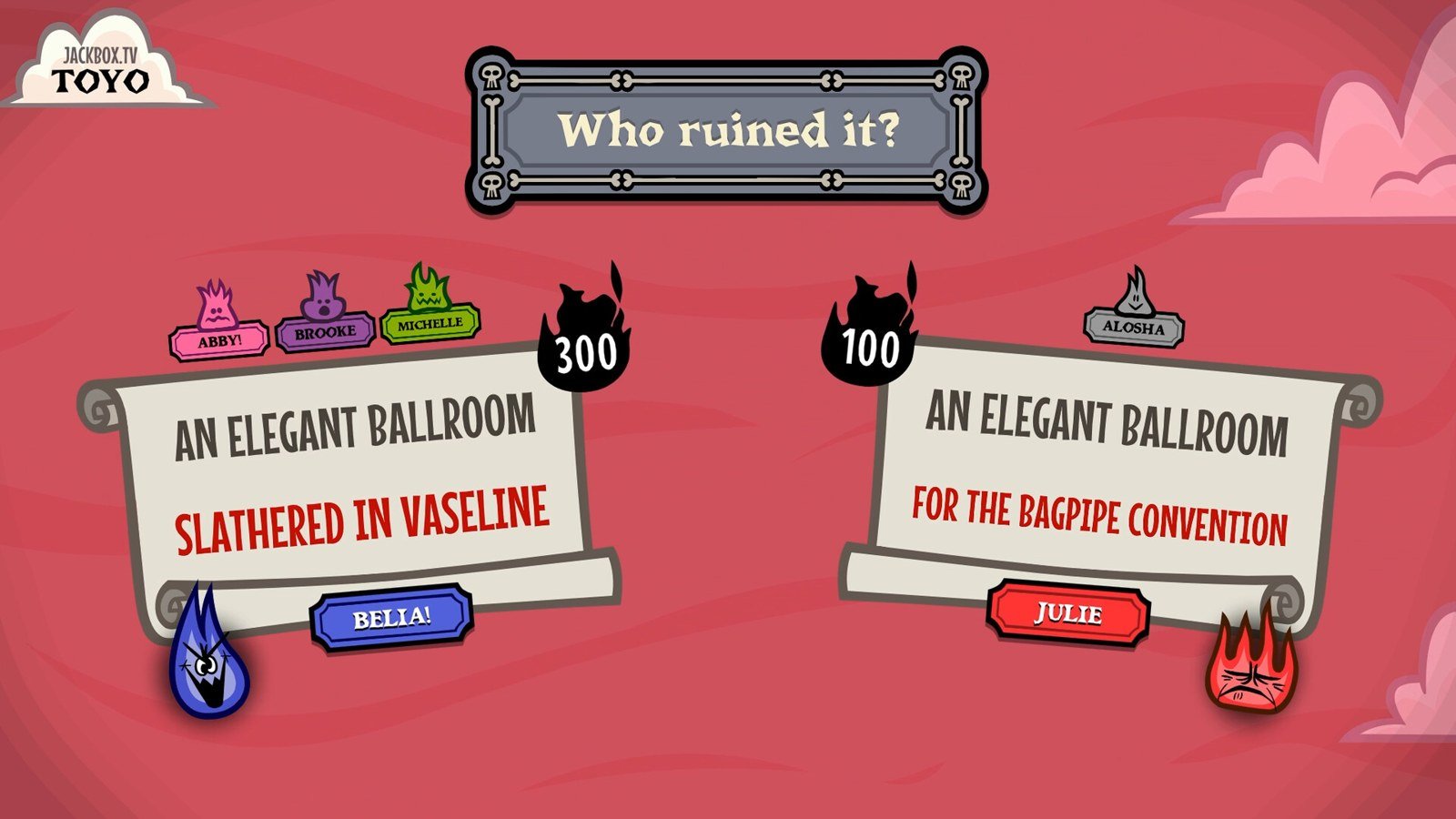
The Jackbox Party Pack 11, launched October 23, 2025, included five new activities. Player limits vary, as do the roles of personal devices. Both Jackbox’s official release announcement and its overview of the five games distinguish them:
- Doominate uses writing to ruin situations in funny ways.
- Hear Say records voices and sound effects on a phone for short scenes.
- Cookie Haus asks players to draw cookies for unusual orders.
- Suspectives mixes answers to questions with investigation and a secret role.
- Legends of Trivia presents knowledge and cooperation in a fantasy setting.
Visual creation, speech, knowledge, and suspicion can all coexist in a collection. A microphone requirement for one activity should not be assigned to the others, and one game’s player limit should not be applied to all five.
The collection released in October 2026

TThe Jackbox Party Pack 12 launched October 15, 2026. The developer’s announcement confirms the PC release on Steam and Epic Games Store, along with PS5, Xbox Series X|S, and Nintendo Switch, featuring five new games:
- We Forgot a Card combines greeting cards with writing for odd occasions.
- MegaPals tests quick associations and insight into how others think.
- Debate and Switch puts opinions and arguments into presentation contests.
- Idol Factions has teams categorize trivia answers under pressure.
- Hyperface uses selfies or supplied pictures and editing tools to respond to prompts.
As of October 22, 2026, Party Pack 12 was already available and was the newest main Party Pack. Trivia Murder Party 3 was a separate project, released in Early Access on September 17, 2026, not a sixth game in that collection. At Camp Mass Acres, trivia is combined with new and reworked challenges. Its launch announcement confirms local play and online matchmaking, a new Jackbox feature that should not be retroactively assigned to earlier Party Packs.
Its official product page still identifies it as Early Access: content, fixes, and systems remain in development.
The consulted Steam listings for Party Pack 11 and Party Pack 12 list English without declaring Brazilian Portuguese. A store page written in Portuguese does not prove that the game content is localized in PT-BR. Check the specific version and platform, especially for questions, instructions, answers, and audio. Understanding the activities can matter more to a group than the number of games in the collection.
Overcooked: dividing the work is the challenge

Overcooked, developed by Ghost Town Games and published by Team17, launched in 2016. Cutting ingredients, cooking, assembling plates, and delivering orders are easy to understand individually, but success depends on synchronizing them. It is not a professional kitchen simulation: it transforms everyday cooking tasks into pressure and coordination.
If everyone chops the same ingredient while nobody watches the stove, excellent individual control does not solve the problem. The team must recognize priorities and communicate changes. Someone might prepare ingredients for the next order while another clears the stage blocking the current delivery.
Levels change routes, access points, and the division of labor. A role that worked at the start may become inefficient when the environment shifts. This requires adaptation rather than a rigid division of jobs. Space is part of cooperation: crossing a passage or handing off an item affects what others can do.
Overcooked! 2 (2018) added more possibilities and online multiplayer. Overcooked! All You Can Eat, first released in 2020, combined rebuilt versions of content from both games with additional features and later expanded to more platforms. Modes and compatibility vary by edition; the 2016 original should not be assumed to support everything introduced later.
It is a cooperative party game because team organization is central to its social experience. That does not make every cooperative RPG or two-player campaign a party game: communication’s role and how sessions are structured can be fundamentally different.
Moving Out, PICO PARK, and divided information
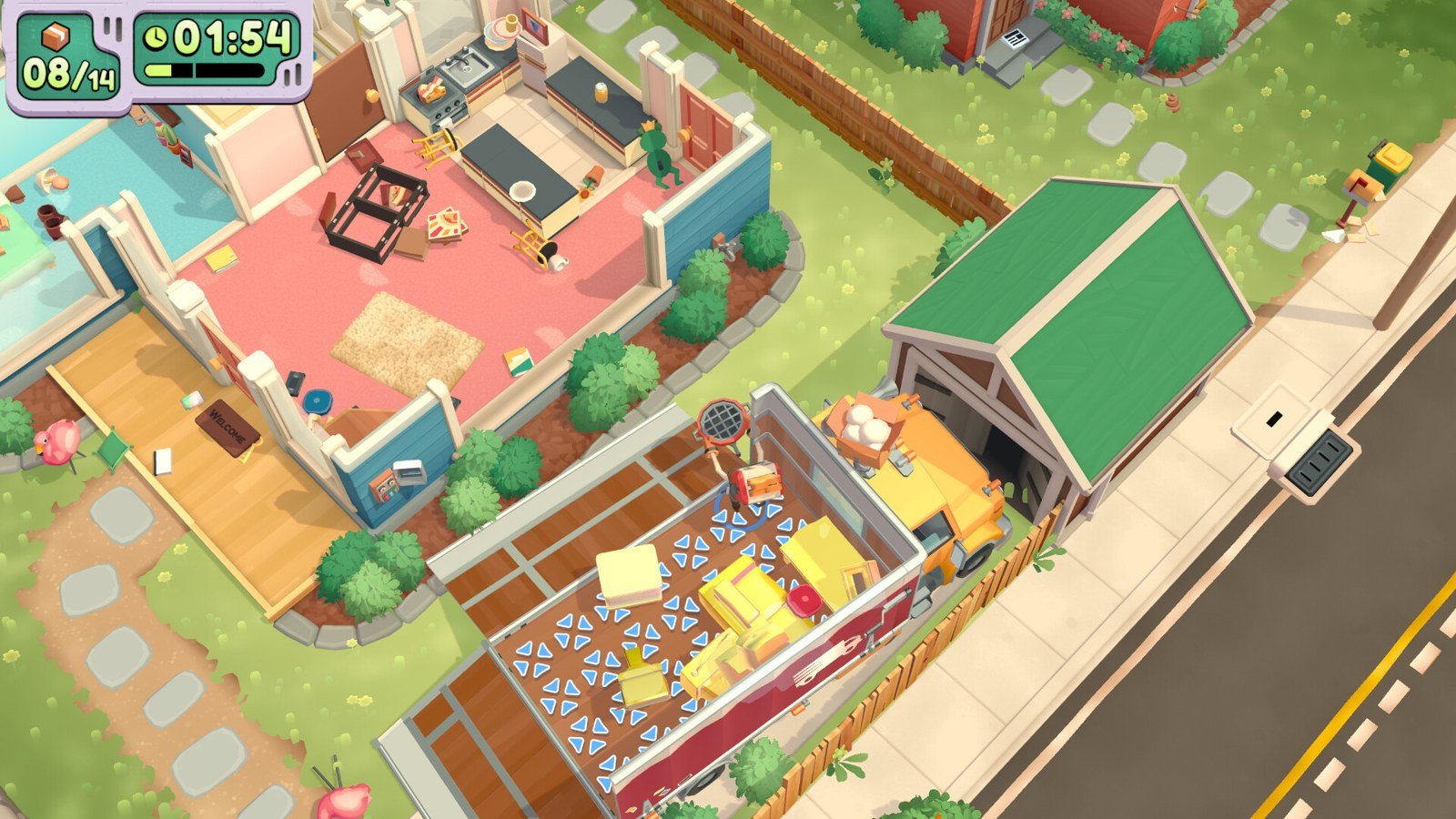
Moving Out (2020), by SMG Studio and DevM Games, features furniture moving, obstacles, and stylized physics. Carrying a sofa may require coordination between players at each end. Knowing the route is not enough if both people’s movements do not line up to pass through a doorway.
Moving Out 2 (2023) expanded the locations and features. The editions are not equivalent in their modes: the sequel added online play, while the original’s identity revolves around local cooperation. Which product you choose changes how the group can get together.

PICO PARK builds cooperation around movement, keys, doors, and obstacles in 2D levels. One participant may need to stand in a particular place to create an opening for others. Progress depends on the entire group instead of simply racing ahead.
The series began with its 2016 original, now known as PICO PARK: Classic Edition, and includes later versions and PICO PARK 2 (2024). Modes and participant limits depend on the edition. Calling it a platformer describes its controls, while collective interaction explains why it is so often played as a party experience.
Keep Talking and Nobody Explodes (2015), by Steel Crate Games, offers a different kind of cooperation. One person sees a fictional bomb; the others consult a manual without seeing the same details. They must describe information accurately and interpret instructions before the timer runs out. Its official press kit documents this split.
The main barrier is not carrying something or controlling the same environment. Participants have complementary information, and communication connects it. Cooperation includes coordinating actions, positioning, and knowledge, which create very different problems.
Stylized physics, arenas, and emergent humor

Gang Beasts, by Boneloaf, circulated in early versions from 2014 and reached its full release in 2017. Awkward characters grab and shove opponents in hazardous arenas. Trying to eliminate someone can throw you off balance, producing a very different outcome from the one intended.
This physics system is not designed to reproduce human movement precisely. It establishes its own language of controls, collisions, and risk. Apparent clumsiness does not eliminate skill: positioning, grabbing, and recognizing openings can still favor experienced players.
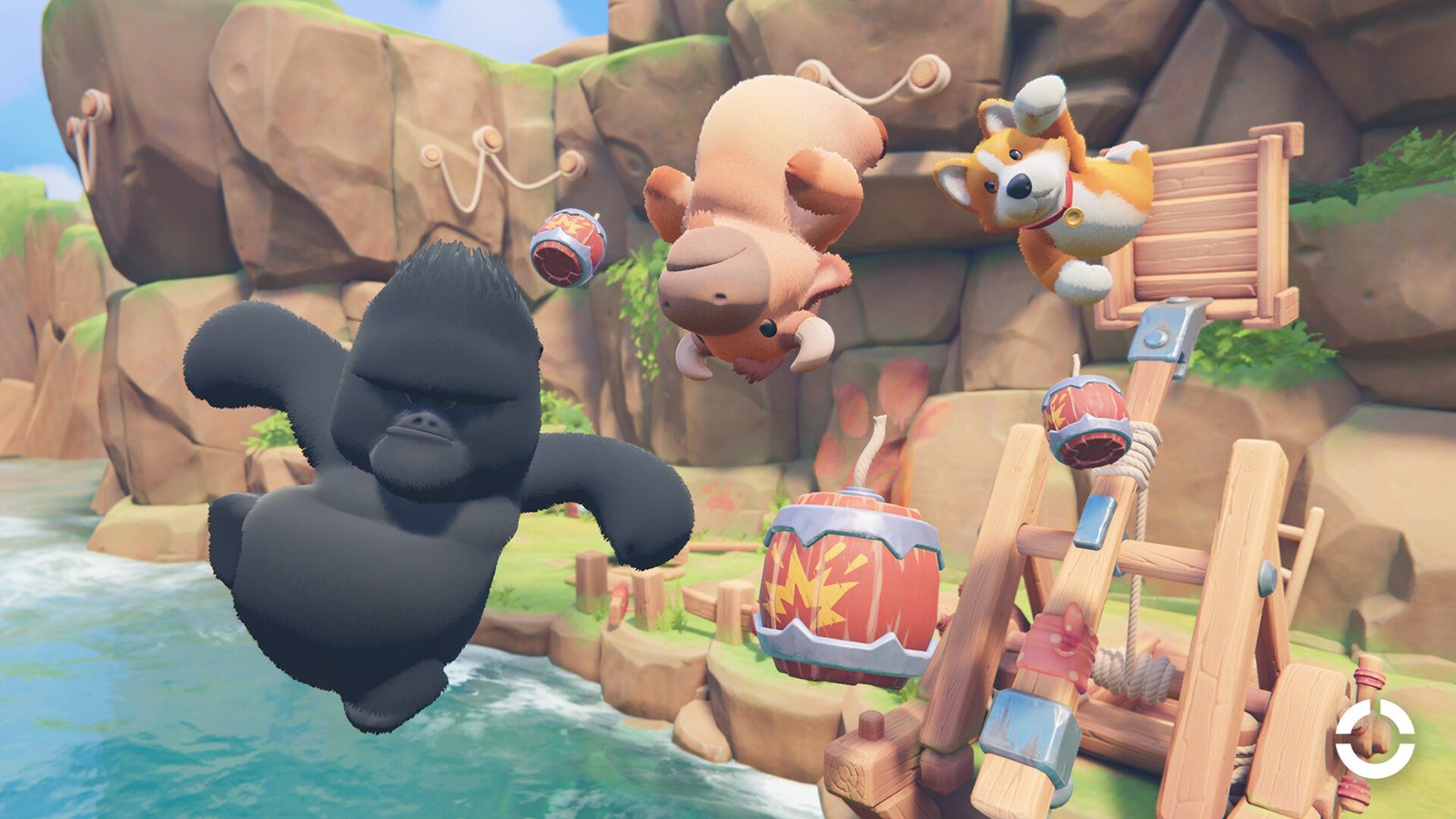
Party Animals (2023), by Recreate Games, uses stylized animal characters, arenas, and competitive activities with its own systems. It shares an interest in exaggerated physical movement but is neither an edition of Gang Beasts nor required to reproduce its rules.
Human: Fall Flat (2016) also uses stylized physics, yet its design is closer to exploration and puzzle-solving, as a puzzle platformer. Cooperation may create humor without replacing that identity. Not every game featuring unsteady characters is primarily a party game.
These experiences illustrate emergent gameplay: events produced by combining rules, environments, and decisions rather than individually scripted scenes for every fall. Humor arises from the gap between intention and result. It is not a universal requirement: other party games value competition or coordination without primarily relying on comedy.
Fall Guys: obstacle courses and round-based elimination

Fall Guys: Ultimate Knockout, by Mediatonic, launched August 4, 2020. Its contests combine races, survival, and other goals across obstacle-filled stages. A round may qualify some participants for the next challenge according to the mode’s rules.
Understanding the finish line is usually immediate, but reaching it involves mastering jumps, routes, and timing. Collisions and other players’ choices alter the outcome without making every victory pure chance. Learning and shared unpredictability coexist.
On June 21, 2022, the game became free to start playing and expanded to additional platforms. The official announcement distinguishes this business-model change from the original launch. Subsequent updates added level creation and sharing.
For the 2026 editorial reference, the official website and news history show that the game continued evolving. The player counts of 2020 cannot simply be applied to all current modes, nor should a creator-made stage be assumed to follow the rules of a traditional competition.
Its connection to battle royale concerns elimination and choosing winners, not mandatory weapons, loot collection, or a massive combat map. It is a hybrid of party game, platforming, and elimination-based competition. Our battle royale feature discusses this overlap without confusing it with PUBG or Fortnite Battle Royale.
Building the challenge: Ultimate Chicken Horse and Pummel Party

Ultimate Chicken Horse (2016), by Clever Endeavour Games, combines platforming with competitive creation. Players place obstacles along a course everyone must attempt. That changes what building means: making a route hard for others is not enough, since the creator must also be able to cross it.
A trap can provide an advantage when it exploits a skill you have mastered, but making a passage impossible may harm the round’s overall result. The level evolves through these choices. Players are no longer simply tackling a challenge prepared by a developer; they also preserve their own decisions in its design.
This freedom operates within a particular structure. Editing tools do not automatically make it an unrestricted sandbox. Competitive context and scoring rules still explain when and why players change the course.
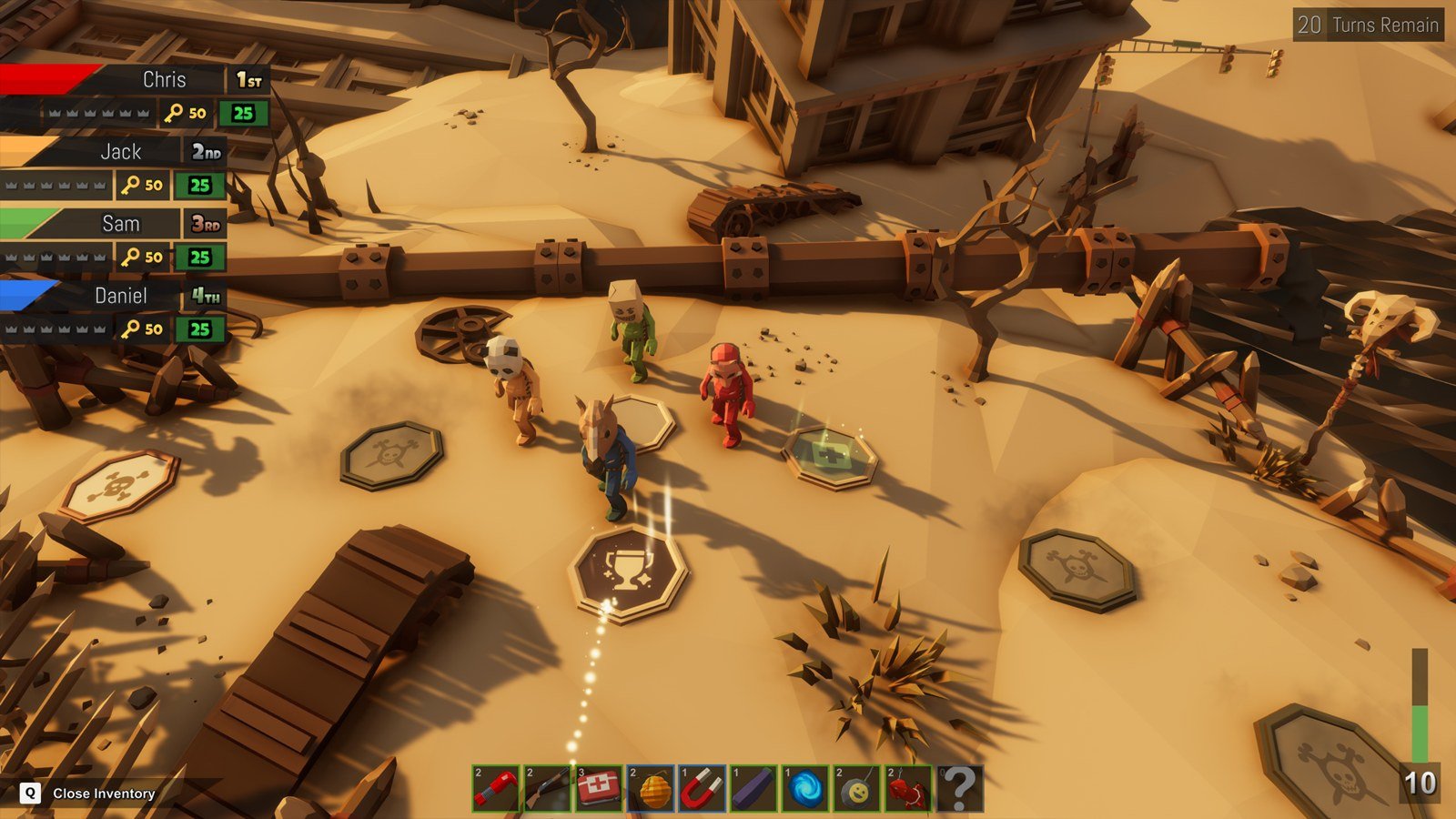
Pummel Party (2018), by Rebuilt Games, combines boards, items, events, and minigames with local and online multiplayer. Its similarities to the Mario Party tradition help explain the design, but its own presentation and rules remain distinct. It is not an official Nintendo sequel or adaptation.
These examples show two paths beyond big console franchises: one has participants create obstacles, while the other ties consequences to boards and challenges. How they operate matters more than simply noting that both can be played with friends.
Words, drawings, and improvisation as mechanics
Gartic Phone, released by Onrizon in 2020, alternates text and drawing in a telephone-game format. One person writes “a cat riding a motorcycle”; someone else draws it; the next participant interprets the picture as “a dog riding a bicycle.” That description becomes another person’s prompt, and the idea keeps changing.
The humor does not depend on a single correct answer at the end. Revealing each transformation allows everyone to compare intention, depiction, and interpretation. Drawing skill can help, but a mistake can be the session’s most memorable event. This is a very different requirement from precision in a physical arena.
Skribbl.io organizes drawing and guessing; Drawful focuses on interpretation and answers; Quiplash emphasizes writing and voting. Guessing a word, inventing a funny answer, and reconstructing a communication chain are separate objectives even when they all use words or pictures.
Shared references influence results. A joke that works brilliantly among friends may fall flat in a different group. Content depends on instructions and the people taking part, an important consideration when planning a family session or playing with strangers. Colorful presentation alone does not dictate the tone of player-generated responses.
Rounds, scoring, chance, and participation rhythm
Many party games alternate preparation, explanation of the goal, action, and results. This is an illustration, not a universal rule. Some feature formal scores; others prioritize finishing tasks or viewing creations without any central competitive ranking.
Reflexes, memory, accuracy, knowledge, and creativity distribute advantages differently. Switching challenges may keep more people involved, but it cannot erase all skill gaps. One player might master multiple activities while another needs more time to understand an instruction or controller.
Chance can create comebacks and keep expectations alive, as with dice and board events. Excessive randomness, however, can reduce the sense that decisions matter. The right balance depends on the concept: a social session need not meet the standards of professional competition, but it should communicate how outcomes occur.
Waiting time is part of design. Long turns and eliminations can leave someone inactive for a while; fast rounds and simultaneous tasks rearrange everyone’s attention. Scores are not the only reason to remain engaged: watching a creation or reacting to a result may also be part of play.
Repeated activities can become predictable. Practice improves execution, yet social novelty also depends on participants, modes, and variations. Adding more minigames does not automatically fix a session whose pace, language, or demands are mismatched with the group.
Local, online, phones, and audiences: different models
Local multiplayer can use one shared screen, separate split-screen areas, or turns at the controller. These options change what people see and when they act. Playing at the same television does not require dividing it permanently into four sections.
Proximity helps people observe reactions and talk directly, but devices still matter. Some games need extra controllers; others require accessories or browsers. Four willing people do not guarantee that a specific edition supports four slots in the chosen mode and setup.
Native online multiplayer uses a game’s own services to connect participants. Private rooms and invitations can organize friends, while matchmaking brings people together in another way. Streaming one game’s screen and joining with a code, as often happens with Jackbox, is not automatically the same system.
Crossplay can connect different platforms when supported. It does not mean all versions, modes, and products in a franchise are compatible. Upgrade packs, rebuilt editions, and original releases may have different requirements. The name of a series alone does not establish interoperability.
Connections and latency—the delay between an action and its response—also affect participation. Reflex challenges can be sensitive to tiny delays; trivia and drawings operate on different timings but are not immune to a late stream. Shared information must stay synchronized with what each participant can submit.
Spectators may watch only or vote in compatible games. Streaming does not make an entire audience active players. Requirements, slots, and interaction features must be checked by title instead of attributing every Jackbox feature to every party game.
Party games and the genres they overlap with
A social purpose can coexist with movement, combat, music, and investigative mechanics. The table compares different emphases without claiming exclusive categories.
| Category | Main focus | Examples | Connection with party games |
|---|---|---|---|
| Party games | Social interaction through approachable challenges | Mario Party, Jackbox | Core category |
| Platformers | Movement and obstacles | Celeste, PICO PARK | Can underpin social challenges |
| Racing | Driving and competition on courses | Mario Kart, Crash Team Racing | Can offer casual group competition |
| Fighting games | Character-based combat systems | Street Fighter, Super Smash Bros. | Can have a strong social dimension |
| Rhythm | Actions synchronized with music or patterns | Just Dance, Rock Band | Can support competition or cooperation |
| Sports | Representations of sporting activities | Wii Sports, Nintendo Switch Sports | Can offer approachable social experiences |
| Puzzle | Problem-solving | Human: Fall Flat, Portal 2 | Can involve cooperation and communication |
| Battle royale | Elimination-based survival competition | PUBG, Fortnite | Shares elimination features with Fall Guys |
| Social deduction | Hidden roles, suspicion, and deduction | Among Us, Goose Goose Duck | Can work as party entertainment |
PICO PARK and Ultimate Chicken Horse use jumps and obstacles, as explained in our platform games feature. Mario Kart and Crash Team Racing retain racing as their central mechanic, as explored in our racing feature, even when items and local rivalries create party-like moments.
Super Smash Bros. has a platform-fighting identity, and physical arenas such as Gang Beasts do not follow the systems of Street Fighter or Tekken. The fighting games feature explains those traditions. Being a good social activity does not require abandoning the core combat system.
Just Dance, SingStar, and Rock Band rely on dancing, singing, and musical performance. Their party appeal coexists with synchronization and performance rules discussed in our rhythm games feature. Wii Sports and Nintendo Switch Sports also retain the sports connection explored in the sports games feature.
Human: Fall Flat uses physics and problem-solving; our puzzle feature offers context. Cooperation and humor do not turn every puzzle experience into a minigame collection.
Where does social deduction fit?
Social deduction uses hidden roles, incomplete information, suspicion, and interpreting intentions as core mechanics. Among Us and Goose Goose Duck organize sessions around those relationships. That is different from merely competing, voting for a joke, or guessing a drawing.
Suspectives illustrates how social deduction can exist inside a party-game collection. This does not mean every party game has an impostor or that Gartic Phone revolves around discovering a secret role. One category describes broad social entertainment; the other identifies a specific structure of information and investigation between participants.
Language, accessibility, and choosing the right group experience
Trivia may require more language proficiency than an obstacle challenge. In creative activities, understanding instructions and cultural references is part of playing. A translated store listing does not guarantee an in-game translation, and subtitles do not prove every voice line or question is localized.
Few controls do not automatically make a game universally accessible. Motion controls can make a gesture easier to understand while making participation harder for people with different motor needs. Fast reflexes, low contrast, and overly brief instructions create different barriers.
Subtitles, contrast settings, clear icons, alternative controls, and adjustable timers may help when available. These features must be verified for the chosen edition. No single accessibility option is mandatory and identical across all party games.
Audiences also differ. Some games are family-friendly, while others feature mature humor or subjects. In text and drawing games, participants create part of the content; when playing with strangers, communication and moderation depend on the available tools. Check age ratings for the relevant region instead of assuming an international rating directly matches Brazil’s.
To choose a session, consider group size, time available, devices, and the desired participation style. Board games emphasize consequences across rounds; cooperative tasks need coordination; trivia relies on language; creative games reward interpretation; arenas and obstacles demand execution. The best choice fits the people present, not necessarily the collection with the most activities.
Timeline: different paths to party gaming
This selection includes predecessors and different formats. It is not a ranking of the best games to play with friends. Dates identify the specified debut, distinguishing regions, Early Access, full release, and expanded editions.
| Game | Year | Contribution or characteristic |
|---|---|---|
| Pong | 1972 | Predecessor of local electronic competition |
| You Don’t Know Jack | 1995 | Humorous digital trivia with game-show presentation |
| Mario Party | 1998, Japan; 1999, other regions | Combined boards and minigames into a popular formula |
| Mario Party 2 | 1999, Japan | Expanded the original formula |
| WarioWare, Inc.: Mega Microgame$! | 2003 | Popularized extremely fast microgames |
| Buzz! | 2005 | Quiz play with dedicated controllers |
| Wii Sports | 2006 | Approachable social sporting activities |
| Rayman Raving Rabbids | 2006 | Varied minigames, controls, and humor |
| Wii Play | 2006, Japan | Activities exploring Wii Remote features |
| WarioWare: Smooth Moves | 2006, Japan | Motion-controlled microgames |
| Wii Party | 2010 | Varied social formats with Mii characters |
| Wii Party U | 2013 | New activities using Wii U features |
| The Jackbox Party Pack | 2014 | Personal devices as controllers |
| Keep Talking and Nobody Explodes | 2015 | Communication and asymmetric information-based cooperation |
| Overcooked | 2016 | Team coordination under pressure |
| Ultimate Chicken Horse | 2016 | Competitive construction of obstacles |
| Human: Fall Flat | 2016 | Physics and cooperative puzzle-solving |
| Gang Beasts | 2017, full release | Stylized-physics confrontations and humor |
| Pummel Party | 2018 | Boards and minigames with local and online multiplayer |
| Moving Out | 2020 | Cooperative furniture moving |
| Fall Guys | 2020 | Round-based elimination obstacle contests |
| Gartic Phone | 2020 | Communication through text and drawing |
| Party Animals | 2023 | Competitive multiplayer with stylized physics |
| Super Mario Party Jamboree | 2024 | Expanded boards, minigames, and modes |
| Super Mario Party Jamboree – Nintendo Switch 2 Edition + Jamboree TV | 2025 | Camera, microphone, and mouse-style interactions |
| The Jackbox Party Pack 11 | Oct. 23, 2025, official release notice | Creativity, sound, drawing, trivia, and social deduction |
| Trivia Murder Party 3 | Sept. 17, 2026, Early Access | Trivia challenges with local play and online matchmaking |
| The Jackbox Party Pack 12 | Oct. 15, 2026, official release notice | New group activities involving debate, writing, pictures, and trivia |
The evolution continues through new ways of bringing people together
By October 2026, board games, microgames, creativity, cooperation, and online competitions still coexist. Jamboree TV adds ways to use devices; Party Pack 12 explores writing, debate, associations, and images; level creation, physics, and team challenges offer other approaches. Phones have not replaced every controller, and the rise of online play has not removed the importance of local gatherings.
Party games are not simply games with multiple participants. They are designed to turn competition, cooperation, creativity, and unpredictable moments into shared entertainment. Sometimes winning is the point of the night; other times the memorable moment is an improvised solution, an interpreted drawing, or something nobody planned.
About the Author