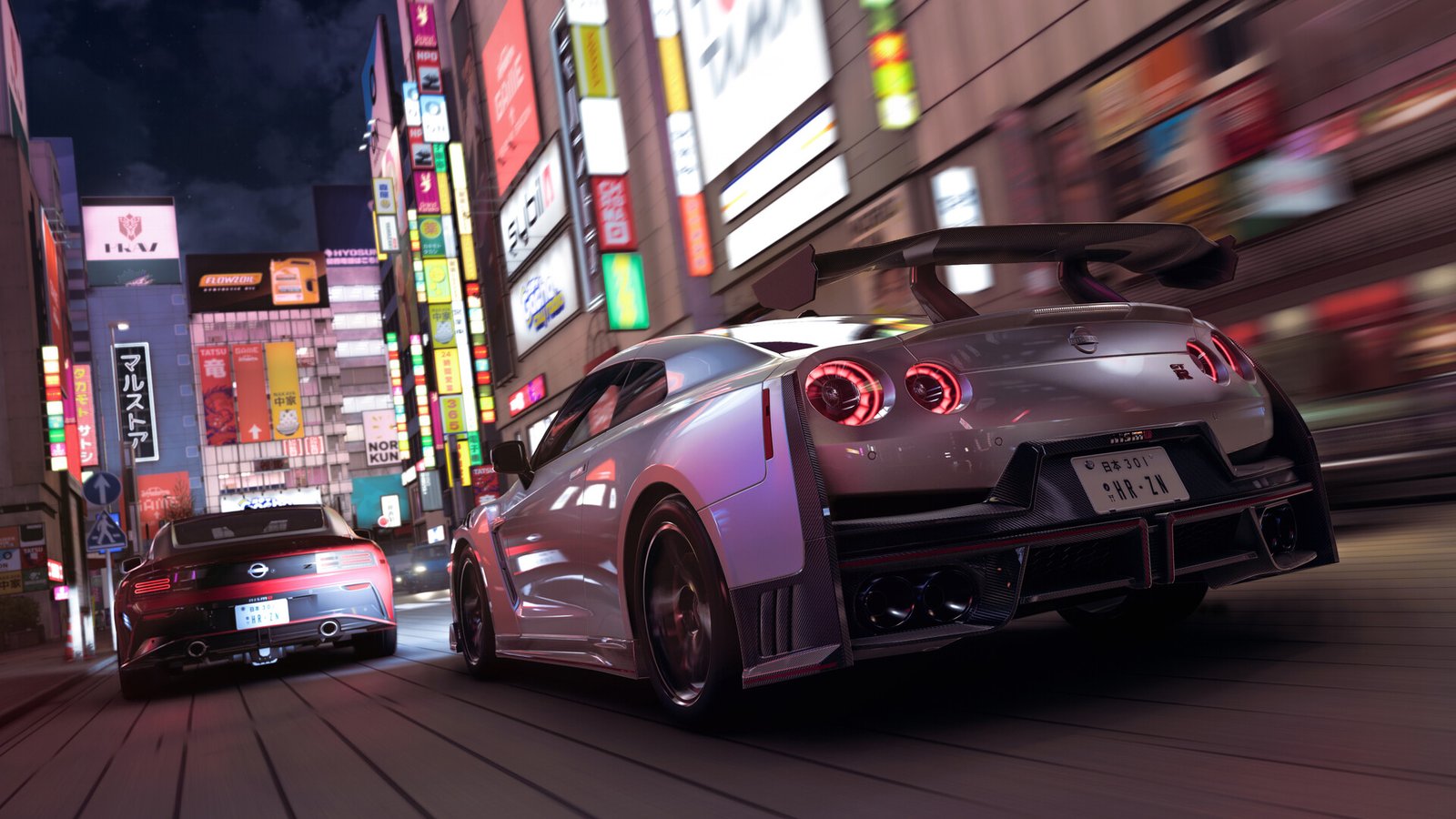
Corrida urbana no Japão de Forza Horizon 6. Imagem: Playground Games / Xbox Game Studios.
Nesta matéria
You approach a corner at high speed while fighting for position. Trying to overtake immediately might send you off the track; braking and choosing a better exit could let you accelerate sooner on the following straight. This relationship between speed, racing line, and decisions lies at the heart of racing video games, or racing games.
From early arcades to online simulators and open worlds, the genre has developed many ways to compete. This feature explores its history, the fundamentals of driving, and the differences between item-based kart races, rally stages, circuits, and contact racing.
Updated October 21, 2026.
What defines a racing game?
Racing games focus on driving and challenges involving travel, time, or finishing position. Competitors may share a track, compare times from separate starts, or pursue goals specific to a racing discipline. Circuits, point-to-point roads, and explorable worlds are all possible formats; simultaneous opponents, laps, realism, and multiplayer are not requirements.
Does every racing game need cars?
The motorcycles of Hang-On, futuristic vehicles of F-Zero, and karts of Mario Kart show that cars are not essential. Boats, aircraft, and fictional machines can also support racing when mastering a route and competing for a result are central.
Is every game with vehicles a racing game?
In Euro Truck Simulator 2, driving primarily serves cargo transportation; Microsoft Flight Simulator organizes flying experiences; BeamNG.drive offers experiments with physics, vehicles, and challenges—including races—without being limited to competition. Driving and racing are related but different. Our comparison of racing, simulation, sports, and platform games explores that distinction.
The origins of racing video games
Electromechanical machines with steering wheels, pedals, and road mechanisms predate video games. They should be distinguished from digital electronic representations: controlling a vehicle, competing in movement, and establishing motor racing in games are different milestones. No one person invented every aspect of the genre.
Space Race: a space competition in 1973
Atari’s Space Race (1973) appears in the company’s historical videography, preserved by the Computer History Museum. Spaceships raced across a screen while avoiding obstacles. It was an early example of competing through movement, not a representation of motorsports.
Gran Trak 10: steering wheel and circuit in a video game
Atari’s Gran Trak 10 (1974) combined a steering wheel, pedals, and gear selector with a top-down car on a black-and-white track. Steering through corners and covering distance within a time limit earned points. The cabinet connected physical driving actions to a digital challenge.
Its milestone was the integration of car, circuit, and automotive controls. It lacked modern physics, opponents, and progression, and it was not the first electronic competition involving any kind of vehicle.
Speed Race and Sprint: other ways to compete
Taito’s Speed Race (1974) used a vertically scrolling road, challenging players to follow curves and avoid vehicles. Atari’s Sprint 2 (1976) allowed two players in a top-down view: beyond controlling the car, each player had to outperform another person.
Night Driver and the road perspective
Atari’s Night Driver (1976) suggested depth using illuminated elements along a night road. Staying on course and anticipating bends created a forward-facing driving sensation with limited visuals. Different viewpoints coexisted; history was not a simple progression in which one camera replaced another.
Pole Position and the rise of arcade racing

Namco’s Pole Position (1982) popularized the view behind the car, with the track extending toward the horizon. Its presentation made it easier to anticipate corners and sense speed, while its format resembled a motorsports event.
Qualifying determined whether the player could enter the main race. During the event, corners, opponents, obstacles, and the clock put pressure on driving. The combination of qualifying and racing was influential, but it did not invent every mechanic that followed.
Its viewpoint was not modern 3D simulation: period graphics techniques created an impression of depth. Pole Position II (1983) carried the formula forward with new tracks.
Hang-On and Out Run: when driving became an arcade experience
At SEGA in the 1980s, projects associated with Yu Suzuki explored cabinets, the presentation of speed, and route choices in different ways.
Hang-On: motorcycle riding
Hang-On (1985) featured a motorcycle seen from behind, racing against time and other vehicles. Some cabinets resembled a motorcycle: leaning the body helped control movement, making the machine itself part of the experience. That physical control was not available in every racing cabinet.
Leaning and weight distribution introduce distinct challenges, simplified under Hang-On‘s arcade rules. Super Hang-On (1987) expanded routes and features in a tradition that would also develop through circuit racing and motocross.
Out Run: speed, music, and route choices

Out Run (1986) combined a sports car inspired by the Ferrari Testarossa with music and scenery on a journey against the clock. At forks, players could select a different upcoming section, experiencing new routes across attempts. Choosing branches is not the same as freely roaming a modern open world.
Reaching checkpoints before the timer expired required driving skill, while the feeling of a road trip came from the soundtrack and environments too. Stylized handling gave the game its own identity rather than faithfully reproducing a real car. Arcade accessibility does not eliminate skill or the need to master a route.
From computers and consoles to new kinds of racing
During the 1980s and 1990s, computers and consoles expanded vehicle selection, modes, and progression. Lotus Turbo Challenge, Top Gear, and Super Monaco GP took racing traditions beyond arcades. This involved new challenges, not merely better graphics.
F-Zero: speed beyond real motorsports
Nintendo’s F-Zero (1990), for the Super Famicom, featured futuristic vehicles and graphics suggesting depth. Corners and obstacles demanded control at high speeds under fictional rules. F-Zero X (1998) and GX (2003) developed three-dimensional environments and other forms of competition within this tradition.
Super Mario Kart and the popularity of item-based racing

Nintendo’s Super Mario Kart (1992), for the Super Nintendo, brought together characters, karts, and items that could affect the race. Driving well and leading were not enough: players had to account for attacks, obstacles, and opportunities created by other racers. Track knowledge and item management became complementary skills.
Kart racing also describes competition with small vehicles in real life, but video games developed an arcade tradition with characters and distinctive rules. Items may attack, protect, or grant a temporary advantage. Each game decides how to combine them with driving; not every colorful car game is automatically a kart racer.
Mario Kart 64, Double Dash, and Mario Kart 8
Mario Kart 64 (1996 in Japan) expanded 3D and multiplayer; Double Dash!! (2003) put pairs in one vehicle; the Wii game (2008) explored new controls; Mario Kart 7 (2011) introduced gliding and underwater sections. Mario Kart 8 (2014) added anti-gravity, with the Deluxe edition (2017) expanding the experience. These mechanics did not all exist in the 1992 original.
Mario Kart World: an interconnected world
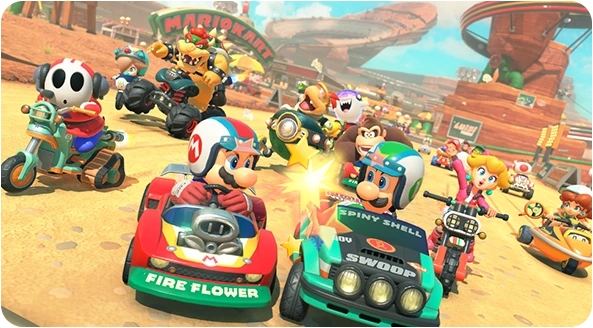
Mario Kart World launched on Switch 2 on June 5, 2025, with connected regions and roads. Free Roam allows exploration outside races; Knockout Tour links courses with up to 24 drivers and eliminations at checkpoints. This is the franchise’s own application of an explorable world, not the invention of that structure across all racing games.
Version 1.5.0 added team competition to Knockout Tour in January 2026. The September 1.8.0 update brought Propeller and Turnip rallies and more selectable courses. These changes demonstrate post-launch support without turning each update into a new game.
Other kart racers
Diddy Kong Racing (1997) combined vehicle types; Crash Team Racing (1999) developed its own movement and items; Sonic & All-Stars Racing Transformed (2012) used vehicle transformations; and Team Sonic Racing (2019) emphasized teams. Disney Speedstorm has its own abilities and progression.
In Sonic Racing: CrossWorlds (2025), mid-race world changes, items, and gadgets shape competition. The October 8, 2026, version 1.4.3 notice documents ongoing support and fixes. These systems should not be treated as identical to Mario Kart‘s.
Ridge Racer, Daytona USA, and Sega Rally: new arcade possibilities
Polygonal arcades of the 1990s broadened how cars and tracks were represented, but each franchise established a distinct relationship between speed, control, and competition.
Ridge Racer: stylized drifting
Namco’s Ridge Racer (1993) made stylized drifting part of cornering mastery. Learning when to initiate and control a slide was a skill under its arcade rules; this did not reproduce tire behavior in a modern simulator.
Daytona USA: competing on three-dimensional tracks
SEGA’s official archive dates Daytona USA‘s arrival in Japanese arcades to March 1994. Polygonal races, overtaking, and linked cabinets allowed players to contest position. Arcade-oriented handling provided its own competition without fully recreating real-life motorsports.
Sega Rally Championship: different surfaces
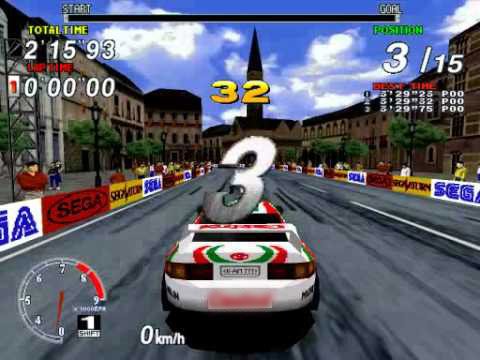
SEGA’s official history records Sega Rally Championship in Japanese arcades in February 1995; the Saturn version also arrived in 1995. Early showings are not the same milestone as release.
Moving from asphalt to dirt changes a vehicle’s response and forces drivers to adapt speed and control. Surface conditions become part of the challenge rather than mere scenery. This arcade interpretation differs from fully simulating a real rally stage.
Need for Speed: from supercars to street racing

The Need for Speed (1994) debuted on 3DO, published by Electronic Arts and developed by EA Canada, whose roots lay in Distinctive Software. Sports cars and roads defined the start of a series that would change direction across generations. Police, open maps, and extensive customization are not present in the same form in every installment.
Hot Pursuit and police chases
Need for Speed III: Hot Pursuit (1998) highlighted racers and police officers. Pursuit adds threats beyond racing opponents, requiring players to respond to interventions during an event. This defines certain periods of the franchise, not every game.
Underground and customization
Underground (2003) brought urban racing together with customization: developing a car’s appearance and performance became part of the campaign. Underground 2 (2004) expanded this identity into an explorable urban environment.
Most Wanted and different phases of the franchise
Most Wanted (2005) combined progression and pursuits; the 2012 game with the same name, developed by Criterion, has a different structure. Carbon, ProStreet, Hot Pursuit (2010), Rivals, and Heat show other directions. Unbound (2022) combines street racing, customization, and stylized visual effects without defining one permanent formula for the whole series.
Gran Turismo: automotive culture on another scale

Gran Turismo debuted on Japanese PlayStation on December 23, 1997. Kazunori Yamauchi’s team worked at Sony Computer Entertainment and formed Polyphony Digital in 1998, according to Polyphony Digital’s history. Licensed cars, events, collecting, and driving became an influential combination on consoles; this does not mean it invented vehicle simulation.
Weight, power, braking, and other characteristics require different approaches for different models. This effort to represent cars helped define the series without promising a perfect reproduction of reality.
License tests present driving challenges; racing events let players earn resources and expand their garage. Learning and progressing are connected with discovering cars and classes. Later generations expanded tracks, photography, and online activities.
Gran Turismo 7 and its evolution through 2026
Gran Turismo 7 (March 4, 2022, PS4/PS5) retains car collecting, licenses, tuning, and assisted competitive modes. The first part of the free Spec IV update arrived in October 2026 as update 1.72, bringing six cars, Sportsland SUGO, and garage and driving features. Part 2 was scheduled for December, still in the future as of October 21.
The series combines automotive culture and accessibility, with priorities different from specialized services such as iRacing.
Forza Motorsport and Forza Horizon: two different approaches
Motorsport focuses on circuits and automotive competition; Horizon combines a festival, exploration, and events in a connected world. Sharing the Forza name does not make their structures equivalent.
Forza Motorsport: circuits and competition
Turn 10’s Forza Motorsport (2005) for Xbox began a tradition of licensed cars, tuning, and events on racing circuits. The October 10, 2023, release is officially named simply Forza Motorsport, without “8” in its title, and retains that track focus.
What happened to Forza Motorsport after 2023?
In its official December 2025 review, Turn 10 said it did not plan additional cars, tracks, features, or regular fixes for the 2023 game. Servers, events, and returns of earlier content would continue. Maintaining a service differs from developing new features; this also did not announce the permanent end of the intellectual property.
Forza Horizon: speed and exploration

Playground Games’ Forza Horizon (2012) placed races and challenges across the roads of an explorable festival. Horizon 4 (2018) used Britain and seasons; Horizon 5 (2021) moved the formula to Mexico. Driving between events became part of the identity alongside competition.
Forza Horizon 6: Japan in 2026
Forza Horizon 6 released for Xbox Series X|S and PC on May 19, 2026, with Premium access from May 15. Japan provides urban areas, mountains, roads, and events, connecting exploration, collecting, and festival progression.
The PlayStation 5 release was announced for January 26, 2027 in Standard/Deluxe editions, with Premium access on January 21. That remained in the future at the October 21, 2026, editorial cutoff, and should not be confused with the Xbox/PC release.
| Feature | Forza Motorsport | Forza Horizon |
|---|---|---|
| Main setting | Circuits and racing facilities | Open world with roads and regions |
| Emphasis | Motorsport competition and driving | Racing, exploration, and festival |
| Event structure | Events organized on tracks | Events spread across the map |
| Driving feel | Closer to the circuit-racing tradition | Handling adapted to varied events |
| Recent example | Forza Motorsport (2023) | Forza Horizon 6 (2026) |
This table compares design and driving priorities. It does not rank the series or assume both share the same physics model.
How does racing work in video games?
Choosing a vehicle, learning the course, controlling speed, and adapting to opponents form an illustrative loop, not a fixed sequence. Two games with identical buttons can feel different: steering, braking, tires, mass, suspension, and surfaces depend on the physics model. A race may reward time, position, items, or pit-stop strategy.
Acceleration and braking
Accelerating raises speed according to the vehicle and the game’s rules. Braking reduces it for obstacles and corners. Imagine approaching a tight bend. Entering too fast may make it impossible to hold your intended line. Slowing down before entry may allow a more controlled exit, even if you lose some speed briefly. In an arcade racer, however, the behavior may differ. Some games encourage maintaining high speed and using exaggerated drifts to clear corners.
Traction and grip
Grip concerns the ability to transmit force between tires and the ground without excessive slipping, helping the car brake, accelerate, and turn within limits. In simplified terms, traction involves delivering the forces needed to move the vehicle. Games represent these properties with varying complexity. A car may react differently to acceleration on pavement and dirt, or lose stability in a corner. There is no single physics model shared by every racing game.
Weight transfer describes changes in vertical load on tires during braking, acceleration, or turning: under braking, the front axle tends to gain load while the rear is relieved. Simulation choices affect the vehicle’s response. Understeer means the front end fails to follow the desired turn, tending to run wide; oversteer means the rear loses proportionally more grip and the vehicle rotates further than intended. These are distinct behaviors, not synonyms for any slide.
Why the racing line matters
A racing line is the path chosen through a section. Approaching a corner means deciding when to brake, where to turn in, and when to accelerate again. The apex is the point where the line passes closest to the inside of the corner. Its position depends on the chosen line and is not necessarily the geometric midpoint. The best option also depends on speed, vehicle, grip, and race conditions.
If another driver occupies the desired line, you must adapt. Good racing is not simply finding one theoretical path and repeating it without considering opponents.
Tracks and surroundings
Tight turns emphasize control and braking; long straights favor acceleration and top speed. Rally surfaces, futuristic obstacles, and fictional vehicles change the demands. The track helps define the challenge without necessarily recreating real-world physics.
Arcade, simcade, and simulation: three driving priorities
| Approach | Main priority | Examples |
|---|---|---|
| Arcade | Speed, accessibility, stylized handling | Out Run, Ridge Racer, Mario Kart, Burnout |
| Simcade | Balance between automotive representation and accessibility | Gran Turismo, Forza Motorsport |
| Simulation | Greater attention to technical behavior and racing rules | iRacing, Assetto Corsa, rFactor 2 |
The table distinguishes design priorities, not a universal quality scale. Boundaries can be blurry, and assists may affect the experience.
Arcade racing
Arcade games may simplify drifting, exaggerate responses, and reduce some penalties to favor pace and approachable controls. This does not mean they lack physics, strategy, or difficulty: understanding controls quickly is different from mastering them.
What is simcade?
Simcade informally combines “simulation” and “arcade” for games balancing driving characteristics with accessibility. Gran Turismo and Forza Motorsport often appear in these discussions, but there is no mandatory certification or consensus. Difficulty alone does not measure realism.
What is sim racing?
Sim racing pays closer technical attention to cars, tires, suspension, track conditions, and sometimes competitive rules. Physics models and racing classes differ. No simulator reproduces everything perfectly; using a wheel does not turn every game into a simulation, and using a controller does not rule it out.
Assetto Corsa and the evolution of simulators

KUNOS Simulazioni’s Assetto Corsa entered Early Access in 2013 and received a full release in 2014. Physics, tires, tuning, and circuits guide driving. PC modders added cars and tracks, but popular community files do not automatically become official content.
Assetto Corsa Competizione
Competizione (full PC release in 2019) focuses on simulation around GT categories, licenses, and competitions. It is more than a larger catalog for the original: its focus on specific cars, regulations, and events defines a separate project.
Assetto Corsa EVO in 2026
EVO began Early Access on January 16, 2025, and received update 0.9 on August 26, 2026. The official page still labels it Early Access and records the October 7 Free Roam reveal. Announcing this feature is not the same as fully delivering everything promised—or releasing version 1.0.
iRacing: organized online competition
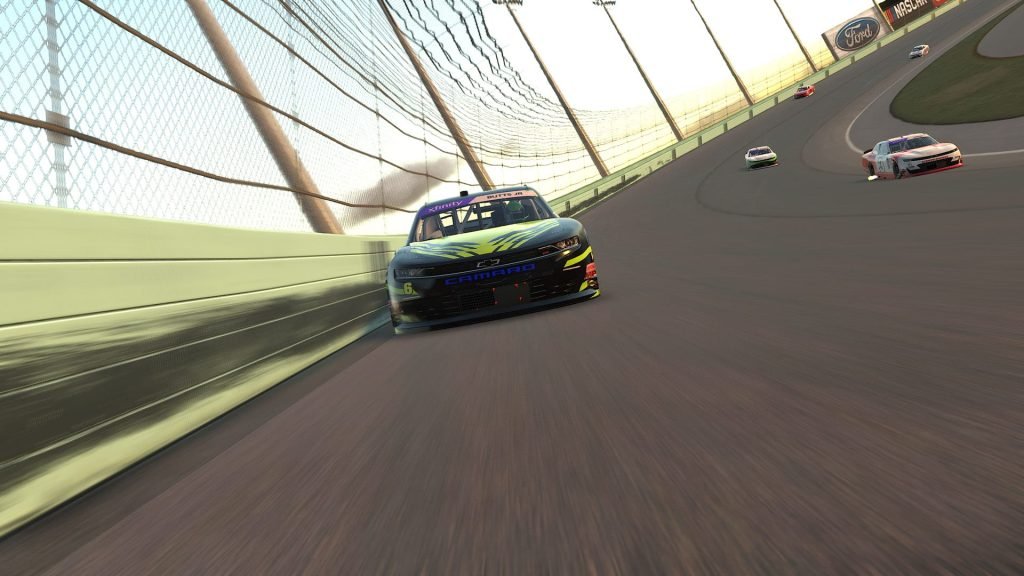
iRacing (2008) combines car and track simulation with structured online racing. Schedules, participation requirements, and ratings are part of its identity alongside steering physics.
iRating and Safety Rating
iRating measures competitive performance relative to other drivers, separately by racing discipline. It helps group drivers with similar performance. Safety Rating instead considers incidents and completed corners in eligible sessions. It is not an individual determination of fault for every contact. The two metrics serve different purposes.
A fast driver may still need greater consistency and safety; likewise, driving cautiously does not automatically produce the best competitive placement.
Licenses and classes
Licenses and eligibility conditions regulate access to events based on safety and participation requirements. High iRating and a high license class are different. The model includes a subscription and specific content terms; no other simulator is required to follow this model.
Other simulators
rFactor 2, RaceRoom Racing Experience, and Automobilista 2, by Brazilian developer Reiza Studios, prioritize different classes and systems. Sim racing encompasses several studios and competition models.
Rally, circuits, and off-road racing
Circuits commonly involve laps; rally often compares times on special stages. Rallycross puts cars on mixed-surface circuits at the same time. Off-road is a broader label for driving away from paved roads, not automatically rally.
Rally: the clock can be the opponent
In many rallies, competitors tackle timed special stages; standings depend on recorded times across sections. Drivers therefore do not necessarily have to overtake another car during a stage to improve their position. Navigation matters too: co-drivers provide information about turns and course conditions. Games usually convey this through visual cues and voice calls, depending on their design.
Colin McRae Rally, DiRT, and WRC
Codemasters’ Colin McRae Rally (1998) popularized the discipline on computers and consoles. DiRT broadened off-road events; DiRT Rally and 2.0 focused on rally driving. Richard Burns Rally (2004) became a simulation reference; EA Sports WRC (2023) continued the licensed tradition. Art of Rally has a distinct stylized visual interpretation.
The state of EA Sports WRC in 2026
In April 2025, EA said the 2024 season expansion would be the last for EA Sports WRC and paused plans for new rally games. The title remained available, without a promise of annual sequels or continued expansions. Availability and active development are different conditions.
Off-road, motocross, and rally raid
MotorStorm uses varied terrain and vehicles with arcade handling; MX vs. ATV explores motorcycles and quads; Dakar Desert Rally represents navigation and long distances. Motocross also emphasizes jumping and landing. On dirt, mud, or gravel, adjusting speed and line can be decisive, depending on the game.
Formula 1 and licensed motorsports games
Licensed games may represent single-seaters, teams, qualifying, tires, pit stops, weather, and regulations to varying degrees. The Codemasters/EA series is a reference; an official license does not automatically make a game a professional simulator.
Strategy beyond speed
In some Formula 1 games, tire choice affects driving and when to stop. Players also consider wear, weather, and race rules. A decision may favor one stage but create problems later, so competition can involve planning beyond cornering. Not every edition uses exactly the same systems.
What happened to F1 in 2026?
The season arrived on June 3, 2026, as the paid F1 25: 2026 Season Pack, while the Season Edition bundles the base game and pack. EA announced a new main experience for 2027, still future as of October 21. This was not an independent annual title called F1 26.
Is F1 Manager the same kind of game?
F1 Manager organizes team and strategy decisions instead of direct driving as in the main series. Sharing the motorsport does not make both experiences equivalent.
Motorcycle racing: tracks, leaning, and balance
MotoGP depicts road racing; Ride explores motorcycles across varied environments and classes; MXGP and Supercross make terrain and circuit conditions central to their disciplines.
Why does riding a bike change the challenge?
Leaning and managing weight transfer through corners changes the connection between line and acceleration. In motocross, preparing jumps and landings adds another demand. Each game simplifies or details these reactions differently: switching from a car to a bike is not merely a visual swap.
MotoGP 26
Milestone’s MotoGP 26 released on April 29, 2026, with the official season and systems connecting rider movement to motorcycle behavior. Its development illustrates motorcycling’s distinct technical tradition.
Burnout and Wreckfest: when collisions become part of racing
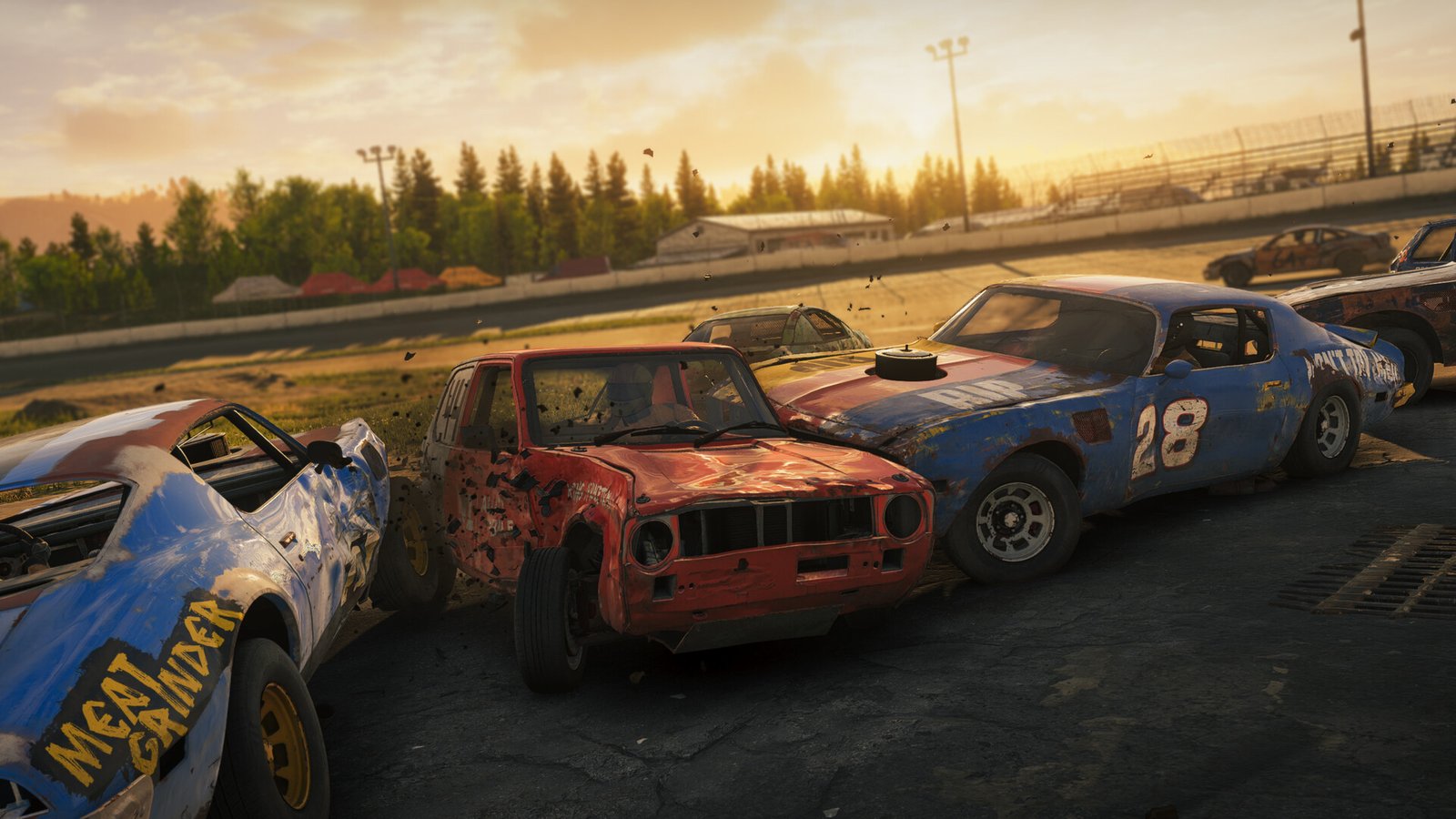
Collisions can introduce risks and competition under specific rules. Contact plays different roles across games; depicting destruction is not the same as faithfully simulating real accidents.
Burnout: speed and risk
Criterion’s Burnout (2001) linked speed, traffic, and risk. Burnout 3: Takedown (2004) emphasized contacts that eliminated rivals; Paradise (2008) placed events in an open map. These are developments in the arcade series, not a universally realistic model of crashes.
Wreckfest and Wreckfest 2
Bugbear’s Wreckfest reached full release in 2018, featuring contact, deformation, and durability. In some events, managing damage helps players finish rather than merely avoiding every collision.
Wreckfest 2 entered Early Access on March 20, 2025. Its ninth content update on October 15, 2026, added tracks, three cars, Demolition Derby and Chase, plus multiplayer and AI improvements. This was the evolution of an Early Access release—not a full 2026 launch.
Combat racing versus vehicular combat
Road Rash combines motorcycle racing and attacks; Blur uses items; Split/Second alters race situations through the environment. Twisted Metal, by contrast, centers on armed vehicle battles. The objective matters: winning a race and destroying opponents are not always the same type of game.
Street racing, open worlds, and freedom to explore
Test Drive Unlimited, Midnight Club, The Crew, certain Need for Speed editions, and Forza Horizon spread events across explorable environments. The Crew Motorfest connects activities to car culture; Burnout Paradise embeds races and challenges in a city map.
Open worlds do not eliminate competition
While exploring, you choose roads or look for an event; once the race begins, you follow its time and placement rules. Open world describes spatial organization, whereas racing describes the challenge. That freedom may resemble sandbox games, but not every open map is a sandbox—and not every racing game offers free exploration.
Time trials, Trackmania, and the pursuit of the best time

In time trials, beating a record organizes competition without requiring vehicles to race physically side by side. The reference time may belong to the player, the game, or someone else.
What is a ghost car?
In some games, a racing ghost visually represents a previous attempt or reference time. It allows players to compare lines and see where one lap was faster. Usually, the ghost does not physically occupy track space like an ordinary car; its purpose is performance comparison.
Trackmania and mastering the racing line
Trackmania (2003) emphasizes precision and restarts to refine a route. Two players on the same track and in the same car may achieve different times because one finds a corner exit that preserves speed. Small execution differences add up by the finish line.
Trackmania (2020) features seasons, track creation, and sharing subject to the game’s available conditions. Its community both competes and invents challenges beyond repeating official courses.
The series organizes tracks and driving through rules unlike a licensed sport such as F1. Its focus on execution and time also relates to speedrunning, whose categories define goals and allowed techniques. Not every time trial is automatically an official speedrun event.
Drifting: technique, discipline, and playing style
Drifting is controlled sliding. It may be a cornering tool in an arcade game, a scored objective in a dedicated competition, or a driving technique represented in a simulator. It is not synonymous with any loss of control or always the fastest racing line: excessive sliding can cost grip and time.
Ridge Racer stylizes drifting; Need for Speed changes its behavior between installments; CarX Drift Racing centers on drift activities; and Gran Turismo offers distinct challenges. Steering, acceleration, and grip interact according to each game’s systems—not a universal rule.
Vehicles, customization, and tuning
| Type | What it changes |
|---|---|
| Visual customization | Paint, wheels, decals, and appearance |
| Performance upgrades | Vehicle characteristics under the game’s rules |
| Technical tuning | Suspension, transmission, brakes, or other adjustments, when offered |
The table distinguishes looks, performance, and setup. Changing paint does not change suspension; power, mass, transmission, or brakes may affect handling when modeled by the game. NFS, Gran Turismo, and simulators tie these choices to progression in different ways. There is no universal parts system or requirement to know engineering to get started.
Opponents, weather, and race strategy
Opponents and race conditions demand adaptation. Competition is not defined solely by the player’s car in isolation.
Opponent artificial intelligence
AI must handle racing lines, positions, and overtaking. Being very fast does not guarantee an interesting race if it cannot react to another car. Varied decisions and behavior within the rules affect racing quality.
What is rubber banding?
Rubber banding changes conditions to bring competitors closer together or farther apart. It can keep races tight but frustrate players when it appears to compensate artificially for performance. It is not mandatory in arcade games, nor identical across implementations.
Weather, tires, and fuel
In some simulators, rain and temperature affect grip, while tire wear changes handling through an event. In longer competitions, fuel and pit stops may become strategic choices. Imagine using dry-weather tires when rain begins: depending on the rules and model, handling may worsen, requiring a strategy change.
Not every racing game simulates tire temperature, wear, and aquaplaning. Rain is chiefly visual in some titles; elsewhere it directly changes the challenge.
Camera, steering wheel, and virtual reality
Perspective and input device affect the information players perceive and how they control the vehicle. Neither a single camera nor any particular piece of equipment is required for the genre.
Driving viewpoints
Top-down, chase, bumper, and cockpit cameras provide different references. Cockpit view shows the dashboard and a driver’s perspective; chase view makes it easier to observe the vehicle and surrounding space. Rules, comfort, and preference guide the choice.
Steering wheels, pedals, and force feedback
Besides controllers and keyboards, there is specialized sim racing equipment. Wheels and pedals offer another way to interact with steering systems, sometimes including shifters, clutches, and other accessories. Force feedback uses hardware mechanisms to communicate certain steering forces and game-represented conditions.
It may help drivers sense the vehicle’s behavior, although results depend on the wheel, simulator, and settings. Many racing games can be enjoyed—and competed in—without specialized equipment. Hardware can change the experience but does not automatically replace learning.
Virtual reality
In compatible games, VR enables players to look around the cockpit and surroundings by moving their heads. GT7 supports PS VR2 on PS5; PC simulators have their own compatibility requirements. Performance and comfort matter, and increased immersion does not guarantee a universal competitive advantage.
Multiplayer and competitive sim racing
Linked arcade cabinets, local console multiplayer, and online networks introduced different ways of finding opponents. Casual races, leaderboards, leagues, and championships coexist with communities that create tracks, share setups, and organize events.
A race among friends may emphasize items and special rules; a simulation league may require specific regulations and penalties. Multiplayer does not guarantee realism, and no safety or ranking system applies to every racing game.
Sim racing and esports
The Gran Turismo World Series, iRacing competitions, and leagues for other games illustrate organized virtual motorsports. That does not make every online race professional esports. Skills may connect with real driving, but racing well in a game does not reproduce every ability and condition in real motorsports.
Racing games on mobile phones
Touchscreens, sensors, and driving assists adapt controls to mobile devices. Asphalt represents an arcade tradition; Real Racing pays attention to cars and tracks; Mario Kart Tour adapts characters and items; CSR Racing emphasizes drag starts and gear changes. Controls and business models vary: monetization may affect progress and access without alone defining driving quality.
How racing games kept evolving through October 2026
Recent evolution combines physics, explorable worlds, community creation, items, and new modes. The examples above show different rhythms: seasons extend existing games, Early Access develops systems gradually, and a new sports season may arrive as an expansion. Maintaining servers and making new content are different commitments. There is no single path of progress for every racing game.
The games that shaped racing history
| Game | Year | Contribution or defining feature |
|---|---|---|
| Space Race | 1973 | Early competition between spacecraft |
| Gran Trak 10 | 1974 | Automotive controls with wheel, pedals, and top-down view |
| Speed Race | 1974 | Vertical scrolling and road representation |
| Night Driver | 1976 | Night-driving perspective |
| Sprint 2 | 1976 | Two-player top-down racing |
| Pole Position | 1982 | Qualifying and racing in a rear-view perspective |
| Hang-On | 1985 | Motorcycle racing and specialized physical arcade controls |
| Out Run | 1986 | Speed, music, and selectable routes |
| F-Zero | 1990 | Futuristic racing on Super Nintendo |
| Super Mario Kart | 1992 | Popularized kart racing with items |
| Ridge Racer | 1993 | Polygonal arcade racing and stylized drifting |
| Daytona USA | 1994 | Three-dimensional arcade competition |
| The Need for Speed | 1994 | Beginning of the sports-car franchise |
| Sega Rally Championship | 1995, Japanese arcade | Mixed surfaces and arcade rally |
| Mario Kart 64 | 1996, Japan | Three-dimensional Mario Kart evolution |
| Gran Turismo | 1997, Japan | Car culture and simulation on consoles |
| Colin McRae Rally | 1998 | Expanded rally’s video game tradition |
| Burnout | 2001 | Arcade racing centered on risk and speed |
| Need for Speed: Underground | 2003 | Customization and urban-racing culture |
| Trackmania | 2003 | Precision, time trials, and track creation |
| Forza Motorsport | 2005 | New motorsport tradition on Xbox |
| iRacing | 2008 | Organized online racing and simulation |
| Forza Horizon | 2012 | Festivals and open-world competition |
| Assetto Corsa | 2013 Early Access; 2014 full release | Driving simulation and modding community |
| Mario Kart 8 | 2014 | Anti-gravity racing mechanics |
| Gran Turismo 7 | 2022 | Car culture, competition, and continued evolution |
| Forza Motorsport | 2023 | New circuit-focused edition |
| Assetto Corsa EVO | 2025, Early Access | New generation of the simulation franchise |
| Mario Kart World | 2025 | Racing and exploration in a connected world |
| MotoGP 26 | April 29, 2026 | Official season and new rider-physics approach |
| Forza Horizon 6 | May 19, 2026 | Japanese open world and new festival activities |
This is a selection of contributions, not a ranking. Dates distinguish arcades, regional releases, Early Access, and full launches; inclusion in the same timeline does not imply identical systems.
Racing, simulation, sports, and platform games: what’s the difference?
| Category | Central activity | Examples |
|---|---|---|
| Racing | Competition over time, speed, placing, or course | Mario Kart, Gran Turismo |
| Driving simulators | Representation of driving and related activities | Euro Truck Simulator 2 |
| Sports | Rules and competitions of sporting disciplines | EA Sports FC, NBA 2K |
| Platform games | Crossing obstacles through character movement | Sonic, Celeste |
| Rhythm | Performing actions to musical or timed patterns | Music and rhythm games |
The comparison covers central activities, not rigid boundaries. Simulation describes representational priorities; open world describes space; sandbox involves experimentation freedom. These traits can coexist with racing without being synonymous with it.
Euro Truck Simulator 2 organizes transport, whereas Gran Turismo puts driving into motorsports challenges. BeamNG.drive supports physics experiments and other situations beyond competition. A driving simulator does not have to center on racing.
F1 and MotoGP are also sports disciplines, while Mario Kart and F-Zero use fictional rules. Racing remains a broad video game identity without every event representing a professional championship.
Traditional Sonic games center on a character crossing obstacles, as the platform-games genre explains. Trackmania centers on vehicles and recorded times. Speed or a timer alone does not define the genre; Geometry Dash also combines movement and timed patterns with a different design.
Challenges and limits of racing games
Mastering items, tracks, grip, or consistency requires different learning processes. Online, latency, contact, and finding opponents add challenges. Licensing cars and championships affects catalogs and commercial terms; a past release does not guarantee a currently active online service.
Hardware and accessibility
Brake assists, traction control, ABS, suggested racing lines, camera options, and difficulty settings can help in different ways. One assist may handle part of the braking while the player still chooses speed and line. Accessibility, assists, difficulty, and peripherals are not synonymous, and options vary by game. Wheels and pedals are alternatives with their own costs and compatibility—not universal requirements.
Who are racing games for?
The choice can begin with the challenge you want: items, rally, simulation, exploration, time trials, or contact. Advanced physics knowledge is not required to start, and a more demanding design is not automatically superior. Casual sessions and organized championships aim for different experiences.
Racing games turn movement into competition and decisions
One corner may reward earlier braking; another contest may change because of an item, pit stop, or community-created racing line. Racing’s appeal lies in turning movement into consequential decisions under rules each game chooses to develop.
About the Author