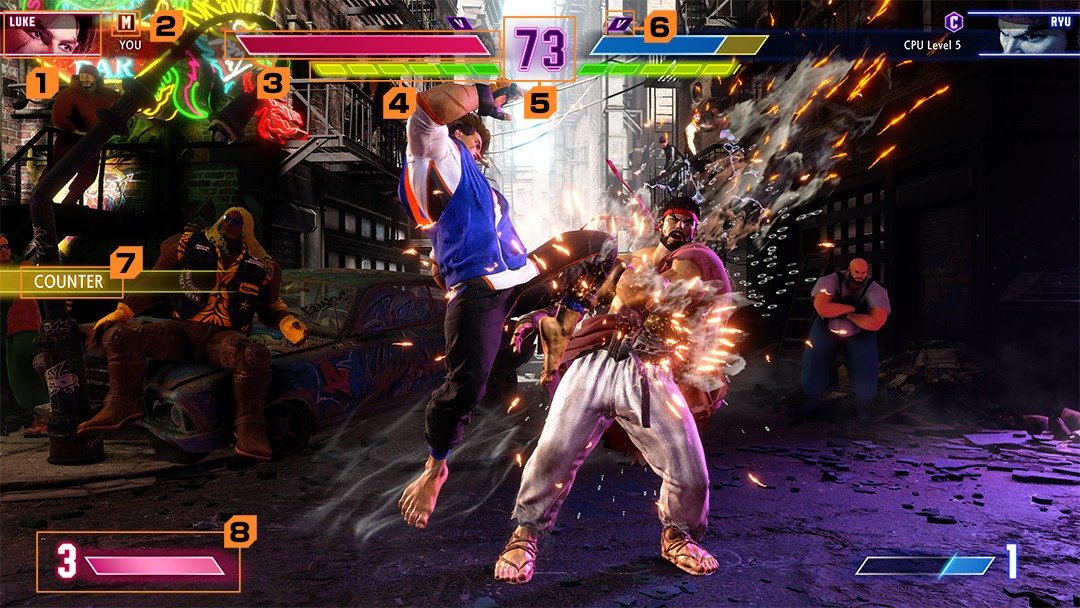
Street Fighter 6: interface de combate em captura do manual oficial da Capcom, com marcações explicativas numeradas. Material de desenvolvimento; a interface pode diferir da versão final. Imagem: Capcom.
Nesta matéria
You approach, take a hit, and retreat. Watching the next attempt, you notice that your opponent is vulnerable after attacking; you wait for that opening and strike back. The difference came from understanding spacing and timing, without needing a huge combo. This relationship between execution, reading the opponent, and adaptation lies at the heart of fighting games.
From early arcades to online matches, the genre has developed side-view duels, teams, movement in depth, and platform-based arenas. In this feature, we explore how these traditions emerged and how attacks, defense, timing, and resources shape the decisions made during a match.
Updated October 21, 2026.
What defines a fighting game?
A fighting game centers on confrontations between characters, organized around distinct movement, attack, and defense systems. A duel with health bars and rounds is familiar, but not mandatory: KOF uses sequential teams; Marvel vs. Capcom allows switches during battle; Smash frequently relies on accumulated damage and ring-outs; and Sparking! ZERO features combat in large three-dimensional spaces.
Does every game with punches and kicks count as a fighting game?
Punches, kicks, and combos are not enough. In Devil May Cry, combat is part of an action adventure; in Streets of Rage, a group advances through stages while defeating enemies. In Street Fighter, competition between fighters organizes the experience. Objectives and rules matter more than the mere presence of attacks.
The genre can also include teams, cooperative participation, and several combatants at once. Arcade controls, long combos, exclusively hand-to-hand attacks, and professional competition are not requirements. Player counts and victory conditions depend on the game.
How did fighting games begin?
Before Street Fighter, arcade games were already exploring boxing and martial arts with controls and scoring systems unlike today’s. The definition of the “first fighting game” depends on the criteria: depicting a sports duel and establishing the modern competitive format are different milestones, without one absolute inventor of the entire genre.
Heavyweight Champ and the early predecessors
SEGA released Heavyweight Champ in 1976, a boxing arcade game featuring two boxers and controls linked to combat actions. Guinness World Records’ historical record recognizes it as an early example of digital fighting. Its sports-based structure differs from the formula later popularized by Street Fighter II. It should not be confused with the game also called Heavyweight Champ released in 1987.
Karate Champ: attacks, distance, and scoring

Released by Data East in 1984 and developed by Technōs Japan, Karate Champ organized duels around points, using two joysticks to perform different actions. The official Arcade Archives listing distinguishes the original arcade game from the modern reproduction shown in the image.
Spacing and the timing of a strike directly affected the result: attacking from outside the required range wasted an opportunity to score. Players needed to choose a suitable move based on the opponent’s position. The later Player vs. Player edition expanded head-to-head competition; its features should not all be attributed to the first version.
Yie Ar Kung-Fu and a variety of opponents
In Konami’s Yie Ar Kung-Fu (1985), Oolong faced opponents with their own attacks and styles. This variety required adaptation rather than repeating the same solution in every fight. That same year, The Way of the Exploding Fist, from Beam Software/Melbourne House, offered another interpretation of martial arts. These were different contributions to a genre still finding its identity.
Street Fighter and the birth of a franchise
Capcom released the first Street Fighter in arcades in 1987, as documented in the company’s official 30th-anniversary retrospective. Ryu, Ken, and their opponents fought using directional commands and special techniques. The Hadouken, an energy projectile, became one of the series’ most recognizable moves.
The connection between commands and techniques helped build the franchise’s identity, but the original did not offer the broad playable fighter selection of Street Fighter II. Nor did it single-handedly invent every combo system, cancel, or resource used in its successors.
Street Fighter II: the game that transformed arcades
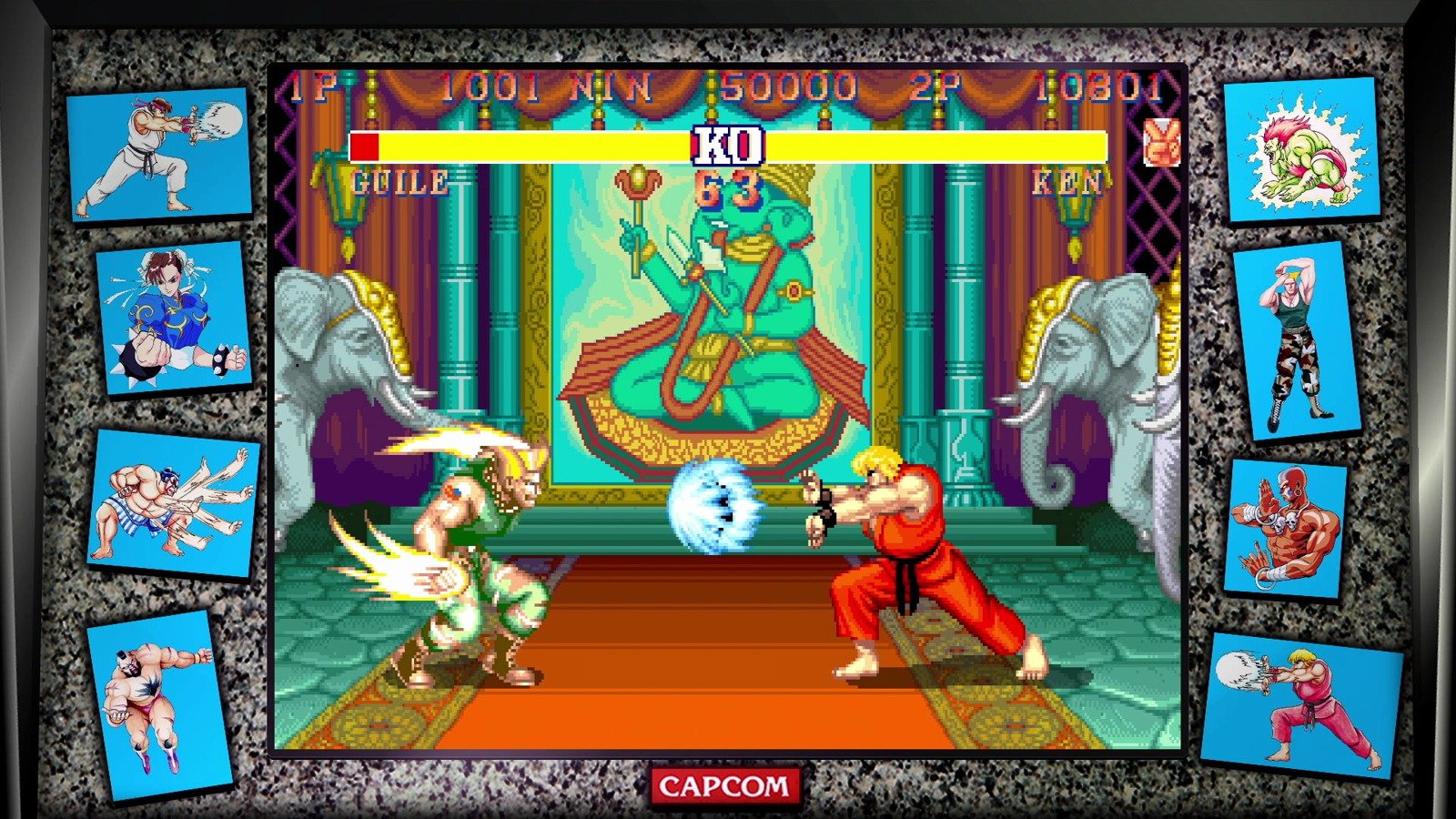
Capcom’s Street Fighter II: The World Warrior (1991) made character selection a central decision. Ryu, Chun-Li, and Guile offered their own tools and movement; Zangief threatened with throws, while Dhalsim used long-reaching attacks. Choosing a fighter changed the possibilities of the confrontation, not merely its appearance.
Against Dhalsim, closing the gap might mean crossing space controlled by long-range attacks. Against Zangief, the challenge might be preventing a dangerous approach and his grapples. The best position depends on who is standing opposite you: this relationship between characters helped make the game popular.
Side-to-side movement, blocking, special moves, health bars, and rounds formed a recognizable structure. In arcades, facing another person introduced a different challenge from computer-controlled opposition: the other player could learn your habits and change their response between attempts. Local competition helped turn commercial success into a culture of matches.
Street Fighter II also popularized linked sequences that connected before the opponent recovered, explored by players as combos. Its importance does not imply that every modern cancel, extension, and meter was fully planned in 1991. Sequels developed other rules; the technical workings of these connections are explained below.
The continuing evolution of Street Fighter
Alpha developed new approaches to side-view fighting; III became associated with the parry, a precision defensive tool; IV arrived in arcades in 2008 and once again expanded the franchise’s reach; V, released in 2016, received successive updates. Street Fighter 6, released on June 2, 2023, added Drive, alternate control schemes, and new modes. Each generation has its own systems.
Mortal Kombat: a different fighting identity

Midway’s Mortal Kombat (1992) distinguished itself through digitized actors, characters including Scorpion, Sub-Zero, Liu Kang, and Raiden, stylized violence, and Fatalities. Special attacks, defense, and combat rules sustained the matches; its visual identity did not replace those systems.
Fatalities are special finishing moves performed after victory under certain conditions. They became a cultural hallmark of the franchise, but do not explain every decision made during a fight: players must first defeat the opponent in combat.
Mortal Kombat II (1993) expanded the formula; 3 (1995) changed the pace and other systems; 4 (1997, arcade) marked a transition to polygonal characters. Mortal Kombat (2011) reorganized the story and reinterpreted side-view combat. X and 11 developed their own mechanics: these generations are not interchangeable.
Mortal Kombat 1 (2023) and Kameo Fighters
NetherRealm/Warner Bros.’ Mortal Kombat 1 launched worldwide on September 19, 2023; certain editions granted early access on September 14. This is a modern game, distinct from the 1992 original.
With Kameo Fighters, the main fighter can call on a partner to extend an attack or change a defensive situation, subject to the rules and available resources. This assistance does not equal the full character switching seen in certain tag fighters.
Mortal Kombat contributed to public and political debates about violence in games during the 1990s. The ESRB’s official history dates the organization’s establishment to 1994. The process involved multiple games, companies, and institutions; it did not arise solely from one franchise.
SNK and the different schools of fighting
SNK consolidated distinct traditions in arcades and on Neo Geo, experimenting with movement planes, resources, weapons, and team arrangements. These choices produced different experiences within the genre.
Fatal Fury and South Town
Fatal Fury: King of Fighters (1991) introduced Terry Bogard, Andy Bogard, Joe Higashi, Geese Howard, and South Town. Certain editions featured switches between fighting planes. Despite its subtitle, this is a separate franchise from The King of Fighters, which began in 1994.
Art of Fighting and Samurai Shodown
Art of Fighting (1992) emphasized large character sprites, visual changes during battle, and energy used for certain techniques. Samurai Shodown (1993) emphasized weapons, range, and high-damage attacks: landing a powerful sword strike can change a match, but missing it creates an opportunity to respond. Risk and reward work on a different scale, without requiring lengthy combos.
The King of Fighters and team combat

The King of Fighters ’94 (1994) brought together characters from Fatal Fury, Art of Fighting, and other series, as noted in SNK’s official presentation. In its traditional format, players select three fighters and their order; once one is defeated, the next takes over. The team’s overall performance determines the outcome.
The first fighter might start strong; the second might have better tools against the remaining opponent; the third might make use of accumulated resources or meet an already weakened foe. Order changes matchups and their conditions, depending on the edition, so players need to learn more than one style.
This traditional succession differs from the in-fight swaps and assists of Marvel vs. Capcom and Dragon Ball FighterZ. Some KOF editions experimented with other rules; no single team structure applies to the whole series. KOF XV (2022) is a modern example of the sequential-team tradition.
Garou and Fatal Fury: City of the Wolves
Garou: Mark of the Wolves (1999) introduced new characters and its own defensive and positioning tools. Fatal Fury: City of the Wolves (April 24, 2025) continued that tradition with Rock Howard, Terry, South Town, and the REV System. Its risk management is explained in the resources chapter; the October update is discussed in the recent-evolution section.
Virtua Fighter: the arrival of polygonal characters
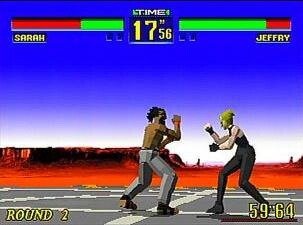
SEGA released Virtua Fighter in Japanese arcades in December 1993, according to the company’s official historical catalog. Polygonal characters represented a technological milestone in a landscape dominated by 2D images. That did not mean the same free movement found in open-arena fighting games.
Attacks, defense, throws, and distinctive fighting styles shaped decisions. Spacing and action timing remained important while polygonal models depicted bodies and animations differently. The visual shift must be understood alongside the combat rules.
Virtua Fighter 2 and later generations
Virtua Fighter 2 (1994) expanded the presentation and systems; 3, 4, and 5 developed other movement options and arenas. Virtua Fighter 5 R.E.V.O. World Stage arrived on October 30, 2025, for PS5 and Xbox Series X|S and as an update to the Steam version, with a single-player mode and cross-platform integration.
On June 8, 2026, SEGA unveiled Virtua Fighter Crossroads, scheduled for 2027. As of the October 21, 2026 editorial reference date, it remained an upcoming title, separate from World Stage.
Tekken: movement and three-dimensional combat
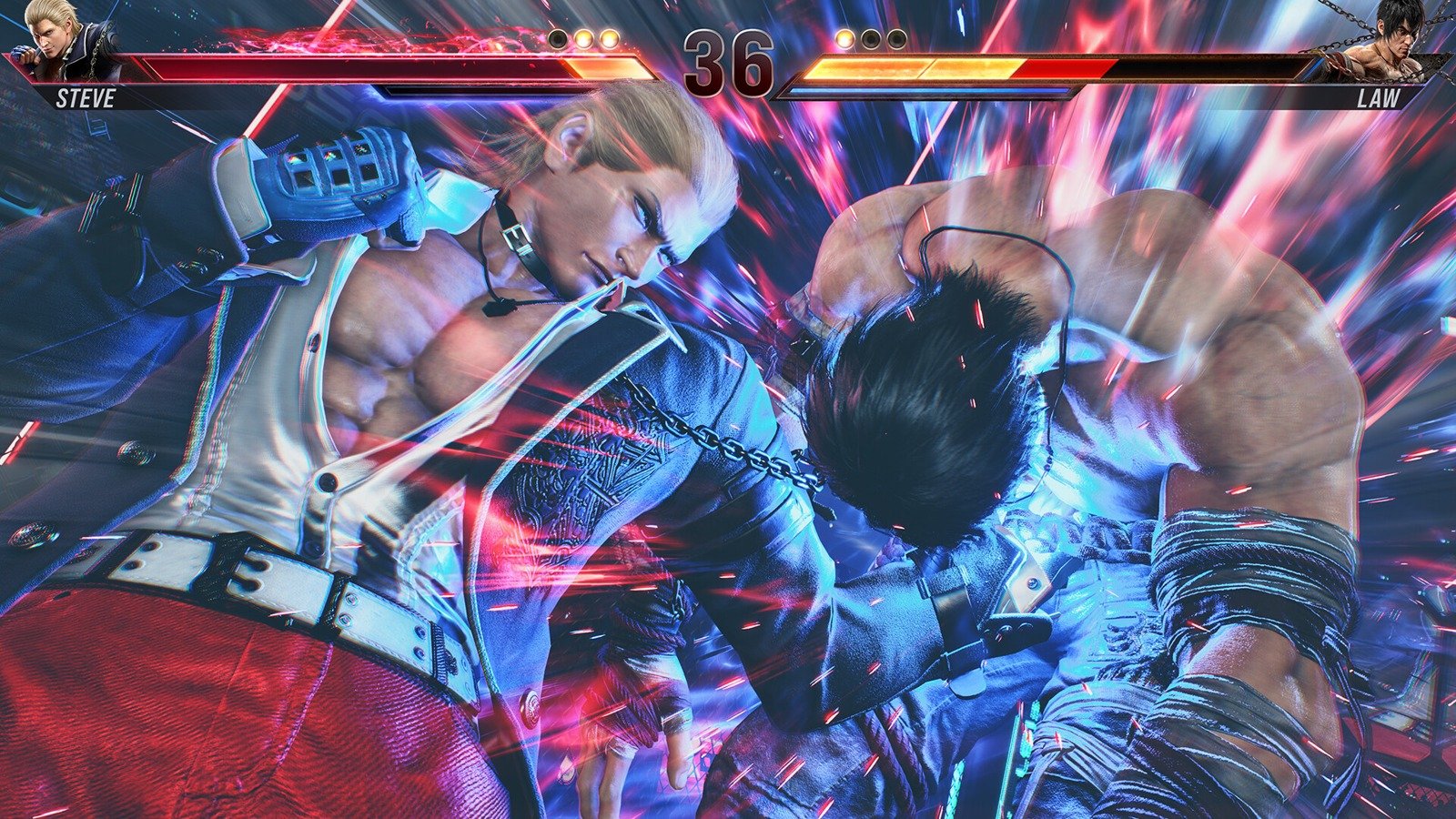
Namco’s first Tekken reached arcades in 1994. The franchise developed a 3D fighting tradition in which fighting styles, combinations, and positioning interact. Sidestepping became more important across successive entries, but its possibilities were not identical throughout the entire series.
Why movement in depth matters
In addition to moving forward and backward, Tekken lets fighters shift sideways through depth. If an opponent attacks straight ahead, stepping aside can make the move miss and create an opening. This depends on the move’s properties: tracking attacks or adequate coverage may catch the sidestep. Sidestepping is not a universal defense.
Walls and combat opportunities
In modern editions, an attack that carries an opponent into a wall can enable further damage or limit escape. The same sequence can have different consequences in the middle of the arena and near its boundaries; location matters beyond the distance between fighters.
Tekken 8 and the Heat System
Bandai Namco Studios’ Tekken 8 launched on January 26, 2024. Heat grants offensive actions for a limited period, expanding pressure and attack options. It does more than simply add damage; its role is explored further in the resources chapter.
Season 3 in 2026 brought balance refinements and Heat changes, described in the official version 3.00 roadmap. Kunimitsu and Bob had already arrived; Roger Jr. was announced for November, still in the future as of October 21. Version changes can alter moves without replacing the franchise’s spatial identity.
Soulcalibur and 3D weapon fighting
Soul Edge (1995, arcade), known as Soul Blade in certain home markets, continued its weapon-based tradition with Soulcalibur (1998). A long weapon threatens from farther away; a shorter-range opponent must find a safe approach. Weapons change positioning, risk, and responses.
The series also uses ring-outs under particular conditions: leaving the arena boundaries can cost the match. This is not a universal win condition in 3D fighters, nor does it make Soulcalibur mechanically identical to Tekken.
How does a fighting game match work?
An illustrative loop helps follow a match: observe → position yourself → attack or defend → recognize openings → adapt. These actions overlap, with no mandatory sequence. Health, rounds, time, teams, and victory conditions depend on the rules; draining a health bar is not the universal objective.
The selected fighter determines available moves, movement, and resources. Fast attacks, dangerous throws, and tools for keeping an opponent at bay create different ways to seek an advantage. Learning a character means recognizing both what they can do and the risks they need to avoid.
Spacing is part of the strategy
Spacing means managing distance to favor your tools. A long-reaching attack cannot hit someone outside its range; getting too close can place you within reach of quick attacks or throws. One option is to remain just beyond the opponent’s threat and punish a missed move. The favorable distance changes with the characters, moves, and game format.
Runs, jumps, and dashes change how fighters approach when available. Tekken adds depth; Guilty Gear can emphasize aerial mobility; Smash ties movement to recovering onto the stage. Learning movement means understanding each game’s rules rather than carrying over one solution from another franchise.
Attacks, defense, and counterattack opportunities
Attacks differ in speed, reach, damage, and risk. A fast attack may have short range; a slower one may cover more ground but leave a longer opening for retaliation. Attack heights, projectiles, throws, and special moves expand the threats, depending on the game.
Normal and special moves
Street Fighter uses normal attacks of different strengths and techniques such as the Hadouken, often performed with directional inputs and buttons. Tekken arranges commands and combinations differently; Smash has its own actions. Knowing one series’ commands makes learning easier but does not automatically mean mastering another.
Why can blocking be a good decision?
Blocking a risky move may allow you to respond while the attacker recovers. The opportunity depends on the move and is detailed in the frame-data section: a blocked attack is not automatically punishable. Defense may rely on directional inputs, a dedicated button, dodges, or special resources, depending on the title.
High attacks, low attacks, and throws
Defense must match the threat: a stance that covers a given high attack may lose to a low; a throw might require moving away or escaping under specific rules. Not every throw bypasses every defense. Blocking forever cannot resolve every situation, but no single defensive formula applies universally either.
How do combos work?
A combo connects attacks under the game’s rules. On hit, a move may leave the opponent in hitstun, the reaction period before normal control returns. If the next hit lands before that window ends, the sequence can continue. Resources, positioning, and move properties determine which connections are possible.
True combos versus strings with gaps
In a true combo, there is no ordinary chance to act between connected hits, subject to the rules and any special escape tools. If there is time to block, dodge, or take another action, the sequence has a gap: it may serve as pressure, but is not necessarily an uninterrupted combo. Recognizing the difference changes the appropriate defense.
Cancels and launchers
A cancel lets players interrupt part of an attack or its recovery to perform another action under specific conditions. That can connect attacks that would not fit after the complete animation. Launchers can also create windows to continue a sequence in the air. Street Fighter, Tekken, and Guilty Gear each have their own allowances and limitations; not every move cancels into every other move.
Is the longest combo always the best?
A long sequence may deal more damage but spend a resource needed later. A shorter combo may be more consistent or carry an opponent to the wall, leaving a better position. Damage, risk, cost, and the resulting situation matter more than the number of hits alone.
Frame data: why does each move have its own timing?
Frame data describes the timing of actions in frames of the combat simulation. Many games operate with a logical rate of 60 frames per second, but this is not universal and does not depend solely on visual smoothness. The information helps compare when a move becomes capable of hitting and when each character can act again.
Startup, active frames, and recovery
| Phase | Common term | What it means |
|---|---|---|
| Attack preparation | Startup | Time before an attack can connect |
| Active attack | Active frames | Period during which an attack can hit |
| Recovery | Recovery | Time before the character can act normally again |
When you throw a punch, there is preparation before contact, an active interval, and recovery. The table separates these stages. Two moves that look similar may have different timings: one may start quickly but leave its user exposed for longer on a miss.
What does frame advantage mean?
Frame advantage compares when each fighter regains the ability to act after an interaction. It can differ on hit (hit advantage) and on block (block advantage). If the attacker can act first, they are at an advantage; if they must wait longer, they are at a disadvantage.
Illustrative example: −6 on block means the defender can act six frames before the attacker. A five-frame-startup response, performed immediately and within range, may hit during that recovery. An eight-frame move will not fit that window simply because it was started first. For a six-frame response, the game’s frame-counting convention and conditions must be checked; distance remains decisive.
A negative value does not guarantee punishment: the response may not reach. A positive value does not guarantee every follow-up attack either; reach, speed, invulnerability, and other options still shape the exchange.
What is a punish?
A punish exploits an opponent’s vulnerability, such as recovery that prevents an attacker from defending in time. It may follow a blocked or whiffed attack; it is not synonymous with any counterattack. The previous calculation explains why speed and range need to line up with the opening.
You do not need to memorize every table to get started. Watching for a move that leaves an opening and testing a response in training already connects the numbers to real matches.
Neutral, pressure, and reading an opponent
The following terms describe situations and decisions during a fight. Understanding them helps you follow a match without making memorization of a glossary a requirement.
Neutral: competing for the first advantage
Neutral is the struggle for an advantage when neither fighter has established offensive control. One character tries to advance while the other uses attacks to stop the approach; both seek a favorable opening. It does not mean combat has stopped: movement, threats, and control of space are already in play.
Pressure: limiting the opponent’s responses
Pressure involves using attacks and movement to restrict or influence responses. A fighter keeps the opponent defending and tries to exploit attempts to escape. That is not the same as a combo: there can be intervals in which the defender chooses whether to keep blocking, move, or use another tool.
Mix-ups: presenting different threats
A mix-up presents threats that require different responses. Switching between a low attack and a throw can force the defender to choose; a response that covers one option may lose to another. Effectiveness depends on the rules and the available alternatives, not on randomly selecting attacks.
Reading the opponent and adapting
A read attempts to anticipate a choice based on habits. If you notice that an opponent often jumps after retreating, you prepare an answer for the next jump. This is a hypothesis, not certainty or a guaranteed reaction: the opponent may recognize your intent and change their behavior.
Archetypes: why do characters fight differently?
| Archetype | Common feature | Illustrative example |
|---|---|---|
| Shoto | Recognizable toolkit associated with the Ryu and Ken tradition | Ryu in Street Fighter |
| Grappler | Throw threats and close-range control | Zangief |
| Zoner | Control over particular ranges and areas | Dhalsim or other long-range characters |
| Rushdown | Aggressive approaches and sustained offense | Characters with aggressive mobility |
| Hybrid | Combines traits of different styles | Varies by game |
These are community-recognized tendencies, not universal rules. A shoto need not have precisely another shoto’s moves; a grappler also uses strikes and movement; a zoner can have strong approach options. Hybrid characters and changes between versions make these categories useful guidance, not a substitute for learning the fighter.
Resources and special systems in modern fighting games
Meters can unlock defense, movement, pressure, and cancels in addition to powerful attacks. Managing them means deciding between an immediate benefit and what options will remain available later. Each game sets its own costs and consequences.
Drive System in Street Fighter 6
Drive includes tools such as Drive Impact and Drive Parry, alongside movement options and enhanced techniques. Exhausting the Drive Gauge puts the character into Burnout, temporarily taking those tools away until the meter recovers. Capcom’s official manual distinguishes Drive, health, and the Super Art Gauge. Spending resources to pressure an opponent can therefore reduce future defensive responses.
Heat System in Tekken 8
Tekken 8‘s Heat offers a period of special offensive actions, including Heat Smash and Heat Dash under the system’s conditions. Using it to maintain pressure requires considering the opening, remaining duration, and the opponent’s responses. It is not the same as Drive; Season 3 also adjusted moves related to this resource.
REV System in Fatal Fury: City of the Wolves
With REV, tools such as REV Arts, REV Accel, REV Blow, and REV Guard are tied to the gauge and conditions described in SNK’s official guide. They can sustain offense or provide defense, but filling the REV Gauge too far causes Overheat and temporarily restricts REV actions. Applying pressure without considering this limit can leave fewer options moments later.
Guilty Gear’s systems
In Guilty Gear -Strive-, the Tension Gauge enables actions such as Roman Cancel, interrupting moves to create new offensive or defensive possibilities. The Burst Gauge provides distinct tools, outlined in Arc System Works’ systems guide. These resources are not interchangeable.
Version 2.00, released in April 2026, removed Wild Assault and introduced Counter Blitz, an action that spends 50% of the Burst Gauge under specific counter-hit conditions. Version 2.03, dated September 24, widened its activation window and adjusted its outcome on block. Counter Blitz is not Roman Cancel, and rules from one update should not be assumed permanent.
2D and 3D fighting games: what is the difference?
| Format | Central characteristic | Examples |
|---|---|---|
| 2D fighting game | Combat organized predominantly on a side-view plane | Street Fighter 6, Mortal Kombat 1 |
| 3D fighting game | Movement into the background matters strategically | Tekken 8, Virtua Fighter |
| Tag fighter | Teams with switches or assists during fights | Marvel vs. Capcom, 2XKO |
| Platform fighter | Stages with platforms and frequently ring-out eliminations | Super Smash Bros., Brawlhalla |
| Arena fighter | Combat in larger 3D spaces with freer movement | Naruto: Ultimate Ninja Storm, Dragon Ball: Sparking! ZERO |
These categories describe how combat is organized, not merely the models used for graphics. Street Fighter 6 uses 3D characters in primarily side-view combat; Tekken 8 gives strategic importance to movement into depth. The table also distinguishes teams, platforms, and larger arenas.
Formats coexist: Street Fighter, Mortal Kombat, and KOF maintained side-view combat while Tekken and Virtua Fighter developed other possibilities. Categories can overlap; a tag fighter can also be 2D. Neither 2D means easy nor 3D automatically means superior or more complex.
Anime fighters and visual styles
Anime fighter often refers to traditions such as Guilty Gear, BlazBlue, and Under Night In-Birth, associated with Japanese animation aesthetics and, in some contexts, aerial mobility and expressive combo systems. There is no universal set of rules. A game based on an anime license may also be an arena fighter; the license does not determine its format.
Tag fighters: teams, switches, and assists

In tag fighters, switching and assists participate in battles according to the game’s rules. Marvel vs. Capcom combines fighters from different series; Dragon Ball FighterZ (2018), by Arc System Works/Bandai Namco, uses teams of three.
One character starts an offense, another provides an assist to expand options, and a switch changes who is directly fighting, potentially protecting a teammate. Building the team requires considering these functions. This differs from KOF’s traditional succession; not every team game allows free switching during a combo or cooperative participation.
2XKO: Riot Games’ team-based approach
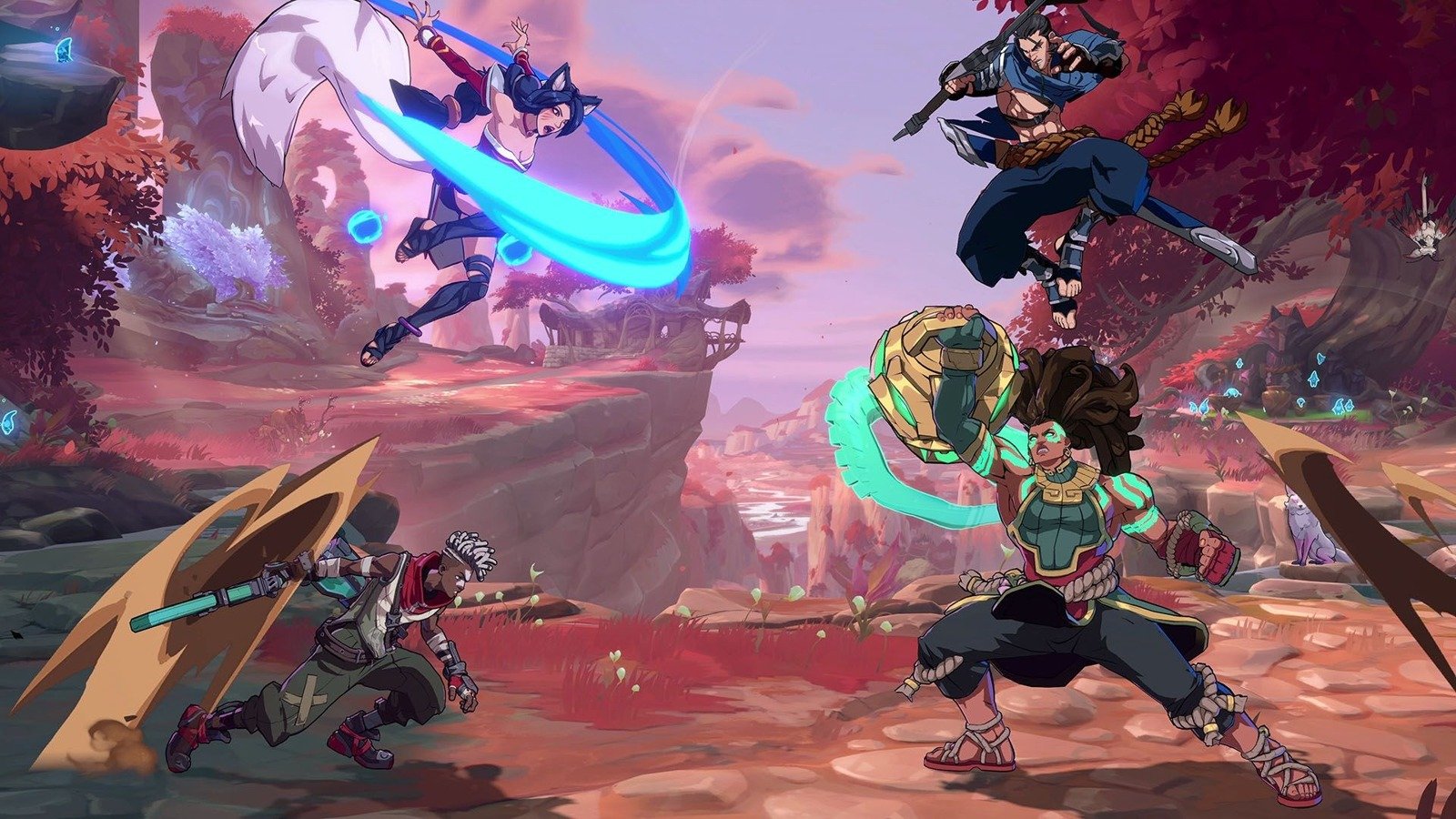
Riot Games’ 2XKO uses two champions per team, switching, assists, and Fuses, choices that change how the duo functions. One fighter can start an attack and call on the partner to continue it; the mode supports controlling the whole team alone or sharing it between two players. Their combination changes how individual tools work together.
The characters come from the universe of League of Legends, a MOBA, but side-view team fighting follows another structure. The objective is not to contest lanes and destroy a base: movement, defense, attacks, and paired actions organize the conflict. Sharing a universe does not make two games part of the same genre.
PC Early Access began on October 7, 2025, with Season 0. Season 1 started January 20, 2026, alongside the PlayStation 5 and Xbox Series X|S launch; the official notes record January 20–21 depending on region.
On August 20, 2026, Riot announced active development of 2XKO would end at the close of 2026, citing insufficient sustainability. The final patch was planned for December; servers would continue after 2026 and offline play would remain available, with no promise of indefinite service. As of October 21, development had not ended and the game had not been shut down.
Lux had already arrived in September; Samira and Sett were scheduled for October 27 in update 1.3.3. These were future announcements relative to the editorial date, not characters already available then.
Super Smash Bros. and platform fighters
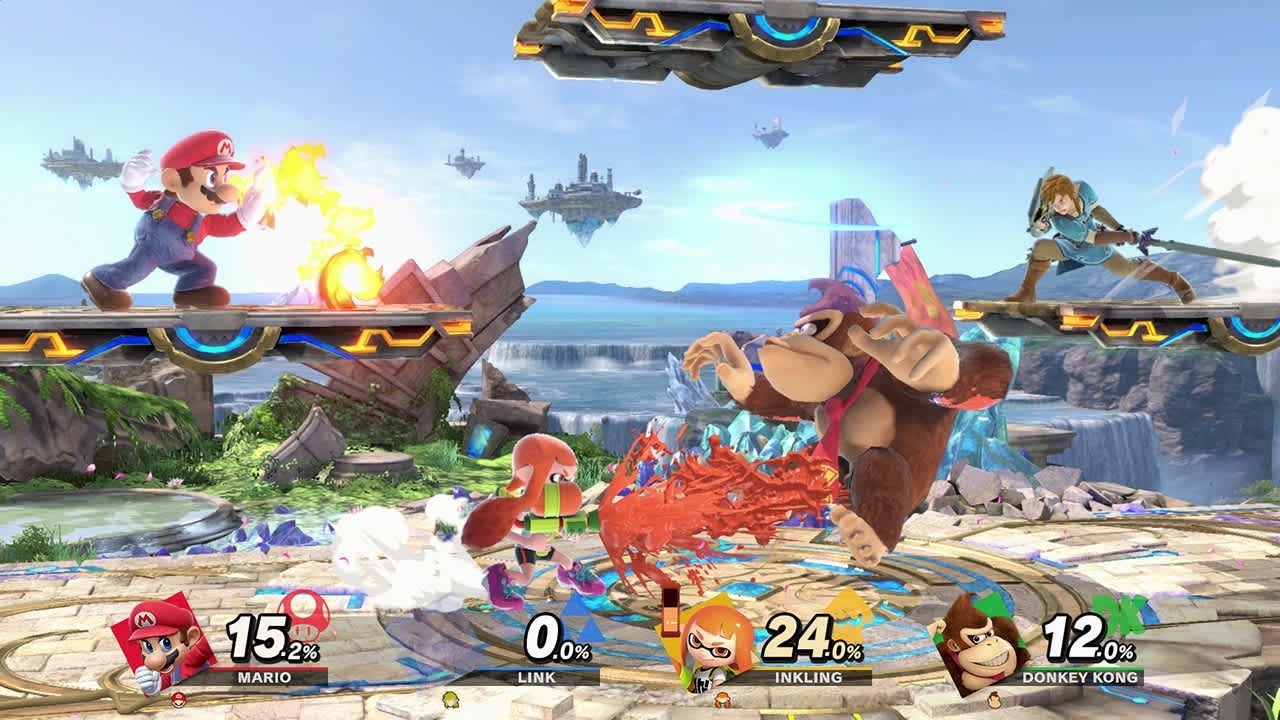
Super Smash Bros. (1999), developed by HAL Laboratory/Nintendo for Nintendo 64, introduced combat on stages with platforms. Under its best-known rules, attacks increase a damage percentage and can launch the opponent farther depending on the move, character, and situation. Players are eliminated beyond stage boundaries rather than by emptying a health bar. Other modes exist.
Position and survival connect: after being launched, getting back onto the stage can matter as much as landing the next attack. Jumps, airspace, and platforms shape the contest, both in reaching an opponent and preventing their recovery.
In Super Mario Bros., traversing courses and obstacles is central; in Smash, platforms structure combat between characters. Our guide to platform games examines that tradition of traversal. The primary objective helps explain the difference beyond the presence of jumping.
Melee, Brawl, and Ultimate
Melee (2001) and Brawl (2008) developed different rhythms and mechanics; the 3DS/Wii U editions expanded the series before Ultimate (2018) on Switch. Melee and Ultimate have their own competitive communities. They are not simply the same combat with different rosters.
Brawlhalla, Rivals of Aether, and other platform fighters
Brawlhalla (2017), developed by Blue Mammoth Games and now published by Ubisoft, combines platforms, eliminations, and distinct weapons under a free-to-play model. Rivals of Aether (2017) features elemental characters and distinctive movement. Rivals 2 (2024) uses 3D presentation while keeping the action on a side-view plane; its graphics do not make it an arena fighter.
MultiVersus brought together Warner Bros. characters, but ended online service on May 30, 2025, and was removed from stores. The official MultiVersus announcement made continued offline access conditional on downloading the updated version and logging in during Season 5 (February 4–May 30, 2025) to create a local save. That allowed training and local play against AI or up to three friends; it does not promise universal access for newcomers in 2026.
Arena fighters: combat in expansive three-dimensional environments
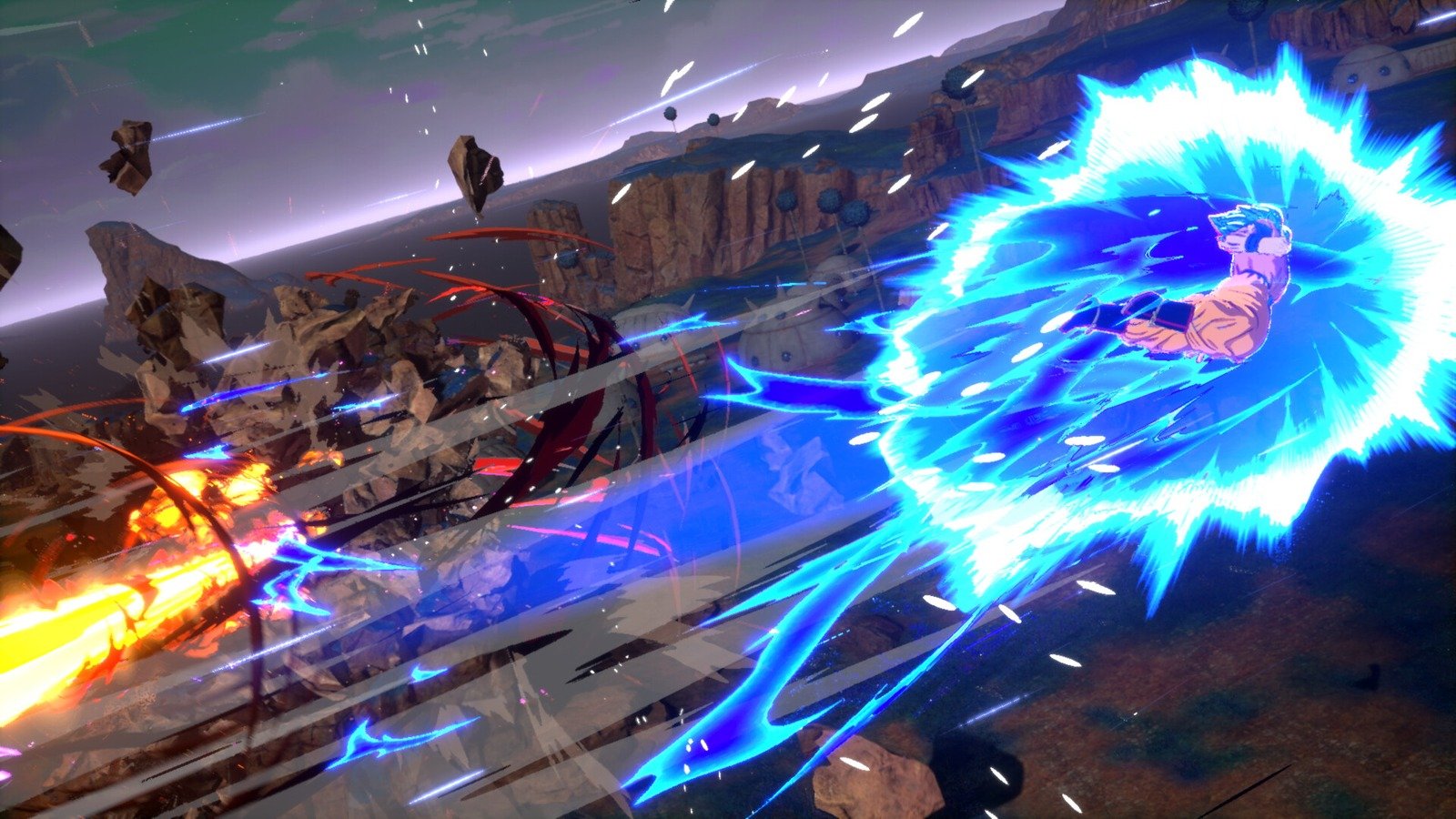
Arena fighters organize battles in larger three-dimensional spaces, often with free movement and their own camera system. Closing the distance may involve moving in several directions; the camera and the range of techniques change how distance is perceived.
Naruto and Dragon Ball
Naruto: Ultimate Ninja Storm uses movement and techniques specific to its franchise. Dragon Ball: Sparking! ZERO (2024) emphasizes large arenas, mobility, ranged attacks, and character abilities. Demon Slayer: The Hinokami Chronicles also belongs to this tradition, with its own systems. A similar format does not imply identical controls and rules.
Tekken structures a more contained 3D confrontation, with sidesteps and specific move properties. Many arena fighters use wider spaces and a camera that follows a different freedom of movement. Both use depth, but the relationship between position, control, and approach changes.
Dragon Ball FighterZ is side-view and team-based; Sparking! ZERO uses expansive arenas. Sharing a fictional universe does not determine the format: the actual combat structure matters.
Fighting games, beat ’em ups, and hack and slash: what is the difference?
| Category | Predominant structure | Examples |
|---|---|---|
| Fighting game | Confrontations between fighters with distinct combat systems | Street Fighter, Tekken |
| Beat ’em up | Advancing through levels while fighting groups of enemies | Streets of Rage, Final Fight |
| Hack and slash | Action built around moves, weapons, and combos against various enemies | Devil May Cry, Bayonetta |
| Platform game | Traversing obstacles and mastering movement | Super Mario Bros., Celeste |
| Combat sports simulation | Representing the rules and competitions of sports disciplines | Licensed UFC and boxing games |
Attacks and combos appear in different genres. The table distinguishes their predominant structures; hybrid experiences make boundaries flexible without removing the value of comparison.
In Streets of Rage and Final Fight, defeating groups while moving through stages drives progression. Street Fighter focuses on confrontations between fighters. Even characters shared between these series may appear within different gameplay structures.
In Devil May Cry, Bayonetta, and Ninja Gaiden, techniques are part of an action adventure against varied enemies and challenges. A sophisticated combo system does not change that organization by itself. Our hack-and-slash genre guide develops that tradition.
Boxing, MMA, and wrestling games may share concepts such as spacing, defense, and direct confrontation, but often aim to represent a sport’s rules, as in EA Sports UFC. This favors classifying them as combat sports or sports games. The distinction is not absolute: hybrids between simulation and arcade gameplay exist.
From arcades to the Fighting Game Community
In the 1990s, arcades turned matches into social events: watching another person, trying again after losing, and facing different habits made learning social. Street Fighter II, Mortal Kombat, and SNK’s franchises helped build this culture, though conditions varied by venue and region.
Friends also gathered around home consoles; computers and online services expanded the search for opponents. New spaces did not eliminate in-person meetings, rivalries, or informal skill sharing. Communities grew along different paths, without one universal local experience.
What is the FGC?
The Fighting Game Community (FGC) includes players, organizers, commentators, and creators from different scenes. It is not a centralized organization and is not limited to professionals: there are local groups, casual meetups, practice sessions, and communities dedicated to particular franchises.
Replays, videos, analysis, and practice sessions make it possible to study other players’ discoveries. A technique can change the community’s understanding of a system and inspire new responses even without an update to the game. Tournaments are part of this process, not the whole FGC.
EVO: from community gatherings to a major championship
The Evolution Championship Series (EVO) grew out of Battle by the Bay, which began in 1996. EVO’s official history records 40 participants in Sunnyvale, California, competing in Super Street Fighter II Turbo and Street Fighter Alpha 2. The community meetup eventually became an event bringing together many franchises, competitions, and in-person activities.
Many tournaments use double-elimination brackets: after one loss, a participant continues in a lower bracket; another loss eliminates them, subject to the event’s regulations. Match counts, permitted characters, and devices vary. No one rule applies to every tournament or game.
EVO Las Vegas took place June 26–28, 2026, in the West Hall of the Las Vegas Convention Center, with 12 main tournaments according to the official event page. The lineup changes from one edition to the next; inclusion in one year does not guarantee the next. Capcom Cup, Tekken World Tour, SNK tournaments, and Arc World Tour also form part of the scene, each with its own structure.
How do players learn fighting games?
Execution and strategic decision-making are different. Knowing a long combo does not solve the problem of finding the right moment to start it. Learning means relating commands to actual situations involving movement, defense, and openings, without requiring a professional practice routine to have fun.
Training modes and repetition
In training, repeating a move can reveal its range and recovery; when the game allows it, configuring an opponent to repeat an attack helps test responses. This practice turns a question from a match into an observable situation instead of repeating sequences without context.
Replays and match analysis
A replay may show that you repeatedly attacked out of range or used a risky move against a prepared opponent. Correcting that habit can help more than adding extra hits to a combo. Campaigns, arcade modes, and casual matches remain valid ways to enjoy the genre.
Classic controls, modern controls, and accessibility
Directional commands and button combinations remain common, but alternative methods coexist. Simplified inputs, assists, training tools, and accessibility features are not the same solution; their usefulness depends on the player’s needs and their implementation.
Street Fighter 6: Classic, Modern, and Dynamic
Classic follows the traditional six-button layout; Modern simplifies certain techniques with its own advantages and limits; Dynamic offers assistance choosing actions in casual situations. According to Capcom’s official support page, Classic and Modern work online, while Dynamic is restricted to certain offline Fighting Ground modes. It is not an option for online casual or ranked matches.
Performing a special move with fewer buttons does not guarantee using it well. The move can still miss because of range or be attempted at a risky moment. Making execution simpler may lower the entry barrier without removing decision-making; it also does not mean every scheme has the same tools and restrictions.
Gamepads, arcade sticks, and leverless controllers
Console controllers, arcade sticks, compatible keyboards, and leverless controllers are all options. An arcade stick uses a lever to enter directions; a leverless controller uses separate buttons. None is mandatory for beginners. Comfort and compatibility matter, while tournaments may enforce their own rules on equipment and inputs.
Online multiplayer and rollback netcode
Online play broadened access to opponents but requires coordinating commands between separate devices. The networking system affects responsiveness, especially in a genre where very short intervals can decide the outcome.
What is latency?
Latency is communication delay. Waiting for remote data can add input lag and make the same command feel different from local play. Unstable connections create an additional problem: data arrives irregularly.
How does rollback netcode work?
Rollback netcode temporarily predicts remote inputs so the simulation can continue before that information arrives. For example, the game may predict that the opponent keeps performing their previous action, allowing local input to register without waiting for the remote update.
When the real input arrives, the prediction is checked. If it was wrong, the game restores an earlier state, applies the correct input, and reruns the simulation to the current moment. GGPO’s documentation describes this combination of prediction, state restoration, and resimulation; it aims to preserve responsiveness, not make data travel instantaneously.
Does rollback eliminate lag?
No. High latency and unstable connections can still produce visible corrections and difficulties. Implementation quality, connection quality, and match conditions remain important. Two games with rollback do not necessarily offer the same experience, and the system cannot eliminate the internet’s limitations.
Crossplay and matchmaking
Crossplay enables matches across platforms where supported; matchmaking matches participants according to the game’s criteria. Neither guarantees a good connection or enough active players. Availability, regions, and matching quality vary by title.
Modern fighting games: different paths through 2026
Recent developments involve different access models and modes. In Street Fighter 6, Fighting Ground brings together traditional activities; World Tour offers a solo adventure with a created character; Battle Hub organizes social encounters and matches. The genre can offer more points of entry than online dueling alone.
Tekken 8‘s Season 3 changes show how one edition keeps evolving through balance updates without each patch creating a new genre. When studying a strategy, checking the game version is useful: a response learned earlier may need revisiting.
Guilty Gear, Granblue, and Under Night In-Birth
Guilty Gear -Strive- (2021) combines expressive movement and resource management. Granblue Fantasy Versus: Rising (2023) brings its universe to side-view fighting with its own commands and tools. Under Night In-Birth II Sys:Celes (2024) maintains distinctive movement and resource systems. These traditions expand diversity beyond older franchises; Strive‘s current systems were covered in the technical section.
Fatal Fury: City of the Wolves in 2026
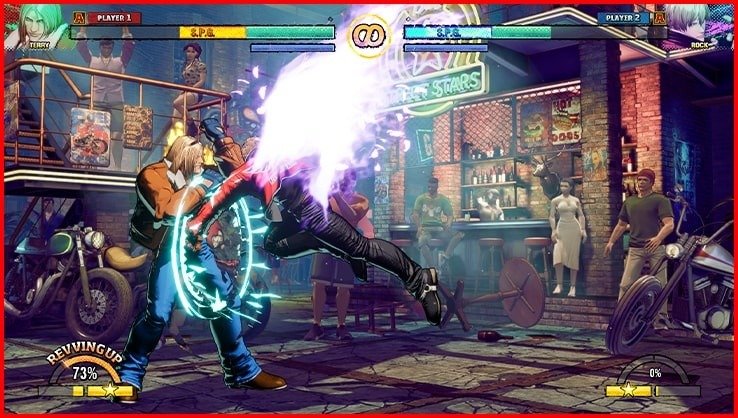
City of the Wolves started Season 2 on January 22, 2026 and Season 3, Destined for Revenge, on July 23, 2026. Patch 3.3.2 notes, published October 19, include Mikey and Draken from Tokyo Revengers, additional stories, and other features. The same document schedules the digital Switch 2 edition for October 22: still in the future relative to October 21.
The Tekken collaboration announced Reina for December 2026, also still in the future. The guide image above is not presented as a screenshot from the October patch.
Campaigns, support partners, extra characters, cosmetics, and seasons follow different schedules and business models. Brawlhalla and 2XKO are free-to-play, while other releases sell a base game and expansions. These models affect access and longevity but do not define the genre; ending development, as announced for 2XKO, is also different from shutting down servers.
Games that shaped fighting-game history
| Game | Year | Significance or distinguishing feature |
|---|---|---|
| Heavyweight Champ | 1976 | Early boxing-based head-to-head combat |
| Karate Champ | 1984 | Scored martial-arts duels and move control |
| Yie Ar Kung-Fu | 1985 | Opponents with distinct fighting styles |
| Street Fighter | 1987 | Special techniques and the start of Capcom’s franchise |
| Street Fighter II | 1991 | Popularized competitive matches and character selection |
| Fatal Fury | 1991 | Established SNK’s distinctive tradition |
| Mortal Kombat | 1992 | Digitized characters and Fatalities |
| Art of Fighting | 1992 | Energy systems and distinctive visual presentation |
| Virtua Fighter | 1993 | Landmark in polygonal-character fighting |
| Samurai Shodown | 1993 | Weapon combat and the importance of high-damage strikes |
| Tekken | 1994 | Developed a 3D fighting tradition |
| The King of Fighters ’94 | 1994 | Sequential team-based combat |
| Killer Instinct | 1994 | Distinctive combo system |
| Soul Edge | 1995 | 3D weapon combat with varied ranges |
| Guilty Gear | 1998 | Stylized action and new side-view fighting options |
| Super Smash Bros. | 1999 | Popularized platform fighters |
| Garou: Mark of the Wolves | 1999 | Continuation of the Fatal Fury tradition |
| Street Fighter IV | 2008, arcade | A new Capcom franchise generation |
| Mortal Kombat | 2011 | Modern reinterpretation of the franchise |
| Super Smash Bros. Ultimate | 2018 | Expanded the platform-fighting concept |
| Guilty Gear -Strive- | 2021 | Modern approach to stylized side-view combat |
| The King of Fighters XV | 2022 | Continued SNK’s team-based battles |
| Street Fighter 6 | 2023 | Drive System, new controls, and multiple modes |
| Mortal Kombat 1 | 2023 | New narrative phase and Kameo Fighters |
| Tekken 8 | 2024 | Heat System and evolution of 3D combat |
| Fatal Fury: City of the Wolves | 2025 | Franchise revival and REV System |
| 2XKO | 2025 PC Early Access; 2026 official launch | Team combat and assists; end of active development announced for December 2026 |
This selection records precursors and contributions rather than ranking the games. Years distinguish original releases, arcade editions, and Early Access; they do not necessarily mean simultaneous releases in every region or on every platform.
Challenges and limitations of fighting games
Learning commands, recognizing characters, and understanding resources can take practice. The pace varies: beginners may enjoy local matches while gradually discovering tools, with no obligation to master advanced techniques first.
Each matchup introduces different threats. A habit that works against one character may fail against another, requiring a change of response rather than blaming every defeat on execution. That knowledge grows through experience, practice, and sharing information.
Updates may alter known tools and responses; balance differences also affect matchups. This means considering the version and the concrete situation instead of assuming all characters have the same options.
Finding opponents nearby with stable connections and comparable experience is not always simple. Player population, region, and ongoing support matter; MultiVersus shows why historical availability does not guarantee online service today. These limitations vary across games.
Who are fighting games for?
Players who enjoy distinctive character styles, competition, or gradual improvement can find different paths: campaigns, arcade modes, matches with friends, teams, platforms, and open arenas. Choosing the format and modes that appeal to you is more useful than treating professional tournaments as a mandatory goal.
Fighting games are about decisions within the confrontation
Knowing a move creates an option; understanding when to use it turns that option into a decision. The appeal of fighting comes from the meeting of execution, reading the opponent, and adaptation, with each participant capable of changing the next encounter.
About the Author