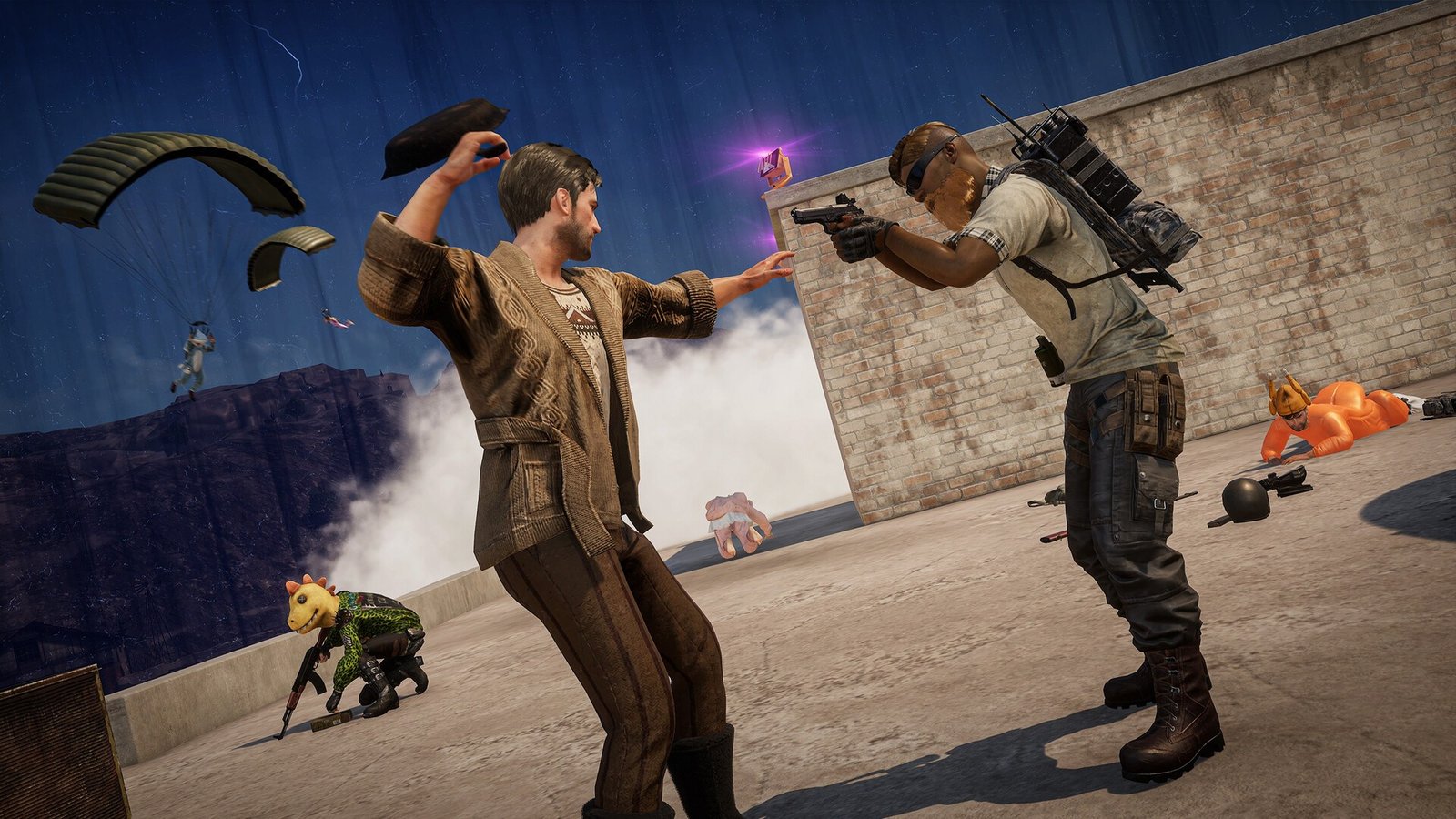
Veículos, terreno aberto e confrontos fazem parte das decisões de sobrevivência em PUBG: Battlegrounds. Captura da galeria oficial atual, não do lançamento de 2017. Imagem: PUBG Studios / KRAFTON.
Battle Royale is a competitive genre in which multiple players or teams fight to survive and eliminate opponents, usually until only one winner remains.
Imagine jumping from an aircraft over an unfamiliar island. You could land in a city packed with buildings and equipment, but other players are likely searching for those same resources. Or you could choose an isolated area, prepare more safely, and risk having to cross the map later.
As you look for weapons and protection, a dangerous area begins to spread, reducing the places where you can stay. Any confrontation can end your match. Even after eliminating several opponents, you still have to survive everyone who remains.
That structure made PUBG, Fortnite, Apex Legends, and Call of Duty: Warzone recognizable to very different audiences. All combine competition and survival, yet each has its own identity: PUBG emphasizes weapons, gear, and positioning; Fortnite added building and changes to the environment; Apex combines mobility with character abilities; and Warzone introduced different systems tied to Call of Duty combat.
The genre is not limited to shooters: some experiences focus on melee combat and other forms of elimination. Understanding that variety begins with the format’s origins and the evolution of its rules. Updated October 16, 2026.
Nesta matéria
What defines a Battle Royale?
In its most familiar form, many participants enter a shared map to survive until the match ends. They search for gear, fight opponents, and adapt as the playable area shrinks. Victory generally goes to the last surviving player or team.
That differs from traditional shooting modes such as deathmatch, where players usually respawn and compete for kills or points over a period of time. Some Battle Royales do allow players to return under specific conditions: the difference lies in the structure and goal of the competition, not an absolute ban on respawning.
Survival is central. A team can win without achieving the highest elimination count.
Does every Battle Royale have 100 players, guns, and a circle?
No. Player counts vary by game and mode, as do camera perspectives, starting gear, and elimination rules. PUBG has first- and third-person options depending on the mode; traditional Fortnite Battle Royale primarily uses third person. Perspective alone does not define the format.
Many games use safe zones that shrink over time, but they do not all follow an identical circular system. Some allow building, teammate recovery, or special abilities, while others emphasize conventional armed survival encounters. Battle Royale chiefly describes the competitive structure of a match, not one specific style of combat.
Where did the name Battle Royale come from?
The English expression battle royal, also spelled battle royale, described contests involving multiple participants long before video games: Merriam-Webster records usage dating back to 1671.
Its modern cultural association with elimination-based survival contests became widely known through Battle Royale (バトル・ロワイアル), a Japanese novel written by Koushun Takami and published in 1999, as described by publisher VIZ. Students in the story are forced into a deadly contest until only one survives. Director Kinji Fukasaku adapted it into a film in 2000.
Other stories explored similar premises, including Suzanne Collins’s The Hunger Games, whose book series began in 2008. It is a related cultural reference, not evidence that every later game was directly inspired by it. These ideas influenced communities creating competitive modes built around being the last survivor.
But the cultural origin of the name and the development of video game mechanics are separate histories. No single novel or movie invented every system found in modern Battle Royales. Large maps, equipment, elimination, and safe zones came together gradually through different projects.
How did Battle Royales emerge in video games?
The modern formula gained momentum in the early 2010s, particularly through player-created experiences. In Minecraft servers, Hunger Games and Survival Games modes placed competitors in arenas to collect resources and eliminate opponents. Community examples existed in 2012, including maps from Team Vareide. These were maps and server projects, not one official Mojang mode with a single universal launch date.
They differed from the large-scale shooting games that followed but showed the appeal of elimination-based survival matches with a final winner. Military and survival games were another important influence.
DayZ, ARMA, and Brendan Greene
DayZ, created by Dean “Rocket” Hall, became prominent in 2012 as an ARMA 2: Combined Operations mod, bringing survival to a shared world. That predates standalone DayZ, which entered Early Access in December 2013. The original mod was not a traditional Battle Royale: its persistent world was not organized into matches with one final winner.
Finding gear and surviving encounters with other players mattered, and the moddability of the ARMA games let communities experiment with new rules. Within this environment, Brendan Greene, known as PlayerUnknown, developed Battle Royale modes.
Greene first worked from the DayZ mod environment in ARMA 2 and later moved the project to ARMA 3, where a version appeared in 2014. A January 2015 interview with Greene documents that sequence and his consulting role. The mode did not originate in ARMA 3.
His projects helped consolidate entering a map, collecting equipment, fighting, and the progressive contraction of a safe area. Greene subsequently consulted on H1Z1‘s Battle Royale mode and played a central creative role in PUBG. He did not single-handedly create all the format’s predecessors, but his contribution to the popularized structure was decisive.
H1Z1: from persistent survival to a separate Battle Royale
H1Z1 began Early Access in January 2015 under Sony Online Entertainment (SOE), as a zombie-apocalypse survival game. The company became Daybreak Game Company shortly afterward. Exploration, resources, and encounters between players were part of the experience, but its Battle Royale mode developed an identity of its own.
In February 2016, Daybreak announced that H1Z1 would be split into two games, effective February 17. H1Z1: Just Survive would focus on survival in a persistent world, while H1Z1: King of the Kill would pursue match-based competition, including Battle Royale.
This was an important shift: survival no longer had to be an extended journey in one world. It could instead be organized into matches with a beginning, progression, and defined winner. H1Z1 helped pave the way for the genre’s commercial expansion.
PUBG and the consolidation of the modern formula
On March 23, 2017, PlayerUnknown’s Battlegrounds, or PUBG, entered Steam Early Access. The full PC release followed in December that year.
The project was initially developed within Bluehole, with Brendan Greene’s creative involvement. Bluehole Ginno Games adopted the name PUBG Corporation in September 2017, after Early Access had already begun. Following KRAFTON’s 2020 reorganization, the team joined its studio system as PUBG Studios. Historical company names and today’s credits should not be treated as identical from the outset.
With Bluehole’s backing, PUBG turned the mod formula into a commercially far-reaching standalone game. In a traditional match, players enter a large map and search for equipment. Arriving by plane and parachute lets them choose different landing areas. Buildings may contain firearms, ammunition, healing items, and protective gear; vehicles cover long distances, while a hazardous zone pushes players to move closer together.
These systems created recognizable survival choices even as weapons, maps, and equipment changed.
Why did PUBG become so important?
A hallmark of PUBG is the connection between combat and positioning. Imagine a team crossing an open field toward the next safe zone. Even with excellent weapons, they can be vulnerable to opponents occupying a building or higher ground.
The team must decide when to move, which route to take, and whether a fight is worth the risk. Loot also makes opening situations variable: two players entering different buildings might find very different resources. Together with shifting safe zones and opponent decisions, these differences produce unpredictable encounters.
PUBG was not the first Battle Royale, but it helped establish and popularize internationally the modern formula of large maps, equipment found during the match, and a last-survivor contest. Later branded PUBG: Battlegrounds, it continued receiving updates, maps, and system changes into 2026, as shown in PUBG’s official news.
Fortnite and the transformation of Battle Royale

On September 26, 2017, Epic Games launched the free Fortnite Battle Royale mode, as documented in its original announcement. It emerged within Fortnite, which already offered the cooperative survival-and-building experience Save the World.
Epic reused existing systems, particularly building and structure destruction, to create a competitive mode. Players enter the map, gather equipment, fight, and avoid a storm that constricts the safe area. But Fortnite added something especially important.
Building during combat
In building-enabled modes, players collect materials to construct walls, ramps, and other structures. This changes positioning in battle. Someone caught in an open field can create immediate cover; another player can build a ramp to gain height. Editing structures also alters spaces during encounters.
These mechanics created a distinctive dimension of combat that mixes aiming, movement, and construction.
Zero Build: another way to play
On March 29, 2022, Epic Games introduced the permanent Zero Build mode, following the temporary removal of building at the beginning of that season. Traditional building was excluded, shifting the focus to other movement, cover, and survival tools.
That allowed Fortnite to offer modes with different demands within its Battle Royale concept. Both Build and Zero Build remained part of its ecosystem in 2026.
A game that grew into multiple experiences
Fortnite expanded through events, map updates, cosmetic customization, and collaborations. But not everything inside Fortnite today is a Battle Royale. Its ecosystem includes other kinds of experiences, while Battle Royale remains one of its central modes. Historically, Fortnite showed how the same competitive structure can work with very different combat systems.
How does a Battle Royale match work?
A traditional cycle can be summarized as follows:
Enter the map → Choose a starting area → Find equipment → Survive encounters → Adapt to the safe zone → Fight for victory.
This is a useful outline, not a mandatory rule for every game.
Choosing where to start
Many Battle Royales let you choose where to land. A busy city may have readily available weapons, but also attract rivals. A remote area can provide a less pressured opening, though you may need to travel farther later. There is no universally best spot: the map, player distribution, and immediate circumstances all matter.
Finding weapons and resources
Finding gear, or loot, is often crucial to survival. Weapons, ammunition, healing items, and armor may be distributed around the map under each game’s rules. Some experiences also offer equipment through shops, contracts, or other special systems. That variety means players neither begin nor develop with exactly the same gear. Usually this equipment serves the current match; other genres organize long-term progression differently.
The safe zone and pressure from the map

Reducing the playable area is among the genre’s most recognizable features. In PUBG, the Blue Zone threatens participants outside the safe area. Fortnite uses a storm. Warzone features gas systems, with rules that depend on the mode.
The purpose is similar: prevent players from staying spread across the map indefinitely. As the available area shrinks, they must choose new positions.
Imagine being inside the safe zone while another team has to cross a road to reach it. Your position offers an advantage, but if the next contraction moves elsewhere, you may have to leave as well. The system constantly puts pressure on player decisions.
Survival does not mean fighting everybody
Eliminating an opponent can yield gear or free up an important position, but starting a fight can attract other players. In team matches, winning one battle may leave the squad injured or low on resources, making it vulnerable to a third party.
Getting many eliminations is therefore not mandatory to win a traditional Battle Royale. Positioning, information about rivals, and choosing when to engage can matter as much as aiming skill.
Apex Legends and Warzone: new ways to play
After PUBG and Fortnite became popular, other games introduced systems that changed match pace and teamwork.
Apex Legends: abilities and teamwork

Released on February 4, 2019, Apex Legends, developed by Respawn Entertainment and published by Electronic Arts, introduced a first-person shooter (FPS) Battle Royale centered on characters with individual abilities. They are called Legends.
Each Legend brings tools for movement, scouting, defense, support, or other functions. Team composition changes how players approach a situation: one character may locate threats while another protects the squad or helps it move. This gives Apex some hero-shooter characteristics without changing its Battle Royale foundation.
Movement is equally important, including sliding and other ways of traversing the environment.
Ping and bringing back teammates
Apex Legends helped popularize two important cooperative tools. First, its contextual ping system lets players mark locations, enemies, and equipment without relying solely on voice chat.
Second, its teammate recovery system enables another chance after elimination. From launch, Respawn Beacons could bring eliminated allies back after their banners were recovered and a respawn point was used, subject to the system’s rules. That is not the same as reviving a knocked-down teammate who has not yet been eliminated.
These features softened a limitation of games where a first elimination permanently ended participation. Exact recovery rules have changed across seasons and may differ by mode.
Call of Duty: Warzone: equipment and second chances

On March 10, 2020, Call of Duty: Warzone brought Battle Royale to a free-to-play experience associated with the Call of Duty franchise. It blended first-person military combat, large maps, and distinctive ways to obtain equipment.
Warzone is known for systems that give players a chance to return to a match. The Gulag, for example, offers specific contests that can let defeated players return. Buy Stations also appear in various modes, allowing players to purchase equipment or other resources under the relevant rules.
These systems are not identical across every version and mode. The franchise had explored Battle Royale before Warzone with Blackout in Call of Duty: Black Ops 4 (2018). In March 2026, Warzone unveiled Black Ops Royale, a new mode inspired by that predecessor, not merely a Blackout rerelease.
At launch, Black Ops Royale took place in Avalon without a Gulag, Buy Stations, or custom loadouts. Players started with a pistol and wingsuit and searched the map for equipment. No Gulag did not mean no return at all: redeployment tokens and special towers could bring teammates back. These were rules documented for this specific mode, not universal Warzone rules or proof that the same rotation would remain in place in October 2026.
Even one game can therefore offer very different interpretations of Battle Royale.
Battle Royale also exists beyond traditional FPS games

First person is not a requirement of the genre. Fortnite mainly uses third-person combat. Naraka: Bladepoint, developed by 24 Entertainment and published by NetEase Games, arrived on PC in 2021 with another approach: close-range weapons, abilities, movement, and traversal tools play an especially important role.
Rather than relying chiefly on guns, Naraka emphasizes strikes, defense, counterattacks, and mobility.
Round-based elimination experiences also exist. Fall Guys, developed by Mediatonic, launched for PC and PlayStation 4 in 2020, originally published by Devolver Digital. Its obstacle challenges and competitive rounds preceded its later shift to free-to-play.
Fall Guys is often associated with Battle Royale in the broader sense, but its elimination rounds differ from exploring, looting, and surviving on a shared map. The common thread is elimination-based competition, even though not every game shares PUBG’s classic structure.
Free Fire and the rise of Battle Royale on mobile

Battle Royale also expanded to mobile devices. Free Fire, officially released on December 4, 2017, became an important reference for the genre’s growth on smartphones. Its design took the platform into account through touch controls and matches organized for mobile play.
The game mixes equipment gathering, combat, and survival, and offers characters, abilities, and multiple modes.
PUBG Mobile, launched internationally on March 19, 2018, also brought PUBG’s formula to phones with adapted controls and interfaces. It is a separate mobile game, developed by LightSpeed & Quantum/Tencent in collaboration with the PUBG organization, not the same PC executable. Publisher Level Infinite’s page identifies the launch and studio partnership.
Mobile expansion was more than a copy of the PC experience: controls, performance, pacing, and match organization needed to fit different devices and project goals. The genre also developed major professional mobile competitions, with circuits for Free Fire and PUBG Mobile.
Battle Royale, Extraction Shooter, and Survival: what are the differences?
These categories can share firearms, exploration, resources, and combat, but their core goals are different. What primarily separates Battle Royale from Extraction Shooter is the condition that organizes a match.
| Category | Core objective or feature | Examples |
|---|---|---|
| Battle Royale | Survive progressive eliminations until the final victory condition | PUBG, Fortnite, Apex Legends |
| Extraction Shooter | Enter a raid, face risks, and try to escape successfully | Hunt: Showdown 1896, Escape from Tarkov |
| Survival | Stay alive and progress while facing needs and environmental threats | The Long Dark, Valheim |
| FPS | First-person shooting combat | Counter-Strike, Valorant |
| Looter Shooter | Gun combat combined with equipment acquisition and progression | Borderlands, Destiny |
Battle Royale vs. Extraction Shooter
In a traditional Battle Royale, victory means being the last surviving player or team. In an Extraction Shooter, you generally enter an area, complete tasks, and successfully extract; eliminating all other participants is not required.
Losing equipment may be an important risk, but progression works differently. Shared features such as loot, player-versus-player (PvP) combat, and large maps do not make them equivalent. Our guide to Extraction Shooter: origins and evolution explains why escaping the raid matters.
Battle Royale vs. Survival
A Survival game may demand management of food, temperature, shelter, and supplies throughout a prolonged experience. Battle Royale generally organizes survival into competitive matches with defined starts and endings.
DayZ, for example, influenced Battle Royale’s history, but its main persistent-survival format differs from a traditional PUBG match.
Battle Royale vs. FPS and Looter Shooter
FPS, or first-person shooter, primarily describes the combat perspective and structure. Third-person shooters are known as TPS. Battle Royale instead describes the contest: Apex Legends is both FPS and Battle Royale, while Fortnite uses third person.
Likewise, picking up guns in a match does not automatically make a game a Looter Shooter. In a Looter Shooter, collecting equipment and repeatedly developing the character are central. Similar mechanics can therefore appear in distinct genres.
Seasons, esports, and Battle Royale challenges
Many Battle Royales receive frequent updates, with maps, characters, weapons, events, and temporary modes. Fortnite, Apex Legends, and Warzone have developed seasons and battle passes that can change strategies and refresh available content.
But Battle Royale does not necessarily mean a live-service game: the competitive format can exist without a continuous seasonal calendar.
How do tournaments work?
Professional tournaments use their own rules. In many Battle Royale competitions, scoring considers both final placement and eliminations, balancing survival with aggressive play.
A winning team may earn important placement points, while another can partly offset a weaker finish with eliminations, depending on the rule set. PUBG, Fortnite, Apex Legends, and Free Fire have different competitive scenes; there is no universal tournament format.
What can make the genre frustrating?
Unpredictability can also be difficult. A match may end seconds after landing, or you might survive for a long time only to lose to an opponent with better positioning. Gear availability, player skill gaps, and server performance also affect the experience.
Modes with teammate recovery or a chance to return can ease some frustration, but work differently in each game. Varied equipment, safe zones, and encounters create different matches without automatically ensuring balance or quality.
The genre can appeal to players who enjoy competition, decisions under pressure, and survival. Those who prefer continuously progressing campaigns or immediate respawns might enjoy another style more.
The games that shaped Battle Royale’s evolution
This selection presents historical milestones and different approaches. It is not a ranking of the best games.
| Game or project | Year | Significance |
|---|---|---|
| Minecraft Hunger Games / Survival Games modes | Early 2010s | Community-created elimination competitions |
| DayZ and ARMA Battle Royale mods | Early 2010s | Development of the modern formula |
| H1Z1 | 2015 | Transition from persistent survival toward Battle Royale matches |
| H1Z1: King of the Kill | 2016 | Establishing a standalone competitive mode |
| PUBG | 2017 | Worldwide popularization of large maps and last-survivor elimination |
| Fortnite Battle Royale | 2017 | Building, destructible structures, and frequent updates |
| Free Fire | 2017 | Expansion to mobile devices |
| PUBG Mobile | March 2018 | Adaptation of PUBG to smartphones |
| Blackout, Call of Duty: Black Ops 4 | October 2018 | Earlier Battle Royale mode in the Call of Duty franchise |
| Apex Legends | 2019 | Legends, abilities, ping, and teammate recovery |
| Call of Duty: Warzone | 2020 | Return systems, purchasing, and Call of Duty combat |
| Fall Guys | 2020 | Elimination through challenges, using a different structure |
| Naraka: Bladepoint | 2021 | Battle Royale with an emphasis on melee combat |
| Fortnite Zero Build | 2022 | Variant without traditional building |
| Black Ops Royale in Warzone | 2026 | Blackout-inspired variant with distinct equipment and return rules |
This chronology distinguishes community projects, full games, and later modes. Dates for early mods are approximate because different versions were made and shared by communities over time.
Battle Royale means surviving as your options shrink
From DayZ and ARMA mods through H1Z1’s commercial transition and PUBG’s mainstream breakthrough, Battle Royale grew through several contributions. Fortnite, Apex Legends, and Warzone developed their own approaches, while mobile games and Naraka: Bladepoint expanded the platforms and combat styles available.
Winning a Battle Royale isn’t just about defeating opponents. It’s about staying alive as rivals are eliminated and your choices on the map become more limited.
A strong weapon helps. A good position can be decisive. And knowing when not to fight may be the difference between an early elimination and reaching the final encounter.
About the Author