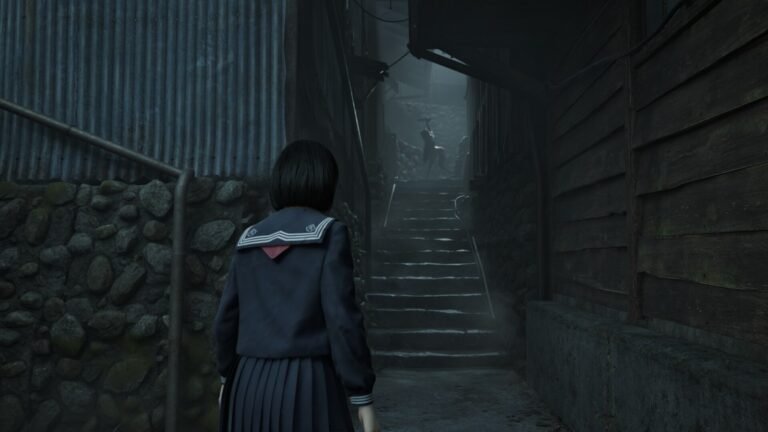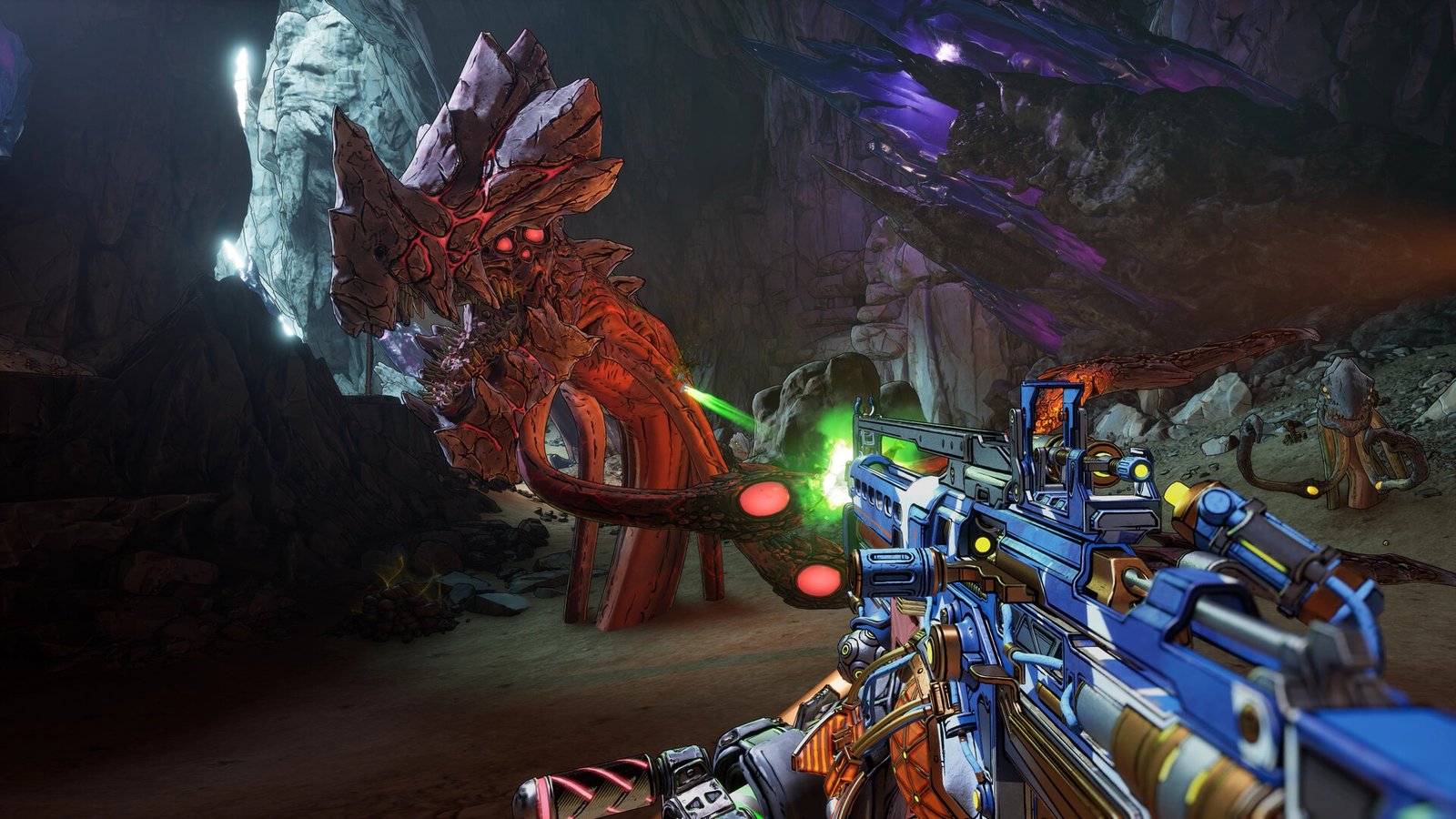
Combate em Kairos em Borderlands 4. Imagem: Gearbox Software / 2K.
Imagine completing a mission and finding two weapons.
The first deals more damage and looks like an obvious upgrade. The second has lower numbers but offers a special effect that fits your character’s abilities perfectly.
Which one do you choose?
In a traditional shooter, that decision might depend mainly on accuracy, rate of fire, or range. In a looter shooter, equipment also plays a role in how your character is built and develops. Perhaps the second weapon lets you use an entirely different strategy, and finding other pieces that complement its effect becomes your next objective.
A looter shooter is a category of games that combines gun-based combat with progression driven by acquiring equipment and rewards (loot). Rather than being an occasional prize, loot has an ongoing role in character development.
Borderlands made this combination particularly well known by bringing together weapons with different properties, character abilities, and first-person combat. Destiny brought the search for gear into a structure of shared online activities. The Division used third-person cover-based combat and equipment systems that support different playstyles. Meanwhile, Warframe developed an experience where finding components, crafting equipment, and combining modifications are essential parts of progression.
These games share an idea, but they do not follow the same formula.
In this feature, we’ll explore the origins of looter shooters, explain how their rewards work, and discover what sets them apart from other shooters.
Updated October 16, 2026.
Nesta matéria
What defines a looter shooter?
The name brings together two terms:
- Loot: equipment, items, resources, or rewards acquired during gameplay.
- Shooter: a game centered on combat with guns or other shooting mechanics.
A looter shooter uses both features within a structure where equipment influences character development and the challenges players can take on. Weapons with different attributes, special gear, abilities, missions, and replayable activities that award rewards are common.
However, none of these systems has to work in exactly the same way in every game.
In Borderlands, weapons can have many combinations of properties and effects. In Warframe, a significant part of progression revolves around components, crafting, and modifications. In The Division, combining equipment and skills can substantially change how you face enemies.
Does finding weapons automatically make a game a looter shooter?
No.
Many first-person shooters let players unlock weapons, attachments, and equipment. That does not make them all looter shooters.
In Counter-Strike, for example, weapons are part of each match’s economy and tactical decisions. The objective is not to develop a persistent character through gear earned in missions.
In a looter shooter, seeking rewards and making the character stronger usually form a central gameplay loop. There is no required camera perspective, either: Borderlands and Destiny primarily use first person, while The Division and Warframe predominantly feature third-person combat.
How did looter shooters emerge?
The modern formula grew from the convergence of two video game traditions: shooters and equipment-driven RPGs.
In RPGs, developing characters through attributes, abilities, weapons, and armor had long been important. In dungeon crawlers, fighting enemies and exploring dangerous areas frequently yielded rewards that helped prepare the next expedition. Action RPGs, particularly those in the Diablo tradition, turned acquiring equipment into a recurring activity.
The influence of Diablo and action RPGs
Diablo, developed by Blizzard North and released by Blizzard in 1996, helped popularize a structure that connects fighting enemies, finding items, and developing characters.
A weapon discovered while exploring can improve your character’s performance. Another item might have attributes better suited to your strategy. Eventually, searching for specific equipment can become just as important as moving forward in the story.
The same principle would appear in different action RPGs, each with its own reward and progression systems. Looter shooters would distinguish themselves by combining this logic with the execution of gun-based combat.
Equipment no longer affects only abstract attributes: it can also directly change how you aim, shoot, move, or use abilities. This relationship with action RPGs matters, but it does not automatically turn Diablo or Path of Exile into shooters.
Hellgate: London and earlier experiments
Released in 2007, Hellgate: London was developed by Flagship Studios, a team established by people who had worked at Blizzard North. The original PC release was published through a partnership involving Electronic Arts and Namco Bandai; it should not be confused with later re-releases.
The game combined action, RPG systems, equipment, and gun combat in a science-fantasy setting. Different classes used their own systems and playstyles, including firearms and melee combat.
Hellgate is an important predecessor because it showed how RPG-style progression could work in an experience with shooter elements. Still, its hybrid features were not identical to those of Borderlands, and it would be inaccurate to claim that a single game invented every element of looter shooters.
Borderlands and the consolidation of the modern formula

In 2009, Borderlands, developed by Gearbox Software and published by 2K, arrived on the market.
Set on the planet Pandora, it combined first-person combat, characters with distinct abilities, RPG progression, and an enormous variety of weapons. Its design offered an important difference from many traditional shooters.
Finding a weapon did not simply mean unlocking a fixed piece of gear. Weapons in the same category could have different attributes and behavior, including effects tied to manufacturers and to properties generated by the game’s systems.
This encouraged players to compare rewards and try new combinations.
When a reward changes combat
Imagine using a weapon that works extremely well against nearby enemies. After defeating a boss, you find another weapon with an elemental effect that supports a strategy based on particular abilities.
The change might be enough to reorganize your equipment or develop your character differently. That relationship makes the reward part of gameplay.
Players do not seek only weapons with bigger numbers. They also seek equipment that expands their options.
How the franchise evolved
Borderlands 2, released in 2012, expanded the series’ identity with new characters, abilities, equipment, and a particularly memorable campaign.
Borderlands: The Pre-Sequel, released in 2014, is a standalone game developed by 2K Australia in collaboration with Gearbox, not an expansion for Borderlands 2. Its setting on the moon Elpis introduced low gravity and oxygen mechanics into exploration and combat.
In 2019, Borderlands 3 introduced more modern movement systems and new possibilities for abilities and equipment.
Borderlands 4, released on September 12, 2025 for PC, PlayStation 5, and Xbox Series X|S, took the franchise to the planet Kairos, featuring new Vault Hunters, skill trees, and expanded movement mechanics.
The series’ evolution illustrates how weapons and character capabilities can develop together. But Borderlands represents only one looter-shooter tradition.
Other games reshaped the format by adding shared worlds, cooperation structures, and different progression systems.
Destiny, The Division, and Warframe: three approaches to the genre
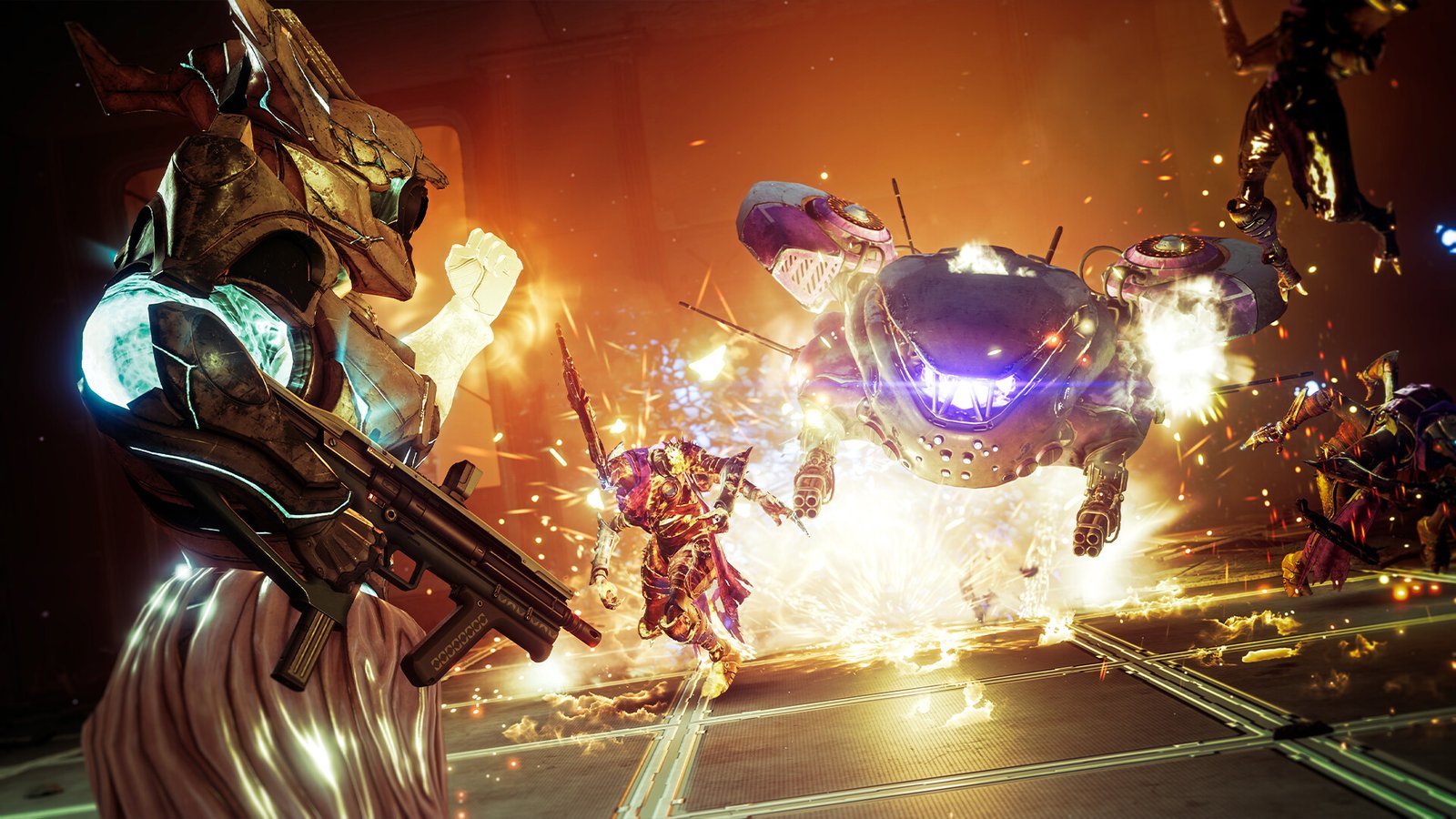
Destiny: equipment in a shared world
In 2014, Bungie released Destiny. The game combined first-person combat with persistent characters, classes, abilities, and online activities.
Players took the role of Guardians, developing their arsenals and participating in missions and challenges of different kinds.
Searching for equipment was connected to preparing for new activities. Weapons had their own characteristics, while abilities and gear influenced how characters functioned.
The game also developed complex cooperative activities, particularly raids, which require coordination to complete objectives and defeat bosses.
In 2017, Destiny 2 expanded this structure. Over the years, it received expansions, equipment changes, new activities, and progression overhauls.
This evolution also created maintenance and preservation challenges, including content that became unavailable during certain phases of the live service.
For that reason, Destiny 2 is especially important for understanding both the possibilities of connected looter shooters and the difficulty of preserving experiences that operate for many years.
The Division: cover, weapons, and equipment combinations

Developed by Massive Entertainment and published by Ubisoft in 2016, Tom Clancy’s The Division offered a third-person interpretation of the looter shooter, featuring an urban setting and cover-based combat.
The sequel, The Division 2, arrived in 2019 and developed its own systems for equipment, activities, and progression.
A defining feature of the series is the importance of combining weapons, gear pieces, and technological skills.
One character might prioritize durability and protection. Another might build around weapon damage. Skill systems can also be used to support allies or confront enemies in other ways.
The third-person camera affects spatial awareness and the use of cover, distinguishing the experience from Borderlands and Destiny.
Loot remains important, but its use belongs to a distinct approach to combat.
Warframe: crafting, modifications, and mobility

Warframe, by Digital Extremes, entered open beta on PC in 2013 and developed a different approach to action and progression.
Players control Warframes—combat suits with different abilities—and undertake missions using weapons, acrobatic movement, and special powers.
Progression depends heavily on obtaining resources, components, and blueprints used to craft equipment.
The modification system, known as mods, is also extremely important. Mods can change the properties of weapons, Warframes, and other equipment, allowing for very different builds.
In other words, progression does not depend solely on receiving a randomly generated weapon after defeating an enemy. Obtaining components, crafting items, and improving mods can be essential parts of the process.
This distinction matters: a looter shooter is not necessarily a game where every weapon drops randomly with a rarity level.
Warframe also developed a structure of ongoing updates with additional activities, stories, and systems. Its mechanics show how crafting and customization can be as important as the items obtained directly during missions.
How does a looter shooter’s gameplay loop work?
One simple way to understand the genre is to look at the relationship between combat and progression:
Prepare equipment → Face challenges → Obtain loot → Compare rewards → Improve the character → Seek new challenges.
This loop may appear during a campaign, in cooperative missions, or in activities unlocked after certain progression milestones. Exactly how it works differs from game to game.
Loot, rarity, and attributes
Rewards can include weapons, armor, accessories, components, or special equipment. Some games organize items by rarity; others use categories, perks, sets, and unique properties.
However, rarer equipment is not automatically the best choice for every character.
Imagine a weapon with high damage per shot but a slow rate of fire. Another weapon may perform better in a build focused on frequent attacks. An item might also offer a special effect that interacts with particular abilities.
That is why comparing loot means understanding what an item does, rather than looking at a single number.
What is a build?
A build is the combination of choices that determines how a character uses gear, attributes, and abilities.
In a looter shooter, a build may combine weapons, equipment pieces, modifiers, classes, and powers.
Imagine two setups using the same weapon category: one prioritizes direct damage, while the other takes advantage of elemental effects and abilities that work better when enemies suffer certain conditions.
The weapon may be similar, but the result in combat can be very different. The available options depend on each game’s systems; not all games have fixed classes or skill trees.
Crafting and equipment upgrades
Some looter shooters also feature item crafting and upgrade systems. Players may spend resources to make equipment, improve pieces, or change particular properties.
Warframe is a major example of crafting from components and blueprints. The Division has its own equipment customization and development systems. Destiny 2 has also gone through different ways of acquiring and improving weapons over its history.
These alternatives broaden progression beyond the items received immediately after combat.
Farming, missions, and endgame: why repeat activities?
A common feature of looter shooters is the ability to tackle certain challenges repeatedly in search of desired rewards.
The term farming describes a targeted search for resources, equipment, or other items.
Imagine a mission that can reward a weapon with a particular effect. You might complete it once during the campaign and move on, or decide to repeat it in the hope of finding a version better suited to your build.
That choice changes how you interact with content. A mission stops being just another stage of the story and becomes a progression activity.
Targeted and random rewards
Some games tie particular items to bosses, activities, or specific sources. Others have broader reward systems. Some combine fixed equipment with variable attributes.
Not every farming method therefore involves a completely random chance of receiving any item. What matters is that looking for specific rewards shapes the player’s decisions.
What is endgame?
Endgame refers to activities and challenges that become relevant after the main campaign or an advanced stage of progression.
It may include more difficult bosses, raids, missions with modifiers, and the pursuit of better equipment.
In Destiny, raids and dungeons are cooperative activities with their own structures. In The Division, certain advanced activities require preparation and effective equipment combinations. Borderlands offers challenges and systems that vary by installment. Warframe features different progression activities unlocked as an account develops.
Not every looter shooter draws a strict line between campaign and endgame. In some, advanced progression unfolds gradually and overlaps with other activities.
Are cooperation and PvP mandatory?
No.
Many looter shooters emphasize PvE—fights against game-controlled enemies—often with cooperative options. Combining characters with different abilities can make demanding activities easier to overcome.
Some games also offer PvP, where players compete directly. Destiny has a history of competitive modes, while The Division has developed experiences mixing game-controlled threats with other players.
But a looter shooter does not need PvP to belong to the genre. Nor is playing with other people at all times mandatory: the single-player options depend on each title.
Looter shooter vs. extraction shooter: what’s the difference?

This is one of the most important distinctions among shooters that use persistent equipment.
A looter shooter’s progression centers on earning rewards, improving the character, and developing equipment. An extraction shooter, by contrast, structures activities mainly around raids where entering, facing threats, and successfully getting out are part of the objective.
Both formats may include weapons, loot, and progression systems. The difference lies in how the experience is organized.
| Feature | Looter shooter | Extraction shooter |
|---|---|---|
| Main focus | Equipment, combat, and progression | Raids, risk, and extraction |
| Rewards | Support character development | May have to be successfully carried out of the area |
| Consequences of defeat | Depend on the activity and its rules | Often involve a risk of losing equipment |
| Structure | Campaigns, missions, and varied activities | Raids organized around an exit or extraction |
| Examples | Borderlands, Destiny, Warframe | Hunt: Showdown, Escape from Tarkov, ARC Raiders |
The Division and its Dark Zones
The Division offers an interesting example of overlap between these approaches.
In the Dark Zones, players can face threats, find equipment, and enter situations involving other agents. Certain contaminated items must be extracted before they can be used.
This creates an experience where obtaining a reward does not automatically mean keeping it.
The Division 2 has also received different versions of these areas. In 2026, Ubisoft confirmed the continued availability of PvE-focused Toxic Dark Zones alongside the Blackout variant. PvP should therefore not be treated as a universal requirement of every current Dark Zone.
However, extraction activities in Dark Zones do not turn the entire The Division franchise into an extraction shooter. Its broader structure is still strongly associated with combat, earning equipment, and developing builds.
Likewise, Hunt: Showdown does not become a traditional looter shooter merely because it offers gear and rewards.
These classifications can overlap, but their identities remain distinct. ZAUS.GG explores that distinction in its feature Extraction Shooter: what it is, how it works, and why surviving matters as much as winning.
Are looter shooters, FPS, and ARPGs the same thing?
No. These classifications describe different aspects of games.
FPS primarily describes first-person shooting. TPS describes third-person shooting. ARPG describes RPG systems combined with real-time combat. Looter shooter emphasizes the relationship between shooting, equipment, and progression.
Borderlands can be both an FPS and a looter shooter. The Division combines TPS with looter-shooter systems. Warframe uses third-person combat, abilities, and progression closely tied to acquiring and customizing equipment.
There is also a meaningful connection to action RPGs. Diablo and Path of Exile helped establish the tradition of developing characters through abilities and rewards. Their combat systems, however, are not organized around shooting in the same way as Borderlands or Destiny.
To understand these traditions separately, ZAUS.GG has features about FPS games and action RPGs (ARPGs).
The games that shaped looter-shooter history
The following selection presents historical milestones and different interpretations of the genre. It is not a ranking of the best games.
| Game | Year | Contribution or characteristic |
|---|---|---|
| Hellgate: London | 2007 | Hybrid experiment combining RPG systems, loot, and gun combat |
| Borderlands | 2009 | Popularized the modern formula of shooting with variable equipment |
| Borderlands 2 | 2012 | Expanded abilities, weapons, and cooperative play |
| Warframe | 2013 | Progression through components, crafting, and mods |
| Destiny | 2014 | Equipment and activities in shared online spaces |
| The Division | 2016 | Third-person looter shooter with cover mechanics |
| Destiny 2 | 2017 | Expanded activities, rewards, and online services |
| The Division 2 | 2019 | Developed builds and varied advanced activities |
| Borderlands 3 | 2019 | New movement, weapon, and ability possibilities |
| Outriders | 2021 | Combined shooting, powers, and equipment in a cooperative campaign |
| Tiny Tina’s Wonderlands | 2022 | Borderlands-style formula with fantasy and its own character systems |
| Borderlands 4 | 2025 | New Vault Hunters, expanded movement, and variable arsenal |
These games do not all use identical loot or progression systems.
Hellgate: London appears as a hybrid predecessor, while Borderlands marks an important step in the commercial consolidation of the formula. Warframe, Destiny, and The Division demonstrate that the genre can take several very different forms.
What changed in looter shooters through 2026?
Part of the genre adopted ongoing updates, seasons, expansions, and events. These systems can add activities, weapons, rewards, and changes to how characters work.
Warframe continued to receive new content. Epoch Operation: Taubound began on October 15, 2026, with an expected end date of November 17. It is a temporary operation connected to the narrative preparation for Tau, not proof that the entire Tau experience is already available.
In The Division 2, the Red Horizon season, available since August 2026, brought the Cleaners to Washington and added equipment and Dark Zone changes. Crossplay had been announced for November and was still a future feature on the date of this update.
Destiny 2 received Monument of Triumph on June 9, 2026, described by Bungie as its final planned content update for the service. That did not mean the servers were being shut down: content remained accessible and stability fixes were still possible.
On September 17, 2026, Bungie announced that work had begun to restore removed campaigns, destinations, and raids. That announcement did not mean all that material had already returned.
These examples show that looter shooter is not automatically synonymous with live-service game.
Outriders, developed by People Can Fly and published by Square Enix in 2021, combines shooting, powers, classes, and loot in a campaign playable solo or cooperatively with up to three participants. It does not require the same seasonal schedule as Destiny.
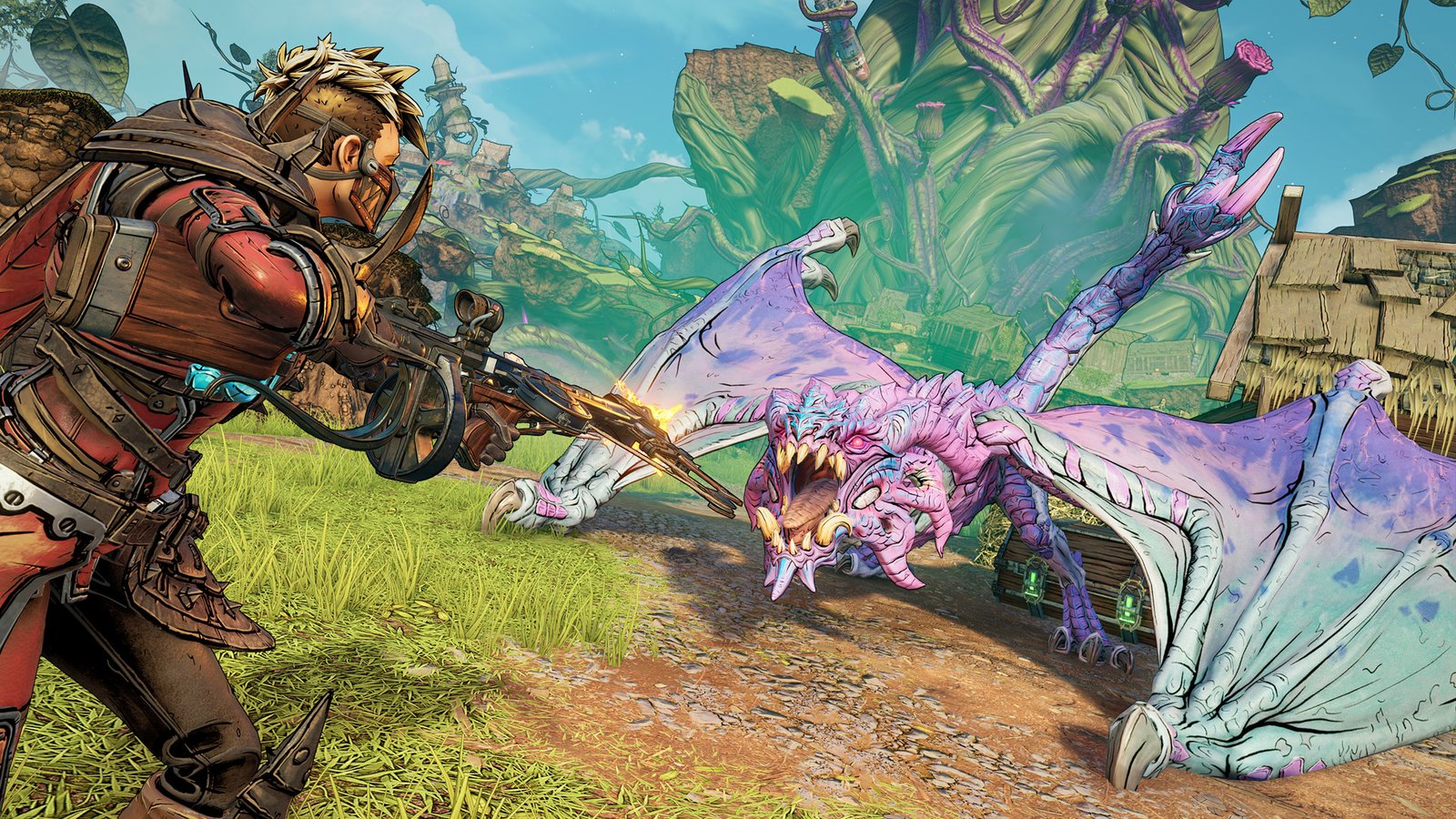
Tiny Tina’s Wonderlands, from Gearbox and 2K, debuted on March 25, 2022 and arrived on Steam in June. It is a standalone fantasy adventure with guns, magic, and character creation—not a DLC for Borderlands 3.
An experience can be built around campaigns and cooperative activities without relying on the same update schedule as a persistent online game.
When does searching for loot stop being interesting?
Repetition can be enjoyable when each reward opens up new possibilities.
Finding a weapon with a different effect might encourage you to try another build. Obtaining a desired piece of equipment might make a harder challenge possible.
But the experience can also become tiring when a player has to repeat an activity many times without feeling meaningful progress.
Complex inventories, balance changes, and equipment that becomes less useful can also make the experience more difficult to enjoy.
These issues vary between games and depend on individual preferences. Some people enjoy hunting for equipment over many hours; others prefer campaigns with more direct progression.
The value of a loot system lies in the relationship between effort, variety, and the ways rewards can actually be used.
Looter shooters turn new equipment into new ways to play
Looter shooters emerged from the convergence of shooters and the equipment systems developed in RPGs.
Hellgate: London experimented with this combination before it gained a more recognizable commercial identity.
Borderlands popularized a formula where varied weapons, abilities, and progression are directly connected. Destiny, The Division, and Warframe broadened that relationship through shared activities, cover-based combat, crafting, and modifications.
These games do not require the same camera, player count, or structure of activities. What connects them is how rewards contribute to character development.
In a looter shooter, finding a weapon is not just receiving a prize. It can mean discovering a new way to face the next challenge.
That ability to turn equipment into new strategies is what defines the genre.
About the Author