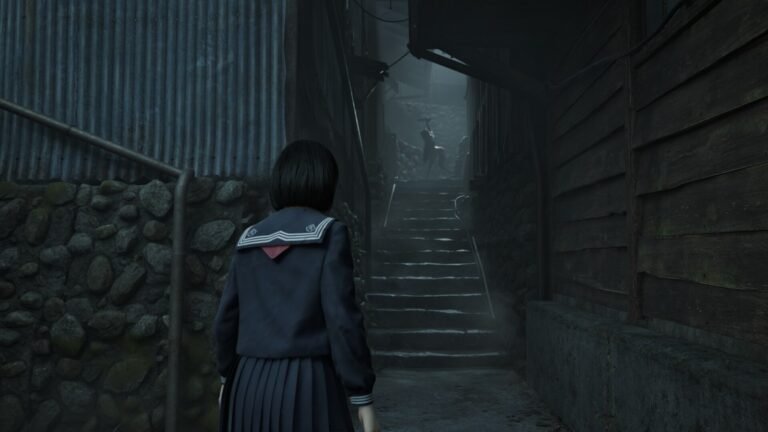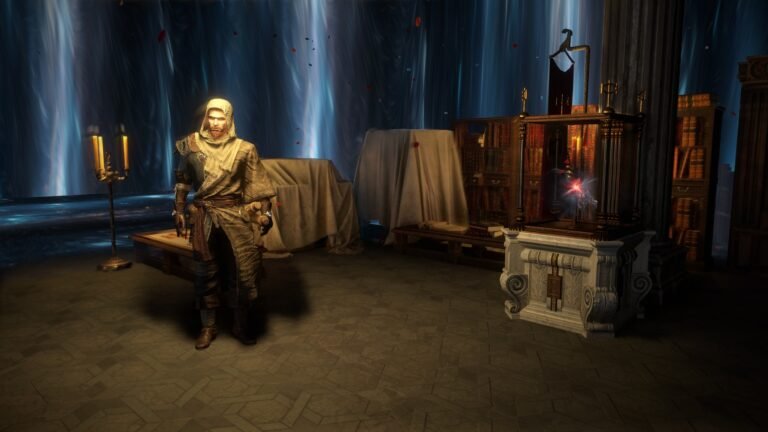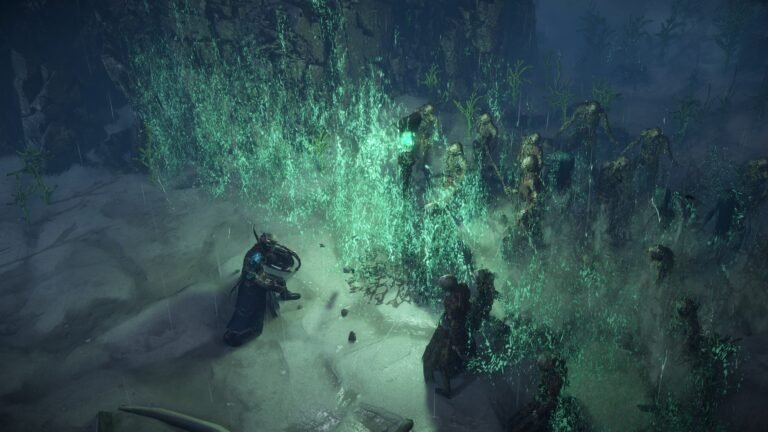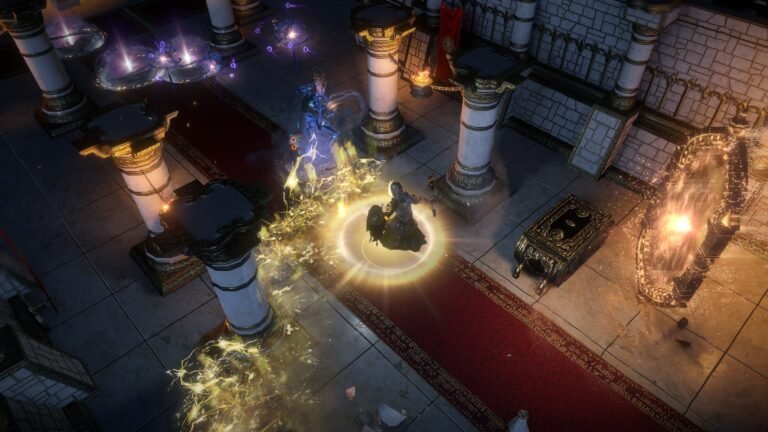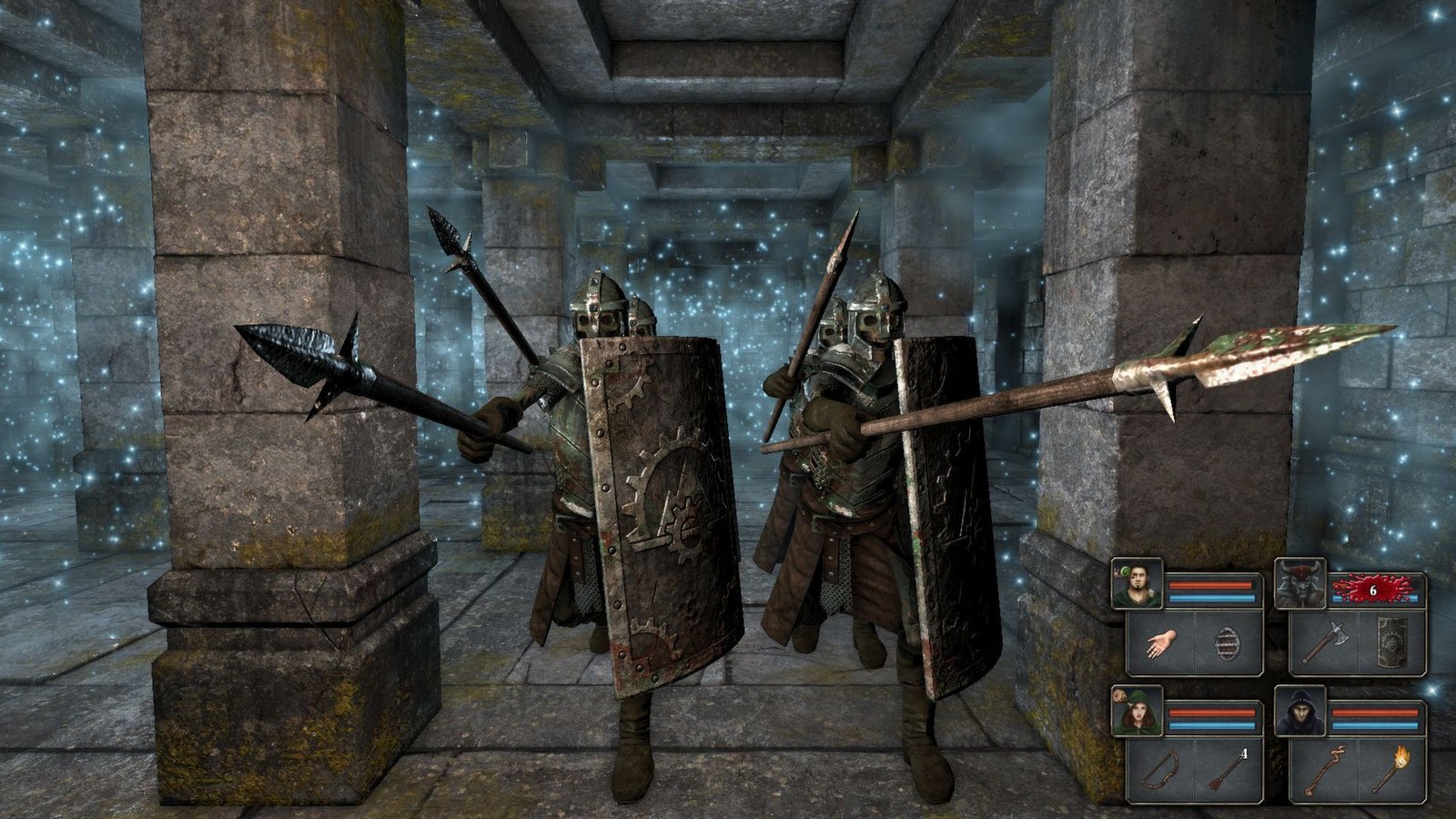
Confronto em Legend of Grimrock. Imagem: Almost Human Games
Dungeon Crawler is a style of game centered on exploring dungeons, labyrinths, and other dangerous environments, where moving forward means overcoming challenges, finding paths, and managing available resources.
Imagine your party of adventurers exploring an unfamiliar dungeon. After crossing several corridors, you discover a staircase leading to the next floor. But your characters are wounded, healing spells are running out, and there is still a locked door you have not managed to open.
Going downstairs might reveal treasure and new challenges. Returning to a safe area would let you recover resources and prepare the party more thoroughly. The problem is that you do not know what lies ahead.
This relationship between exploration, risk, and discovery is one of the defining characteristics of dungeon crawlers.
In Wizardry, players organize a party of adventurers to explore labyrinths and fight enemies in turn-based battles. Dungeon Master uses a similar perspective but features real-time combat and more direct interaction with the environment.
Etrian Odyssey makes dungeon mapping a major part of the experience. Legend of Grimrock, meanwhile, revisits classic exploration with modern three-dimensional graphics, traps, and puzzles. The style also appears in action games and experiences with procedurally generated maps.
But there is an important distinction: a dungeon crawler is not simply any RPG that contains a dungeon. To understand why, we need to look at its origins and why exploring the environment can be just as important as defeating enemies.
Updated October 16, 2026.
Nesta matéria
What defines a dungeon crawler?
The expression brings together two ideas. Dungeon means a prison or underground chamber, but in video games it can also refer to ruins, caves, labyrinths, and other spaces designed to be explored. Dungeon crawling describes moving through these places, overcoming their challenges, and discovering what lies ahead.
A dungeon crawler is a game where that exploration is central to the experience. Players may need to investigate corridors, find passages, detect traps, fight creatures, and search for equipment. Progress often depends as much on understanding the layout as on improving the characters.
Does every dungeon crawler take place underground?
No. The setting might be a castle, a forest laid out like a maze, a technological facility, or any other space suited to this kind of exploration.
There is no mandatory camera perspective, either. The classic tradition is closely associated with first-person views, but some games use top-down, side-on, or other perspectives. Likewise, some dungeon crawlers feature turn-based combat while others offer real-time action.
What unites these experiences is the structural importance of advancing through dangerous areas, overcoming challenges, and discovering new paths.
How did dungeon crawlers begin?
The style’s origins are connected to early tabletop RPGs and attempts to adapt their adventures to computers. Dungeons & Dragons, created by Gary Gygax and Dave Arneson and published by TSR in 1974, was especially influential. Its roots in wargaming helped transform the control of armies into campaigns centered on individual characters.
In tabletop adventures, parties could explore dungeons designed by a game master. Each location offered different possibilities: a chamber of creatures, a trapped corridor, a hidden passage, or treasure protected by an obstacle. Players made decisions about routes, equipment, and resource use.
This structure gave early computer RPGs an important foundation. However, not every tabletop RPG focused on dungeons, and labyrinth exploration already existed in other game traditions.
pedit5 and the first computer dungeon RPGs
In 1975, Rusty Rutherford developed pedit5, also known as The Dungeon, on PLATO, a system associated with the University of Illinois. PLATO was a computer-based education platform accessed through terminals connected to central computers. Alongside educational activities, its community experimented with communication tools and games.
In his account of creating the game, Rutherford places its development in the Northern Hemisphere’s autumn and winter of 1975. The pedit5 file contained the game; pedit4 held its instructions.
Players controlled a character exploring a single-floor dungeon with a fixed layout but random encounters and treasure. They could fight, cast spells, or flee; hit points, experience, and levels contributed to progression. It was heavily constrained by computers of the period, but already combined elements familiar in digital RPGs.
Another significant project was dnd, or The Game of Dungeons, developed on PLATO in the mid-1970s by Gary Whisenhunt and Ray Wood, then expanded in later versions by Dirk Pellett and Flint Pellett. Its name refers to that specific game, not merely an abbreviation of Dungeons & Dragons.
These experiments featured character systems, attributes, combat, and exploration inspired by tabletop RPGs. Others in the story include Moria, by Kevet Duncombe and Jim Battin, developed on PLATO from the mid-1970s, and Oubliette, begun by Jim Schwaiger in 1977 and expanded with collaborators. The Cyber1 preservation community identifies their creators and keeps these projects accessible. The Moria mentioned here is the PLATO game, not the later roguelike of the same name.
There is no entirely straightforward answer to which digital dungeon crawler came first. These projects emerged amid incomplete documentation, successive versions, and community experimentation. The key point is that the structure was already taking shape before commercial RPGs became popular.
Wizardry and the consolidation of classic dungeon exploration
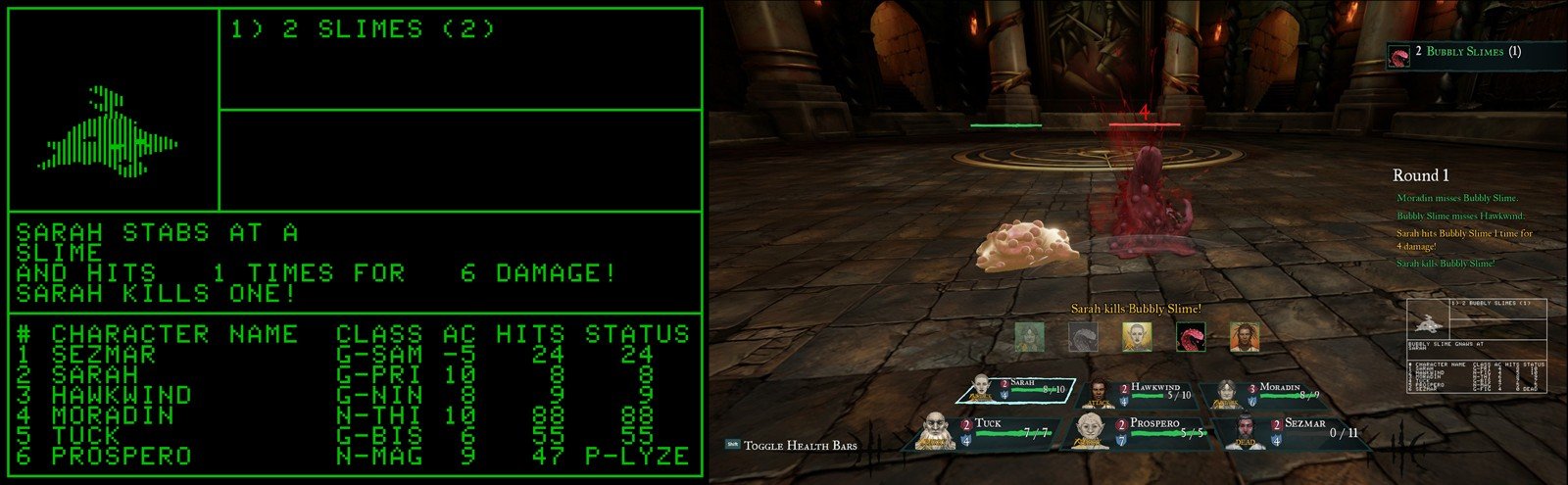
In 1981, Wizardry: Proving Grounds of the Mad Overlord arrived on the Apple II and became one of the most influential milestones in digital dungeon RPGs.
Developed by Andrew Greenberg and Robert Woodhead and published by Sir-Tech, it put players in charge of an adventuring party exploring a labyrinth filled with enemies and obstacles. Characters had their own classes, attributes, and equipment. In battle, players chose turn-based actions using attacks, spells, and other resources.
But the heart of the experience was not only combat. Players had to enter the labyrinth, discover its routes, and decide how far their party could safely venture.
Exploration and preparation
Building a balanced party was part of the challenge in Wizardry. Different characters offered different abilities, while the party’s condition determined how long an expedition could continue.
The castle and its services connected one expedition to the next: returning made it possible to reorganize equipment, regain strength, and prepare before exploring deeper areas. This relationship between preparation and exploration became one of the most recognizable features of party-based dungeon crawlers.
Mapping the labyrinth was part of the game
Spatial orientation was another important characteristic. Exploration took place in first person, with movement through spaces organized on a grid. Players had to understand corridor layouts, identify routes, and avoid getting lost.
For years, drawing maps on paper was a common way to track progress in this tradition. Knowing the dungeon became a reward in itself.
The influence of Wizardry
Wizardry helped establish a recognizable RPG structure based on parties, turn-based combat, and labyrinth exploration. Its influence reached other computer RPGs as well as Japanese developers.
Tales of the Unknown: Volume I — The Bard’s Tale, created by Interplay and published by Electronic Arts in 1985, and Might and Magic Book One: Secret of the Inner Sanctum, from New World Computing in 1986, developed party-based exploration, character systems, and combat. Both debuted on Apple II and later reached other computers.
Ultima combined different kinds of exploration, including overworlds, towns, and dungeons, so not every installment should be classified as a pure dungeon crawler. Wizardry did not single-handedly invent digital RPGs, but it helped consolidate a formula recognizable for decades.
Dungeon Master and the transformation of combat
In 1987, FTL Games released Dungeon Master for Atari ST. It retained first-person exploration and grid-based movement, but built an experience around real-time action.
Enemies could move while players made decisions. Objects and environmental elements could be manipulated directly, while spells, inventory, and equipment influenced exploration. This changed the pace of combat.
Instead of selecting every command in a conventional turn sequence, players had to respond to danger while action continued. Dungeon Master did not invent real-time RPG combat, but it was a milestone in popularizing that approach in first-person dungeon games.
Eye of the Beholder and the formula’s continuation
In 1991, Eye of the Beholder, developed by Westwood Associates and published by Strategic Simulations (SSI), followed a similar tradition. Its adventure beneath Waterdeep used the Advanced Dungeons & Dragons license.
The game featured first-person exploration, a party of characters, and real-time encounters in a fantasy setting connected to Dungeons & Dragons.
Other experiences expanded the style. Ultima Underworld: The Stygian Abyss, developed by Blue Sky Productions and published by Origin Systems for DOS in 1992, offered three-dimensional exploration with more freedom of movement and environmental interaction. Unlike earlier tile-based movement, it let a single protagonist move more continuously through space.
These games showed that dungeons, characters, and combat could work within different technical structures. Exploration did not have to remain tied to a single command system.
How does dungeon exploration work?
In many dungeon crawlers, the experience follows a recognizable loop:
Prepare the party → Enter the dungeon → Explore → Face challenges → Find rewards → Advance or return.
This sequence is illustrative, not a mandatory rule. Some games have no towns or frequent returns to safety. Others use just one character or structure progress around separate expeditions. Even so, the loop helps explain the relationship between exploration, resources, and character development.
Paths, secrets, and puzzles
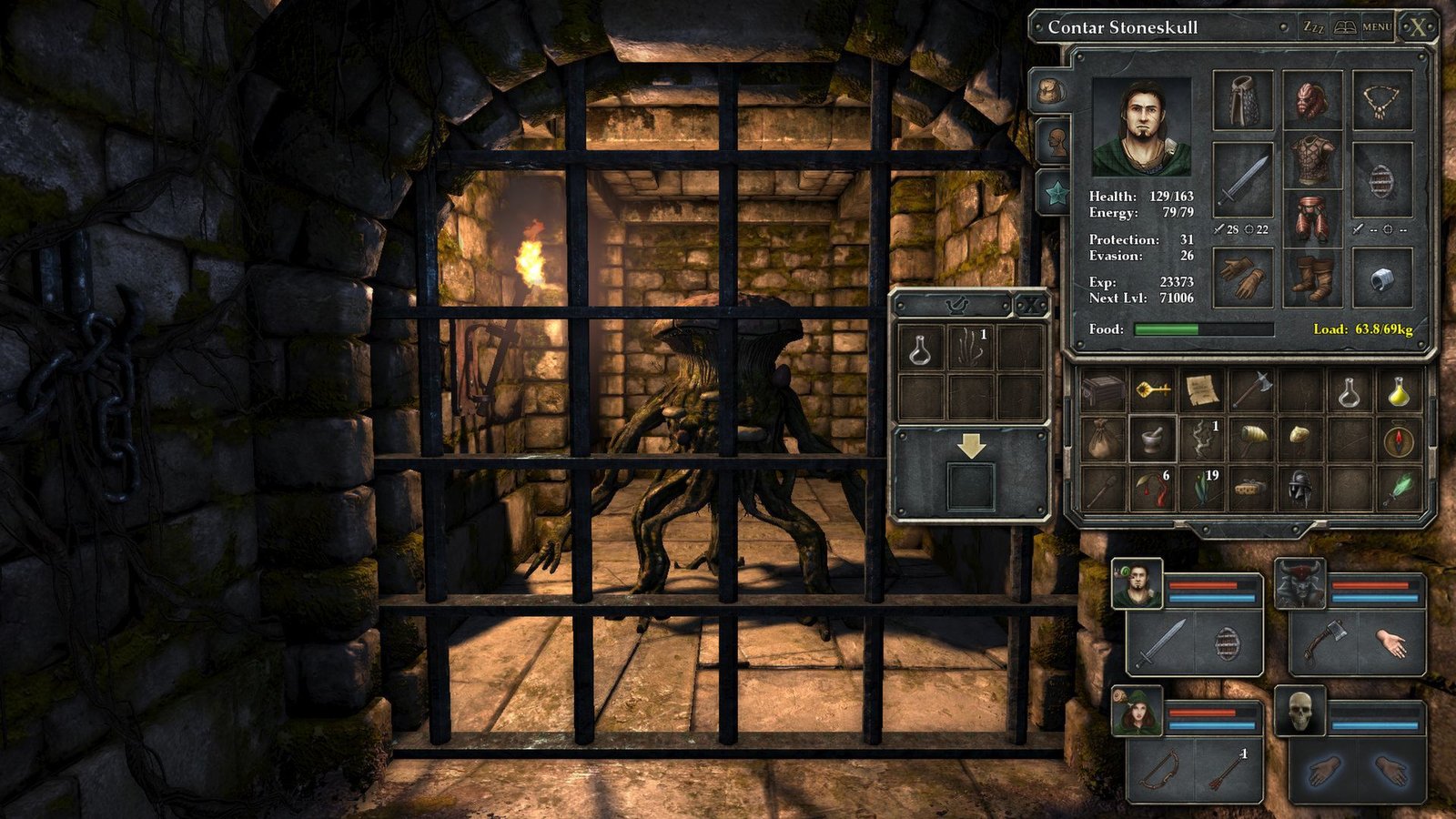
A dungeon might consist of corridors, rooms, stairs, doors, and alternative passages. Some routes require keys. Others hide behind walls or depend on solving puzzles.
Imagine a room with three switches and a blocked passage. Players might need to study clues found earlier to discover the correct activation order. In other cases, the challenge lies in understanding the map and finding a safe route.
Dungeon layout determines the kind of exploration: certain games emphasize complex mazes, while others offer more direct routes and combat challenges.
First-person views and grid-based movement
Grid-based dungeon crawlers organize their environments into defined spaces. A character or party moves from one position to another, often turning the camera in set increments.
This structure helps create corridors, intersections, traps, and navigation puzzles. The term blobber is also used by part of the community for first-person RPGs where a party moves as a single unit during exploration.
Wizardry and Dungeon Master represent traditions associated with that format. But not every dungeon crawler is a blobber, and not every exploration game uses grid movement.
Turn-based or real-time combat
Combat systems change how players confront challenges. In Wizardry and Etrian Odyssey, turn-based encounters allow actions to be chosen under each game’s rules.
Dungeon Master and Legend of Grimrock, by contrast, use real-time encounters where movement and attack timing affect survival. Some games also feature more direct action combat. Dungeon crawler does not, by itself, determine the pace of combat.
Characters, resources, and equipment
Many dungeon crawlers feature RPG elements such as attributes, classes, experience, and skill development. Party composition can affect the ability to overcome enemies or withstand certain situations.
Resources also matter in planning. Healing items, spells, equipment, and inventory space can determine how long an expedition lasts. A party’s makeup opens up different possibilities, too: healing, defense, and magic capabilities complement one another according to the game’s rules. Managing these resources connects character choices to the duration and goals of exploration.
What happens when the party is defeated?
The consequences vary considerably. In Wizardry, certain defeat and character-recovery systems could be harsh, making preparation especially important. Other games let players load an earlier save, recover characters, or retain part of their progress.
Some modern experiences feature permadeath or expedition resets. Losing all progress upon death is not a mandatory dungeon crawler feature. Likewise, treasure does not mean every game features randomized gear or intricate item-rarity systems.
What matters is how resources and consequences affect decisions while exploring.
Etrian Odyssey and Legend of Grimrock: keeping the tradition alive
Even as open-world RPGs and action games expanded, classic dungeon exploration continued to inspire new interpretations.
Etrian Odyssey and manual mapping
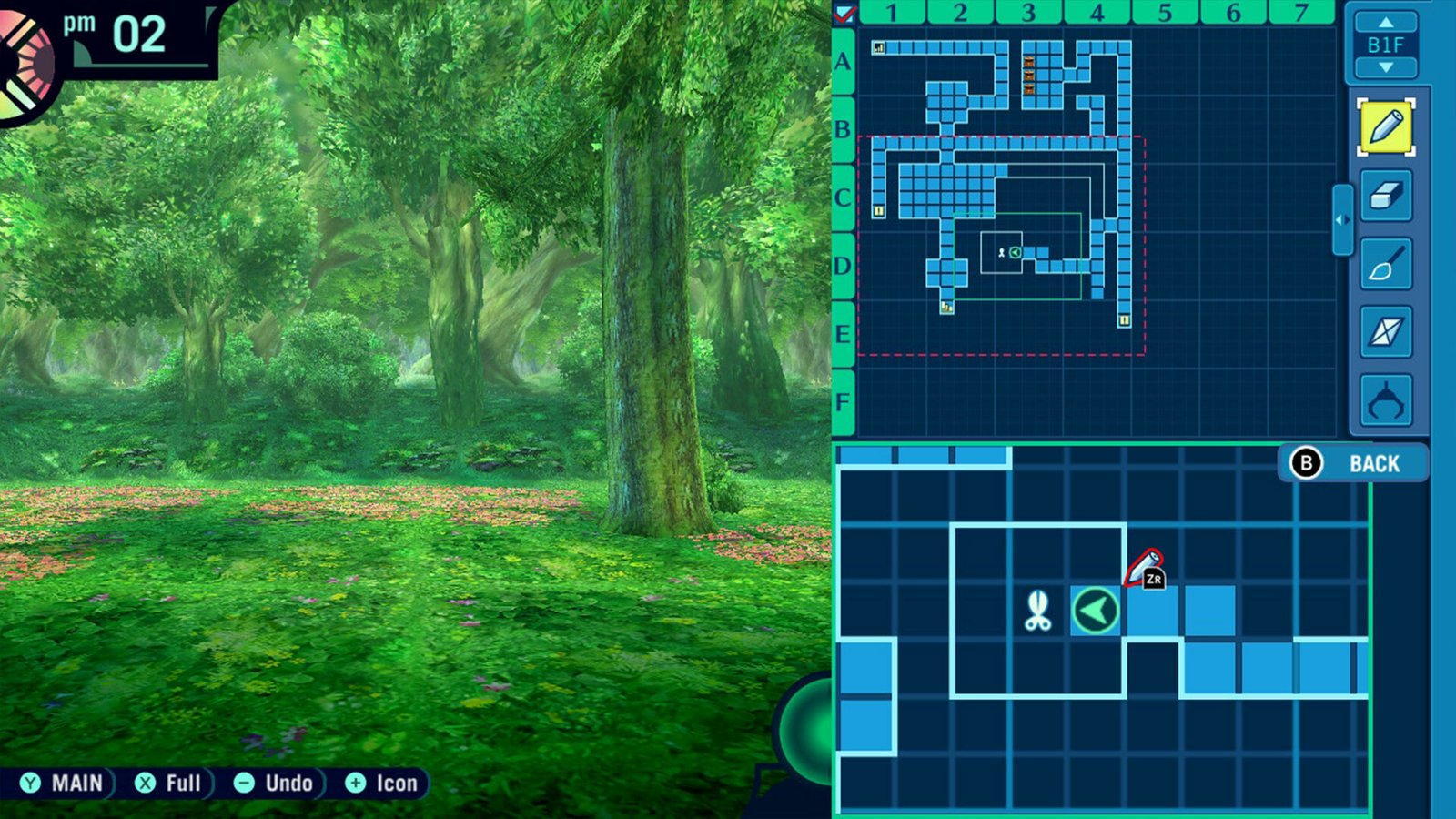
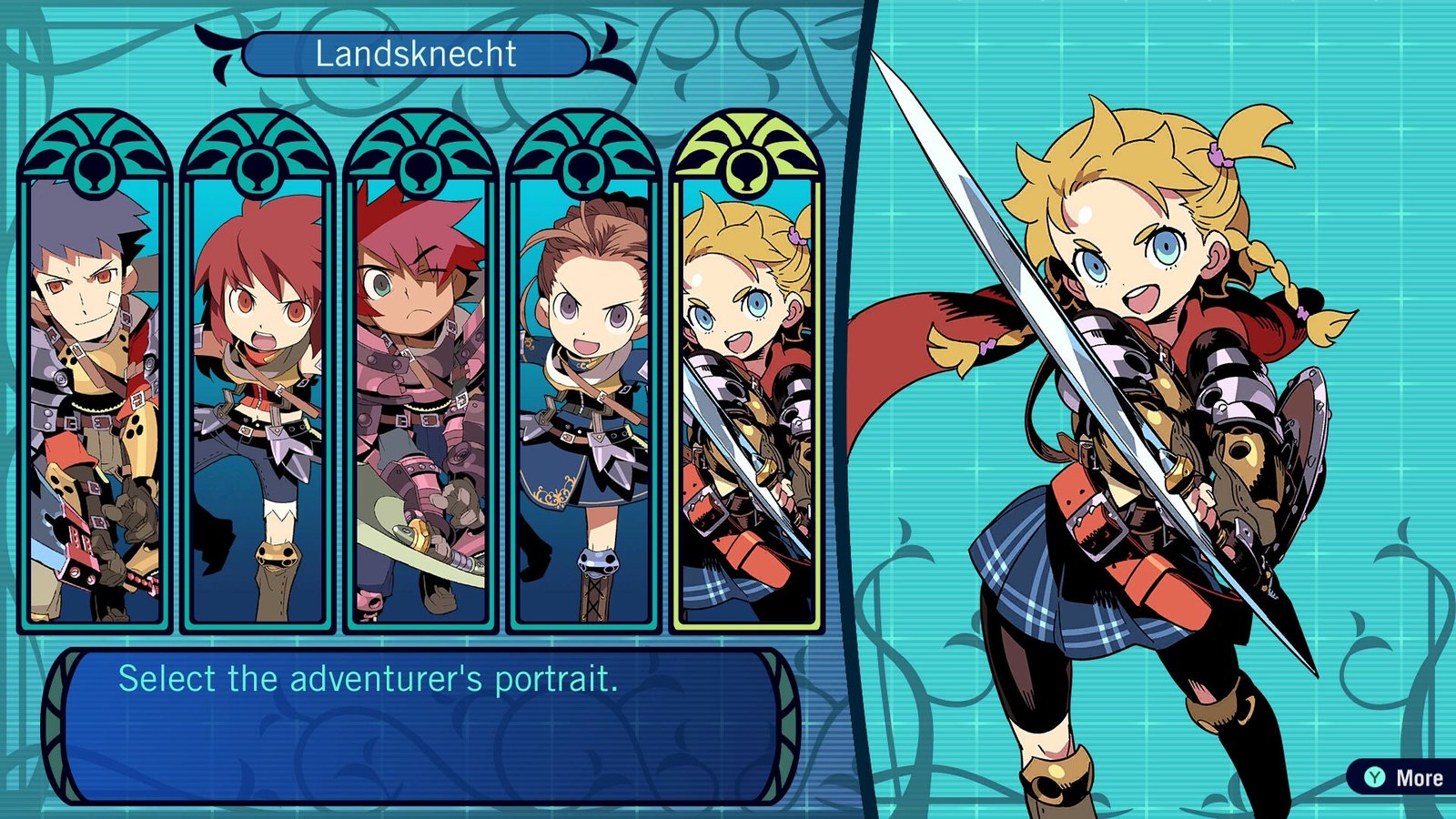
In 2007, ATLUS released the first Etrian Odyssey for Nintendo DS. It revisited traditional dungeon crawler elements: first-person exploration, adventuring parties, classes, turn-based battles, and dangerous labyrinths.
But the game used a distinctive feature of its console to forge its identity. The touchscreen allowed players to draw and record a dungeon map, marking walls, routes, and points of interest as they explored.
Mapping accurately helped players understand the labyrinth and plan future expeditions. Etrian Odyssey also tied party development to progress through increasingly dangerous regions. Returning to town to reorganize the characters and prepare equipment was part of the experience.
In 2023, Etrian Odyssey Origins Collection brought together Etrian Odyssey HD, Etrian Odyssey II HD, and Etrian Odyssey III HD on Nintendo Switch and PC through Steam. These are remasters, not three brand-new adventures.
Alongside updated visuals and difficulty options, mapping was adapted for touch controls on Switch and mouse controls on PC. The single-screen presentation reorganizes the map and exploration areas rather than literally recreating the Nintendo DS’s dual screens.
The collection shows how a mechanic associated with older RPGs can remain engaging when supported by a suitable interface.
Legend of Grimrock and real-time exploration
Released in 2012, Legend of Grimrock revived another historical tradition: first-person, grid-based exploration paired with real-time combat. Players control a group of prisoners navigating dungeons packed with creatures, traps, and puzzles.
The game combines three-dimensional environments with movement organized into defined spaces. Its presentation is modern, but many decisions recall Dungeon Master. Players must inspect walls, identify mechanisms, manage equipment, and react to enemies that keep acting during encounters.
In 2014, Legend of Grimrock 2, also from Almost Human Games, expanded the premise with the Isle of Nex, which includes outdoor environments, ruins, and dungeons.
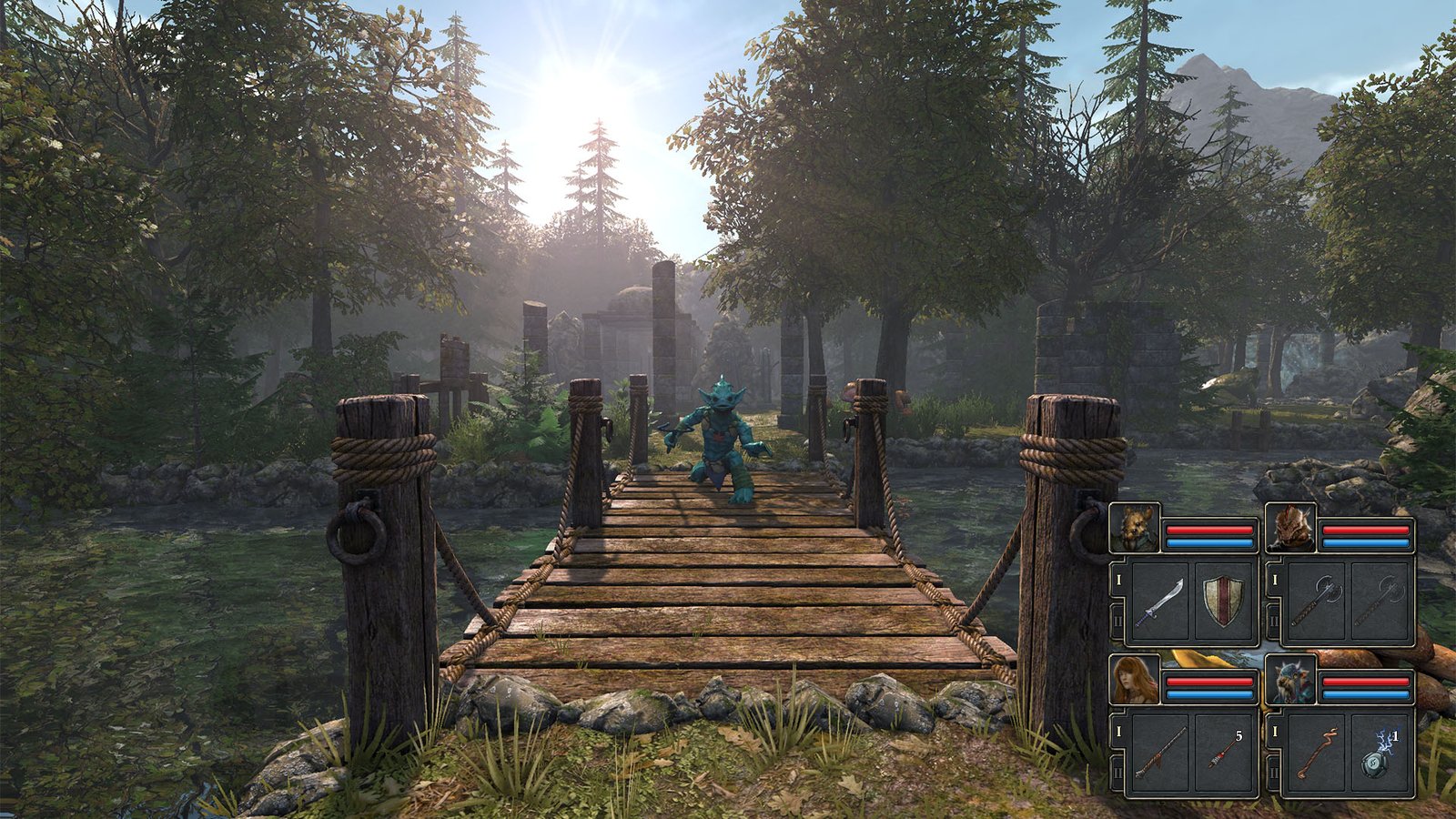
This expansion of the setting matters because it shows that a dungeon crawler does not necessarily mean spending an entire adventure in underground corridors. The important thing is the structure of exploration and the challenges that shape progress.
Darkest Dungeon and expeditions with consequences

Darkest Dungeon, from Red Hook Studios, left Early Access and received its full PC release on January 19, 2016. It offers another interpretation of exploring dangerous environments. Players recruit and develop adventurers who undertake expeditions into hostile regions.
Combat is turn-based, while resources, physical condition, and character stress affect whether expeditions can continue. Its structure is not the same as first-person grid-based games.
Even so, preparation, risk, and decisions about pressing on or abandoning an expedition connect it to the dungeon-exploration tradition. The game also has elements associated with roguelikes and its own progression systems, showing how genre labels can intersect.
Dungeon crawler, ARPG, and roguelike: what’s the difference?
These terms often appear together, but they do not mean exactly the same thing.
| Classification | Main characteristic | Examples |
|---|---|---|
| Dungeon crawler | Structured exploration of dungeons and dangerous environments | Wizardry, Legend of Grimrock |
| ARPG | Character development combined with action combat | Diablo, Path of Exile |
| Roguelike | Tradition associated with Rogue, exploration, procedural generation, and severe consequences | Rogue, NetHack |
| Roguelite | Attempts and resets, often with some persistent progression | Hades |
| Turn-based RPG | Combat and actions organized through turn systems | Dragon Quest, Wizardry |
These classifications can overlap. They describe different aspects of exploration, progression, or the way combat is organized. Our feature on turn-based RPGs explores that last dimension in greater detail.
Are Diablo and Path of Exile dungeon crawlers?
Exploring dangerous areas, fighting enemies, and collecting rewards are important parts of Diablo and Path of Exile. Both therefore feature elements of dungeon crawling.
However, they mainly belong to the action RPG (ARPG) tradition, characterized by real-time combat and character development through skills and equipment. In Path of Exile, for instance, exploring maps and defeating creatures feeds into a larger system of progression, equipment, and endgame activities.
That differs from classic Wizardry, which centers on exploring first-person labyrinths and managing a party. ZAUS.GG explains the genre in ARPG: what it is, how it works, and the genre’s history and explores the history of Path of Exile.
How are dungeon crawlers related to roguelikes?
The historical connection is close. Rogue began development in 1980 at the University of California, Santa Cruz, in a Unix environment, with Michael Toy and Glenn Wichman. Ken Arnold contributed to later versions. The 1980 milestone refers to initial development, not later commercial ports.
The game featured dungeon exploration, procedural generation—maps produced by the program’s rules—and permadeath. That combination influenced the roguelike tradition, which ZAUS.GG covers in Roguelike and Roguelite: differences and evolution.
But dungeon crawler and roguelike are not synonyms. Wizardry uses predesigned dungeons, while games inspired by Rogue can rearrange environments on each attempt. Not every roguelike or roguelite takes place in a traditional dungeon, either.
Procedural generation is not required for a dungeon crawler, just as including a dungeon does not automatically make a game a roguelike.
Does every RPG with dungeons belong to the genre?
No. In World of Warcraft, dungeons are activities within an MMORPG with many other progression paths. In open-world RPGs, they can be optional areas. In ARPGs, they may be repeatable activities for obtaining equipment.
In these cases, dungeon exploration is part of the experience without necessarily defining the entire game. Dungeon crawler may be used as a primary classification or to describe an exploration structure found in other genres. The distinction lies in how important that activity is to the game’s identity.
Games that shaped the evolution of dungeon crawlers
This selection highlights historical milestones and different interpretations of dungeon exploration. It is not a ranking of the best games.
| Game | Year | Main contribution or characteristic |
|---|---|---|
| dnd | Mid-1970s | PLATO experiment with combat, characters, and exploration, expanded through successive versions |
| pedit5 | 1975 | Pioneering digital dungeon-exploration RPG experiment |
| Rogue | 1980, initial development | Historical foundation of the roguelike tradition |
| Wizardry | 1981, original | Consolidation of parties and first-person labyrinths |
| The Bard’s Tale | 1985 | Party-based RPG with classes and exploration |
| Might and Magic | 1986 | Broader exploration and character progression |
| Dungeon Master | 1987 | Real-time combat and direct interaction |
| Eye of the Beholder | 1991 | Continuation of party-based first-person exploration |
| Ultima Underworld | 1992 | Three-dimensional exploration with greater movement freedom |
| Etrian Odyssey | 2007 | Revival of mapping and turn-based labyrinths |
| Legend of Grimrock | 2012 | Modern reinterpretation of the classic grid-based formula |
| Darkest Dungeon | 2016 | Expeditions with important resources and consequences |
| Etrian Odyssey Origins Collection | 2023 | Remasters of the first three games |
| Wizardry: Proving Grounds of the Mad Overlord | 2024, remake | Modern reconstruction of the 1981 game |
These titles do not all share a combat system, perspective, or progression model. The ordering of PLATO experiments is approximate: surviving records and versions do not allow us to establish an absolute sequence of pioneering releases.
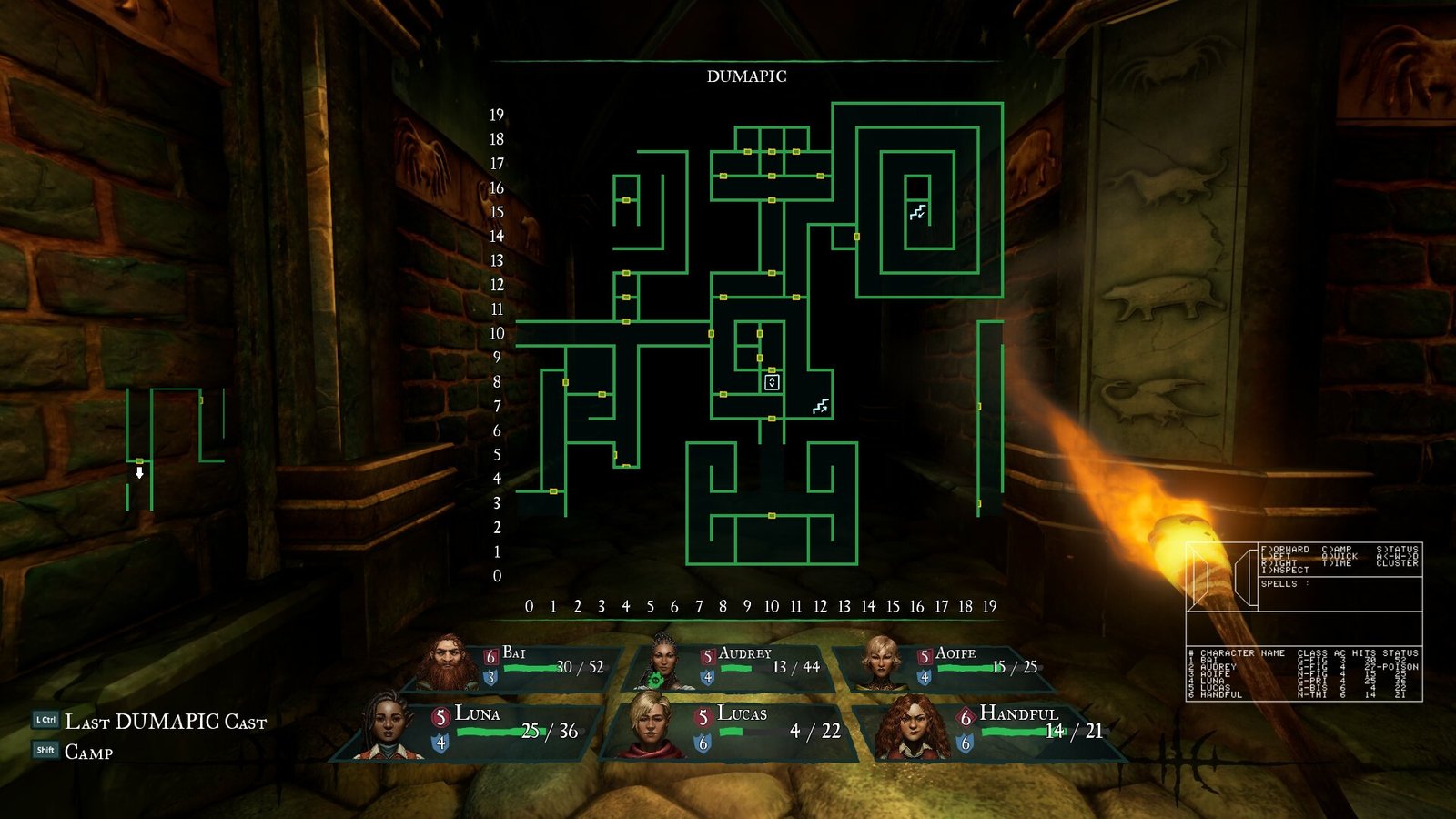
The Wizardry remake, developed by Digital Eclipse and distributed by Digital Eclipse and Atari, began Early Access in September 2023 and reached full release on May 23, 2024, for PC and PlayStation, Xbox, and Nintendo Switch consoles.
Its three-dimensional reconstruction runs on top of the original 1981 code, and the original interface can be displayed during play. Improvements to party management, navigation, spells, and combat do not mean these modern features existed in the Apple II original.
These rereleases help keep a tradition accessible that continues to influence developers and players.
Why is dungeon exploration still interesting?
Much of the satisfaction offered by dungeon crawlers comes from gradual discovery. Initially, players know only a small part of the maze. After exploring, finding passages, and learning the dangers, the environment is no longer completely unknown.
Progress can appear on the map, in equipment, and in character development. But another kind of progress does not depend on numbers: players themselves learn to recognize routes, interpret clues, and prepare more effectively.
This can appeal to anyone who enjoys careful exploration, strategic combat, resource management, and uncovering secrets. Conversely, extensive labyrinths, repeated encounters, and severe defeat penalties may be tiring for players who prefer more direct adventures.
Interfaces and difficulty options vary widely, particularly between classics and modern releases. Wizardry, Etrian Odyssey, Legend of Grimrock, and Darkest Dungeon handle these challenges in different ways. None needs to be everyone’s ideal experience.
Dungeon crawlers turn exploration into challenge and discovery
Dungeon crawlers emerged from attempts to bring aspects of tabletop RPG exploration to computers. Projects such as pedit5 experimented with these ideas during the 1970s.
Wizardry helped consolidate adventuring parties and first-person labyrinths. Dungeon Master developed a real-time combat approach, while Etrian Odyssey revived manual mapping and Legend of Grimrock reinterpreted the classic formula through a modern presentation.
Meanwhile, dungeon exploration also appeared in ARPGs, roguelikes, and other kinds of RPGs. What distinguishes a dungeon crawler is not simply the presence of monsters, treasure, or underground corridors. It is the importance of exploring dangerous environments, understanding their paths, and deciding how to advance.
Sometimes the reward is finding a more powerful weapon. Sometimes it is locating a secret passage after several minutes of searching. And sometimes the greatest progress comes from realizing it is time to turn back, recover resources, and prepare for the next expedition.
About the Author