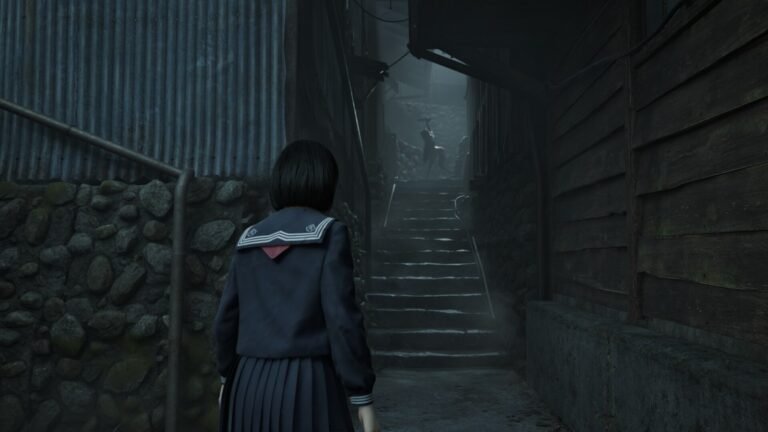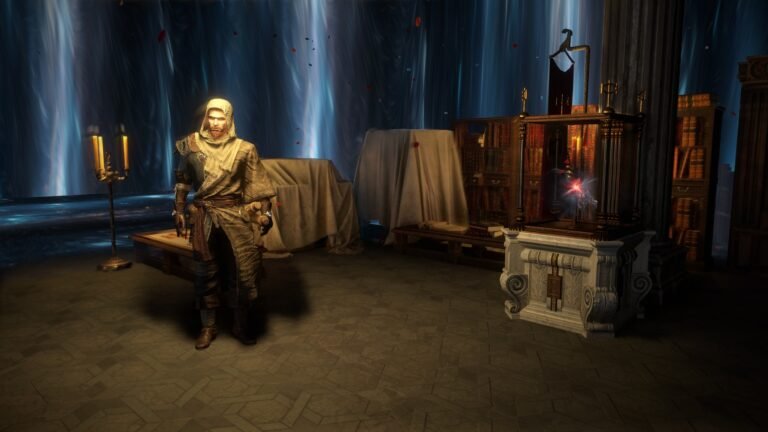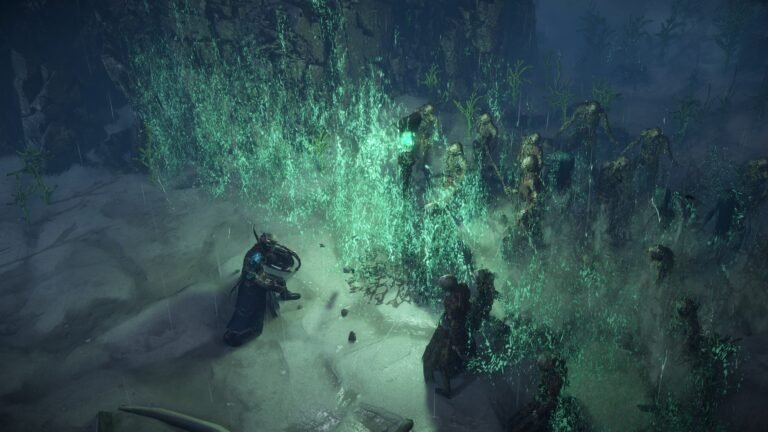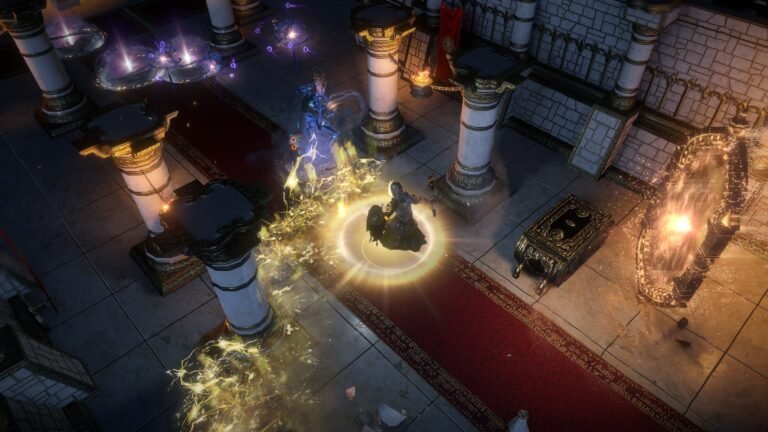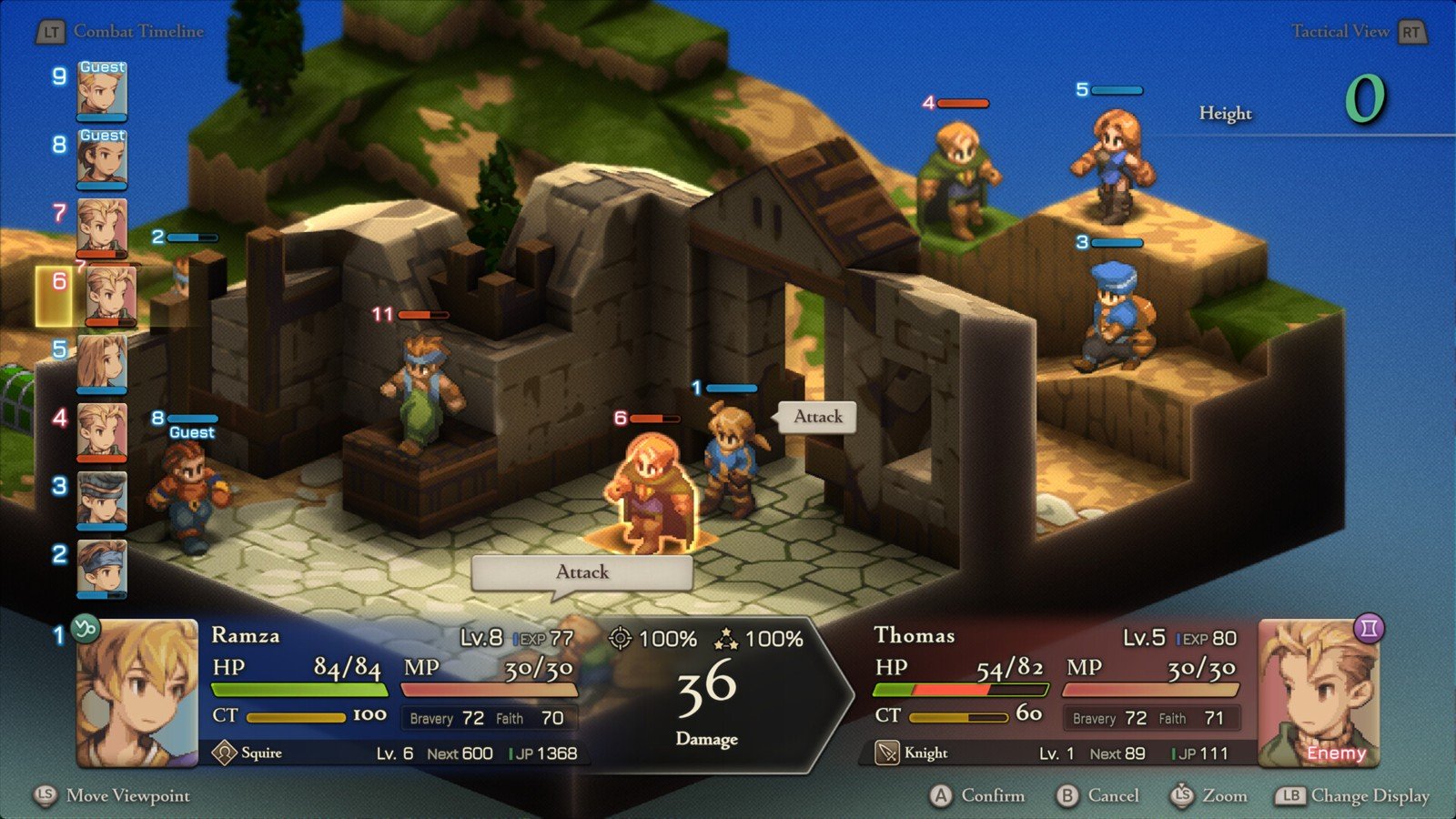
Terreno e posição influenciam as decisões em Final Fantasy Tactics: The Ivalice Chronicles. Imagem: Square Enix.
Tactical RPG is a role-playing subgenre in which character positioning, movement around the battlefield, and decisions made during combat play a central role. Beyond choosing attacks and abilities, players must consider where each character stands and which actions that position makes possible.
Imagine a battle where your party must cross a bridge. Archers wait on the far side, while a heavily armored enemy blocks the crossing. Your team includes a warrior who can withstand attacks, a ranged specialist, and a healer. Advancing everyone at once may seem fastest, but it would leave the party exposed.
A better approach might be to place the warrior at the bridge entrance, keep the healer protected, and use ranged attacks to weaken the enemy. In a more conventional RPG, the decision might center on which skill to use. In a tactical RPG, where each character stands is part of the strategy.
This is a defining feature of series such as Fire Emblem, Tactics Ogre, and Final Fantasy Tactics. The genre combines RPG-style character development with battle systems inspired by strategy games. Over the decades, that combination has taken many forms, from grid-based clashes to squad-focused games and hybrid systems.
In this feature, we explore its origins, explain how combat works, and examine what separates tactical RPGs from other role-playing and strategy games. Updated October 20, 2026.
Nesta matéria
What defines a tactical RPG?
In tactical RPGs, players generally command a party of characters or units in battles where movement, range, and positioning influence what they can do. As in other RPGs, those characters may have levels, attributes, classes, equipment, and skills.
The main difference is the importance of spatial decisions. A unit behind a wall might be unable to attack a particular enemy. An archer on higher ground could gain an advantage, depending on the game’s rules. A sturdy character might shield allies by occupying a narrow passage. These conditions affect combat itself; they are not merely visual details of the map.
Do Tactical RPG, Strategy RPG, TRPG, and SRPG mean the same thing?
Tactical RPG and Strategy RPG commonly describe games that combine character progression with strategic battles. Their abbreviations depend on context. SRPG is associated with both Strategy RPG and Simulation RPG, a term with a history in Japan. TRPG sometimes means Tactical RPG in gaming communities, but in Japanese contexts it often refers to a table-talk RPG, or tabletop role-playing game.
These labels overlap without being perfect synonyms in every region. Here, tactical RPG refers primarily to games in which unit organization and decisions during battles are structural parts of the experience.
Do all tactical RPGs use turns and square grids?
No. The best-known model features turn-based battles on maps divided into tiles. However, other games use different movement systems, hybrid rules, or partially automated battles. We should also distinguish a tactical RPG from an RPG that simply offers strategic choices.
Almost any RPG can require planning. What defines the traditional tactical RPG is how much positioning and unit control matter when resolving encounters.
Where did tactical RPGs come from?
The genre’s roots lie in wargames, tabletop RPGs, and early digital strategy experiments. Miniature wargames already made distance, movement, terrain, and unit formations important. Tabletop RPGs also developed systems in which a character’s location could change their combat options.
That does not mean every tabletop RPG needs a board or miniatures, or that wargames were already tactical RPGs. Their contribution was the gradual combination of those ideas with individual characters and progression. As they reached video games, developers explored different ways to connect character growth to strategic battles.
Precursors in the 1980s
One early experiment was Koei’s Dragon & Princess, also known as The Dragon and Princess, released in Japan in 1982 for the NEC PC-8001 and subsequently adapted to computers such as the FM-7. Text commands guided the adventure, while encounters used an overhead battlefield view. Material preserved by Gaming Alexandria helps establish its place as a precursor, without requiring the definitive label of the world’s first tactical RPG.
Another important title was Bokosuka Wars, created by Koji Sumii, also known as Rashou, for the Sharp X1 and published by ASCII. Its timeline needs care: the project was linked to a competition announced in 1983, but an account by a contributor to its later conversions, published by BEEP, dates commercial release of the X1 edition to March 1984. The Famicom version followed in December 1985.
Players led forces across a map in real time, while encounters were resolved according to the units’ conditions. This mixture of action, strategy, and progression was not the same as the later system of individual turns in Final Fantasy Tactics.
Neither game necessarily used the formula later associated with Fire Emblem. Historians also classify them differently depending on their criteria. What matters is that developers were already experimenting with characters, progression, and strategic decisions before tactical RPGs became popular on consoles.
Fire Emblem and the consolidation of the formula

On April 20, 1990, Nintendo released Fire Emblem: Shadow Dragon and the Blade of Light for Famicom in Japan, developed by Intelligent Systems. This was the original Japanese debut, preceding its rereleases and official English localization in 2020.
It became one of the genre’s most influential milestones. Players commanded individual characters across maps, moved them, fought enemies, and completed objectives. Each unit had its own weapons, attributes, and opportunities to grow. Terrain, attack range, and equipment helped determine the risk: exposing a fragile unit to several enemies could result in its loss, while a durable unit in a key position could protect an advance.
Combat followed alternating phases in which the player’s units acted and enemies responded. Marth’s adventure made the survival and development of distinct units part of the campaign’s continuity. Nintendo’s historical account confirms the April 20, 1990 Japanese debut, separate from later releases and localizations.
Why was permadeath so important?
One of Fire Emblem‘s best-known historical features is the ability to lose defeated characters permanently. This mechanic, called permadeath, gives decisions lasting consequences. If an important ally dies, the party may have to finish the campaign without them. Players therefore assess risk differently, protect teammates, and manage their roster more carefully.
However, not every Fire Emblem game uses identical defeat rules. In Fire Emblem Engage, for instance, Classic mode retains permanent losses, while Casual mode allows defeated allies to return after battle. These settings are distinct from combat difficulty; their availability and details vary by game. Permadeath helped shape the series, but it is not a universal requirement for tactical RPGs.
How has Fire Emblem evolved?
Across generations, the franchise expanded its class systems, character relationships, and narrative structures. Fire Emblem: Genealogy of the Holy War, released for Super Famicom in 1996, offered sprawling maps and a story following multiple generations.
Fire Emblem Awakening debuted in Japan in 2012 for Nintendo 3DS and reached North America and Europe in 2013. It helped expand the series’ audience and highlighted character relationships. Fire Emblem: Three Houses (2019, Nintendo Switch) combined strategic battles with teaching, relationships, and branching story paths.
Fire Emblem Engage (2023, Nintendo Switch) emphasized Emblem Rings, linked to heroes from earlier games, providing distinct abilities and combinations in combat. These changes show how a series can retain positional strategy while changing progression, storytelling, and battle tools.
Fire Emblem: Fortune’s Weave — a new chapter in 2026
Fire Emblem: Fortune’s Weave launched on September 17, 2026, for Nintendo Switch 2. Developed by Intelligent Systems with Nintendo, which also publishes it, this new installment takes place in the empire of Dagda. The return of the demon god Balor threatens the future, and the goddess Fortuna helps the protagonist travel into the past, to Dagsion’s Heroic Games, to gather allies.
The journeys of Cai, Dietrich, Theodora, and Leda can be experienced in different orders. Their personal goals intersect throughout the campaign as players assemble teams and consider classes, weapons, range, and position in turn-based battles. Its historical significance is a new interpretation of the series for Switch 2, not a replacement for previous tactical RPG models.
Nintendo’s Brazilian product page describes Blaze Arts, special attacks that consume HP while filling a gauge. Intermediate levels provide benefits, but filling it triggers a Burst and an HP penalty. Divine Blessings add support effects. These illustrate preparation and risk management beyond simply choosing the highest-damage unit.
An interview with the developers places the project in a world connected to Three Houses, but with a different setting and experience. That connection does not make it a Three Houses remaster, an Engage expansion, or a remake of Marth’s story.
On October 15, 2026, Nintendo announced that Part 1 of the Expansion Pass was available, including prototype weapons for the four heroes inspired by the Heroes’ Relics from Three Houses. As of this article’s October 20, 2026 editorial revision, only Part 1 was available. Part 2, featuring recruitable gods and costumes, was scheduled for late 2026; Part 3, featuring new stories, allies, and classes, for 2027. Future content must not be presented as already implemented.
Langrisser and Shining Force: other paths for the genre
Fire Emblem was not the only influence during the genre’s early years. Other franchises developed different ways to combine characters and strategy.
Langrisser, originally released for Mega Drive in 1991 by NCS/Masaya, used commanders accompanied by hired troops. The Genesis edition was published in North America by Treco as Warsong. These credits refer to the original release, not later remakes. Battles emphasized troop organization, commanders’ areas of influence, and class progression. Soldiers grouped around leaders gave combat a distinct scale.
Shining Force (1992, Mega Drive), developed by Sonic! Software Planning and Climax and published by SEGA, combined tactical map battles with more conventional RPG adventure elements. Players could explore towns, speak with characters, and recruit party members. In battle, units moved according to their individual traits and available actions.
These approaches proved that tactical RPGs did not have to choose between military strategy and character-driven adventure. The two traditions could be mixed in different ways.
Tactics Ogre and Final Fantasy Tactics: expanding the genre

During the 1990s, tactical RPGs increasingly explored political stories, choices with lasting consequences, and elaborate customization systems. Tactics Ogre and Final Fantasy Tactics were two major influences on that development.
Tactics Ogre and narrative decisions
Tactics Ogre: Let Us Cling Together, developed and published by Quest for Super Famicom in 1995, was directed by Yasumi Matsuno, who also shaped its political story. It combined tactical battles with conflicts and difficult choices. Players controlled characters across maps featuring elevation, obstacles, and strategically important positions.
Progress, however, did not depend solely on combat. Certain decisions could change events and branches of the narrative. This forged a connection between military strategy and story consequences.
Quest had already explored a different format in Ogre Battle: The March of the Black Queen (1993, Super Famicom). Parties move in real time on its strategic map, and encounters trigger battles with automated actions. That is different from directing each unit individually on a Tactics Ogre battlefield.
Thus, Ogre Battle and Tactics Ogre share a tradition but not identical systems. On November 11, 2022, Square Enix released Tactics Ogre: Reborn for Switch, PlayStation 4, PlayStation 5, and Windows. It builds on the 2010 Japanese PSP reworking, which arrived in the West in 2011, with changes to presentation and gameplay systems. It is not merely the 1995 release under a new name, and its features should not automatically be attributed to that original.
Final Fantasy Tactics and the strength of the job system
Released by Square for PlayStation in Japan in 1997 and directed by Yasumi Matsuno, Final Fantasy Tactics became a landmark tactical RPG. Set in Ivalice, it tells a story of political disputes, characters, and military conflict. Movement, elevation, attack range, and the order of actions matter on its battle maps. One of its most important features, however, is the job system.
Characters earn Job Points (JP) to learn abilities associated with their jobs. Access to new jobs depends on development requirements; not every combination is available from the beginning. In addition to their current job’s action set, characters can equip an action set learned from another job, plus reaction, support, and movement abilities, subject to the system’s slots and rules. Training a job can therefore remain useful after changing roles.
One party member may focus on offense, while another specializes in support or magic. Character development directly influences the choices available in battle. That differs from games where each unit’s abilities are relatively fixed. Final Fantasy Tactics also shows that drawing on the setting and traditions of an RPG franchise does not require reproducing its usual combat system.
How Final Fantasy Tactics evolved
Final Fantasy Tactics: The War of the Lions (2007, PSP) expanded on the 1997 game with revised translation and additional content. Final Fantasy Tactics Advance (2003, Game Boy Advance) and Final Fantasy Tactics A2: Grimoire of the Rift (2007 in Japan for Nintendo DS, 2008 in the West) are separate games with their own stories and systems. They developed distinct approaches to progression.
On September 30, 2025, Square Enix launched Final Fantasy Tactics: The Ivalice Chronicles for Nintendo Switch, Switch 2, PlayStation 4, PlayStation 5, Xbox Series X|S, and Windows. Its official presentation describes two versions. The enhanced version updates the visuals and interface, adds fully voiced dialogue, gameplay adjustments, and difficulty options, including the more accessible Squire setting. The classic version retains the 1997 graphics and gameplay while using the English script from The War of the Lions.
Using that translation does not mean it includes all of the PSP edition’s extra content. The Ivalice Chronicles should not be described as a complete, straightforward port of The War of the Lions. Square Enix’s official announcement also highlights autosaving and faster battles in the enhanced version. These accessibility and pacing changes leave its central combination of jobs, progression, and spatial decisions intact; this is not a new sequel.
It demonstrates the enduring appeal of the design created in 1997 without confusing the original release with its modern presentation.
How does a tactical RPG battle work?
Every game has its own rules, but a traditional encounter can be described through a simple cycle:
Prepare the team → Analyze the terrain → Position units → Take actions → Respond to threats → Complete the objective.
Players usually begin by selecting characters, equipment, or abilities from the available options. They then assess the map, identifying enemies, obstacles, and objectives. During combat they move units and use attacks or other commands within the game’s rules. The key difference is how those decisions interact.
Why does positioning matter?
A unit’s safety also depends on what happens after its action. Before confirming a move, check which enemies can reach it, which allies still have a turn, and whether there is an escape route. The bridge example at the start illustrates these relationships; the specific solution changes with each game’s blocking rules, support range, and turn order. Powerful equipment can expand your options, but it cannot make these considerations irrelevant.
Terrain, elevation, and obstacles

The battlefield itself can influence combat. Forests, walls, rivers, bridges, and high ground can alter movement or the effectiveness of certain actions. In Triangle Strategy, for example, elevation and unit positioning shape battle decisions. Tactics Ogre and Final Fantasy Tactics also feature terrain differences that affect combat.
However, effects vary by game: higher ground does not automatically provide the same bonus in every tactical RPG. The important point is that the environment can create advantages, impose restrictions, and change the routes available to the player.
Range and abilities
Weapons and skills have conditions of use. Movement determines how far a unit can travel; range specifies potential targets from a position; and area of effect identifies which spaces an action affects. Obstacles and line of sight can prevent attacks even against nearby targets. These three concepts are not interchangeable.
A melee fighter normally needs to approach the target. A ranged unit can attack from farther away, but may face restrictions in certain positions. Special abilities might affect several tiles or consume particular resources. Imagine a spell capable of striking three enemies simultaneously. Casting it immediately could seem useful, but reaching the required position might expose the mage to a counterattack. Players need to evaluate both the immediate effect and the consequences.
Turns and initiative
Tactical RPGs organize actions in different ways. In many Fire Emblem titles, player-controlled units act during one phase, followed by the enemy phase, with details varying by installment.
In Final Fantasy Tactics, each unit accumulates Charge Time (CT), a readiness value influenced by speed. Units therefore act in an individual order rather than all moving within a shared player phase. The Charge Time used in Final Fantasy Tactics is not the CTB — Count Time Battle system in Final Fantasy X. Both influence readiness and action order, but they are different systems. Here, the important question is how individual turns affect a position’s safety and enemy responses.
Tactics Ogre has its own initiative and turn-order rules. Such differences change how players plan. If several allied units can act before the enemy responds, coordinated attacks may be possible. With individual turns, the next character or enemy in the queue might be more important. No single turn system is mandatory across all tactical RPGs.
Classes, equipment, and team composition
Positioning matters, but it is not enough on its own. Characters need abilities suited to the challenge. A team consisting only of attackers might struggle to protect an objective, while an extremely defensive party could have trouble reaching distant opponents or completing a mission quickly.
Classes and roles
Many tactical RPGs feature specialists. Some fight up close; others attack at range, heal, control enemies, or move more freely. Combining these roles creates tactical possibilities.
There is no compulsory tank–mage–healer formation, or universal party size. Recruitment, fixed roles, class changes, and specialization offer different levels of customization. There is a difference between selecting a unit with a clearly defined role and building a character from abilities drawn from multiple classes. The first emphasizes recruitment and leveraging existing strengths; the second allows more customization. Neither removes the need to coordinate the party.
Some games use fixed classes; others allow extensive changes throughout the campaign.
Character progression
As in other RPGs, characters may earn experience, level up, and improve their stats. Equipment can change their capabilities as well. A previously limited unit might become stronger or take on new roles. Yet high levels do not guarantee victory. Even a powerful character can become isolated, be attacked from several directions, or be vulnerable to an enemy exploiting a weakness.
Progression increases strategic options without replacing good decisions during battle.
Objectives beyond defeating enemies
Not every fight requires eliminating all opponents. A mission might ask players to protect a character, reach a location, defeat a commander, escape, defend an area, or survive for a set duration. Such objectives change how the team should act.
A rescue may reward fast units; holding a position may require durable allies and control of narrow routes. The battle’s objective matters just as much as the enemy lineup.
Storytelling, characters, and the consequences of decisions
In tactical RPGs, party members often remain with the player for an entire campaign, connecting progression, narrative, and the consequences of combat. Permadeath, as discussed in relation to Fire Emblem, is one possibility. In other games a defeated unit may simply be incapacitated, need revival, or return later. Defeat rules change the risks and continuity of a team, but no single rule defines the entire genre.
When choices change the story
Tactics Ogre includes narrative choices that alter how its campaign unfolds. Fire Emblem: Three Houses also builds character decisions and relationships into its story.
Triangle Strategy, released in 2022, combines tactical battles with choices that influence events and story paths. However, branching stories are not mandatory in a tactical RPG. Some games have mostly linear campaigns; others put more emphasis on combat mechanics and progression. Narrative depth and tactical depth can coexist, but they do not mean the same thing.
Disgaea and the expansion of character progression
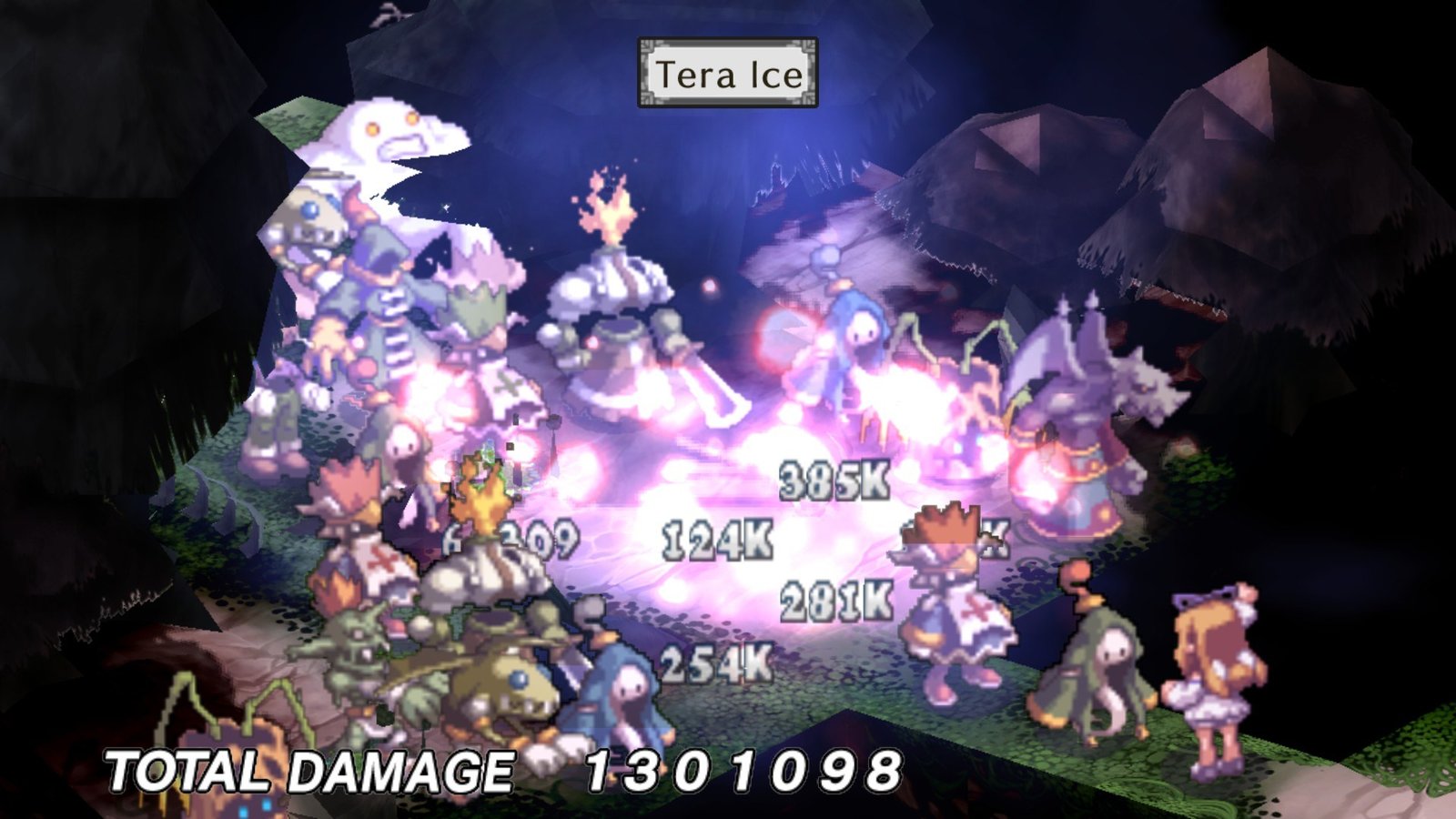
In 2003, Nippon Ichi Software released Disgaea: Hour of Darkness for PlayStation 2. Its original North American publisher was ATLUS, distinct from later editions distributed by NIS America. The franchise developed an identity combining tactical combat with humor, exaggerated characters, and extensive progression systems.
Battle maps make positioning and abilities important, but Disgaea also became known for allowing characters and equipment to grow extraordinarily far. One concrete example is the Item World, where players enter stages associated with individual items to improve them. The system also appears in Disgaea PC, the 2016 edition pictured in this article, linking equipment development to further combat.
Customization and prolonged stat growth can become goals in their own right, even beyond the main campaign. This appeals to players who enjoy optimizing characters and items after completing the story. It is a characteristic of Disgaea, however, and does not make farming or endgame optimization mandatory for all tactical RPGs.
The series shows that tactical RPGs can reward both careful battle decisions and long-term development of characters and systems. Its exact mechanics vary across installments, and not every release offers identical progression options.
How have tactical RPGs evolved in modern games?
Traditional turn-based battles remain important, but developers have experimented with how maps are presented, characters are organized, and encounters are resolved. That variety can be found in established series as well as independent productions.
Triangle Strategy and the importance of terrain
Developed by Square Enix and Artdink, Triangle Strategy debuted on Nintendo Switch on March 4, 2022, and later came to PC. Its HD-2D visuals place pixel-art characters in environments featuring volume and elevation.
Beyond the terrain mechanics explained earlier, the game features political storytelling: members of the party debate and vote on decisions through the Scales of Conviction. Those choices affect the campaign without making such a system obligatory for the genre. It is a modern example that retains recognizable traits of traditional tactical RPGs.
Fell Seal and class customization
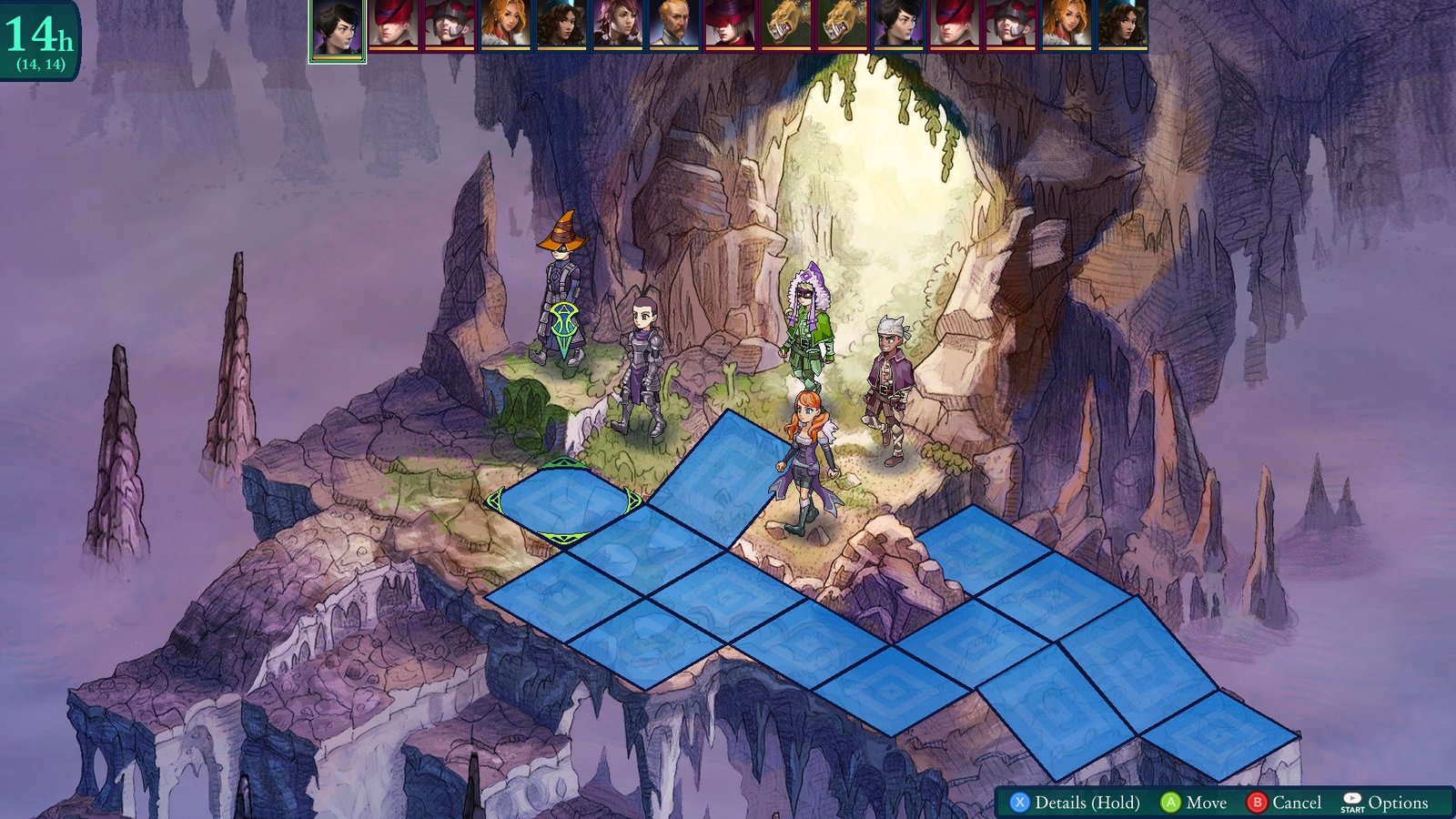
Fell Seal: Arbiter’s Mark, by 6 Eyes Studio, launched on April 30, 2019, revisiting mechanics associated with the Final Fantasy Tactics tradition. Originally published by 1C Entertainment, now Fulqrum Publishing, it is not part of Square Enix’s franchise.
Its battles combine positioning with classes, equipment, and character customization. The game illustrates how independent studios have contributed to preserving and developing the genre’s traditional systems.
Unicorn Overlord: strategy and automated battles

Developed by Vanillaware and published by ATLUS/SEGA, Unicorn Overlord launched on March 8, 2024, for Nintendo Switch, PlayStation 4, PlayStation 5, and Xbox Series X|S. Its design is a hybrid.
Instead of manually moving each character from tile to tile throughout every battle, players assemble squads and watch them travel across battle maps in real time. When squads meet enemies, actions resolve automatically based on character traits and previously configured conditions. Strategy involves picking members, arranging their positions within the squad, and deciding when particular abilities should be used.
Much of the planning therefore takes place during preparation. Players do not choose every individual attack the way they do in Final Fantasy Tactics. ATLUS’s official explanation emphasizes this combination of map movement and automated encounters.
Unicorn Overlord demonstrates that tactical RPGs can use real-time movement and automation while retaining party composition, formations, and progression. This does not mean that any real-time strategy game featuring characters automatically becomes a tactical RPG.
Other tactical RPG formats

Symphony of War: The Nephilim Saga, developed by Dancing Dragon Games and released on June 10, 2022, organizes squads of up to nine soldiers. Movement across the strategic map is turn-based, while individual engagements resolve automatically—unlike Unicorn Overlord‘s real-time map.
Class choices, formations, and squad membership all affect performance. Preparing squads can become as important as moving them on the battlefield.
These approaches show that the genre need not be confined to tile grids and individual turns. The September 2026 launch of Fortune’s Weave, discussed earlier, adds another model to the mix. It preserves turn-based tactical combat while introducing intertwined journeys and new tools for risk and support. Meanwhile, Unicorn Overlord and Symphony of War offer other combinations of preparation, movement, and encounter resolution.
Tactical RPG vs. turn-based RPG: what’s the difference?
It is an important distinction. Turn-based RPG mainly describes how actions are sequenced: characters and enemies act according to turns, phases, or initiative systems.
Tactical RPG places special emphasis on organizing units and on positioning, movement, and the environment during battle. The two categories can overlap without being synonymous.
Traditional turn-based RPG
In games such as Dragon Quest and many classic Final Fantasy installments, players usually select commands and skills without moving each character freely around a tactical battlefield. That does not make them unstrategic: choosing abilities, managing resources, and understanding enemies still requires planning. The difference is the role of spatial positioning.
Traditional tactical RPG
In Fire Emblem, Tactics Ogre, and Final Fantasy Tactics, the units’ locations are central to the encounter. Players must consider paths, range, terrain, and movement. A poorly placed unit can undermine an entire plan even when it has strong abilities.
What about Baldur’s Gate 3 or Divinity: Original Sin 2?

These games use turn-based combat where positioning, terrain, and environmental interactions are extremely important. They clearly have strong tactical elements.
However, they are frequently classified primarily as computer role-playing games (CRPGs), a tradition that emphasizes story, choices, and role-playing systems. The term refers to that tradition—not simply to any RPG available on PC.
That does not prevent CRPGs from featuring tactical combat. The distinction concerns their larger genre heritage and structure. Our article on turn-based RPGs: origins and evolution explores ways of sequencing actions in more detail; here the focus is on character development and tactical unit control.
Are tactical RPGs, RTS games, and turn-based strategy the same thing?
No. They may all involve planning, moving units, and controlling objectives, but important distinctions remain.
| Classification | Core characteristic | Examples |
|---|---|---|
| Traditional tactical RPG | Progressing characters and battles built around positioning | Fire Emblem, Final Fantasy Tactics |
| Traditional turn-based RPG | Turn-based combat often focused on choosing commands | Dragon Quest |
| RTS | Real-time strategy, often with simultaneous army and economic control | Age of Empires, StarCraft |
| Turn-based tactics | Positioning and tactical objectives; may include soldier progression | XCOM |
| CRPG with tactical combat | Computer RPG combining story and progression with position-focused battles | Baldur’s Gate 3, Divinity: Original Sin 2 |
In real-time strategy (RTS), players generally manage simultaneous activities while the world continues moving. Economy and unit production are common to classic RTS titles, but not obligatory for every nearby design tradition. In traditional turn-based tactical RPGs, moments of action are more clearly separated according to each game’s rules.
XCOM helps illustrate another boundary. The series combines positioning, cover, and soldier management, but is usually classified primarily as turn-based strategy or tactics. Soldier development gives some systems an RPG-like quality, yet it does not automatically turn every strategy game into a traditional tactical RPG. Categories can shift depending on community and classification criteria.
Games that shaped the history of tactical RPGs
This selection highlights milestones in the genre’s evolution; it is not a ranking of the best games.
| Game | Year | Main contribution or feature |
|---|---|---|
| Dragon & Princess (The Dragon and Princess) | 1982 — PC-8001 | Precursor combining command-based adventure with a tactical battle screen |
| Bokosuka Wars | 1983–1984 — competition and X1 commercial release | Real-time hybrid experiment; Famicom version followed in 1985 |
| Fire Emblem: Shadow Dragon and the Blade of Light | 1990 | Consolidated unit control, turns, and consequences of defeat |
| Langrisser | 1991 | Commanders and accompanying troops in strategic encounters |
| Shining Force | 1992 | Combined tactical battles with exploration and adventure |
| Ogre Battle: The March of the Black Queen | 1993 — Super Famicom | Real-time party movement and automated encounters |
| Front Mission | February 1995 — Super Famicom | Tactical combat with customizable Wanzer mechs; G-Craft / Square |
| Tactics Ogre: Let Us Cling Together | October 1995 — Super Famicom | Terrain, classes, and branching political narrative |
| Final Fantasy Tactics | 1997 | Jobs, learned abilities, and party customization |
| Disgaea: Hour of Darkness | 2003 | Extensive progression and customization systems |
| Fire Emblem Awakening | 2012 in Japan — 3DS | Character relationships and revitalization of the franchise |
| Fell Seal: Arbiter’s Mark | April 2019 | Independent reinterpretation of classic mechanics |
| Fire Emblem: Three Houses | July 2019 | Character development and branching story paths |
| Triangle Strategy | March 2022 | Positioning, terrain, and narrative decisions |
| Symphony of War: The Nephilim Saga | June 2022 | Turn-based squad map with automated engagements |
| Tactics Ogre: Reborn | November 2022 | New edition based on the 2010 PSP reworking |
| Fire Emblem Engage | 2023 | New combinations of abilities in combat |
| Unicorn Overlord | 2024 | Squads, real-time movement, and automated actions |
| Final Fantasy Tactics: The Ivalice Chronicles | 2025 | Modernized rerelease with enhanced and classic options |
| Fire Emblem: Fortune’s Weave | September 17, 2026 — Switch 2 | New installment with four intertwined journeys and turn-based tactical combat |
Dates indicate the original milestones or specific rereleases shown, not necessarily every version’s release in every country. Some titles are precursors or hybrids because the genre did not originate with a single rigid definition.
What sets tactical RPGs apart from other RPG experiences?
Their central appeal lies in the relationship between planning and execution. Developing a team creates opportunities, while understanding the map’s threats reveals when and how to use them. This depth can appear both in demanding campaigns with harsh consequences and in accessible games offering difficulty settings or recovery tools. The number of classes or rules alone does not determine tactical quality; what matters is whether they create meaningful decisions.
Tactical RPGs are about developing characters and using them strategically
A character’s abilities gain meaning when paired with a position, an objective, and the right time to act. Preparing the party expands its options; reading the battlefield helps decide when to use them. This relationship supports alternating phases, individual initiative, or squads that resolve encounters automatically. With so many systems, each game must be understood on its own terms: where to move, whom to protect, and which risks to accept.
Victory can begin when assembling the team—and depend on the exact position each unit occupies when the opponent responds.
About the Author