Doom (2016) retoma a tradição de combate veloz da série. Imagem: id Software / Bethesda Softworks.
FPS stands for First-Person Shooter, a shooting-game genre where players see the action through their character’s eyes and weapons or other projectile systems are central to play. Imagine two situations.
In the first, you cross a demon-infested facility, searching for ammunition, dodging projectiles and constantly moving to avoid being surrounded. In the second, you defend an objective with your team. Seconds remain, an opponent may appear at any moment, and an impulsive shot might expose your position.
The first resembles Doom; the second could happen in Counter-Strike or Valorant. Yet FPS games go far beyond those styles. Apex Legends brings first-person combat to a squad-based survival competition, while Hunt: Showdown 1896 combines firearms, monsters, rival players and the risk of losing gear during an expedition.
All are FPS games, despite offering very different experiences. The genre began developing decades before professional tournaments and realistic graphics. Experiments on university computers paved the way for Wolfenstein 3D, Doom and Quake, which helped establish the foundations of modern FPS design.
Over time, story campaigns, tactical matches, military combat, cooperative games and cross-genre hybrids emerged. This feature explains what defines an FPS, traces its history and distinguishes its major approaches.
Updated October 20, 2026.
Nesta matéria
What defines an FPS?
An FPS is a shooting game whose camera predominantly represents the controlled character’s point of view. Instead of observing the protagonist from outside, we usually see the world as though looking through their eyes. Weapons, hands or equipment may appear on screen, while the player controls where to look and shoot.
This perspective changes how we explore, aim and recognize threats. Watching a corridor may require looking directly toward it. An opponent behind a wall can remain outside the field of vision until the character moves.
The camera alone, however, does not define the genre.
Is every first-person game an FPS?
No. Exploration, horror, adventure and simulation games can also use first-person cameras. To qualify as an FPS, fighting with guns or other projectile-based mechanisms normally needs to be central. Doom clearly meets that description: players advance by fighting enemies with different weapons. A game built exclusively around exploration and puzzles might use the same viewpoint without being an FPS. Hybrids also exist, such as Borderlands, which combines FPS combat with RPG systems, equipment and progression.
Does an FPS have to be military or multiplayer?
No. Half-Life follows a science-fiction narrative campaign. Counter-Strike stages team-based competitive encounters. Left 4 Dead offers cooperation against computer-controlled infected, while Doom prioritizes fast action against demons. FPS therefore does not automatically mean realism, online competition or player-versus-player combat.
Where did first-person shooters come from?
FPS history predates Wolfenstein 3D and Doom. During the 1970s, researchers and developers were already experimenting with environments viewed and explored from a participant’s perspective. Available computers severely limited those experiments, but their ideas would develop further.
Maze War and Spasim: early experiments
Maze War, created in the early 1970s, is often named among FPS precursors. Steve Colley’s account preserved by DigiBarn dates his maze experiments to 1973, although participants recall different versions and timelines. Features added to later networked versions should not all be attributed to the initial implementation.
Players could navigate mazes from a first-person viewpoint. Later versions introduced encounters between connected participants. Despite simple visuals, the game already combined spatial navigation, perspective and player interaction. Another experiment, Spasim, was developed by Jim Bowery in 1974 for PLATO, with spacecraft in a shared three-dimensional environment.
Spasim did not follow the structure of a modern FPS, but demonstrated 3D combat and interaction. This is why identifying the single “first FPS” is not straightforward: the answer depends on whether perspective, movement, combat, multiplayer or their combination matters most.
Battlezone and early combat environments
In 1980, Atari released Battlezone, an arcade game in which players controlled a tank from the vehicle’s viewpoint. Vector graphics depicted structures and enemies in a three-dimensional environment. It helped popularize first-person combat without using a walking character or the format of later FPS games.
Hovertank 3D and Catacomb 3-D
In the early 1990s, id Software made experiments closer to the genre’s familiar formula. Hovertank 3D (1991) offered movement and fighting in simulated three-dimensional spaces. That same year, Catacomb 3-D paired first-person navigation with magical attacks and enemies. Wolfenstein 3D was therefore the result of technical evolution, not an isolated invention.
Wolfenstein 3D: popularizing the modern formula

Released in 1992, Wolfenstein 3D popularized a style based on fast movement, corridor exploration and direct combat. Players controlled B.J. Blazkowicz, facing enemies in facilities full of rooms, doors and secret passages. The loop was relatively simple: find a route, defeat opponents, gather supplies and reach the exit. Speed and perspective nevertheless made it feel unlike many contemporary games.
Technically, Wolfenstein 3D used environments with significant geometric limitations. They looked three-dimensional but lacked the spatial flexibility later provided by fully polygonal worlds. Its historical importance lies above all in commercially popularizing this formula. It was not the first FPS ever made, but it shaped how the genre became widely recognized.
Doom and Quake: establishing modern FPS games
In the following years id Software released two games that transformed the genre. Doom expanded combat and exploration; Quake marked another technological and competitive leap.
Doom: combat, maps and multiplayer
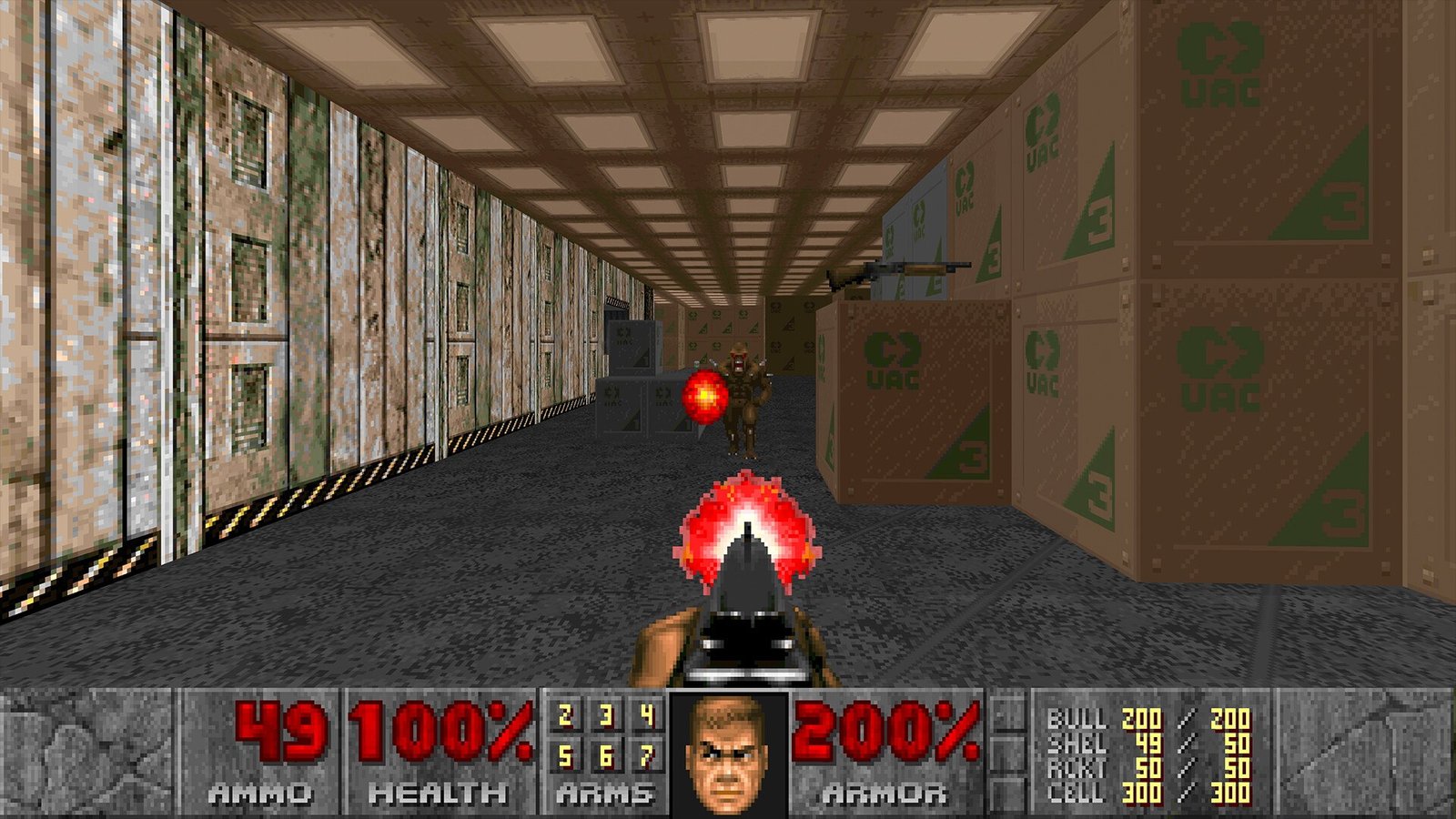
Released in 1993, Doom took players through technological facilities and hellish environments filled with demons. Combat was fast, with distinct weapons and enemies encouraging constant movement. A shotgun handled differently from a rocket launcher; some foes attacked from afar, while others closed the gap. Players had to recognize dangers, manage ammunition and use available space.
Doom was not just about shooting. Doors, keys, switches, secrets and alternate paths made exploration matter. Its levels were more involved than straightforward corridors, despite not using complete polygonal 3D environments. Shareware distribution helped it reach many PCs.
Doom also popularized multiplayer deathmatch, where players fought each other. Community-created maps and modifications, or mods, established a lasting culture. Doom II (1994) added enemies, gear and maps, including the celebrated Super Shotgun. For part of the 1990s other shooters were frequently compared with Doom.
Quake: true 3D environments and competition

In 1996, Quake advanced beyond the geometry of Wolfenstein 3D and Doom with fully polygonal 3D levels and characters. That enabled greater verticality, more complex spaces and freedom of movement. Players could aim up or down and face enemies on different elevations.
Quake also profoundly influenced competitive multiplayer. Movement, weapon mastery and map knowledge mattered in player encounters. Communities developed advanced movement techniques, while servers and tournaments helped build a competitive scene.
Quake III Arena and Unreal Tournament
At the end of the 1990s, Quake III Arena and Unreal Tournament (both 1999) cemented the arena shooter tradition. Matches typically take place on maps designed for frequent encounters. Weapons, armor, ammunition and other supplies spawn in known locations, rewarding spatial control and anticipation.
A skilled player needs more than accuracy: understanding when to contest gear, avoid a dangerous position or use a movement technique can make the difference. Arena shooters show that fast action and strategic depth can coexist.
DOOM: The Dark Ages — the modern series in 2025–2026
DOOM: The Dark Ages launched May 15, 2025 on Xbox Series X|S, PlayStation 5 and PC. Developed by id Software and published by Bethesda, it is a new campaign set before DOOM (2016) and Eternal, not a remaster of 1993’s Doom.
The official presentation emphasizes grounded combat, the Shield Saw, the Atlan mech and Mecha Dragon. This is a distinct interpretation of the series’ weapons and movement; narrative continuity does not require the same combat pace across every entry.
The Revelations campaign expansion became available July 7, 2026. It adds six levels, the Chain Spear and associated challenges. It belongs to The Dark Ages, not the 2025 base release or a separate standalone game.
How did FPS games move beyond classic combat?
As the genre grew, designers explored storytelling, atmosphere, controls and different match structures. Fast FPS games did not disappear; several traditions came to coexist.
Half-Life and narrative campaigns

In 1998, Valve released Half-Life, placing players in scientist Gordon Freeman’s shoes during a catastrophe at the Black Mesa complex. It did not invent storytelling in shooters; its contribution was integrating events, characters and information into active play. The narrative often moved forward while players retained control.
Environments also told the story, revealing the disaster’s consequences. In Half-Life 2 (2004), environmental interactions and physics expanded this approach. The Gravity Gun let players manipulate objects, making the scenery part of combat and puzzles.
Other games followed different paths. System Shock blended shooting, exploration and RPG-like systems; BioShock combined atmosphere and narrative; Metro emphasized survival and tension; and Titanfall 2 paired advanced mobility with a varied campaign. An FPS campaign can offer much more than one firefight after another.
GoldenEye 007 and Halo: FPS on consoles

FPS games also had to adapt to console controllers. Keyboard and mouse gave PC players efficient ways to move and aim, while console designers needed to distribute those functions across directional inputs, analog sticks and buttons.
GoldenEye 007 (Nintendo 64, 1997) popularized console shooters, especially local split-screen multiplayer for up to four people. Perfect Dark (2000) expanded ideas involving missions, gear and multiplayer. Halo: Combat Evolved (2001) became another landmark, helping establish dual-stick controls and combining weapons, grenades, melee attacks, shields and vehicles.
Halo did not invent those elements individually but assembled them into a design that influenced later shooters. Halo 2 (2004) expanded the importance of console online multiplayer, particularly through Xbox Live.
Call of Duty and Battlefield: different combat scales
Military FPS games also became major franchises. Medal of Honor (from 1999) helped popularize campaigns about historical conflicts. The first Call of Duty (2003) introduced cinematic missions featuring allied soldiers, before the series expanded across periods and multiplayer formats.
Battlefield 1942 (2002) established a tradition of larger-scale battles featuring vehicles, classes and objectives spread across wide maps. Call of Duty often emphasizes direct confrontations and cinematic campaigns; Battlefield often focuses on larger teams, vehicles and territory, although individual entries vary. ARMA pursues military simulation and procedures. A military setting does not automatically guarantee realism.
Battlefield 6 launched October 10, 2025 on PlayStation 5, Xbox Series X|S and PC. It includes a single-player campaign, infantry combat, vehicles, destruction and multiplayer modes such as Conquest, Breakthrough and Rush. Portal returned with tools for custom experiences. The fictional campaign setting in 2027 is not its actual release year. Environmental destruction can open routes or remove cover; its official FAQ distinguishes campaign, multiplayer and Portal. At the time of this article’s revision, the game is not an upcoming release.
How does combat work in an FPS?
Despite their differences, many shooters share aiming, movement, weapons and environmental awareness. Each game assigns different weight to those foundations.
Aiming, accuracy and recoil
Aiming determines an intended shot direction, but it does not guarantee identical bullet placement. Games may use spread, recoil patterns and accuracy penalties related to movement. In Counter-Strike and Valorant, controlling movement while firing can be essential. In Doom, combat often favors shooting while constantly moving. These design choices result in different rhythms.
Time to Kill (TTK)
Time to Kill (TTK) is the time needed to defeat an opponent under particular conditions. Damage, fire rate, range, health, armor, hit location, abilities and the target’s state all influence it. With lower TTK, a few shots may end a duel; higher durability can leave more room for repositioning, abilities and reactions.
Apex Legends, for instance, uses shields and equipment that affect fight duration. TTK is not one fixed universal value for each game: different weapons and circumstances can significantly change it.
Movement, maps and positioning
Movement shapes survival and opportunities to attack. In Quake, advanced movement helps secure resources and positions. In Valorant, anticipating angles and controlling exposure are critical. In Apex Legends, mobility and terrain directly affect squad tactics.
Map design defines pathways, cover, contested areas and lines of sight. A strong position may reveal opponents before they can react.
Sound information and types of encounters
Footsteps, gunfire and interactions with objects can expose players. In Hunt: Showdown, unnecessary noise may attract rival hunters.
FPS games also feature different types of encounters:
- PvE: players fight computer-controlled enemies.
- PvP: human players fight each other.
- PvPvE: players face both human rivals and AI threats.
These categories do not by themselves determine the camera perspective or overall match format.
Tactical FPS: Counter-Strike, Rainbow Six and Valorant
Tactical shooters reward positioning, accuracy, communication and coordinated decisions. A team may have excellent aim yet lose by failing to manage the objective. Winning individual duels does not always mean winning the match.
Counter-Strike and round-based competition
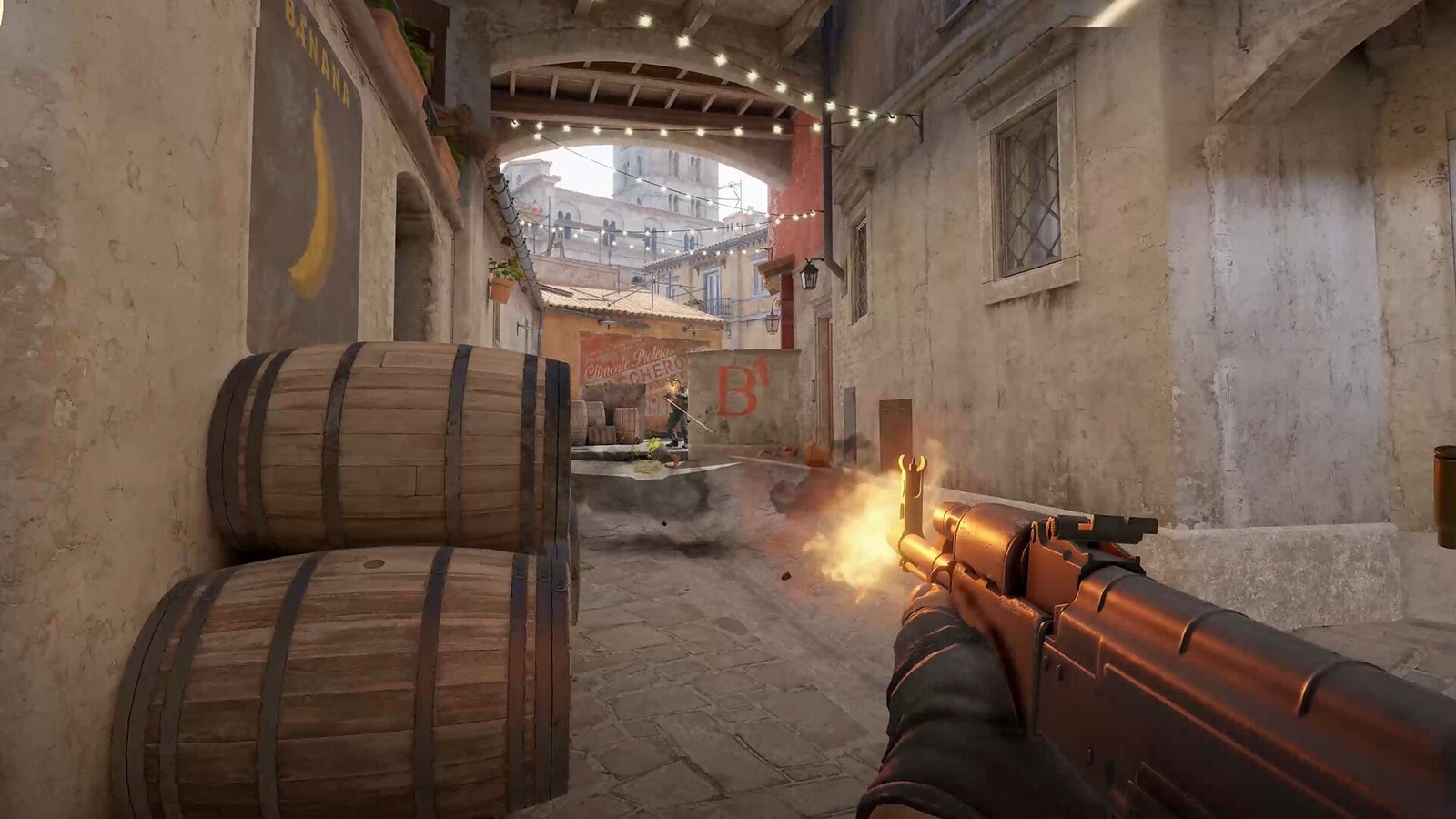
Counter-Strike began in 1999 as a Half-Life mod by Minh Le and Jess Cliffe. Terrorists and counter-terrorists compete over goals such as planting or defusing bombs, rescuing hostages or stopping the opposing team.
Its economy is another defining element: players earn money to purchase weapons and gear, so decisions in one round shape the next. The series evolved through Counter-Strike 1.6, Source and Global Offensive.
In 2023, Valve released Counter-Strike 2, updating the presentation and technical systems. Valve’s introduction presents CS2 as the evolution of Counter-Strike. The 2012 date still attached to Steam app 730 reflects Global Offensive’s historical listing; it is not CS2’s release date. Rounds, economy, objectives and accuracy remain central to the competitive identity.
Rainbow Six Siege and environmental control
Rainbow Six Siege (2015) took a different tactical approach. Operators possess specialized equipment and abilities, while destructible surfaces enable new lines of sight and attack routes. Information and coordination still matter, within a structure unlike Counter-Strike.
On June 10, 2025, Siege X expanded the existing game, preserving earlier players’ progression, inventories and operators. It was not simply a standalone sequel. Among its changes was Dual Front, a 6v6 mode with simultaneous offense and defense, initially available only on PC, PS5 and Xbox Series X|S.
The free-access model introduced then did not automatically include all competitive options: Ranked and Siege Cup required paid access and unlock conditions. Dual Front was not offered on PS4 or Xbox One. A technical update, a new mode and a commercial model must not be treated as the same thing.
Valorant: accuracy and agent abilities
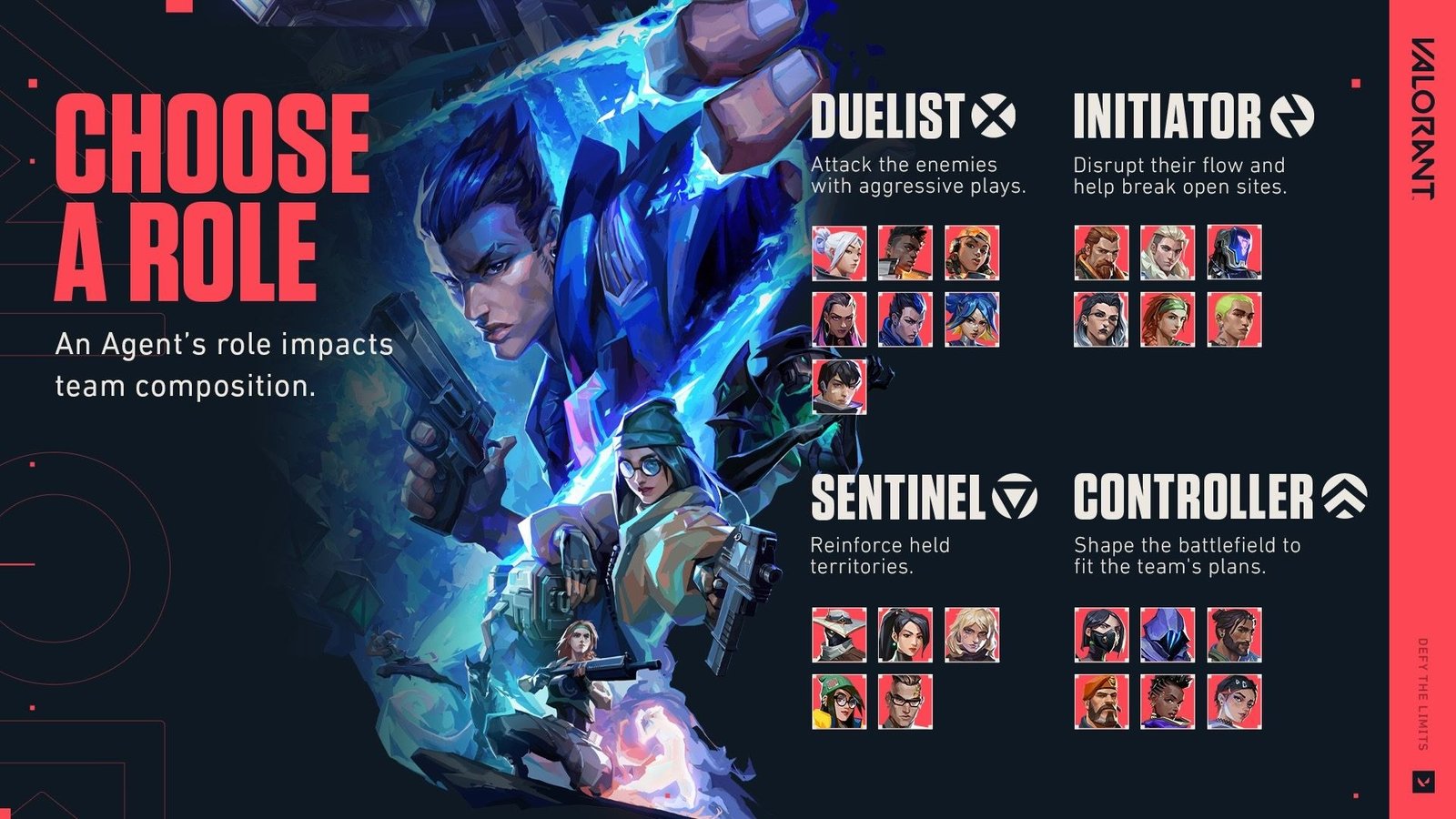
Riot Games launched Valorant in 2020, combining tactical FPS mechanics with agents who have distinct abilities. Its principal competitive format pits two teams against each other in attack-and-defense rounds. Players purchase weapons and certain equipment while pursuing objectives such as planting or defusing the Spike.
Agents distinguish Valorant from Counter-Strike. Their abilities can gather intelligence, control space, block vision, protect allies or create openings. Riot’s official beginner guide covers agent selection, credits, weapons, abilities and Spike objectives. The infographic used in this article came from 2024, so its roster and figures must not be assumed to represent October 2026.
Four roles guide agent design: Duelists favor entry and combat; Initiators gather information and prepare pushes; Controllers restrict sight lines and organize space; and Sentinels provide surveillance, defense and support. They are not mandatory team composition rules, and not every agent performs a role identically. The official agent catalog details individual kits.
Imagine a team entering a defended site: one ability limits enemy visibility, while another reveals threats. Such tools reshape strategy but do not eliminate the importance of aim and gunplay. Valorant combines tactical FPS rules with hero shooter elements, without functioning identically to Overwatch.
Counter-Strike, Siege and Valorant offer three different takes on tactical competition. None is inherently more strategic in every respect: each emphasizes different systems.
The main branches of modern FPS games
FPS design now overlaps with different match formats and progression systems. These labels are not mutually exclusive: a shooter can include specialized characters, survival matches and RPG elements.
Hero shooters: characters and abilities
Hero shooters make character-specific abilities an important part of play. Team Fortress 2 (2007) is a reference for class-based shooting, while Overwatch (originally 2016) popularized individualized heroes with distinct weapons, skills and roles. These differences affect team composition and objectives. Valorant also has agents but maintains its own tactical, round-based structure.
Not every game with abilities follows the same rules. Nor must a hero shooter be first-person: Marvel Rivals uses third-person combat. Valorant’s economy and rounds remain essential alongside its agents and skills.
Apex Legends: an FPS with battle royale and abilities

Apex Legends, developed by Respawn Entertainment and released by Electronic Arts in 2019, combines FPS, battle royale and hero-shooter elements. In the classic battle royale format, squads enter a large map and search for weapons, ammunition and resources while the safe zone progressively shrinks. The aim is to be the last surviving squad.
Apex stands out for movement, shields, teamwork and its playable Legends, who bring mobility, recon, defense or support depending on their characteristics and classes. One Legend might help the squad reach an important position while another protects it. A contextual ping system helps players point out enemies, gear and locations without relying solely on voice chat.
Unlike Valorant’s two-team rounds, Apex places several squads together on a map. Winning one fight can attract another team; choosing when not to fight is part of strategy. Battle royale describes a survival competition format, not a required viewpoint: Fortnite primarily uses third person in traditional modes, and PUBG offers perspective options depending on mode. Apex’s classic format does not cover every temporary or alternate mode.
Extraction shooters: Hunt and Escape from Tarkov
Extraction shooters organize raids where players enter an area, pursue goals, collect resources and try to leave safely. The possibility of losing gear or rewards shapes decisions. Escape from Tarkov is an important reference, while Hunt: Showdown 1896 mixes PvPvE, bounty hunting, sound-based information and extraction.
Players must choose whether to fight another group or protect what they have and head for an exit. ZAUS.GG has a dedicated history of Hunt: Showdown 1896. An extraction shooter is not necessarily an FPS: ARC Raiders uses third person while following the extraction tradition. Our guide to extraction shooters explores preparation, raids and evacuation in greater depth.
Bungie’s Marathon launched March 5, 2026 on Steam, PS5 and Xbox Series X|S. It brings cybernetic Runners to Tau Ceti IV for incursions involving gear, faction contracts, AI enemies and human rivals. Looting and extracting define its risk-reward structure. PlayStation’s support information confirms the launch, distinct from its January announcement. Although it revisits Bungie’s historic universe, the 2026 Marathon is a new extraction FPS, not a remaster of the older campaigns.
Looter shooters: Borderlands and Destiny
Looter shooters combine gunplay with equipment acquisition and progression. Borderlands offers weapons with varied properties, skill development and enemy loot; Destiny 2 likewise blends FPS combat, equipment, abilities and cooperative or competitive activities. FPS mechanics can therefore coexist with RPG systems.
Looter shooter and extraction shooter are not synonyms: the former centers on equipment and progression; the latter on entering and leaving a risky raid. Loot-focused games need not use first person either—The Division is third person. Another related dimension is the immersive sim, built around interactive systems and multiple solutions. System Shock, Deus Ex and Prey show how shooting, exploration and experimentation can overlap without turning every immersive sim into a conventional FPS.
FPS versus TPS: what’s the difference?
FPS (First-Person Shooter) and TPS (Third-Person Shooter) mainly describe the camera viewpoint. An FPS predominantly shows combat from the character’s perspective. A TPS follows the character externally, typically showing their body while moving. This affects spatial awareness: first person often requires turning or moving to see an area, whereas third person can reveal surrounding space without exposing the character in quite the same way.
| Feature | FPS | TPS |
|---|---|---|
| Camera | Primarily first-person | Primarily third-person |
| Character | Usually not fully visible | Generally visible |
| Spatial awareness | Closely tied to view direction | Can show more of the surroundings |
| Examples | Doom, Valorant, Apex Legends | Gears of War, The Division |
These are not absolute rules. Some games switch perspectives or use different cameras for specific actions. FPS and TPS titles can also share shooting, cover, progression or extraction mechanics.
How did FPS games reach the present day?
The genre’s evolution extends beyond graphics. Controllers, networking and online infrastructure enabled different player counts, matchmaking and competitive formats. Modern shooters range from self-contained single-player campaigns to frequently updated games with seasons, maps, equipment and characters.
Multiplayer and esports
Quake helped establish competition based on speed, movement and arena mastery. Counter-Strike consolidated rounds, objectives and teamwork. Halo spread competitive multiplayer on consoles, while Valorant and Apex Legends developed scenes around their own rules. Not every FPS needs ranked play or professional tournaments: cooperative titles and single-player campaigns remain important.
Seasons and business models
Some contemporary FPS games are continuously updated with maps, weapons, characters, events and balance changes. Some are free to access, selling cosmetics or battle passes; others require an upfront purchase. These business choices affect maintenance but do not alone determine quality.
Competitive balance and cheating
Maintaining online FPS games brings challenges. Changes to weapons or skills can alter strategies. Developers also tackle synchronization, latency and cheating software. Anti-cheat systems aim to protect competitive integrity, although they raise security and privacy questions.
Preservation matters too. Games tied exclusively to online servers may become inaccessible when a service closes. Local campaigns, community tools and re-releases can help keep historical games playable, especially in a genre shaped by player communities.
FPS games that shaped the genre’s history
The milestones below illustrate the evolution of FPS games. This is not a ranking of the best games.
| Game | Year | Main contribution |
|---|---|---|
| Maze War | Early 1970s | First-person navigation and connected experiments |
| Spasim | 1974 | Multiplayer 3D space combat |
| Battlezone | 1980 | First-person combat with vector graphics |
| Wolfenstein 3D | 1992 | Popularized the modern FPS formula |
| Doom | 1993 | Combat, map design, deathmatch and mods |
| Quake | 1996 | Polygonal environments and competition |
| GoldenEye 007 | 1997 | Local multiplayer and console FPS |
| Half-Life | 1998 | Narrative integrated into gameplay |
| Counter-Strike | 1999, as a mod | Round-based tactical FPS |
| Unreal Tournament | 1999 | Consolidated arena shooters |
| Halo: Combat Evolved | 2001 | Controls and combat on consoles |
| Battlefield 1942 | 2002 | Large battles and vehicles |
| Call of Duty | 2003 | Cinematic military FPS expansion |
| Half-Life 2 | 2004 | Physics and environmental interactions |
| Team Fortress 2 | 2007 | Classes and team roles |
| Borderlands | 2009 | FPS combined with loot progression |
| Rainbow Six Siege | 2015 | Operators and tactical destruction |
| Overwatch | 2016 | Popularized hero shooters |
| Hunt: Showdown | 2018 (Early Access); 2019 (full PC launch) | PvPvE, risk and extraction |
| Apex Legends | 2019 | Battle royale with Legends and mobility |
| Valorant | 2020 | Tactical FPS with agents and abilities |
| Counter-Strike 2 | 2023 | Modernized competitive tradition |
| DOOM: The Dark Ages | 2025 — May 15 | New campaign and interpretation of DOOM’s arsenal |
| Rainbow Six Siege X | 2025 — June 10 | Major Siege evolution with different modes and access rules |
| Battlefield 6 | 2025 — October 10 | Infantry, vehicles, destruction and Portal tools |
| Marathon | 2026 — March 5 | New Bungie game built around raids and extraction |
Dates indicate the original milestones listed, not necessarily releases on every platform or in every region. The table also shows that distinct traditions continue to coexist. Tactical shooters did not eliminate arena shooters, and live-service growth did not make solo campaigns obsolete.
FPS is defined by perspective, not a single way to play
Perspective places players close to the action; objectives, resources and consequences shape each encounter. Pushing forward, waiting, coordinating an entry or seeking extraction can all be appropriate in different experiences. Understanding a game’s rules is more useful than expecting the same pace from every shooter. Campaigns, arenas, round-based contests, survival and extraction continue to coexist. The camera provides a shared viewpoint, while each design determines what players do from there.
About the Author