O cookie, as construções e a taxa de produção apresentam o ciclo de reinvestimento de Cookie Clicker. Imagem oficial: Orteil / DashNet; publicação Steam: Playsaurus.
In Idle and Incremental games, small decisions can turn resources into new capabilities. Buying a structure that produces automatically, choosing a skill to train, or discovering another system changes the player’s role over time.
Growth, automation, and clicking are not the same thing. In this feature, we’ll explore their differences, the history of the format, and how resources, multipliers, offline progress, and prestige work—from RPG satires to narrative and skill-based experiences.
Updated October 21, 2026.
Nesta matéria
Idle, Incremental, and Clicker: What’s the Difference?
The three terms frequently appear together, but they describe different characteristics.
| Term | What it emphasizes | Example |
|---|---|---|
| Incremental | Cumulative growth and reinvestment in new capabilities | Cookie Clicker, Antimatter Dimensions |
| Idle | Progression requiring little continuous player intervention | Melvor Idle, AdVenture Capitalist |
| Clicker | Clicking or tapping as an important part of interaction | Cookie Clicker, Clicker Heroes |
These classifications can overlap. Cookie Clicker combines clicking, reinvestment, and automated production; Melvor Idle emphasizes automatic activities and skill training; Antimatter Dimensions organizes growth and resets into systems of its own.
In an Incremental game, acquired resources fund capabilities and unlocks: produce → invest in upgrades → expand capabilities → unlock → reinvest. A resource may be currency, damage, energy, or another measure. Huge numbers, infinite growth, and prestige are not mandatory.
Idle, literally meaning inactive, emphasizes reduced continuous intervention. Automating production or training shifts attention toward occasional decisions without necessarily removing strategy—and without guaranteeing progress while the app is closed.
Clicker emphasizes clicking or tapping as an important form of interaction. A Clicker may demand frequent participation, while an Idle game may do without repeated clicks. Levels, purchases, automatic combat, or upgrades alone do not define these classifications.
Where Did Idle and Incremental Games Come From?
RPGs, strategy games, management games, and browser experiences already explored numerical progression, reinvestment, and automatic processes before modern clickers. Those isolated features do not make every old game an Idle or Incremental title: the format’s identity emerged gradually, without a single inventor.
Progress Quest: An RPG That Practically Plays Itself
In 2002, Eric Fredricksen released Progress Quest, a satirical experience inspired by online RPGs. Its official website celebrated its twentieth anniversary on January 3, 2022, placing the debut on January 3, 2002.
After creating a character, players watch battles, equipment, rewards, experience, and attributes advance with almost no intervention. Its meter-based presentation and exaggerated repetition satirize MMORPGs. For that reason, Progress Quest is associated with the idea of a zero-player game.
It is a precursor to automated progression, but it does not use the same economy of buying buildings to raise output as Cookie Clicker. Its operation also helps distinguish automation from offline progress, as we’ll see later.
Cow Clicker: A Critique of Repetitive Systems
Another important precursor was Cow Clicker, released in 2010 by Ian Bogost. In the creator’s own retrospective, the premise of clicking a cow every six hours is presented as satire of social games and their commercial mechanisms.
Spaced-out clicks, rewards, and social interaction reduced participation to an intentionally absurd routine of waiting. Even as criticism, the project attracted interested players. Its contribution does not amount to single-handedly inventing the incremental economy or the later systems of production and prestige.
Candy Box! and A Dark Room: Numbers That Conceal Discoveries
Candy Box!, developed by aniwey and released in April 2013, began with candy accumulation and a minimalist interface based on text characters. Its preserved version makes this combination of counters and adventure recognizable.
New actions and systems appeared as players progressed, including adventure and RPG elements.
A Dark Room, created by Michael Townsend and released for browsers in June 2013, also began with a discreet structure. The official history from doublespeak games identifies the project as the studio’s starting point. Later mobile adaptations involved Amir Rajan; they should not be confused with the authorship of the original browser version.
A Dark Room likewise reveals systems and narrative through a few initial actions. Alongside Candy Box!, it shows how discovering mechanics can be a central reward of progression beyond increasing a production rate.
Cookie Clicker and the Rise of the Modern Incremental Game
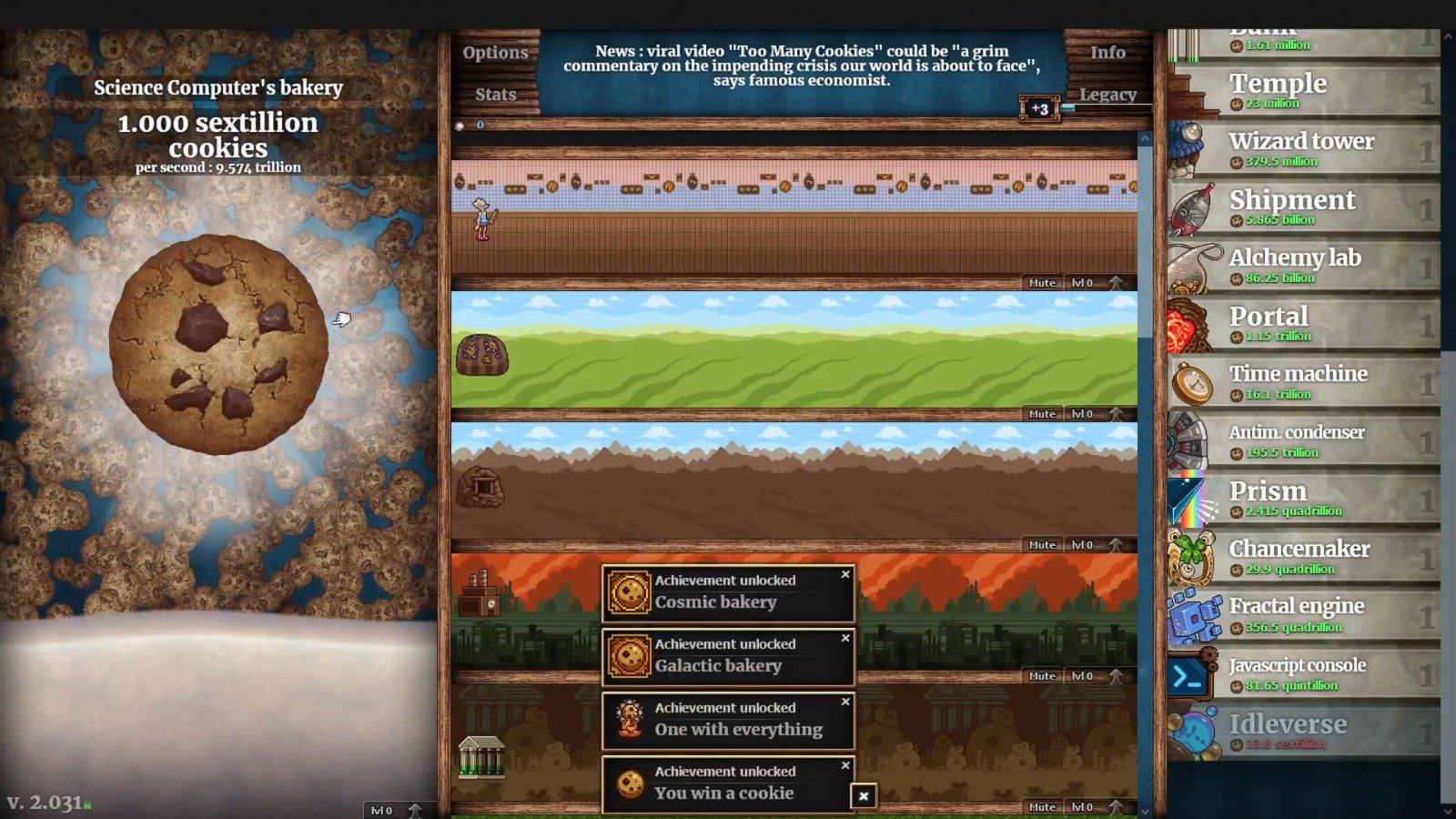
On August 8, 2013, Julien Thiennot, known as Orteil, released Cookie Clicker online. The official press kit from Orteil / DashNet and Playsaurus distinguishes that debut from the later commercial edition.
Clicks produce cookies that fund automated buildings and upgrades. After purchasing a first cursor, for example, players begin receiving production without repeating every click. The next stockpile can fund another production source or an upgrade to an existing one. Attention shifts from the act of producing to deciding where to reinvest, comparing each purchase’s gain with its cost.
That combination helped popularize the modern incremental game without inventing all earlier automatic progression. Clicking remains an option, but no longer explains the entire economy on its own.
As development continued, buildings, upgrades, achievements, minigames, and ascension and prestige systems expanded. These features should not all be attributed to the original August 2013 release: they reflect years of evolution.
From the Web to Steam
On September 1, 2021, Cookie Clicker received an official Steam version, published by Playsaurus.
The official DashNet website also preserves access to historical versions and the browser version. These channels do not necessarily receive the same features at the same time; availability does not constitute a promise of future updates.
On May 22, 2025, Orteil announced Cookie Clicker for PlayStation, Xbox, and Nintendo Switch, published by Playsaurus. That represents an expansion to more platforms, not the game’s original debut, and does not imply simultaneous updates on every platform.
Clicker Heroes: When Production Becomes Damage

In 2014, Playsaurus released Clicker Heroes in browsers. Its Kongregate listing dates publication to August 6, 2014. The Steam version arrived on May 13, 2015.
Clicker Heroes turns incremental production into combat capability. Clicks deal damage, monsters yield gold, and recruiting and upgrading heroes increases automatic attacks, allowing players to face tougher enemies. It is an incremental structure with RPG elements; the difference from ARPGs is discussed in the genre comparison section.
Prestige and Ascension
The systems expanded throughout development. An interview with Playsaurus distinguishes ascension from transcendence: these resets involve different resources and scope, rather than being interchangeable names for one operation.
Clicker Heroes 2 is a sequel with its own systems and development history; its existence does not automatically replace the first game.
AdVenture Capitalist: Automating Businesses and Expanding Revenue
Another important example is AdVenture Capitalist, developed by Hyper Hippo.
The game initially launched in browsers in 2014, before the mobile editions announced by Hyper Hippo in February 2015. Its Steam version followed on March 30, 2015. These were separate stages of distribution.
Its humorous business expansion runs from simple activities such as a lemonade stand to increasingly large ventures. The business theme serves progression, not realistic economic simulation.
Managers and Automation

Managers automate cycles that initially require manual action. Once a lemonade stand is automated, for example, revenue can be reinvested in that stand or saved to open another business. Spending now may accelerate one activity but postpone the alternative that would use the same money. The choice changes with prices, rates of return, and available benefits: this opportunity cost gives investment a purpose beyond the business theme.
Resets involving angel investors add long-term benefits. Accelerated growth and automation are part of a stylized portrayal, not a faithful model of business administration.
Universal Paperclips: An Incremental Game That Tells a Story

In 2017, Frank Lantz released Universal Paperclips, as recorded in the creator’s portfolio, associated with Everybody House Games.
Players control an artificial intelligence devoted to producing paperclips. At first, increasing output also means obtaining raw materials and selling what has been manufactured. Expanding capacity without considering sales conditions or supply can create another bottleneck rather than solve the whole operation.
Progress unlocks new resources, forms of automation, and management systems. As a result, players no longer solve exactly the same problem: new decisions expand the scope of activity and change its relationship with the original goal. This shift in available actions develops the narrative through the mechanics themselves, not merely through bigger numbers.
The premise echoes the paperclip maximizer, a thought experiment associated with philosopher Nick Bostrom, who did not create the game. Pursuing a simple goal without considering other values can have problematic consequences. Lantz turns that discussion into an interactive experience.
Without spoiling its major discoveries, Universal Paperclips also shows that an incremental game can have a defined objective and a narrative ending rather than run indefinitely.
How Do Resources, Upgrades, and Multipliers Work?
Resources fund upgrades, new production sources, and unlocks. Depending on the game’s concept, they may represent cookies, gold, materials, or capabilities. A decision depends on expected benefits, costs, and alternatives that the same investment would leave unfunded.
Total Production vs. Production per Second
Total or cumulative production measures what has already been produced or collected; production rate measures how much is generated per interval. Saved inventory and an all-time total may appear in separate counters, particularly after spending.
At a constant rate of 20 resources/s, 200 resources are produced in ten seconds, before accounting for spending or losses. Having a large stockpile does not guarantee fast production; it is also possible to produce a lot and spend almost everything on upgrades.
How Do Multipliers Work?
An upgrade can increase output by a fixed or proportional amount.
Illustrative example — not data from any specific game:
| Situation | Production |
|---|---|
| Initial production | 100 resources/s |
| Upgrade adding 50 resources/s | 150 resources/s |
| 2× multiplier applied to initial production | 200 resources/s |
| Two successive 2× multipliers, when combined multiplicatively | 400 resources/s |
The way bonuses combine depends on the rules: two 100% bonuses do not necessarily multiply each other. Some effects are added together before other factors apply. You must check the calculation base and order rather than treat the table as a universal formula.
Linear and Exponential Growth
With linear growth, the total increases by constant increments over equal intervals, as in production with an unchanged rate. Exponential growth involves successive multiplication by a constant factor: 10, 20, 40, 80, 160 illustrates doubling.
Incremental games mix different patterns and also raise purchase costs, introduce caps, currencies, and other layers. Progression does not need to remain exponential for the entire experience.
Why Do the Numbers Get So Large?
Abbreviations and scientific notation make large quantities easier to read: 1,000,000,000 is one billion, or 10⁹. They are interface conventions, not genre requirements; discoveries and choices can support an incremental game without enormous values.
Automation and Offline Progress: Does the Game Keep Running When Closed?
Automation keeps activities going without constant manual commands. Offline progress recognizes or calculates advancement corresponding to a period without active use or execution. Saving preserves the previous state and, by itself, does not guarantee production while away.
The Progress Quest manual gives an example: the character advances while the program is running, but closing the game stops progress. Automation is not the same as continuing to produce offline.
Other titles calculate resources on return, may cap the time counted, or reduce efficiency. Some have connection requirements and other restrictions. You should therefore never assume unlimited production after closing an Idle game; its rules must be consulted.
Prestige: Why Can Resetting Help Players Advance?
Prestige is a partial reset of progress in exchange for advantages in later stages. It can become attractive when new upgrades cost too much relative to their gains. Deciding involves comparing what will be lost with the lasting benefits; there is no universally correct moment to reset.
In Cookie Clicker, ascension opens a path to persistent benefits, allowing players to revisit earlier stages under different conditions. This is different from simply erasing progress and beginning an identical run.
Ascension, transcendence, reincarnation, and rebirth do not describe identical systems in every game. What is lost, what carries over, and which currencies or upgrades become available depend on each game’s rules; one title may have several reset layers. Prestige is not compulsory in an incremental game.
Metaprogression means development that persists between cycles or attempts, a concept also found in other genres. Adding layers does not guarantee depth: they must create meaningful decisions rather than just repeat the same process with larger numbers.
Realm Grinder, NGU IDLE, and Melvor Idle: Different Paths to Progression
Incremental games also developed more elaborate structures involving choice, RPG systems, and long-term progression.
Realm Grinder: Factions and Specialization

Released on Kongregate in May 2015, Realm Grinder, developed by Divine Games, uses a fantasy setting and kingdom development.
Its factions provide distinct benefits and systems for production and buildings. Choosing an alliance changes which combinations of buildings and upgrades are worth prioritizing; a purchase that works well for one specialization may be less important for another. The decision becomes how to organize the kingdom around those benefits, not merely repeat the same shopping list under fantasy names.
Realm Grinder received its Steam edition on June 15, 2017, two years after appearing on Kongregate. One date does not replace the other in the game’s history.
NGU IDLE: Multiple Layers of Numbers and Systems
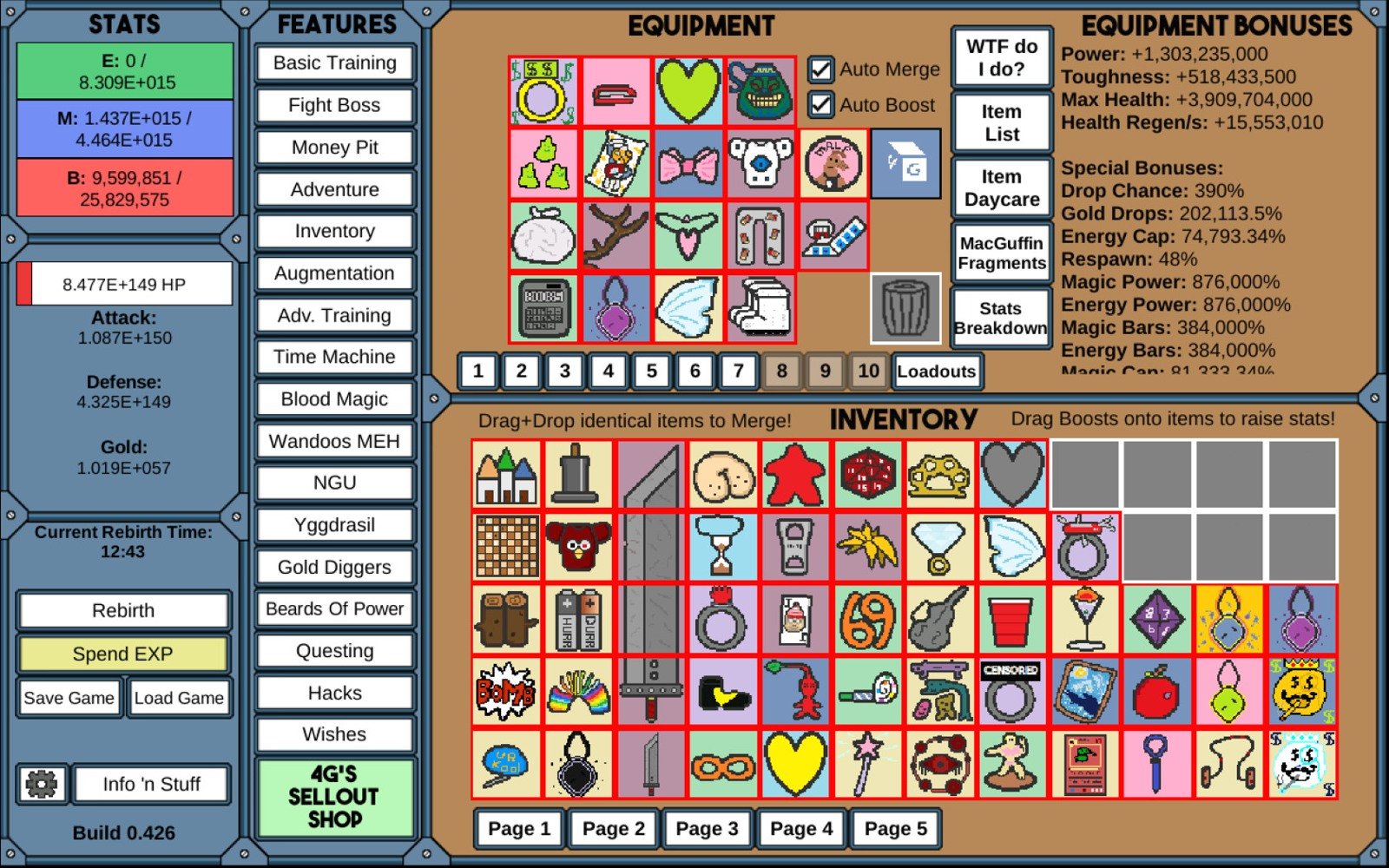
NGU IDLE, developed by 4G, became known for blending humor, growing numbers, and different activities.
It arrived on Steam on October 1, 2019, after a February 2018 Kongregate release. That earlier release is documented in the game’s historical Kongregate listing.
By this article’s editorial date, the page already identified June 19, 2026 as the last day of the Kongregate version. That notice refers to that platform and does not mean all versions were discontinued. The Steam edition follows its own development path; the old browser version must not be presented as an ordinarily active service in October 2026.
Training, equipment, combat, energy, and magic coexist in simultaneous systems. Allocating a limited resource across activities means accelerating one area while leaving another with less capacity at that moment. Players monitor what each system improves and reconsider priorities when new equipment, challenges, and opportunities appear.
Humor accompanies the management of these interconnected layers. Unlike a single production line, the challenge lies in understanding how parallel progress paths support one another and compete for attention and resources. This complexity is a particular approach taken by NGU IDLE, not a required template for all incremental games.
Melvor Idle: RPG Skills with Automated Progression

On November 18, 2021, Melvor Idle received its full version 1.0 release. Jagex’s announcement distinguishes that milestone from Early Access, which started in September 2019.
Created by Brendan Malcolm of Games by Malcs and published by Jagex, the game draws inspiration from RuneScape. Gathering, crafting, training, equipment, and combat interconnect: mining provides ore for smithing, which produces equipment for combat. Spending time collecting material can therefore prepare a later activity instead of merely increasing a currency.
Choosing a skill to train involves considering the goal that skill will help achieve. Some resources have multiple uses: woodcutting produces logs that can support activities such as firemaking and fletching. Deciding how to spend those materials ties together progress across different skills.
Its distinctive approach organizes progression around skills and RPG systems rather than solely increasing a currency. That inspiration does not make it an automatic version of RuneScape: Melvor Idle has its own rules, interfaces, and objectives.
The standalone sequel Melvor Idle 2, from Games by Malcs, received a public Steam demo on October 19, 2026 during Steam Next Fest. It includes some developing skills, a level cap of 60, combat, and the story’s first act; the team announced that saves would carry over into the future Early Access release.
On October 21, 2026, the official store page still listed a future release: Early Access was planned for 2026 without a fixed date, and version 1.0 had not launched. The studio expected to keep the demo available for a few weeks after the event, not permanently. The demo does not mean the full game is available on mobile, and the image in this section still depicts the first Melvor Idle.
Incremental Games That Reveal New Systems and Stories
Other projects explore their own approaches to discovery, mathematics, magic, and visual presentation without necessarily copying Cookie Clicker‘s interface or economy.
Spaceplan, by Jake Hollands, had its commercial release on May 3, 2017, published by Devolver Digital. It blends incremental progression, humor, and a distinctive narrative presentation.
Antimatter Dimensions, initially created by Hevipelle, combines production dimensions and reset systems. Its layers do more than generate one currency: higher-tier dimensions feed the production of lower-tier ones, forming a chain that changes where an investment has an effect. New resets reorganize those capabilities and add decisions. Its browser changelog records updates in 2016, ahead of the Steam edition on December 17, 2022.
Arriving in that storefront does not mark the game’s origin.
Magic Research, by Maticolotto, blends magic, research, management, and RPG elements. Its Steam edition arrived on March 22, 2023. The sequel, Magic Research 2, released on May 21, 2024, expands magical development and automation with a team of wizards.
The Gnorp Apologue, by Myco and released on December 14, 2023, uses small creatures, resources, and upgrades for a visually distinct progression system. Production and transport appear in the creatures’ on-screen activity, making the effects of choices visible in the system’s movement as well as in numerical indicators.
Idle and Incremental vs. Auto Battler, RPG, and Automation Games
Progression, automatic attacks, or resources alone do not determine a game’s genre.
| Classification | Core characteristic | Examples |
|---|---|---|
| Idle | Processes requiring little continuous intervention | Melvor Idle, AdVenture Capitalist |
| Incremental | Cumulative growth and reinvestment in new capabilities | Cookie Clicker, Antimatter Dimensions |
| Auto Battler | Building compositions for largely automated battles | Teamfight Tactics, Auto Chess |
| ARPG | Real-time combat and character progression | Diablo, Path of Exile |
| Management and simulation | Managing or interactively representing activities and systems | Various management and simulation games |
| Factory automation | Building and organizing production processes and logistics | Factorio, Satisfactory |
| Roguelite | Structured runs, challenges, and possible progression between attempts | Hades and other roguelites |
In Auto Battlers such as Teamfight Tactics, automated combat belongs to competitive encounters: players recruit, organize compositions, and adapt between rounds. That differs from the extended progression of activities and skills in Melvor Idle. Automatic attacks do not make a game Idle.
Clicker Heroes and Melvor Idle use RPG elements, but their focus is not direct movement and combat control as found in ARPGs such as Diablo and Path of Exile. Likewise, a simulator or management game may involve revenues and costs without centering the entire experience on incremental reinvestment.
Factorio and Satisfactory place considerable importance on the spatial layout, engineering, and logistics of factories. Sharing production and automation does not automatically make them Idle; the Sandbox pillar explores the freedom to build and experiment with those systems.
In Roguelites, runs with their own challenges structure the experience and may include metaprogression. A reset with bonuses is not enough to equate that structure with incremental prestige. Overlap is possible, but the genres are not interchangeable.
Idle Games on Mobile: Progress, Notifications, and Monetization
Touchscreens, periodic decisions, and automation suit short mobile sessions. Notifications and rewards may encourage returning, but neither short play sessions nor being a mobile app defines the genre.
Gameplay and monetization are different dimensions. Some games are free with advertising, resource purchases, or speed boosts, while paid titles may not rely on those mechanisms. One model might sell faster progress; another may keep upgrades tied to resources earned through play.
These choices affect pacing and must be assessed for each title. Idle does not automatically mean free-to-play, pay-to-win, advertising, or aggressive monetization—and it does not guarantee offline progress.
Games That Shaped the Evolution of Idle and Incremental Games
This selection covers precursors and different interpretations of the genre. It is not a ranking of the best games.
| Game | Year | Contribution or characteristic |
|---|---|---|
| Progress Quest | 2002 | RPG satire with nearly fully automated progression |
| Cow Clicker | 2010 | Critique of social clicking and waiting systems |
| Candy Box! | 2013 | Incremental progression with discoveries and adventure elements |
| A Dark Room | 2013 | Gradually revealed narrative and systems |
| Cookie Clicker | Aug. 8, 2013, web; Sept. 1, 2021, Steam; May 22, 2025, consoles | Popularization of the production-based modern incremental game |
| Clicker Heroes | 2014, browser; May 13, 2015, Steam | Damage, heroes, and progression with RPG elements |
| AdVenture Capitalist | 2014, browser; Mar. 30, 2015, Steam | Business automation and stylized economic growth |
| Realm Grinder | May 2015, Kongregate; June 15, 2017, Steam | Factions and distinct production strategies |
| Antimatter Dimensions | 2016, browser; Dec. 17, 2022, Steam | Numerical progression with resets and new layers |
| Spaceplan | May 3, 2017, commercial release | Progression with humor and narrative presentation |
| Universal Paperclips | 2017 | Narrative developed through incremental progression |
| NGU IDLE | 2018, Kongregate; Oct. 1, 2019, Steam | Multiple layers of training, resources, and progression |
| Melvor Idle | Sept. 2019, Early Access; Nov. 18, 2021, version 1.0 | RPG skills and systems with Idle progression |
| Magic Research | 2023; Steam edition on Mar. 22, 2023 | Incremental game with magic, management, and RPG elements |
| (the) Gnorp Apologue | 2023 | Production and upgrades with a distinctive visual presentation |
| Magic Research 2 | May 21, 2024 | Sequel with magic, RPG elements, and automation |
| Melvor Idle 2 | Oct. 19, 2026, public demo | Demo of some skills and the first act; Early Access still upcoming |
The dates distinguish browser debuts, store arrivals, Early Access, and full versions. The selection does not credit each game with independently inventing its mechanics, and a demo is not a commercial launch.
Why Can Rising Numbers Be Interesting?
Seeing an investment’s effect, overcoming a limitation, or discovering new possibilities may be more rewarding than the counter itself. Large numbers do not guarantee interesting decisions; smaller systems can provide meaningful choices too.
What Are the Main Challenges?
Repetition and waiting can tire players who prefer variety and immediate responses. Dense menus, many layers, offline progress limits, and frequent resets may also make learning harder or frustrate expectations.
For others, following a long-term project and returning to decide the next step is the main appeal. The pacing differs between titles; consider whether your choices remain meaningful and whether the required time fits the experience you’re looking for.
Idle and Incremental Games Turn Small Actions into New Possibilities
From satire to narrative adventures and skill systems, the format has found different ways to make progression an engaging activity. What sustains the experience is the transformation of decisions: learning something new, reconsidering a strategy, or discovering a possibility may matter more than simply reaching the next number.
About the Author