Construções e transformação do ambiente fazem parte das possibilidades de Minecraft. Captura da galeria oficial do jogo. Imagem: Mojang Studios / Microsoft.
Sandbox games give players the freedom to experiment with systems, create situations, and pursue their own goals within established rules. That freedom may take the form of world building, character relationships, engineering, or choosing a path through a game world.
The concept does not require a huge map, unlimited resources, or the absence of a story. In this feature, we explore its origins and the different approaches that led from Elite and SimCity to Minecraft, Garry’s Mod, and automation games.
Updated October 21, 2026.
Nesta matéria
What does Sandbox mean in video games?
Sandbox literally refers to a box of sand: a metaphor for a space where people can build, take things apart, and invent activities with the materials available. In video games, it describes tools and systems that allow different approaches without imposing a single correct sequence of actions.
The word can classify experiences centered on that freedom or describe a design approach used in simulation, RPGs, strategy, and other genres. A game does not need to abandon its main identity to incorporate Sandbox characteristics.
Building, crafting, survival, multiplayer, procedural generation, destruction, and realistic physics are possibilities, not universal requirements. Player autonomy can also involve trading, social relationships, or managing groups.
Missions, campaigns, and progression can coexist with experimentation. Access to tools may depend on resources and challenges. No game offers literally infinite freedom: each system permits some actions and limits others, and a title may allow open-ended building while restricting combat.
Where did the Sandbox concept come from?
The sandbox metaphor described spaces for experimentation before becoming a video game classification. Computing also uses the term in separate technical contexts; in games, it came to emphasize autonomy within available tools and boundaries.
This approach developed gradually, combining traditions of exploration and simulation. No single game or studio invented every Sandbox characteristic. The classification may also be retrospective: displaying these qualities does not mean a game was originally marketed under that label.
Elite and SimCity: two different origins of player freedom
In 1984, David Braben and Ian Bell released Elite, initially for the BBC Micro and Acorn Electron. The historical record of the BBC Micro edition documents its creators and publication by Acornsoft.
Piloting a spaceship, players could travel between systems, trade commodities, and fight, choosing activities and using their outcomes to shape their own path. Its simple 3D graphics and the systems of the period imposed limits, but that autonomy made Elite an important historical reference.
This freedom concerned activities within a spacefaring universe, not reshaping the terrain with blocks. Choosing a trading route or seeking combat represents a different tradition from the construction later popularized by Minecraft.
SimCity: building and observing the consequences

In 1989, Maxis released SimCity, created by Will Wright, as recorded in the studio’s official history.
SimCity popularized another form of autonomy: planning roads, residential zones, commerce, industry, and infrastructure while watching how those decisions affected urban growth and public services. The city could become a project of the player’s choosing rather than one driven exclusively by a campaign. Establishing a new residential area may attract people and increase demand for roads and services.
If infrastructure fails to keep up, the plan must change: expanding a city generates new needs, not just more buildings on the map.
Its primary genre remains City Builder. Its Sandbox contribution lies in allowing players to modify a system, observe the effects, and revisit decisions; they do not need to control a character in a 3D world.
The Sims and the freedom to create situations

On February 4, 2000, Maxis released The Sims, a date confirmed by the franchise’s tenth-anniversary retrospective.
The life simulation let players create characters and homes, arrange furniture, and manage needs, relationships, and careers. Building a house or improving a family’s life could become a personal goal, with no single mandatory storyline.
Needs and social decisions interact, creating events that can change plans over the course of a game. Devoting more time to one character’s career might leave fewer opportunities for socializing or meeting their needs. The player then has to reorganize the routine; the original goal of advancing at work may give way to restoring family relationships and well-being. The game has its own rules and progression without representing the full complexity of human behavior.
The Sims 2, The Sims 3, and The Sims 4 developed different systems for customization, building, and relationships. This tradition shows how experimentation can also concern characters and social interactions. The image in this section is from The Sims 4, not the original 2000 game.
Garry’s Mod: a Sandbox where the tools are the main attraction
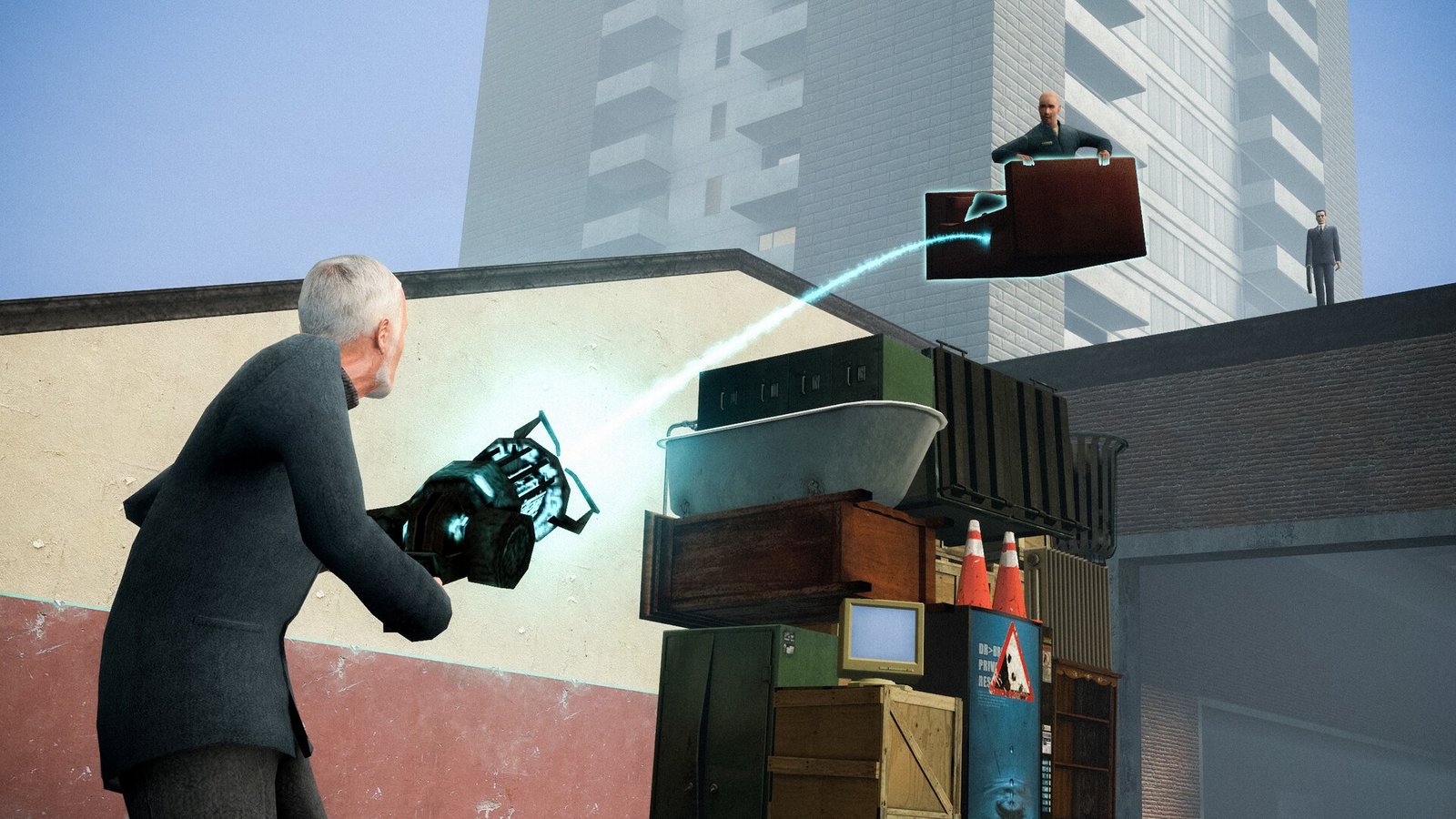
The project began in 2004, created by Garry Newman as a modification associated with Half-Life 2 and Valve’s Source technology.
On November 29, 2006, it received a commercial Steam release. Facepunch’s retrospective distinguishes that release from its origins as a mod in 2004.
Sandbox mode gives players tools and objects without imposing predetermined mandatory objectives. They can spawn parts, move and position objects, and connect them with attachment and constraint tools, including welding.
The arrangement of the parts, their connections, and their physical behavior determine how a makeshift vehicle or machine performs. Imagine building a wheeled platform: it may appear balanced while stationary and tip over once it moves. Shifting a heavy part or changing the base alters the next test. The fun comes from understanding why something went wrong and trying another construction, rather than following a ready-made answer.
This cycle of building, observing, and adjusting turns tools into instruments of experimentation. The physics model serves the game’s design; it is not a complete reproduction of real-world engineering.
Community-created game modes
Community content expanded these possibilities. Trouble in Terrorist Town and Prop Hunt include competition, identifying opponents, and their own objectives. Not every Garry’s Mod mode therefore provides the same freedom as Sandbox mode.
Facepunch also released s&box on April 28, 2026, a separate creation platform based on Source 2. It does not automatically replace Garry’s Mod, its tools, or its community content.
Minecraft and the worldwide rise of the modern Sandbox
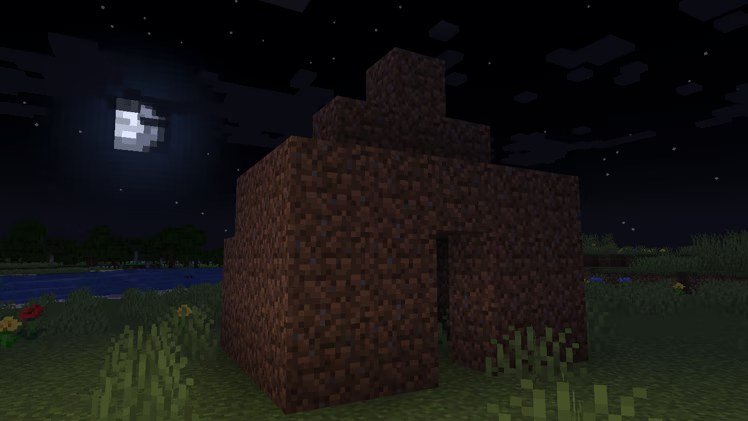
Minecraft began receiving public versions in 2009, initially created by Markus Persson.
Mojang expanded its development, and the original PC version received its full release on November 18, 2011, according to the official timeline of its major milestones. The public versions of 2009 and full release of 2011 are different milestones.
Minecraft combines exploration, gathering, crafting, construction, and an extensively modifiable block-based world. Removing materials, opening routes, and reshaping the landscape allow players to pursue projects of their own. Creatures, equipment, and challenges add other dimensions to that setting.
Faced with a river, for example, a player can search for another crossing or build a bridge for future journeys. That bridge may become part of a road, a hillside house, or a collaborative project. The game provides building blocks and rules; the purpose and shape of the structure may come from the player. Changing the environment also changes how it can be used afterward.
Its contribution was bringing building, exploration, and survival together in an experience familiar to a broad audience, without being the first game to offer experimental freedom.
Minecraft Creative vs. Survival
The two modes demonstrate how freedom operates under different rules.
| Feature | Creative | Survival |
|---|---|---|
| Materials | Broad, immediate access to available resources | Resources normally need to be gathered |
| Building | Focuses on experimenting and completing projects | Building requires materials and preparation |
| Flying | A standard ability in this mode | Not a normal starting ability |
| Health and hunger | Without traditional survival requirements | Depend on the chosen rules and difficulty |
| Main possibilities | Create and modify freely | Explore, survive, craft, and build |
In Creative, immediate access to materials helps players execute and test projects. In Survival, preparing tools, gathering resources, and facing dangers add conditions to the same building possibilities. These represent different degrees and forms of autonomy within one game.
Redstone and player-built mechanisms
Redstone lets players combine components into circuits and mechanisms. A button may send a signal along redstone wiring to open an iron door; changing the button’s position or connecting other parts changes how the entrance works. Rather than selecting a finished door, the player learns the relationship between input, signal transmission, and response. Larger systems reuse these connections to solve building and transportation problems.
The official update timeline records the Chaos Cubed game drop in June 2026 and Wilderness Bound in September, which brought new materials, interactions, and possibilities for exploration and construction.
As of October 21, 2026, icy caves, crystals, stalactites, and a frozen zombie variant were part of testing for an upcoming game drop in Java snapshots and Bedrock beta/Preview versions. Those tests, including October 20 additions, did not mean that the content was already in the stable release.
Terraria: building and progression in a two-dimensional Sandbox

On May 16, 2011, Re-Logic released Terraria for PC.
The game features a two-dimensional world made of blocks that can be mined and used for construction.
Players can explore caves, gather materials, craft equipment, develop bases, and fight enemies.
Gear, biomes, and bosses create an important progression structure. Exploring caves provides materials to improve tools and protection; preparing a character helps them overcome challenges that unlock further resources and possibilities. Building a base exists alongside this progression: players may devote time to rooms and housing or head out to collect materials and fight.
This gives exploration direction without determining every personal project. A construction may motivate an expedition, while a discovery may inspire another structure. Terraria‘s identity lies in the relationship among exploration, crafting, combat, and world modification, not simply in being “Minecraft in 2D.”
On January 27, 2026, Re-Logic released version 1.4.5 — Bigger & Boulder, featuring new content and improvements to crafting and item management, including recipe searches and organization and crafting from nearby chests.
How does a Sandbox experience work?
There is no universal gameplay loop. For construction, an illustrative sequence might be plan → gather materials or tools → build → test → modify. For physics experiments, it might be choose objects → combine them → observe the result → adjust. Players may also leave a project behind and explore other activities.
Tools make objects and spaces interactive, but environmental modification is not essential: other games place their freedom in trade, social decisions, or groups.
Crafting turns materials into equipment, tools, or structures through recipes or assembly. It can expand creation possibilities, but crafting alone does not define Sandbox: linear campaigns can use crafting too, while games such as Garry’s Mod offer objects directly.
Emergent gameplay: when systems create new situations
Emergent gameplay occurs when interactions among rules and systems produce meaningful situations that need not be individually scripted as missions. In The Sims, for instance, needs and relationships can combine into a conflict that changes a family’s plans.
Emergent does not necessarily mean random or impossible to predict. Learning the rules makes it possible to anticipate results; that learning is part of play. Bugs should not automatically be equated with emergence either: an unexpected error is not, by itself, an interesting or intentionally supported system interaction.
Physics, engineering, and experimenting with machines
Gravity, collisions, weight, and movement can turn machine or vehicle construction into an experimental problem. Each game chooses its physics model; maximum realism is not a requirement, and similar-looking parts do not guarantee equivalent behavior.
Besiege: building machines to solve challenges
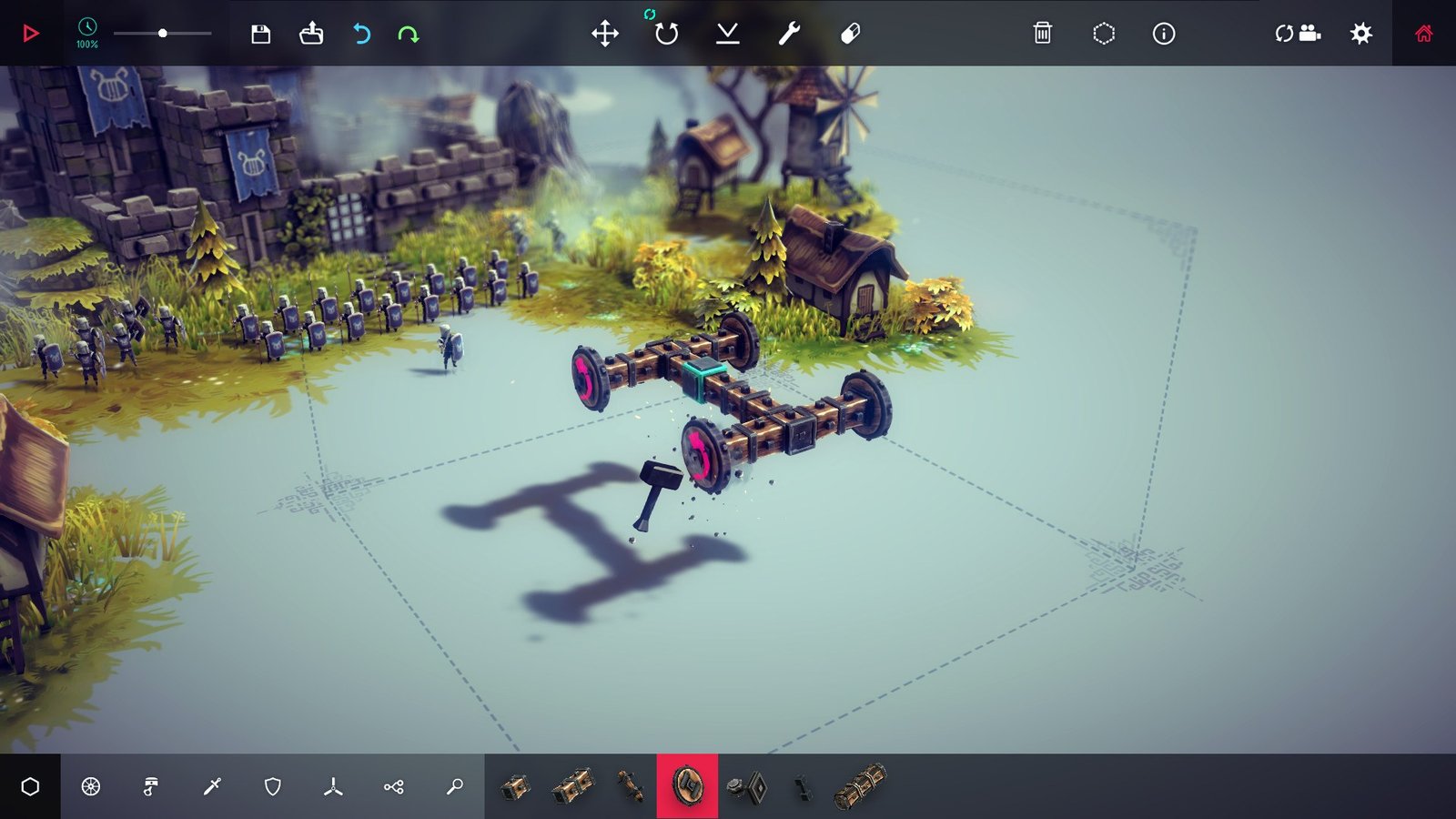
Developed by Spiderling Studios, Besiege entered Early Access in 2015 and reached full release on February 18, 2020.
Modular parts, wheels, and mechanisms let players build machines to overcome obstacles, destroy fortifications, and solve challenges. They test movement and balance, then revise the build based on the results. Creation outside level objectives is also possible, showing how defined challenges can coexist with player-devised solutions.
Space Engineers: building in space
Keen Software House’s Space Engineers entered Early Access in 2013 and reached full release on February 28, 2019.
Blocks and components allow players to create ships, stations, and bases with specific functions, such as transporting resources and exploring. A working spaceship needs to combine structure, propulsion, and power: merely making something look like a ship does not make it perform the task. Adding cargo or changing its purpose means reconsidering the system’s overall capacity.
Depending on the mode, modular engineering combines with gathering, exploration, and survival. A project becomes more than a visual shape: it is a system that must function under the game’s conditions.
Scrap Mechanic, Trailmakers, and other tools
Scrap Mechanic, released into Early Access in 2016, uses parts and mechanisms to create vehicles and other machines. Connections are part of the design: linking an engine to the bearings that turn the wheels and tying controls to the seat determines how the build can be driven. Freedom lies in the functional relationships among the parts as well as in their shape.
Axolot Games released version 1.0, Drilling Thunder, on July 24, 2026, ending that Early Access phase. The update expanded the world, building tools, and Survival content.
Trailmakers reached full release on September 18, 2019 after Early Access, concentrating creative activity on vehicles for different environments. A car must support itself and steer on wheels; an aircraft also needs lift and stability in the air. Changing the mode of travel changes the engineering problem, not merely the machine’s appearance. The editor lets players experiment and revise a build after driving or flying it.
BeamNG.drive and vehicle experimentation
BeamNG.drive emphasizes vehicle physics and deformation, allowing players to test handling, terrain behavior, and collisions. Comparing how a vehicle tackles an obstacle or examining how a crash changes the bodywork puts the focus on how the machine behaves during use. That differs from the modular assembly in Besiege, where selecting and connecting parts is central.
Teardown, which entered Early Access on October 29, 2020, and reached full release on April 21, 2022, explores destructible environments and physical solutions. During its heist missions, creating a passage or preparing a shortcut can make the escape route easier before triggering the alarm. Destruction has a planning role: modifying the surroundings creates a solution for the route. There is also room to experiment outside those objectives.
These examples expand the variety of Sandbox experiences without making every physics simulation a Sandbox game by default.
Factorio and Satisfactory: freedom to build automation systems
In automation games, freedom means organizing resources, transportation, and machines into production systems, identifying bottlenecks, and improving operations as a factory expands. This differs from Idle and Incremental games: automating production does not imply offline progress or a game centered on reinvesting ever-increasing numbers.
Factorio: building a factory that works
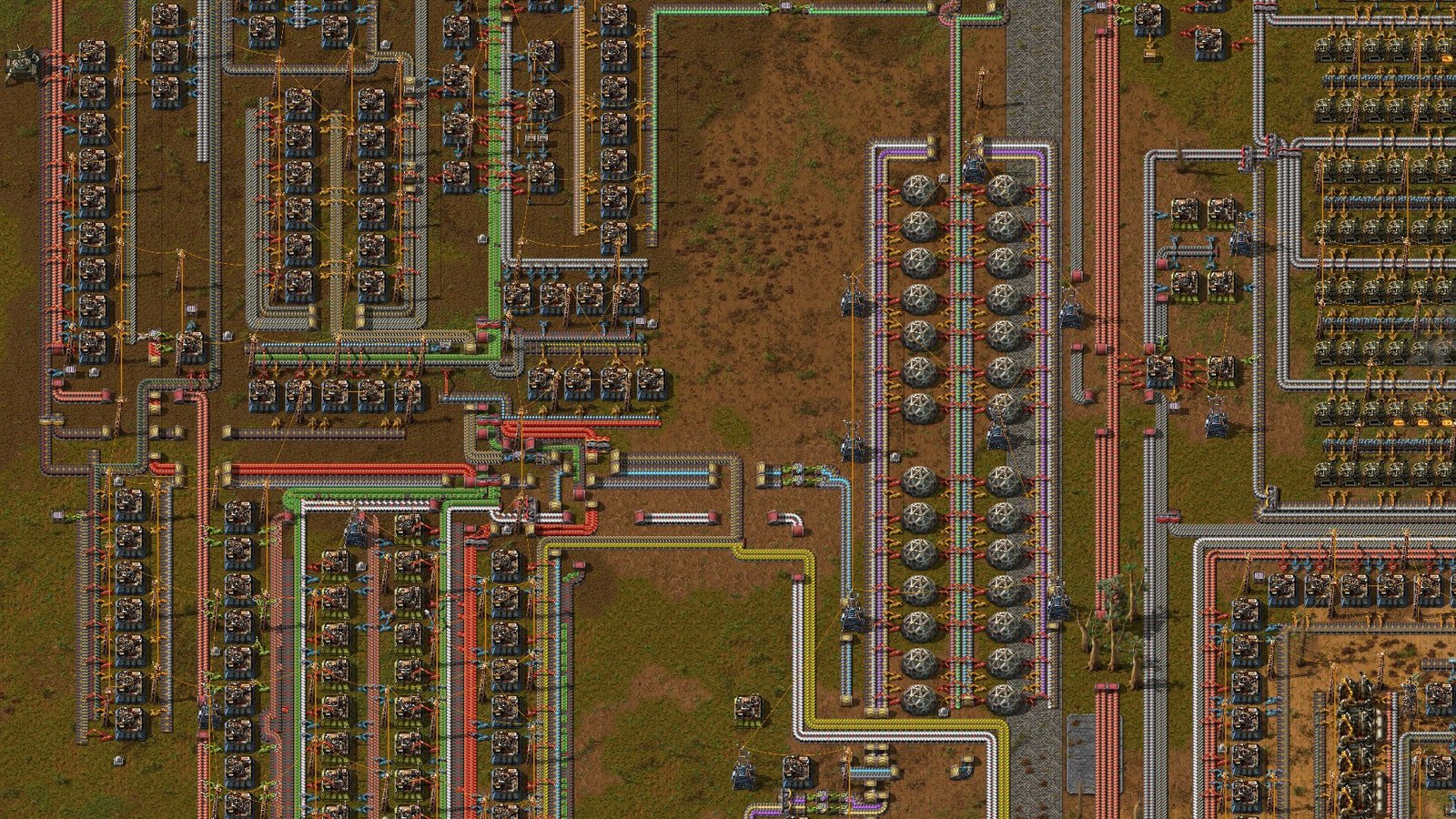
Developed by Wube Software, Factorio uses conveyor belts, inserters, furnaces, and machinery to automate tasks. Resources, power, science, and research place conditions on expansion. Players choose the factory layout and can prioritize efficiency, organization, or self-imposed challenges, even though technological progression and defined objectives exist.
A production line depends on preceding stages: extracting more ore will not solve a shortage of parts if furnaces cannot process it or transport cannot deliver materials to the machines. Adding equipment at the end of the chain may only increase waiting time. Identifying the bottleneck requires tracing the resources’ route and deciding where to increase capacity, change routes, or secure power. The factory becomes a problem of interconnected processes, with multiple possible solutions to the same goal.
On October 21, 2024, the Space Age expansion added planets and systems tied to space exploration and interplanetary logistics. The game had previously reached version 1.0 on August 14, 2020 after its Early Access development.
In its June 26, 2026 newsletter, Wube announced the experimental 2.1 release, with usability and tooling improvements. As of October 21, official documentation still distinguished experimental 2.1 from stable 2.0. Version 2.1 is not another expansion equivalent to Space Age.
Satisfactory: first-person automation

In Satisfactory, by Coffee Stain Studios, players explore an alien planet and combine conveyors, pipes, transportation, and power in industrial facilities. The first-person perspective lets them walk through the factory and plan three-dimensional layouts, unlike the predominantly top-down view of Factorio.
Building also means considering walking space, transporting resources from distant sites, and connecting facilities at different heights. An extra floor can accommodate another production stage, but it still needs to connect to the flow of materials; a new line can require changes to transport and power. Exploring the terrain and moving through the finished construction are part of industrial planning.
The difference, then, is not just the camera: it changes how players understand distances, elevations, and expansion as production chains grow.
Satisfactory reached full release on September 10, 2024 after Early Access.
On June 2, 2026, Coffee Stain released update 1.2 to the stable branch, following experimental testing begun in March. Changes included the return of rain with revised visuals, improvements to automated vehicle routes, and new daisy-chain electrical connections for compatible buildings. Stable availability is a different milestone from experimental testing.
Sandbox vs. open world: what is the difference?
Open world primarily describes a spatial structure in which players are free to travel and explore multiple regions.
Sandbox emphasizes freedom to interact with systems, create situations, and experiment with possibilities.
The two ideas can overlap, but they are not equivalent.
| Feature | Sandbox | Open world |
|---|---|---|
| Main focus | Interaction and experimentation | Exploration and movement |
| Map size | Can be small or large | Usually a large, connected setting |
| Changing the environment | May matter, but is not mandatory | Not mandatory |
| Objectives | Often supports player-defined goals | May feature structured campaigns and missions |
| Example | Garry’s Mod | Various open-world action games |
| Overlap | Minecraft combines both features | Minecraft is also open world |
Minecraft combines both concepts. Garry’s Mod offers experimentation within a delimited space, while The Sims makes social creation possible without requiring a continuous open world. Grand Theft Auto III (2001) combined urban exploration with activities and Sandbox-like interactions, but not block-based terrain modification.
Map size and freedom of interaction are different dimensions. A huge environment may offer very few actions, while a small space can allow deep combinations of tools.
How do Sandbox, Survival, Simulators, and City Builders relate?
Sandbox also overlaps with other classifications.
Each category, however, emphasizes different aspects of an experience.
| Category | Central characteristic | Examples |
|---|---|---|
| Sandbox | Freedom to experiment with systems and set goals | Minecraft, Garry’s Mod |
| Survival | Resources, threats, and conditions necessary to stay alive | The Long Dark, Valheim |
| Simulators | Interactive representation of activities and systems | Microsoft Flight Simulator, The Sims |
| City Builder | Building and managing cities or settlements | SimCity, Cities: Skylines |
| RPG | Developing characters through rules, choices, and progression | Various RPGs, including open-ended experiences |
| Automation | Building and organizing production processes | Factorio, Satisfactory |
In Survival games, resources and threats organize the effort to stay alive. Minecraft combines that with building, but The Long Dark does not offer the same level of environmental modification. Survival and Sandbox are not synonyms.
Simulators represent activities and processes. Autonomy depends on what each system allows: The Sims encourages social experimentation, while other simulators prioritize procedures and missions.
For City Builders, the focus is on building and managing cities. SimCity encourages urban experimentation; Frostpunk centers its decisions on collective survival and extreme conditions. A city-building game may have structured scenarios, and a Sandbox game need not involve urban management.
Sandbox RPGs: creating your own path without building blocks
Sandbox freedom also appears in some RPGs and strategy experiences.
Such games may give players few tools for directly changing terrain but substantial freedom to choose activities and develop characters.
Kenshi: different ways to survive and progress
Kenshi, developed by Lo-Fi Games and fully released in 2018, combines RPG and strategy in an open world.
Players can explore, trade, develop skills, fight factions, manage groups, and establish settlements. Choosing a life of trade means weighing routes and dangers; sustaining a group or settlement brings other needs and commitments. An unsuccessful expedition may interrupt the plan and shift attention to recovering the group, showing how consequences in the world can redirect a player’s trajectory.
Freedom lies in choosing activities and responding to circumstances. It does not mean every goal is immediately achievable: abilities, resources, and relationships with other groups limit what is practical at any given time.
Mount & Blade: freedom of action and strategy
TaleWorlds’ Mount & Blade series combines RPG systems, combat, and strategy. In Bannerlord, developing a character, recruiting troops, and gaining influence involve factions, economics, and warfare. Maintaining an army requires resources; taking part in conflicts changes relationships and future possibilities. The player’s story emerges through decisions within an existing political world rather than requiring them to build that world physically from blocks.
Roblox, Dreams, and player-created experiences
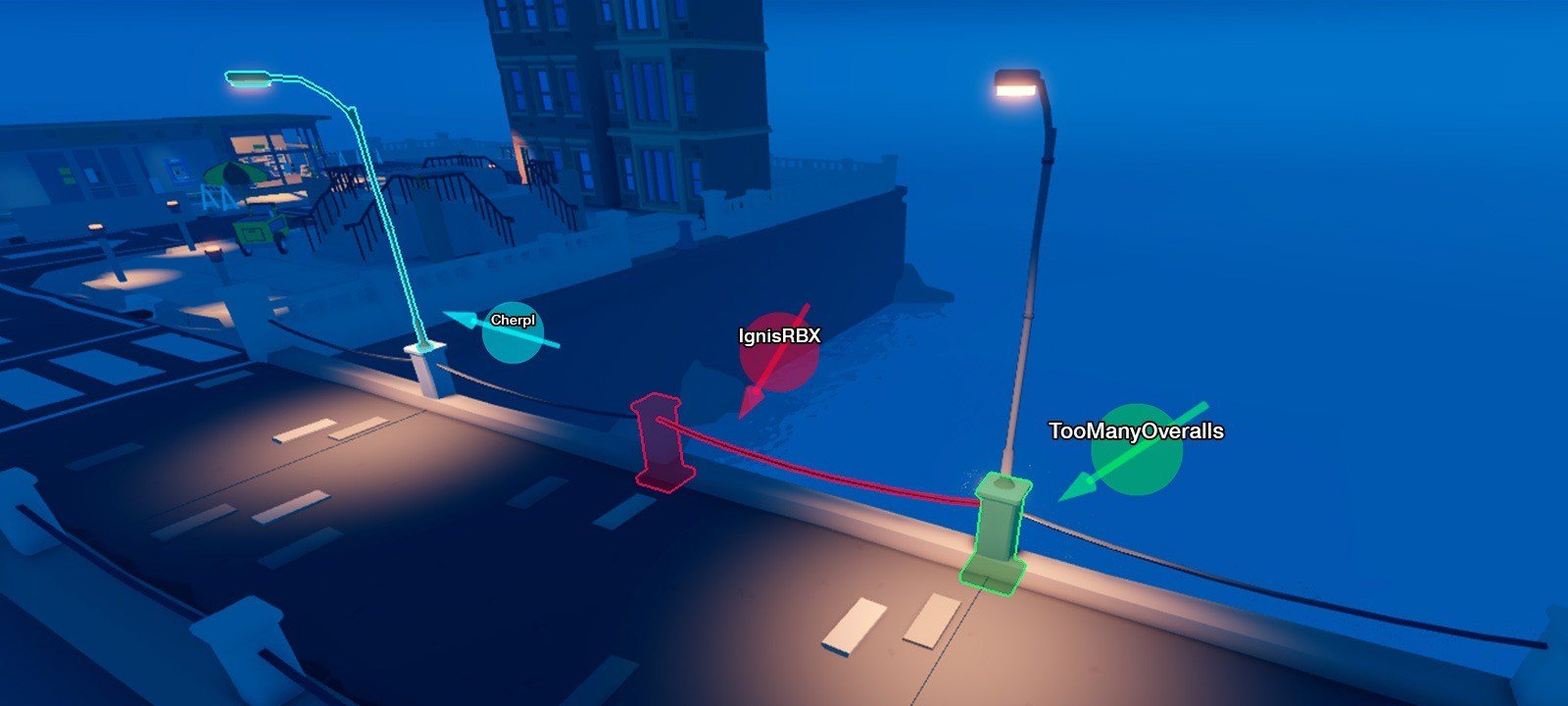
Another important development in creative freedom came through tools designed for making playable content.
Instead of modifying only the environment of an existing session, participants can build locations and develop complete experiences.
Is Roblox a Sandbox or a platform?
Roblox began its public life in 2006 and grew into a platform for user-created experiences.
Its tools allow creators to develop environments, characters, rules, and systems. Building a racetrack creates a location; defining a start line, finish line, and victory conditions creates an experience for other people to play. Roblox is a platform for creating and distributing experiences, not a single game with fixed mechanics. Some experiences provide Sandbox freedom, while others are adventures, competitions, or games with strict objectives.
In September 2026, Roblox celebrated its twentieth anniversary, highlighting community-created experiences since 2006. Roblox Studio is the official creation tool; available mechanics depend on each published experience.
Dreams and LittleBigPlanet
Dreams, developed by Media Molecule, reached full release on February 14, 2020 after Early Access, featuring tools to create levels, characters, animations, and interactive experiences.
The studio ended active support and new updates on September 1, 2023. Its announcement preserved the ability to play, create, and share, but should not be interpreted as a promise of new content in 2026.
The original LittleBigPlanet, developed by Media Molecule and released in 2008, also emphasized building and sharing levels within a platform-game framework.
That historical contribution does not guarantee all services are still available: Sony reports that the online services for LittleBigPlanet 3 on PS4 remain indefinitely disabled after their suspension in January 2024. Offline content and online sharing are different situations.
On these platforms, creating rules and activities can form part of the experience. Even so, offering a level editor does not automatically make a game Sandbox: the tools’ role and the degree of autonomy matter.
Mods, servers, and collaborative creation
Mods can add objects, tools, and systems. Minecraft, Garry’s Mod, Terraria — through tools such as tModLoader — and Space Engineers all have creator communities, but support, compatibility, and distribution differ.
In multiplayer, people can divide responsibilities and work on shared projects. Building a city together within an existing ruleset differs from installing a mod that adds new tools or using an editor to define a new activity. Servers also set permissions, limits, and objectives: one community may encourage unrestricted construction, while another restricts the same resources to competitive play.
Sharing a game’s name therefore does not guarantee access to the same tools or degree of autonomy.
A file’s presence in a community does not guarantee permission, security, or compatibility with the current version. Nor does it automatically authorize republishing screenshots and constructions. Their origin, permissions, and terms of use must be checked.
Games that shaped the evolution of Sandbox
This selection gathers historical precursors and different interpretations of the concept. It is not a ranking of the best Sandbox games.
| Game or platform | Year | Contribution or characteristic |
|---|---|---|
| Elite | 1984 | Space exploration and freedom to choose activities |
| SimCity | 1989 | City building and system experimentation |
| The Sims | 2000 | Life simulation and creating situations |
| Grand Theft Auto III | 2001 | Open world with activities and different kinds of interaction |
| Garry’s Mod | 2004 mod; 2006 commercial release | Tools, physics, and community creation |
| Roblox | 2006 | Platform for experiences made by users |
| Minecraft | 2009 public versions; 2011 full release | Building, exploration, and a highly modifiable world |
| Terraria | 2011 | Two-dimensional Sandbox with exploration and progression |
| Space Engineers | 2013 Early Access; 2019 full release | Engineering and building space structures |
| Kerbal Space Program | April 27, 2015 version 1.0, after development versions | Spacecraft construction and experimentation |
| Besiege | 2015 Early Access; 2020 full release | Building and testing physics-based machines |
| Scrap Mechanic | 2016 Early Access; July 24, 2026 version 1.0 | Engineering tools and vehicles |
| Kenshi | 2018 full release | Open-world RPG with freedom to choose a path |
| Factorio | 2020 full release | Factory construction and automation |
| Teardown | October 29, 2020 Early Access; April 21, 2022 full release | Destructible environments and physical experimentation |
| Satisfactory | September 10, 2024 full release, after Early Access | Automation and three-dimensional industrial construction |
Dates distinguish early versions, Early Access, and full releases. The order follows the milestones shown in the table; version 1.0 is not the same as the first public build. Kerbal Space Program 1.0 arrived in April 2015; Teardown entered Early Access in October 2020 and fully launched in April 2022.
Who are Sandbox games for?
Sandbox games tend to appeal to people who like setting their own projects and learning through experimentation. Building, social relationships, engineering, automation, and character-driven paths appeal to different interests, so it is worth choosing according to the systems one wants to explore.
That autonomy can also leave players without direction if they prefer clear goals and campaigns with a defined beginning and ending. Complex projects require learning, resources, planning, and testing; mods and servers introduce compatibility, performance, and organization concerns. These are factors to evaluate, not signs that Sandbox is superior to linear experiences.
Sandbox is the freedom to experiment with a game’s rules
Different Sandbox traditions continue to expand how people can create and interact in video games. Their value lies in understandable rules and possibilities that encourage curiosity: learning turns familiar tools into new projects, solutions, and situations.
About the Author