EA Sports FC 27 (2026), cobrança de escanteio. Captura oficial do guia de jogabilidade. Imagem: Electronic Arts.
Nesta matéria
Five minutes remain in a soccer match, and your team is down by one goal. Attacking down the wings, crossing into the box, or sending more players forward could create an equalizer. But pushing up also leaves room for a counterattack. On a basketball court, the choice is different: shoot despite a defender or pass to an open teammate before the shot clock expires.
At a skatepark, the challenge changes again. Ramps and rails allow tricks to be chained together, but the sequence must end without a fall for the points to count. These experiences belong to sports games, although they demand very different skills. There are also motion-controlled gestures in Wii Sports, management without direct control over athletes in Football Manager, and fictional sports in Rocket League.
This feature traces the history of sports games and explores how rules, controls, choices, and competitive formats gave rise to simulations, arcade experiences, and management games. The aim is to understand how each approach works, from electronic experiments to contemporary franchises.
Updated October 22, 2026.
What defines a sports game?
Sports games represent, adapt, or reinterpret sporting activities and competitions. Rules, scoring, movement, and goals organize the experience. In soccer, controlling players and creating opportunities helps score goals; in golf, selecting a shot brings the ball closer to the hole; in skateboarding, exploring obstacles can support trick challenges and high scores.
Real athletes, licenses, teams, or rigorous simulation are not required. Mario Tennis uses fictional characters and unique abilities. NBA Jam exaggerates recognizable basketball moves. Football Manager focuses on decisions made at the club. Multiplayer, professional schedules, and annual releases are not mandatory either: an individual career, a match against the computer, or a high-score challenge can provide progression.
Sports games and esports are not the same thing
Sports games describes a type of gameplay; esports refers to organized video game competition, regardless of genre. An EA Sports FC tournament uses digital soccer; a Counter-Strike tournament uses a competitive FPS. Both can be esports, but the existence of a circuit does not turn Counter-Strike into a traditional sports game.
Street Fighter still belongs to fighting games and League of Legends to MOBAs, even when played professionally. Rocket League can fit both classifications: its activity is a fictional sport and it can be played in tournaments. Our history of FPS games covers a separate tradition. These classifications can coexist without one being a prerequisite for the other.
Arcade sports, simulation, and management games
The approaches below describe the main focus of interaction. They may coexist within the same title and are not a hierarchy of quality.
| Type | Main characteristic | Examples |
|---|---|---|
| Arcade sports | Adapted rules, accessible controls, and stylized actions | NBA Jam, Mario Strikers, SSX |
| Sports simulation | More detailed representation of a sport’s rules and characteristics | NBA 2K, EA Sports FC, MLB The Show |
| Sports management | Managing teams, strategies, and seasons | Football Manager, Out of the Park Baseball |
An arcade game may be easy to pick up but difficult to master, as combos and reading opponents demonstrate. Simulation adapts reality; management turns decisions and consequences into gameplay.
Tennis for Two and Pong: the predecessors of sports games

On October 18, 1958, William Higinbotham presented Tennis for Two to visitors at Brookhaven National Laboratory. An analog computer calculated the trajectory of a ball, displayed as a bright dot on an oscilloscope. The side view of the court included a net but no players or spectators.
Two participants used separate controllers to adjust and return shots. The interaction transformed a recognizable activity into electronic entertainment without reproducing every rule of tennis. The image accompanying this article shows a 2008 reconstruction, not a photograph of the original equipment from 1958.
Brookhaven National Laboratory discusses earlier experiments and the criteria that make the phrase “first video game” controversial. Tennis for Two is an important predecessor, but cannot categorically be credited with an isolated invention. Its contribution is demonstrating two people interacting with a sporting activity through an electronic system.
Pong: the commercial popularization of sports video games
Atari’s Pong (1972) brought a racket-inspired contest to arcades. Each participant moved a vertical paddle to return a ball; allowing it to pass awarded a point to the opponent. Positioning the paddle was understandable without memorizing complex commands, encouraging short matches between two people.
This accessibility helped demonstrate the commercial potential of video games. Pong did not appear in isolation, however: the Magnavox Odyssey, also released in 1972, offered electronic tennis at home, and Nolan Bushnell knew of it before Atari’s commercial launch. Their relationship led to patent disputes. Pong is primarily a commercial milestone, distinct from Higinbotham’s earlier experiment and from the claim of being the first video game ever.
Sports on 8-bit and 16-bit consoles
During the 1980s and 1990s, 8-bit and 16-bit consoles expanded the presence of sports in homes. Nintendo’s Tennis and Golf adapted trajectories, returns, direction, and power to limited controls. Punch-Out!!, originally a 1984 arcade game, turned reading opponents’ patterns into its own version of boxing. Tecmo Bowl (1987) adapted runs, passes, and plays from American football.
The first digital soccer games
Adapting soccer required representing multiple players, the ball, goals, and changes between attacking and defending. Championship Soccer, known as Pelé’s Soccer in certain markets, brought a simplified interpretation to the Atari 2600 in the early 1980s. International Soccer (1983) on the Commodore 64 and Match Day (1984) advanced this tradition on home computers.
Receiving the ball in midfield presents a familiar decision: carry it forward alone or pass to a better-positioned teammate. A pass may exploit space before the defense reorganizes; insisting on dribbling may create an opening or surrender possession. Even with simple visuals, these relationships conveyed the sport.
Controlling many athletes with one controller required choosing which player received direct input and deciding how the others would move.
Kick Off and Sensible Soccer: soccer before the great modern simulations
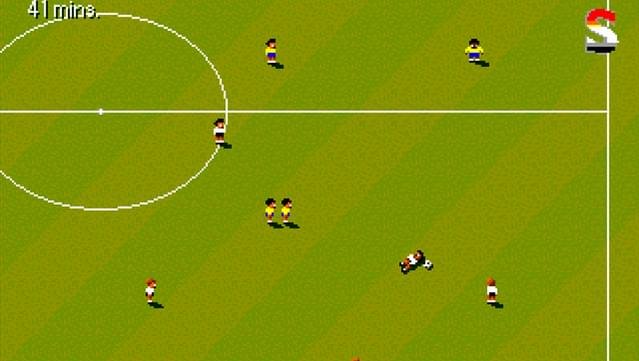
Dino Dini’s Kick Off (1989) explored ball control and high-speed movement. The ball was not simply attached to the player’s feet; following its movement required mastery of the controls. Sensible Soccer (1992) used small players and a wide field view to make spacing and passing plays understandable at an accessible pace.
Simple graphics did not prevent interesting decisions. Spotting an unmarked teammate and making a pass at the right moment could matter more than visual detail. The image shows Sensible World of Soccer 96/97, a later release in this tradition, rather than the original 1992 game.
Track & Field and multisport experiences

Konami’s Track & Field (1983), known in Japan as Hyper Olympic, brought running, jumping, and throwing events together in one arcade game. Some events tied rapid button pressing to speed, while others required executing an action at the right instant. In a jump, building speed is not enough if the final input comes outside the required timing.
The challenge was making different activities understandable within the same product. Mixing rhythm, accuracy, and local competition influenced later multisport experiences without attempting to simulate every detail of athletic effort. The screenshot here is from the Arcade Archives re-release, not a photograph of the original arcade cabinet.
Olympic games and multisport experiences
The multisport tradition continued with Olympic Gold, Athens 2004, Beijing 2008, and London 2012. Switching from a race to a jumping event changes the required actions: command speed in one, timing and precision in the other. A collection must simplify controls without erasing each event’s identity.
Mario & Sonic at the Olympic Games used Nintendo and SEGA characters in a stylized interpretation of the competitions. Not every game featuring several sports is therefore an officially licensed Olympic production. Names, symbols, and competitions require specific agreements.
FIFA International Soccer: the beginning of a major sports franchise
Electronic Arts’ FIFA International Soccer (1993) introduced national teams and an isometric field view. Its diagonal perspective set the presentation apart and launched a far-reaching franchise. Later generations expanded passing, shooting, dribbling, defense, competitions, and careers, along with 3D players and stadiums.
The FIFA name connected the production to international soccer but did not guarantee every club, player, and competition. Those rights depended on separate agreements that changed from edition to edition.
FIFA 23 was the last mainline entry under the previous commercial identity. With EA Sports FC 24 (2023), Electronic Arts adopted another brand for its soccer series. Ending use of the FIFA name did not mean stopping soccer games or automatically losing every other license.
EA Sports FC: Electronic Arts soccer after FIFA
EA Sports FC offers different objectives: quick matches; player or manager careers; cooperative play with characters in Clubs; and squad building in Football Ultimate Team. Having a feature in one mode does not make its rules apply to all others. Playing a season and constructing a team from digital items are different experiences.
FC 27 launched worldwide on September 25, 2026. Alongside gameplay, career, and Ultimate Team adjustments, it introduced The Grounds, a social soccer space with experiences connected to Clubs. The official EA Sports FC 27 launch announcement limits The Grounds to PS5, Xbox Series X|S, PC, and Nintendo Switch 2; receiving FC 27 on another platform does not guarantee that feature.
FC 27 Lite is a limited free version, distinct from the full game. At launch, it offered Kick Off, Learn to Play, Online Friendlies, and Online Seasons, requiring an ongoing connection and an EA account. Modes and availability may vary by platform, territory, and period. That distinction avoids presenting a free introduction as universal access to the franchise.
International Superstar Soccer, Winning Eleven, and Pro Evolution Soccer
Konami’s history comprises lines and names that were not interchangeable in every era. Jikkyō World Soccer: Perfect Eleven debuted on Japan’s Super Famicom in 1994; its Western version, International Superstar Soccer, arrived in 1995. Winning Eleven also began in 1995, according to Konami’s official retrospective. Not every earlier Konami game should be treated as PES.
Pro Evolution Soccer established its brand in 2001. Positioning, pass timing, ball behavior, and defensive responses helped shape its identity. Winning Eleven was used in different contexts and markets, while the ISS family involved other development teams. The names do not always signify translations of a single game.
Compared with FIFA, controls, physics, modes, and licenses varied across generations. Neither series enjoyed permanent superiority in every criterion. In several editions, modified team names, kits, or players resulting from missing licenses encouraged edit files and communities updating squads. That is different from a game choosing fictional athletes as a creative decision.
eFootball: the commercial transformation of the PES tradition
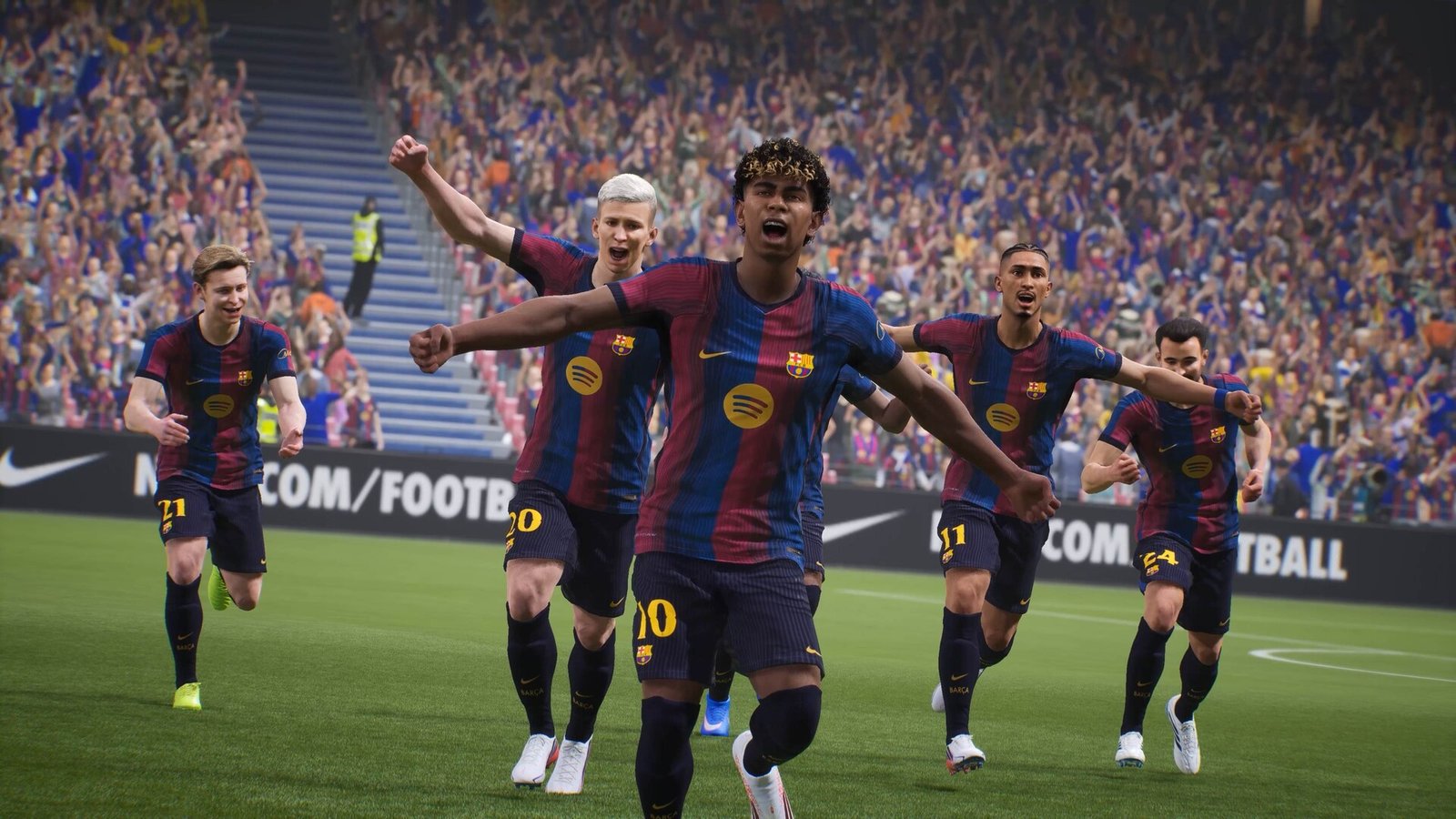
In 2021, Konami adopted eFootball in a transformation combining historical continuity with changes in systems, presentation, and distribution. Free-to-start access and ongoing updates altered the relationship with the previous annual commercial editions. Calling this merely a name change obscures genuine differences; denying its connection to PES obscures its history.
In Dream Team, squad creation and participation in activities follow specific recruitment, development, and event rules. This is not automatically equivalent to recreating a professional season. The mode organizes player choices within a distinct progression structure.
Update v6.0.0 on August 12, 2026, introduced movement adjustments, custom tournaments, and a formation that can change between attack and defense. The official version information shows how these options affect preparation and team organization. The v6.1.1 patch for iOS and Android, published October 15, 2026, illustrates ongoing fixes, not an entirely new installment.
Basketball: from the spectacle of NBA Jam to simulations
Midway’s NBA Jam (1993) turned basketball into an arcade spectacle. Reduced teams, speed, and exaggerated dunks made situations possible that did not aim to reproduce professional basketball in full. Driving to the basket could lead to an impossible leap by real-world standards, under rules designed for pace and immediate competition.
That did not eliminate skill: players still had to defend, time shots, and recognize opportunities. Stylization represented a different priority, not an inferior simulation. Other series would focus their evolution on more detailed representations of basketball actions and organization.
NBA Live and NBA 2K: the evolution of basketball simulations

Electronic Arts developed an important tradition with NBA Live, but the series experienced interruptions. NBA Live 19 (2018) remained the last available mainline installment at the editorial reference date. Its PS4 and Xbox One online services ended January 30, 2026, according to EA’s official service record. It was not a continuous annual series through 2026.
The first NBA 2K launched on Dreamcast in 1999, developed by Visual Concepts. Shooting, rebounding, blocking, passing, and defensive movement increasingly combined attributes, animations, and specific rules. Imagine receiving the ball at the three-point line, off balance and tightly guarded: shooting immediately may lower the quality of the opportunity. Passing to an open teammate may be better, but waiting too long risks losing possession.
NBA 2K27 launched September 4, 2026. 2K’s official announcement describes gameplay changes, The City, MyCAREER Eras, and the continuation of MyTEAM and MyNBA.
Madden NFL: American football and play strategy
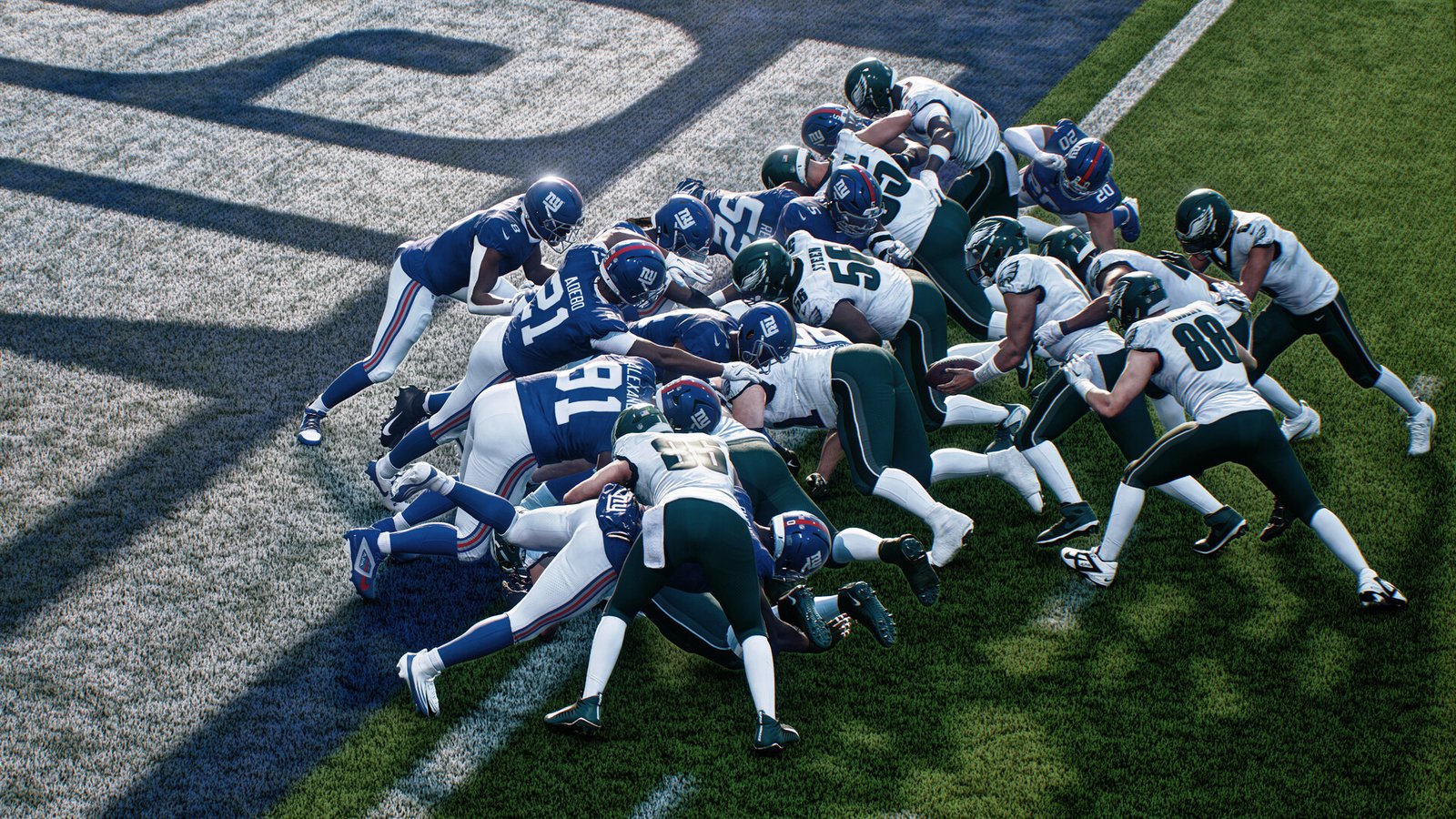
American football structures its contests around plays with specific roles. The offense seeks to advance downfield; downs are attempts to gain the required distance, normally ten yards in four attempts, depending on the situation and rules. Runs and passes provide ways to advance while the defense tries to stop them. This is different from association football, played mainly with the feet.
Electronic Arts’ John Madden Football (1988) began a tradition connecting play selection with execution. If only a few yards remain to renew the downs, a run may seem safe; a short pass might exploit a different opening. The defense tries to anticipate the choice. Selecting an appropriate play does not guarantee success when execution or reading the opponent fails.
Madden NFL 27 arrived August 13, 2026. EA’s official FAQ distinguishes Franchise, focused on the team’s journey; Superstar, centered on an athlete’s career; and Ultimate Team, built around squad creation. Coverage and short-yardage adjustments illustrate system changes, without turning this section into a complete manual for the sport.
Baseball, hockey, rugby, and other team sports
Baseball: MLB The Show represents pitching, batting, baserunning, and fielding. Facing the pitcher, observing the ball’s trajectory and speed helps determine whether and when to swing. Swinging too early or waiting too long can produce different outcomes; player attributes and game rules also matter. The core is not continuously carrying a ball toward a goal.
Ice hockey: EA’s NHL series combines skating, the puck, passing, checking, and shooting. Speed on ice and transitions between attacking and defending change positioning and control. Merely replacing a soccer field with a rink would not be enough: how athletes and the contested object move demands different responses.
Rugby, cricket, and volleyball widen the range. Rugby revolves around territorial advances, passing, and contact under its rules; cricket combines bowling, batting, and its own scoring system; volleyball uses serving, receiving, setting, attacking, and blocking across a net. Adaptations simplify these activities in different ways while retaining priorities that cannot be reduced to variations of soccer.
Tennis and golf: positioning and precision
Digital tennis evolved from simple representations into differentiated players, courts, and shots. NES Tennis was part of the home-console tradition; Virtua Tennis became associated with dynamic matches and an approachable arcade style, while Top Spin paid greater attention to technical details.
Imagine a ball sent to the left corner. Reaching it is only part of the task: player positioning and swing timing can change the return’s direction, power, and quality. Recovering the center of the court prepares the next response. Movement and shot selection create a sequence of decisions, not merely pressing a button when the ball arrives.
Mario Tennis retains the court, ball, and scoring, but can add characters and abilities that modify those relationships. A fictional interpretation does not eliminate its connection to tennis.
Golf: a precision sport in video games
Golf leaves room to plan direction, club selection, and power. When a sand trap lies between the ball and the hole, a powerful shot may clear it but overshoot the desired area. A more controlled stroke may reduce risk and require another shot later. Distance, terrain, wind, and slope contribute when the game represents these conditions.
Links and Tiger Woods PGA Tour contributed to this evolution alongside NES Golf. EA Sports PGA Tour and PGA Tour 2K explore contemporary adaptations; Everybody’s Golf, also known as Hot Shots Golf in some markets, and Mario Golf have stylized identities. Input meters and motions vary: precision does not mean demanding lightning-fast reflexes at every moment.
In 2026, PGA Tour 2K25 received new editions and seasonal content, according to 2K’s announcement. This was not a separate release called PGA Tour 2K26. Updating tournaments and selling a new edition of an existing product are different events.
Boxing, MMA, and wrestling in video games

Boxing, MMA, and wrestling each have distinct relationships between offense, defense, and presentation. Punch-Out!! turns pattern recognition and dodging into arcade boxing. Fight Night and Undisputed explore strikes, movement, and stamina through their own systems. In MMA, stand-up exchanges and ground fighting broaden the situations and rules that must be represented.
EA Sports UFC 6 arrived June 19, 2026, for PS5 and Xbox Series X|S, according to the official launch announcement. Movement, striking, and fighters’ individuality received attention. Flow State connects building momentum and advantages with the chosen athlete’s traits; EA’s official guide explains its effects and conditions. It is not a universal, identical power increase for every fighter.
WWE 2K adapts professional wrestling, a form of sports entertainment whose real-world performances and outcomes are planned. The game turns that identity into interactive confrontations. This nature should be distinguished from competitive boxing or MMA without assuming that the player merely watches choreography.
There is overlap with fighting games, but Street Fighter and Tekken organize combat around their own traditions of characters, moves, and rules. UFC starts from adapting a real sport. Sharing attacks and defenses does not make these experiences mechanically equivalent.
Skateboarding in video games: Tony Hawk and Skate

Neversoft and Activision’s Tony Hawk’s Pro Skater (1999) turned skateboarding into exploration, objectives, and points. A ramp begins a jump; landing may allow another trick to connect and extend a combo. Multipliers make the sequence valuable, but falling can erase the points for that attempt under the rules. Knowing when to stop is part of the skill.
Parks with rails, ramps, and obstacles offer different connections. Discovering a route enables longer sequences, so knowing the environment matters as much as the controls. Later entries expanded the systems; Underground (2003) gave more room to narrative and exploration. Exaggerated tricks belong to the arcade approach, without a promise to reproduce real skateboarding in full.
After THPS 1 + 2 (2020), THPS 3 + 4 arrived July 11, 2025, as a modern recreation developed by Iron Galaxy. Activision describes its parks, features, and two-minute sessions, including the THPS 4-inspired levels. The original fourth game used a different mission structure; the recreation does not reproduce every system exactly. The image belongs to the 2025 product.
Skate: a different approach to controlling a skateboard

EA Black Box’s Skate (2007) developed a distinct identity with Flickit. Performing an ollie through an analog-stick motion creates a different relationship with the controls than assigning it to a single button. Physics, stance, obstacles, and urban exploration shape the learning process.
The new skate., developed by Full Circle, entered free public Early Access on September 16, 2025. San Vansterdam offers exploration and shared activities, along with progression and updates. As of the October 22, 2026 editorial reference, it remains in Early Access and should not be presented as an already completed release.
Season 5 began September 8, 2026, adding areas and activities and adjusting progression and tricks. The preserved screenshot shows a mountainous area, not a city street.
Winter and water sports
Snow descents can prioritize speed, trajectory, balance, or tricks. Nintendo’s 1080° Snowboarding (1998) for Nintendo 64 explored control on snowboard courses. SSX (2000) emphasized exaggerated jumps and arcade spectacle: a descent could offer opportunities to score as well as to finish first.
Amped developed another snowboarding tradition; Steep offered activities in large mountain environments. Riders Republic (2021) combined sports and shared experiences built around speed and tricks. Open settings and their own physics do not automatically make a title a realistic simulator. A timed contest can resemble racing, whereas a score challenge changes the priority within the same sporting environment.
Surfing and other water sports
Kelly Slater’s Pro Surfer and Transworld Surf adapted balance, movement, and tricks on waves. Approaching a favorable section requires considering position and speed: acting too soon or too late may spoil a maneuver. The wave’s shape changes opportunities in games that simulate it, unlike a fixed track.
Wakeboarding and other water activities also support tricks, routes, or speed challenges. Objectives and the relationship with the environment help explain each design. Being on water does not make all such experiences boat racing or guarantee the same kind of simulation.
Wii Sports and Nintendo’s interpretations of sports

Nintendo’s Wii Sports (2006) brought tennis, baseball, bowling, golf, and boxing to the Wii. The Wii Remote connected physical gestures with virtual actions: swinging the controller to return a ball or making a bowling motion conveyed an understandable intention to people unaccustomed to complex button inputs.
The system interpreted movements through simplified rules. It did not reproduce every biomechanical aspect of tennis or bowling, and recognizing a gesture did not equal mastering the real sport. Familiar objectives and shared participation helped broaden the audience; its historical contribution lies in interaction and social experience as well as sports fidelity.
Wii Sports Resort and Nintendo Switch Sports
Wii Sports Resort (2009) expanded the selection of activities using Wii MotionPlus. More detailed tracking of controller orientation and motion enabled new ways to perform actions in activities such as swordplay and table tennis. This remained a digital adaptation, not a perfect simulation of the body or real-world conditions.
Nintendo Switch Sports (2022) continued the tradition with Joy-Con controls and an initial selection of tennis, bowling, volleyball, badminton, soccer, and chambara, with more activities added through updates.
Mario Sports: real sports with adapted rules
Mario Tennis, Mario Golf, and Mario Strikers use familiar sports as a foundation for characters, abilities, and altered rules. Mario Sports Mix brought together further activities. A special shot can change play without eliminating the court, goals, or scoring as fundamentals. Mario Strikers is arcade soccer with an identity different from professional simulation.
These franchises do not universally rely on motion controls. Mario Kart, meanwhile, emphasizes driving and racing within a tradition with its own systems. Our history of racing games discusses that distinction without denying that motorsport is also a sport in the real world.
Rocket League, Windjammers, and fictional sports
Rocket League (2015), originally developed by Psyonix, uses vehicles, a ball, and goals. Acceleration, boost, and jumps allow participants to contest the ball and coordinate attack and defense. Because the central goal is not completing laps on a track, the presence of cars alone does not make it traditional racing. It is a fictional sport with vehicle-based movement.
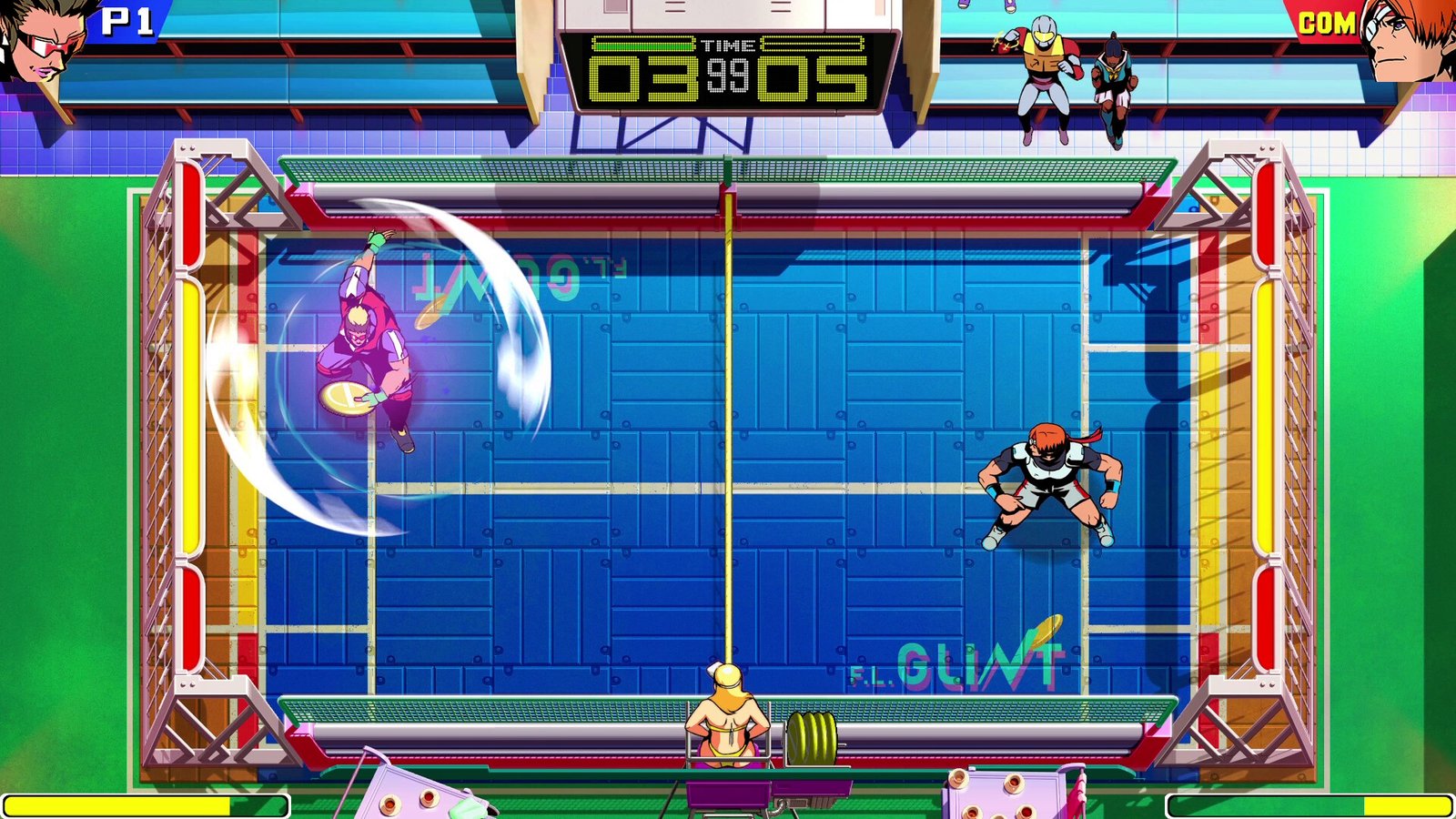
Windjammers (1994) introduced an arcade contest with flying discs: positioning, reacting, and reading trajectories help beat the defense and score. Windjammers 2 (2022), shown in the image, is the modern sequel, not the original. Its rules and field established a sport with a distinct identity.
Blood Bowl combines fantasy, physical sporting contact, and strategic systems inspired by American football.
How does a sports game match work?
An illustrative loop is choose a sport or team → understand the rules → prepare → execute → adapt → evaluate the result. It is not universal: soccer involves goals, skateboarding may score combos, and golf tracks strokes until the course is completed. Understanding what creates success is just as important as knowing the buttons.
During preparation, participants may choose an athlete, team, formation, or conditions. During play, each outcome changes the next decision: losing possession changes a team’s role; missing a golf shot may require another trajectory; falling during a trick may end the scoring sequence. Victory, defeat, or qualification may conclude a single match or affect a wider calendar.
Controls: how video games represent sporting movements
Controls translate complex actions into buttons, analog sticks, gestures, sensors, or context-sensitive inputs. A pass may require direction and power, but the result also depends on distance, the player’s position, and a teammate’s movement. Pressing a button expresses an intention interpreted by the system according to the situation.
In basketball, shot timing may combine with defensive pressure and attributes; in golf, direction and club selection come before a meter or analog motion. An action with the same name need not have identical controls across franchises. Sensors, touchscreens, and conventional gamepads each require different solutions.
More buttons do not guarantee realism or precision. A simple interface can express important decisions well, while too many commands can make intentions hard to communicate. Quality depends on the relationship between chosen action, response, and rules. Learning the controls means understanding what they allow, when, and with what consequences.
Physics, animation, and athlete behavior
Physics calculates behavior such as trajectory, speed, and collisions under defined rules. Animation visually depicts movement, which can be preauthored, motion-captured, or combined through systems. A game may mix these methods; convincing visuals do not imply that every part of the body is simulated independently.
Imagine sending a pass before a defender closes the lane. An overly long animation may delay the response and lose the opportunity; an instantaneous action may erase the impression of weight, balance, and continuity. Balancing input responsiveness and movement representation is a design decision. Not every trajectory is physically realistic, and visual realism does not guarantee accurate gameplay.
Artificial intelligence in sports games
When a player controls only one athlete, AI directs teammates and opponents. A teammate seeks space to receive a pass, a defender marks a threat, and players carry out their formation roles. Positioning rules, action selection, and situation evaluation underpin this behavior; it does not require human-like reasoning or continuous learning from every user.
Increasing difficulty may change reaction speed, accuracy, or advantages without creating a more sophisticated AI. The goal is to produce coherent situations: teammates who never offer passing options undermine team play, while an arbitrary defense makes learning difficult.
Strategy, tactics, and in-match decisions
Strategy concerns a broader plan; tactics concern specific decisions used to execute it. In soccer, pushing fullbacks forward can create attacking options while opening space behind the defense. The scoreline and opponent’s behavior help determine whether the risk is worthwhile.
In basketball, movement and screens may free a shooter; in American football, choosing the play comes before running it. No formation works equally well for every situation or sport. Even a strong plan needs good inputs, and mastering controls does not replace understanding an opponent. Skill emerges from reading, choosing, and executing.
Seasons, championships, and career modes
A quick match may end with the final whistle; a season links results to a schedule, standings, and objectives. Losing one match does not necessarily end the competition, but may alter priorities. Lineups and squad development become long-term decisions.
A player career follows an individual character, skills, and goals. A manager career may combine formations, signings, and direct match control, depending on the game. Sports management can focus the entire interaction on training, finances, squads, and planning. Mode names do not guarantee the same degree of management or hands-on participation between franchises.
Football Manager and sports management games
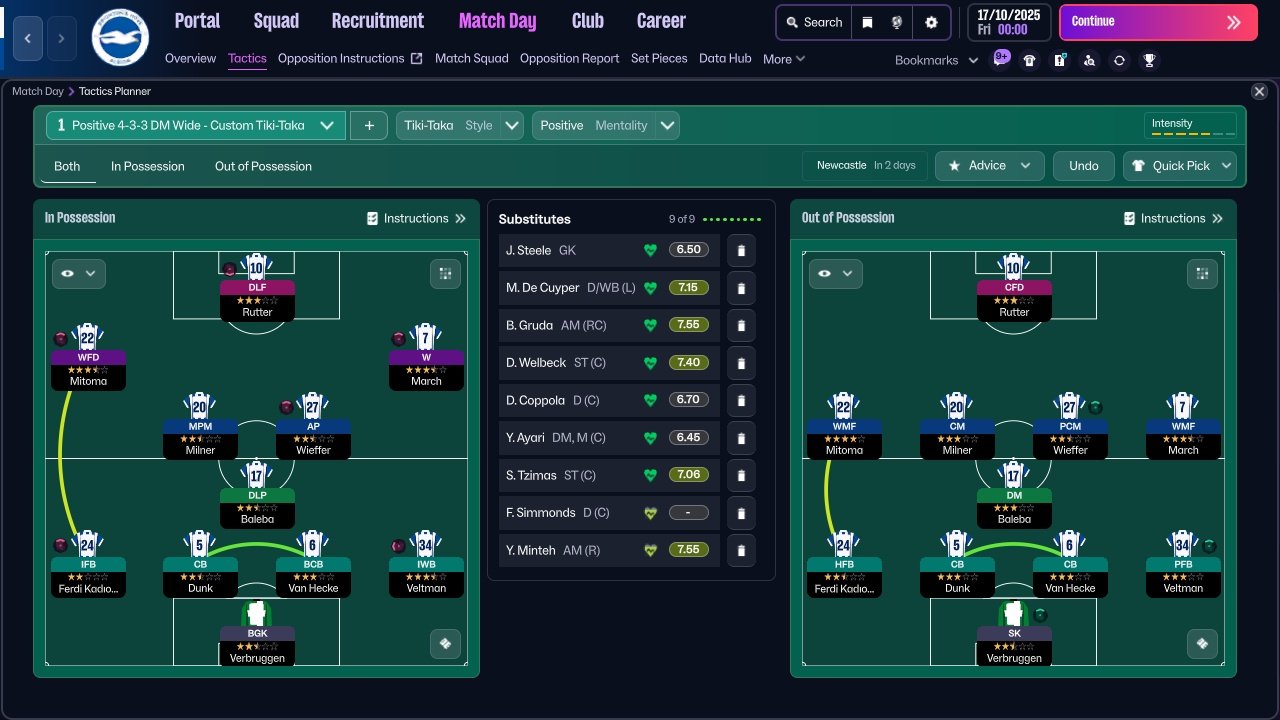
Sports Interactive’s Football Manager puts administration at the center. Training, scouting, transfers, squads, finances, and tactics shape player intervention. Directly controlling every pass is unnecessary: matches show the consequences of decisions within a simulated system.
Imagine a club in need of reinforcements with a limited budget. Signing a veteran may provide an immediate answer but tie up funds; investing in cheaper players and development may require time and a different structure. Choosing training, monitoring results, and revising the plan connects finances with performance rather than turning management into an isolated shopping list.
Football Manager 26 arrived from November 4, 2025, across its main editions; Touch on Switch followed December 4, 2025. SEGA explains the differences: the switch to Unity and the new presentation did not apply in the same way to Mobile, which retained another foundation. PC/Mac, Console, Touch, and Mobile do not have completely equivalent interfaces or features.
FM26 also integrated women’s soccer into the series’ core ecosystem. This article’s screenshot shows Football Manager 26 Touch with in-possession and out-of-possession formations, not the standard PC interface.
Licensing, releases, and squad creation
Licenses may cover athletes, clubs, leagues, crests, kits, stadiums, and brands under different agreements. Authorization for one competition does not guarantee all other rights. That distinction helps explain why EA could stop using the FIFA name while retaining other agreements, or why some PES editions used adapted names and elements.
Official representation boosts familiarity among fans who recognize teams and competitions, but does not determine the quality of controls, physics, or AI. Fictional elements can also reflect a creative choice. Commercial authenticity and match quality are related dimensions, not automatically equivalent ones.
Annual releases and seasonal updates
Squads, kits, and competitions change with real-world schedules. Franchises such as FC, NBA 2K, and Madden release periodic editions that may update those elements and change modes or technology. Not every installment is identical, and not every novelty fundamentally transforms the experience: the actual content determines the difference.
eFootball and skate. illustrate ongoing updates to an existing product. Seasons can introduce activities and progression under specific access conditions. Live service, free version, annual edition, and Early Access describe different aspects; none guarantees all content or rules out another release in the future.
Ultimate Team, MyTEAM, and player cards
Football Ultimate Team and MyTEAM represent athletes as digital items used to assemble squads. Position and attribute choices change the available options during matches, according to each mode’s relationships and restrictions. Acquisition, development, rewards, and competitions follow their own rules; the two systems are not identical copies.
Packs may be acquired through rewards or purchases, depending on the title, using virtual currency and sometimes real money. Probabilities, content, and progression impact are not universal. Buying packs is not a requirement of all sports games. Likewise, having cards does not turn FC into a card game: the central contest is still the soccer match, whereas card games organize their encounters around cards and their rules.
Local multiplayer, online play, and sports games on mobile
From duels in Pong to console matches and Wii Sports gestures, competing in the same space has been part of the genre’s history. Familiar goals, such as scoring a goal or basket, help people get started but do not mean the systems are immediately mastered. Friends can compete, cooperate, or control athletes on the same team when a mode allows it.
Local multiplayer depends on the game, platform, controllers, and format. It cannot be assumed just because online matches are available. That distinction especially matters for people seeking a shared social experience in the same room rather than distant opponents.
Online multiplayer, ranked play, and sporting esports
Online play allows remote opponents, team organization, and ranked competition. Matchmaking may consider region, mode, or skill level without guaranteeing perfect balance. Latency affects input timing in precision contests even when the underlying plan is sound.
Crossplay means playing between compatible platforms; shared progression means retaining certain data across systems. One does not guarantee the other. Support, accounts, modes, and servers must be checked for each product rather than carrying promises from one edition across an entire series.
Organized competitions are part of the history of FC, eFootball, NBA 2K, and Rocket League. That does not guarantee an active professional circuit for every franchise at every point in time. Ranked matches, community tournaments, and professional leagues should be distinguished without inventing 2026 results or prizes. Reliance on services also matters: commercial availability and online maintenance are not the same thing.
Sports games on mobile
EA Sports FC Mobile, eFootball Mobile, NBA 2K Mobile, and Golf Clash adapt sports objectives to touchscreens. Virtual buttons, gestures, and assists change execution compared with analog sticks and physical buttons. A similar-looking interface does not guarantee equivalent modes or features on consoles.
Some experiences offer short matches, others elaborate squad and progression systems. Monetization and connectivity also vary. A mobile edition should be understood through its own rules rather than presented as a full reproduction of another version because it shares a name or sport.
The representation of women’s sports
Female athletes were present before 2025: tennis games and other sports had represented them much earlier. Progress involves expanding teams, competitions, licenses, and visibility within modes, in different ways across franchises. No single milestone summarizes that entire history.
FIFA 16 added women’s national teams, and EA Sports FC expanded licensed content over subsequent editions. NBA 2K developed its WNBA representation, without every mode necessarily being equivalent. FM26 marked women’s soccer’s first integration into Football Manager’s core ecosystem, as explained by Sports Interactive. Those are milestones for specific series, not the creation of women’s representation in sports video games.
Accessibility and learning sports
Tutorials and training modes teach actions; difficulty settings change the challenge; assists may simplify passing and shooting. Accessibility also concerns barriers to interaction and perception, with features such as remapping and visual options when available. These features differ by game.
An assist can make a pass easier to execute while the player still chooses the recipient, timing, and risk. Learning concepts through games can help recognize rules and situations within the medium’s simplifications. Motion controls, meanwhile, are a type of interaction: they do not recreate every physical demand of a sport and should not be treated as a universal substitute for real sporting practice.
Sports games, fighting games, racing, and simulators: what are the differences?
This table compares priorities without making the categories mutually exclusive. Racing, fighting, management, and social experiences developed separate traditions despite sharing competition and planning.
| Category | Main characteristic | Examples |
|---|---|---|
| Sports Games | Representing or adapting sporting activities | EA Sports FC, NBA 2K |
| Racing Games | Competing in races and driving challenges | Gran Turismo, Forza Motorsport |
| Fighting Games | Confrontations based on fighting systems | Street Fighter, Tekken |
| Simulation Games | Representing activities and interactive systems | Microsoft Flight Simulator, The Sims |
| Strategy | Planning and decisions in strategic systems | Civilization, StarCraft |
| Party Games | Accessible activities for social sessions | Mario Party, various casual multiplayer games |
Gran Turismo emphasizes driving and racing; UFC adapts a combat sport; Street Fighter follows its own fighting systems; Football Manager manages teams. Rocket League uses vehicles for a fictional sport, while not every simulator represents a sport. Our features on racing, simulators, and fighting games explore these differences.
Wii Sports can offer sporting and social participation without every multiplayer game being a party game. Football Manager requires planning but does not have the same context as Civilization or XCOM. Esports is a form of organized competition, not an additional gameplay genre.
The games that shaped the history of sports games
This selection gathers milestones and different interpretations, not a ranking or a list of every edition. Original dates, regional launches, recreations, and Early Access should be read as distinct events.
| Game or franchise | Year | Contribution or characteristic |
|---|---|---|
| Tennis for Two | 1958 | Electronic tennis experiment |
| Pong | 1972 | Commercial popularization of a simplified sports contest |
| International Soccer | 1983 | Development of soccer on home computers |
| Track & Field | 1983 | Arcade adaptation of track-and-field events |
| Punch-Out!! | 1984 | Arcade interpretation of boxing |
| Tecmo Bowl | 1987 | Popularization of digital American football |
| John Madden Football | 1988 | Beginning of a major American football tradition |
| Kick Off | 1989 | Advances in soccer controls and movement |
| Sensible Soccer | 1992 | Accessible soccer with a wide field view |
| FIFA International Soccer | 1993 | Establishment of a major soccer franchise |
| NBA Jam | 1993 | Popularization of arcade basketball |
| International Superstar Soccer / Jikkyō World Soccer: Perfect Eleven | 1994, Japan; 1995, Western release | Expansion of Konami’s soccer tradition |
| Windjammers | 1994 | Fictional arcade sports competition |
| 1080° Snowboarding | 1998 | Snowboarding adaptation for Nintendo 64 |
| Tony Hawk’s Pro Skater | 1999 | Popularization of score- and combo-based skateboarding |
| NBA 2K | 1999 | Beginning of a major basketball franchise |
| Pro Evolution Soccer | 2001 | Establishment of Konami’s soccer brand |
| Wii Sports | 2006 | Popularization of motion-controlled sports |
| Skate | 2007 | New approach to skateboard control and tricks |
| Wii Sports Resort | 2009 | Expansion of motion-based sporting experiences |
| Rocket League | 2015 | Fictional vehicle-based sports competition |
| eFootball | 2021 | Rebranding and business-model shift in the PES tradition |
| Nintendo Switch Sports | 2022 | Modern continuation of the Wii Sports tradition |
| EA Sports FC 24 | 2023 | Electronic Arts soccer’s new commercial identity |
| Tony Hawk’s Pro Skater 3 + 4 | 2025 | Modern recreation of classic games |
| Football Manager 26 | 2025 | Integration of women’s soccer into the franchise’s management ecosystem |
| skate. — Early Access | 2025 | Free return in Early Access, with exploration and ongoing updates |
| EA Sports UFC 6 | 2026 | Contemporary evolution of digital MMA adaptations |
| Madden NFL 27 | 2026 | Continuation of American football simulations |
| NBA 2K27 | 2026 | Contemporary evolution of digital basketball |
| EA Sports FC 27 | 2026 | Continuation of Electronic Arts’ soccer franchise |
Challenges and limitations of sports games
The challenge is balancing input responsiveness, consistent rules, and representation of athletes. Visually convincing motions can harm play if the action does not respond understandably. Continuity also matters: licenses, modes, and services can change, with different consequences for solo players and those who depend on online features.
Who are sports games for?
Players who prefer quick decisions may enjoy direct matches; those interested in learning a sport can explore more detailed systems; those who prefer administration can follow seasons without controlling every movement. Combos, gestures, management, and fictional competition suit different interests. Solo, local, and online games have their own depth and demands.
Sports games turn competitions into different ways to play
A late goal, a successfully completed trick sequence, and a squad that improves after months of decisions offer different kinds of satisfaction. Sports games turn technique, movement, and planning into forms of participation. Their diversity comes precisely from allowing competition to be interpreted from several perspectives, through rules that players learn, use, and put to the test.
About the Author