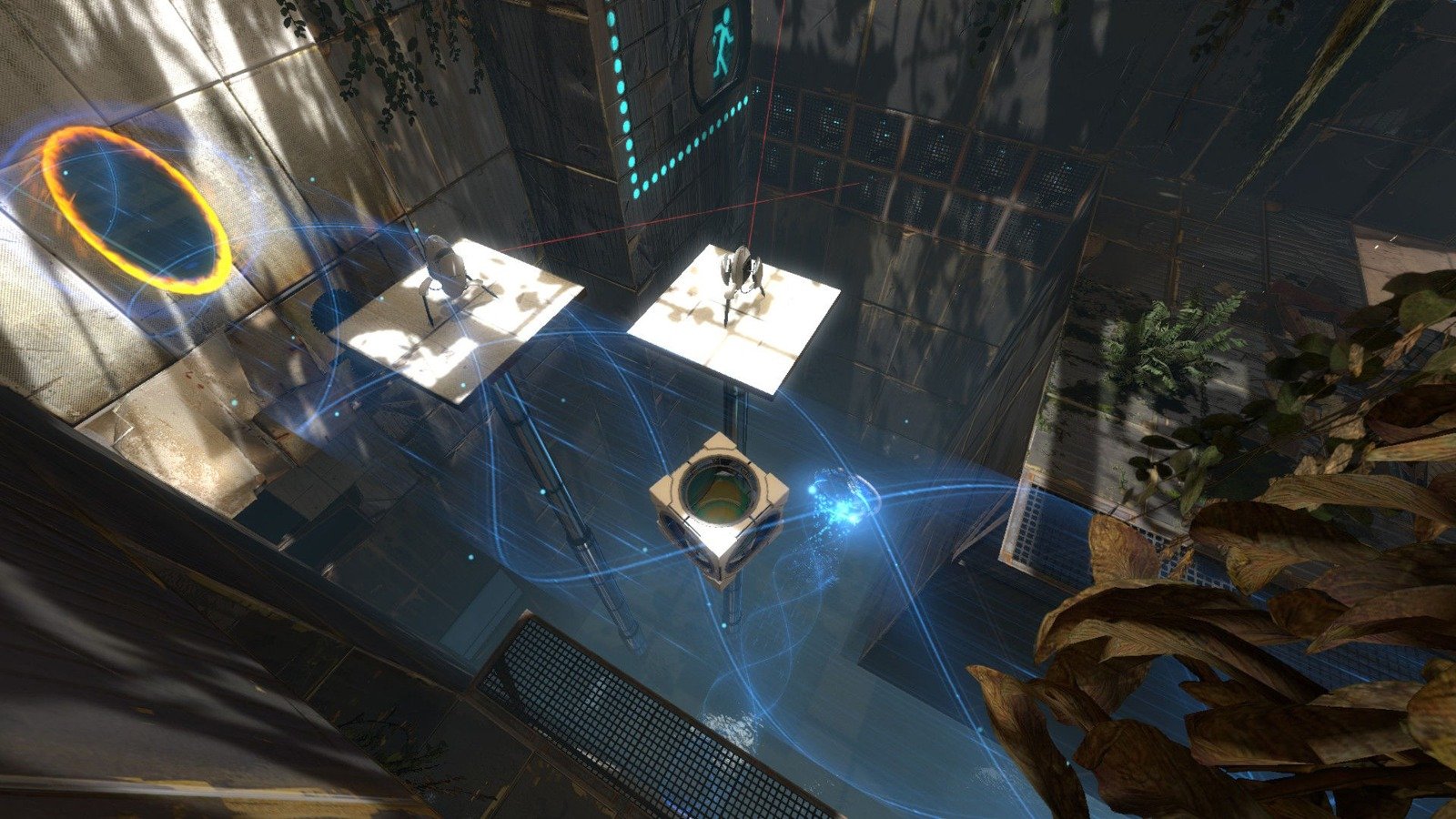
Portal 2 (2011): cubo, portal e mecanismos espaciais em uma sala de testes da Aperture Science. Captura oficial: Valve.
Nesta matéria
Imagine entering a room with a locked door and a button that must remain pressed. There is a cube on the other side, but a pit prevents you from carrying it directly to the button. You have a tool that can create passages between compatible surfaces. The solution depends on understanding its rules and finding a way to move the object to its destination.
When it works, the satisfaction comes from understanding a situation that once seemed impossible. That discovery connects experiences as different as arranging pieces in Tetris, interpreting mechanisms in Myst, and changing the rules in Baba Is You. Puzzle games have developed their own ways of combining observation, planning, and execution. This feature explores their origins, mechanics, and historical contributions, from boxes and falling blocks to investigation, language, and programming.
Updated October 22, 2026.
What defines a puzzle game?
Puzzle is a genre classification in which understanding rules and solving problems take center stage. A challenge may involve logic, patterns, space, physics, observation, language, timing, or interactive systems. Geometric pieces, numbers, an absence of enemies, a story, or explicit clues are not universal requirements. There are solo, cooperative, competitive, and action-oriented experiences.
Numbers are only one possibility. Sokoban deals with positions; Return of the Obra Dinn with evidence; The Room with mechanisms. Even in Sudoku, deducing where symbols belong matters more than performing arithmetic. Professional mathematical knowledge does not define the genre.
Does every puzzle have only one solution?
Some challenges have a specific answer or sequence; others allow different paths that satisfy the same conditions. Building a mechanism may permit several working solutions, and competitive matches do not necessarily follow predetermined decisions. The possibilities depend on each game’s rules.
Does including riddles make any game a puzzle game?
Puzzle can be the primary genre or a mechanic within a different experience. Resident Evil remains associated with survival horror even though it includes puzzles; The Legend of Zelda combines spatial problems with adventure. In Tetris, arranging pieces is central; in Portal, solving test chambers drives progression. Classifications can overlap without a single riddle determining the identity of an entire game.
Puzzles existed long before video games
Mazes, mathematical problems, board and tile games, and mechanical and logical challenges predate computers. The Rubik’s Cube, invented in the 1970s and popularized worldwide in the following decade, shows how complex a limited set of moves can become, but it did not originate every digital puzzle. Digital technology added systems that check actions, change environments, and automatically produce consequences.
This allowed older traditions to blend with real-time play, interactive spaces, and new kinds of problems, without one absolute inventor of the entire genre.
The first digital puzzles and the importance of Sokoban
In the late 1970s and early 1980s, computers and other platforms hosted abstract challenges involving organization and movement. No single game is universally recognized as the first digital puzzle. One major milestone in this diversity came from Japan.
Sokoban: pushing boxes can be complicated

Created by Hiroyuki Imabayashi and commercially released by Thinking Rabbit in 1982, Sokoban presents a simple idea. The series’ official history records versions for PC-8801, FM-7, and PC-8001mk2 in December 1982. Players control a character inside a warehouse-like space. Boxes must be placed on designated squares. The character can push them, but under the classic rules cannot simply pull them back.
Why does that limitation matter so much?
Imagine pushing a box into a dead-end corner. There might be no room to stand behind it and move it again. Even if the goal looks close, that choice may make the level impossible to finish. Players therefore need to consider the consequences of their moves before acting. The challenge is not executing a difficult command; it is understanding how positions, walls, and objects restrict future options.
Move order matters: even a box placed on its goal can block another box’s path. This relationship between positions and future possibilities made Sokoban a landmark of spatial puzzles, although not every space-organizing game is directly descended from it.
Tetris: turning the arrangement of pieces into a worldwide challenge
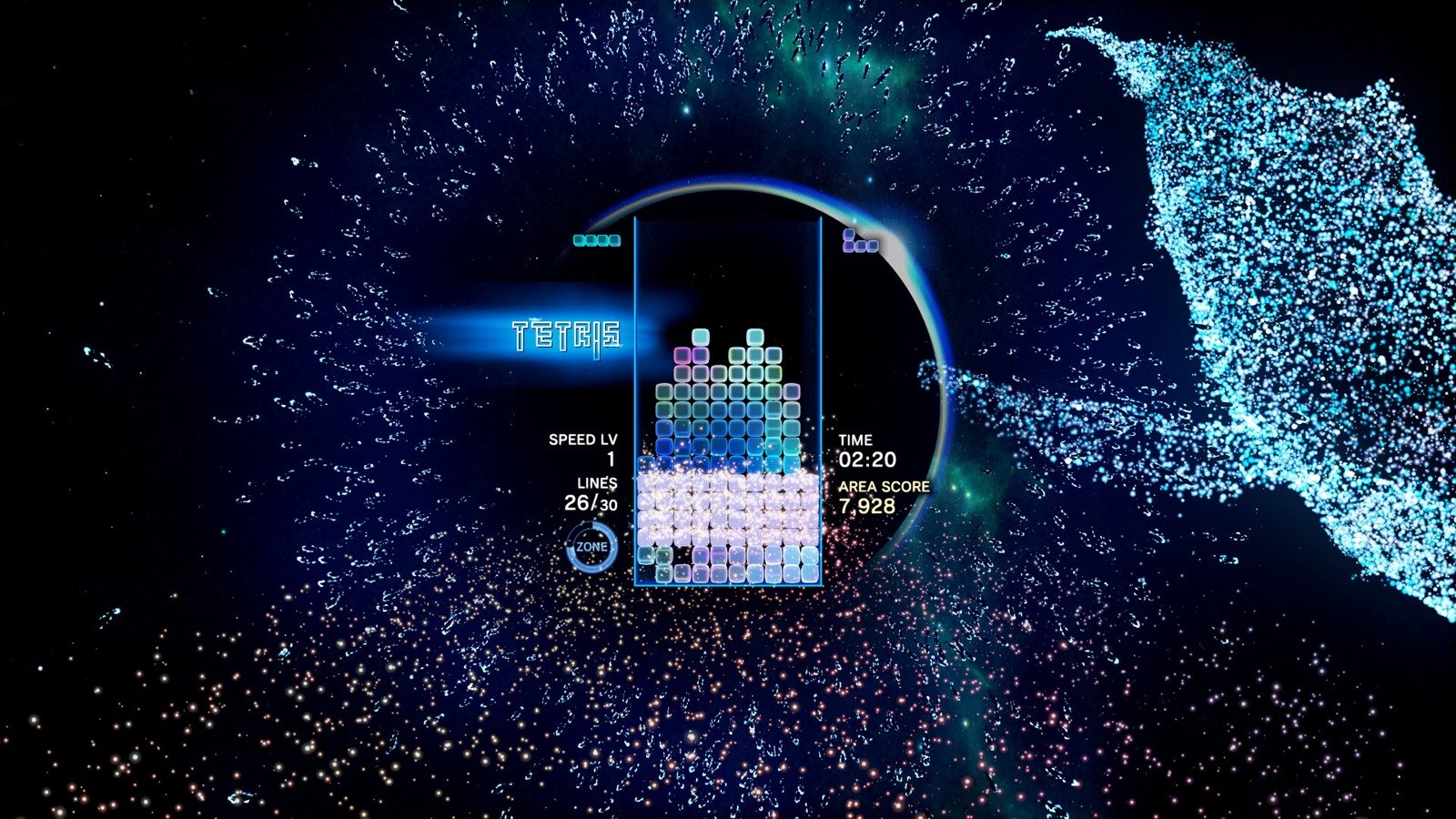
In 1984, programmer Alexey Pajitnov created Tetris in Moscow, then part of the Soviet Union. Its first version was developed for the Electronika 60 computer, according to the official history of Tetris. The central idea was to arrange geometric pieces within a limited area. These pieces, known as tetrominoes, consist of four squares. Players can position and rotate them according to the version’s rules.
When a horizontal line is completely filled, it disappears and frees up space.
How do simple rules produce complex challenges?
Imagine a long piece falling. You can fit it into a gap to complete a line, or use it to prepare a future combination. The choice depends on the arrangement already on the board and what you hope to achieve next. Because new pieces keep arriving, players must organize the available space while the challenge continues. A bad placement can create holes that are difficult to fill. As the speed increases, decisions may also need to become faster.
Tetris combines spatial organization and planning with real-time execution. It is not simply a reflex test, although speed matters in many versions.
Tetris popularized an influential formula of falling pieces and cleared lines, but other digital puzzles already existed. Its structure also differs from matching three identical pieces, a mechanic associated with match-3 games.
How did Tetris reach the world?
Its circulation on computers was followed by ports and international licensing negotiations. Henk Rogers participated in the agreement that brought Tetris to Game Boy in 1989; the game was bundled with the handheld in several markets. Short sessions on a portable device helped it reach a much larger audience.
Tetris Effect, Tetris 99, and Tetris Forever
Tetris Effect (2018), developed by Monstars and Resonair and published by Enhance, integrated music and visual effects into arranging blocks. Connected (2020) expanded the concept with multiplayer, debuting on Xbox and PC through the Microsoft Store; the official retrospective distinguishes later releases. Tetris 99 (2019), by Arika and Nintendo, features online competition among 99 players with its own attack mechanics.
Tetris Forever (2024), by Digital Eclipse, is a documentary collection featuring historical games and Tetris Time Warp, as explained in the official presentation. These reinterpretations do not retroactively give the 1984 original modern multiplayer features; scoring and rotation systems also vary between editions.
Match-3: what does matching three pieces mean?
Match-3 games involve forming combinations of three or more matching elements according to their rules. Swapping a piece may complete a line, remove it, and cause others to fall, creating more combinations. Colors, symbols, and shapes help identify relationships; the way pieces move depends on the game.
Shariki, Bejeweled, and Candy Crush
An important precursor to the modern formula is Shariki, developed by Eugene Alemzhin in 1994 for computers. Players swapped adjacent pieces to form lines of three or more matching elements. This structure later influenced the match-3 tradition.
Bejeweled, by PopCap Games, popularized accessible piece matching on computers: the commercial Windows edition dates to 2001, while its browser history began earlier as Diamond Mine in 2000. An official Bejeweled 3 strategy guide by Jason Kapalka recalls that origin.
Candy Crush Saga, by King, further spread the format on mobile devices and other digital platforms. It debuted on Facebook on April 12, 2012, according to the company announcement; mobile versions arrived later that year. Its progression uses levels, objectives, and conditions that vary by challenge.
Do all match-3 games use the same system?
Swapping neighboring pieces, selecting groups, obstacles, and move limits produce different challenges. The objective may be to clear specific areas or meet conditions instead of merely scoring points. Not every game with colorful blocks is match-3: Tetris clears lines, while Puyo Puyo uses its own grouping rules.
Puyo Puyo and competitive puzzles

Puyo Puyo began in 1991, developed by Compile, with an original version for MSX2 computers and Famicom Disk System. In 1992, a new arcade version helped establish the competitive formula for which the franchise became known. A SEGA retrospective distinguishes the 1991 debut from the 1992 arcade release. Players arrange colorful creatures called Puyos.
Under the classic rules, four or more connected Puyos of the same color disappear, as SEGA explains. Remaining pieces can then fall and produce new combinations.
Chain reactions
Imagine arranging several colors in layers. One match removes some pieces, allowing others to fall and form new groups. If that process continues, a chain reaction occurs. Players can prepare such situations in advance. In competitive matches, successful chains may send obstacles or penalties to an opponent’s board, depending on the edition. This creates a contest combining spatial organization, planning, and quick execution.
Puyo Puyo Tetris
Puyo Puyo Tetris debuted in Japan in 2014, followed by other releases and Puyo Puyo Tetris 2 (2020). It combines boards with different rules: horizontal lines in Tetris, groups and chains in Puyo Puyo. The competitive tradition also includes Dr. Mario and Puzzle Bobble (1994), known in some markets as Bust-a-Move.
Lemmings and The Incredible Machine: solving problems through systems
Moving characters and machines made of objects introduced different approaches to problem-solving in the 1990s.
Lemmings: guiding characters through the environment
Lemmings (1991), developed by DMA Design and originally published for Amiga by Psygnosis, is revisited by developer Mike Dailly in his retrospective. Characters move through the level while players assign abilities to build paths, dig, or block areas rather than controlling every step as in a traditional platformer.
Planning under pressure
Imagine a group walking toward a cliff. You have limited resources to change its path. Use an ability at the wrong moment, and you may fail to save enough characters. The challenge involves observing the environment, understanding the available tools, and deciding when to use them. Lemmings combines spatial reasoning with real-time execution, but that does not automatically make it a traditional RTS.
Its primary goal is solving traversal problems, not the conventional strategic management of armies and resources.
The Incredible Machine: cause-and-effect mechanisms
Released in 1993, The Incredible Machine took a different approach. Players arrange objects and mechanisms to achieve a specified outcome. Its structure resembles a Rube Goldberg machine, where a simple task is performed through an elaborate chain of events. Imagine needing to activate a switch: a ball might roll down a ramp, strike another object, and set off a reaction.
Players arrange the available parts and observe what happens. The appeal lies in understanding cause and effect.
Gravity, collisions, and movement follow programmed rules, rather than constituting a perfect scientific simulation. Consistent interactions let players plan, test, and understand the result. This tradition also appears in later games such as World of Goo and construction puzzles.
Myst: exploring a world to understand its puzzles

Released by Cyan in September 1993, Myst integrated puzzles into explorable environments. Mechanisms, documents, and environmental details must be interpreted together instead of appearing as a list of independent problems.
How does the environment become part of the puzzle?
Imagine entering a room filled with unfamiliar equipment. Symbols, records, or objects might provide clues about how it works. Players must observe the environment and find connections. A clue discovered in one location may help explain a mechanism found earlier. Exploration becomes part of the reasoning process. Progress may depend less on executing commands quickly and more on interpreting information.
The world also tells a story: environments and documents reveal events while giving context to mechanisms. Myst popularized this integration of detailed exploration and puzzle-solving, without being the first adventure to feature puzzles.
Riven and modern remakes
Riven (1997) deepened the relationship among mechanisms, environment, and fictional culture. Understanding the world’s context helps interpret its challenges. Cyan’s modern recreation of Myst debuted on Oculus Quest in 2020 and PC in 2021. The Riven remake arrived on June 25, 2024. These are recreations in 3D environments, distinct from the original releases of the 1990s; modern screenshots must not be presented as images from those debuts.
Point-and-click and Professor Layton: puzzles within stories
Point-and-click describes an interaction method based on pointing and selecting, often associated with graphic adventures. Monkey Island, Day of the Tentacle, and Broken Sword combine objects and puzzles with characters, narrative, and exploration. The interface does not make every adventure a puzzle game or require puzzles to be its sole priority.
Professor Layton and the Curious Village
In 2007, Level-5 released Professor Layton and the Curious Village for Nintendo DS in Japan. The game follows Professor Hershel Layton and his apprentice Luke during an investigation. Progression blends characters, storytelling, and different kinds of puzzles. Some challenges require logic; others rely on observation, spatial organization, mathematics, or interpreting information. Variety is a major part of the experience.
The investigation, dialogue, and characters provide context for the problems. Nintendo DS also allows touch-screen interactions. Its identity is that of a puzzle adventure combining logic, observation, mathematics, and spatial organization—not simply a collection of Sudoku grids.
Professor Layton and the New World of Steam
By October 2026, Professor Layton and the New World of Steam had an announced release date but was not yet in stores. The official Level-5 website gave December 10, 2026, as the planned date for Nintendo Switch, Nintendo Switch 2, PlayStation 5, and PC via Steam. That was the announced schedule as of the editorial date. The new game presents another Layton-and-Luke adventure with puzzles integrated into the narrative.
It should therefore be described as a confirmed future release, not a game already available in October.
Portal: understanding space in another way
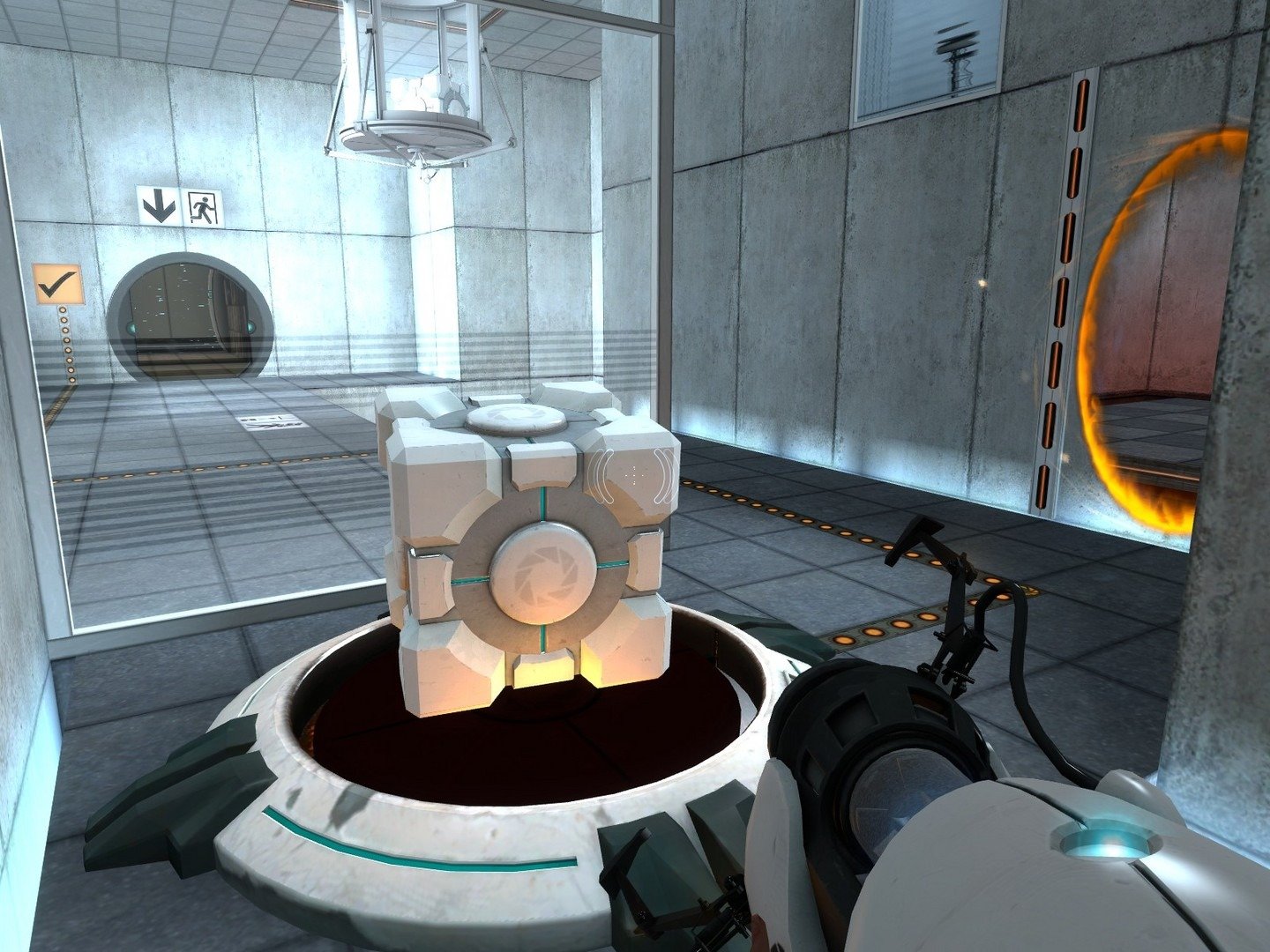
Valve released Portal on October 10, 2007. It takes place in test chambers at the fictional Aperture Science facility. Players use a device that creates portals on certain surfaces. Those portals connect two points in space: passing through one brings the character out of the other, according to the system’s rules.
What makes portals into puzzles?
Imagine needing to place a cube on a button in an area without direct access. Creating portals on compatible surfaces changes the object’s route, but height, momentum, and position still matter. In other chambers, momentum gained from a fall makes it possible to reach another area after passing through a portal. The tool changes spatial relationships under specific rules; it does not work on every surface.
Cubes, buttons, and gradual introduction
Cubes, buttons, and platforms appear gradually. Learning an interaction in a simple situation prepares players to combine it with others later; progression teaches the tools before requiring more elaborate uses.
Portal 2 and its new systems
Portal 2 (2011) expanded the mechanics, narrative, and interactions. Gels change movement conditions, while beams and devices create new connections between energy and objects. Valve’s store page distinguishes the single-player campaign from the cooperative one. In the Atlas and P-Body campaign, two people coordinate portals, tools, and positions. One may need to hold a passage open while the other reaches a mechanism.
These systems and two-player structure go beyond simply adding chambers to the first game.
The first-person camera and gun-like device alone do not define the genre. Portal‘s tool connects spaces to solve problems; defeating enemies through shooting is not its main goal. Its identity is a spatial puzzle game with movement and narrative.
First-person puzzles and challenges of perspective
Other experiences explore three-dimensional problems under different rules. Q.U.B.E. uses blocks and mechanisms; Antichamber (2013) challenges assumptions about spatial layout; Superliminal (2019) makes perceived size and distance part of the solution. Viewfinder (2023) turns images into environmental elements. A shared viewpoint does not mean identical mechanics or automatic classification as an FPS.
The Talos Principle and philosophical puzzles
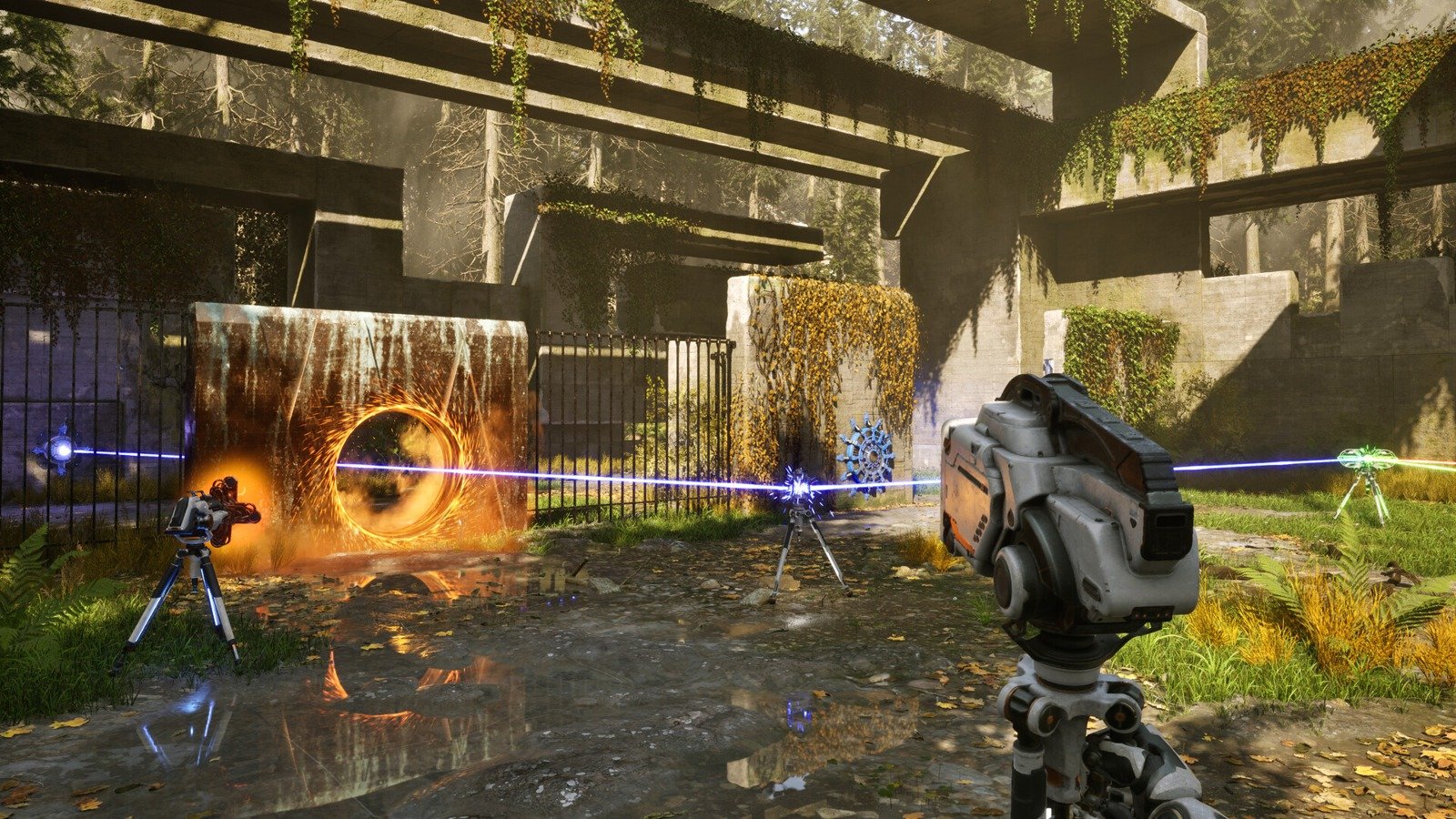
The Talos Principle (2014), by Croteam, combines tools, barriers, security systems, and energy connections. Learning to position devices and connect beams helps solve environments; exploration and reflections on consciousness, identity, and existence provide narrative context. The Talos Principle 2 (November 2, 2023) expanded both the systems and the story.
Reawakened (April 10, 2025) recreated the first game in Unreal Engine 5, including Road to Gehenna, In the Beginning, and a puzzle editor, according to Croteam. The original, sequel, and recreation are separate milestones.
The Witness: learning rules through observation
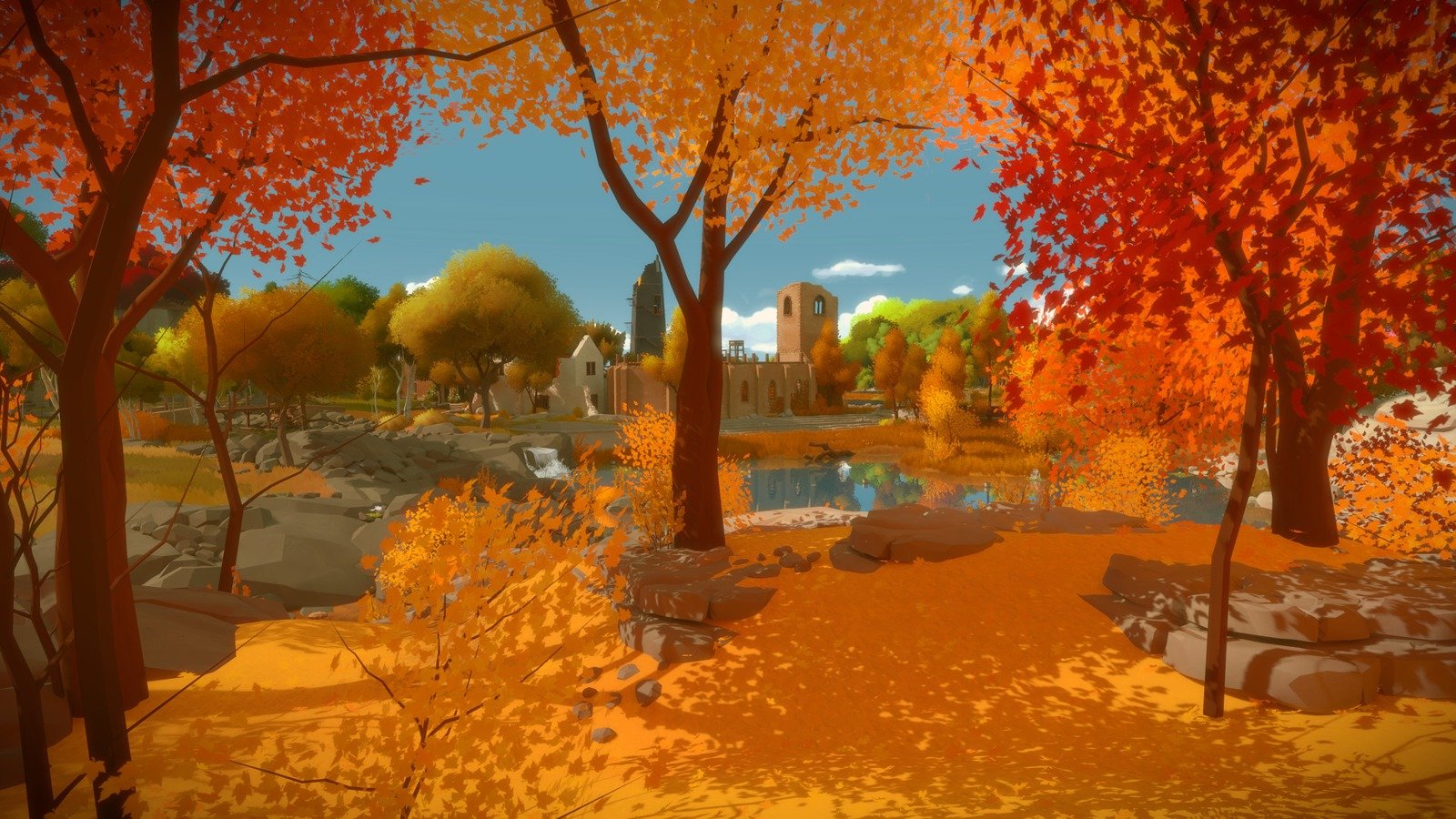
On January 26, 2016, Thekla, Inc. released The Witness, directed by Jonathan Blow. Its official Steam page confirms the release and its focus on exploration and discovery. Players explore an island full of panels and other elements involved in the puzzles. Many panels require drawing lines under particular conditions, but the rules are not always explained directly.
Discovering the rule is part of the game
Imagine finding a panel covered in unfamiliar symbols. At first, you have no idea what they mean. Exploring the area reveals another, simpler challenge that looks similar. After experimenting and observing the differences, you begin to understand a possible rule. Later, another situation asks you to apply that knowledge differently. This process is central to The Witness: players do not merely solve problems with familiar rules.
Sometimes they must discover the rules themselves.
Different regions of the island introduce patterns and examples for comparison. Environments can teach without relying entirely on written instructions, but lacking a tutorial does not automatically make for good design: challenges must communicate their conditions and offer opportunities to learn.
Baba Is You: when rules become pieces of the level
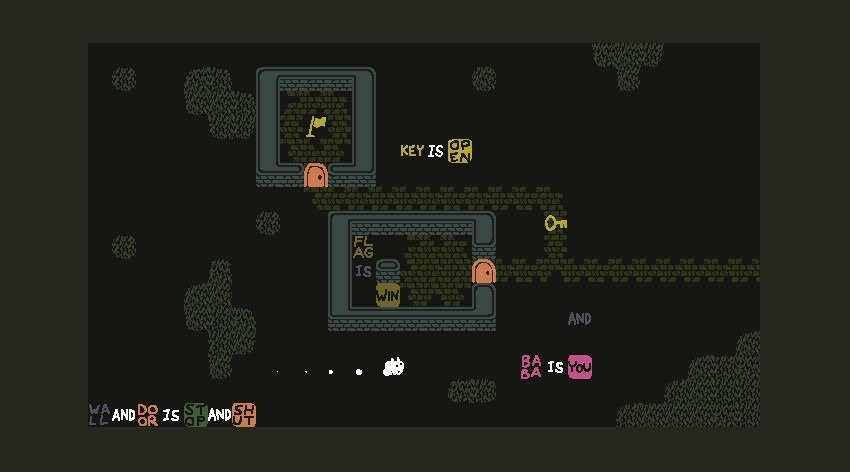
On March 13, 2019, Arvi Teikari, known as Hempuli, released Baba Is You. Its official store description explains how word blocks change the rules. This is a very different approach from Tetris or The Witness. Certain words appear as movable objects within levels. Arranged into specific sequences, they form rules that determine properties of the environment.
How can a word change the game?
Consider the sequence BABA IS YOU. It establishes a relationship between the character Baba and player control. Elsewhere, words may determine which objects are obstacles, which can be pushed, or what counts as a win condition. If particular text blocks can be moved, players can change an existing rule, altering the level’s behavior.
Rather than working only within a fixed set of conditions, players may need to reorganize the conditions themselves.
Why is this idea different?
In Sokoban, the challenge is moving boxes under relatively stable rules. In Baba Is You, moving words can transform the rules governing how objects behave. Changes must still follow the systems available, so players cannot invent any conceivable rule. Yet they can produce solutions unlike those of traditional spatial puzzles.
Baba Is You shows how the definition of a problem itself can become part of the puzzle.
How does puzzle-solving work?
An illustrative process is observe → identify the objective and rules → form a hypothesis → experiment → evaluate consequences → adjust the approach. This is not mandatory: one game may demand quick reactions, another allow free experimentation, and another permit a deductive solution before any action.
Sometimes players know the allowed moves and seek a combination; elsewhere, discovering how things work is part of the problem. Receiving a rule, deducing one, or being able to alter one changes what information is needed to progress.
Is trial and error always bad?
Experimenting is useful when a hypothesis produces a comprehensible result: an unsuccessful attempt can eliminate a possibility. That differs from randomly trying actions without clues or consistent outcomes. The relationship between rules, information, and consequences determines how much failure teaches.
Logic, patterns, space, and physics: main approaches to reasoning
| Approach | What players try to understand | Examples |
|---|---|---|
| Logic and deduction | Relationships between information and possibilities | Picross, Return of the Obra Dinn |
| Spatial organization | Position and movement of objects | Sokoban, Tetris |
| Pattern recognition | Regularities in symbols, colors, and sequences | Puyo Puyo, The Witness |
| Physics and mechanisms | Cause-and-effect relationships | The Incredible Machine, Portal |
| Perspective | How perception changes paths and objects | Monument Valley, Superliminal |
| Rule manipulation | Changing conditions that govern a level | Baba Is You |
| Programming and optimization | Building systems to achieve results | SpaceChem, Opus Magnum |
These approaches can coexist. A puzzle might ask players to recognize a symbol, connect it to evidence, and then apply that finding in space. Investigation and language depend on context and evidence; programming arranges instructions; optimization compares valid solutions by cost or efficiency.
Logic does not necessarily mean numbers
Consider two restrictions: the red object cannot be on the left, and the blue one must stay beside the green one. Eliminating incompatible positions makes it possible to deduce a valid arrangement without doing arithmetic. In games, this reasoning can rely on numbers, words, or visual relationships.
Recognizing a regularity makes it possible to predict an outcome or propose a rule. The key is checking whether the observed relationship remains valid in other examples instead of drawing a conclusion from a coincidence.
Positions, orientations, trajectories, and routes determine what is possible. A solution might require changing move order or examining an area from another angle; moving an object closer to its goal does not always bring the level closer to completion.
Here, understanding how one element affects another is essential. Players combine interactions permitted by the system—even stylized ones—to produce predictable consequences.
Picross, Sudoku, and Minesweeper: deduction through abstract rules
Not all puzzles need characters or explorable environments. Some present grids and information to interpret.
Picross and nonograms
In nonograms, commercially known in several versions as Picross, players use numbers associated with a grid’s rows and columns. These indicate groups of spaces that must be filled under the rules. The challenge is deducing which positions to mark. When the grid is completed correctly, an image may emerge.
Sudoku is not just arithmetic
Sudoku uses numbers, but its traditional structure is mainly about deduction and correctly placing symbols. The objective is not adding or multiplying values; it is respecting the constraints of rows, columns, and regions.
Minesweeper
In Minesweeper, numbers indicate nearby mines. Comparing a clue against known squares can narrow possibilities and reveal a safe move. Depending on the version and board generation, there may not be enough information for guaranteed deduction, forcing a probabilistic choice. That differs from a puzzle designed to be solved entirely without guessing.
Investigation and language: puzzles without traditional pieces

Problem-solving can also take the form of investigation. Instead of arranging pieces, players interpret information, connect events, and draw conclusions.
Return of the Obra Dinn: reconstructing events
Return of the Obra Dinn (2018), by Lucas Pope, asks players to reconstruct events and identify people from evidence found aboard a ship. A detail in one scene may confirm or contradict a theory formed elsewhere. Deducing those relationships is the central mechanic, not merely the theme of a detective story.
The Case of the Golden Idol
Released in 2022, The Case of the Golden Idol also centers on investigative challenges based on interpreting scenes and information. Players seek connections among characters and events to deduce what happened. It has its own methods of presentation and verifying answers.
Chants of Sennaar: interpreting unfamiliar languages

On September 5, 2023, Rundisc released Chants of Sennaar. It presents a tower inhabited by groups who use different languages. Players observe symbols, actions, and situations to understand meaning. Imagine encountering an unknown word in two contexts. In one, a character points to an object; in the other, the same symbol accompanies a similar action. These relationships can help build a hypothesis about the word’s meaning.
The experience uses linguistic discovery as a puzzle mechanic, but it is not a formal course in real languages and does not depend on automatic translation.
Players learn to interpret fictional systems through context and deduction.
Lorelei and the Laser Eyes
Lorelei and the Laser Eyes (2024), by Simogo, arranges documents, symbols, and patterns into a nonlinear mystery. Players must connect information discovered at different times, uniting narrative and problem-solving without relying on combat.
The Room and Monument Valley: objects and perspective on mobile
Touch controls let players inspect, rotate, and drag elements directly. Those possibilities produced distinct approaches: examining a detailed mechanism and reorganizing a path through perspective are not equivalent gestures or puzzles.
The Room: mechanisms that must be examined
The Room, by Fireproof Games, debuted on iPad in 2012; the studio’s website distinguishes subsequent ports. Examining a box may reveal a movable part that opens a compartment or changes another mechanism. Careful observation guides manipulation and reveals new possibilities while preserving the surprises of specific solutions.
Monument Valley: changing architecture through perspective

Monument Valley (2014), by ustwo games, uses architecture and perspective illusions to create paths. Rearranging an element can change the visible connection between passages and help guide the character forward. This impossible geometry follows rules of perception rather than realistic physical simulation.
The series continued with Monument Valley 2 (2017) and 3, initially released on mobile through Netflix Games on December 10, 2024, and on PC and consoles on July 22, 2025, according to official ustwo games announcements. The image here shows the first game’s 2022 PC adaptation, Panoramic Edition, not the third game.
Puzzle platformers: when solving the problem requires movement
Puzzle platformers combine traversal with problems that require understanding the environment. Characters may need to jump and reach certain surfaces, but they may also need to manipulate objects or use mechanisms to open a route.
Braid and time manipulation
Braid (2008), by Jonathan Blow, combines side-scrolling platforming and time manipulation. Reversing a previous action can enable a different route, but players must understand how the environment’s rules affect the interaction. Time is part of the solution, not a universal feature of every puzzle platformer. Braid, Anniversary Edition revised the presentation and added content in 2024. Steam lists May 14; the Xbox release followed on May 15.
The new edition does not change the original 2008 milestone.
Limbo, Inside, and FEZ
Limbo (2010) and Inside (2016) combine traversal, observation, and environmental mechanisms with their own storytelling identities. FEZ (2012) uses perspective and spatial organization. The Pedestrian (2020) lets players connect signs and reorganize paths through which a character moves. These are different ways to integrate movement into puzzle-solving.
Puzzle platformers versus precision platformers
In Celeste, the focus is primarily mastering movement abilities to overcome obstacles. In Braid, understanding time-manipulation rules is structurally important to progression. Both use platforming but create different challenges. For more on this tradition, read ZAUS.GG’s guide to platform games.
Programming, engineering, and optimization puzzles
Some games let players create systems to solve problems rather than merely manipulate existing objects. Zachtronics became especially well known for several games in this tradition.
SpaceChem and Infinifactory
SpaceChem (2011) presents challenges involving organizing processes and systems. Players use its rules to produce specified results. Infinifactory entered Early Access in January 2015 and launched in full in June that year. It involves building mechanisms that manipulate materials and parts in three-dimensional spaces, as Zachtronics explains. Such challenges can have different valid solutions.
SHENZHEN I/O, Opus Magnum, and EXAPUNKS
The Zachtronics tradition includes SHENZHEN I/O (2016), featuring programming and circuits; Opus Magnum (2017), with manipulation mechanisms; and EXAPUNKS (2018), with programmable instructions. Each has its own tools and constraints. Professional programming-language knowledge is not required to begin; learning the system is part of the experience.
More than one solution can be correct
Imagine needing to transport a part between two points using mechanisms. One solution might use few parts but require many actions; another might occupy more space and finish quickly. If both satisfy the challenge’s conditions, both can be valid. Some games let players compare solutions by efficiency, time, or resources. This makes finding a working solution only the beginning.
Players can then decide whether to refine it.
What about Factorio?
Factorio features logistics and optimization problems within a broader construction-and-automation framework. Those decisions do not reduce its overall identity to a puzzle game; classification depends on how the entire experience is structured.
Cooperative puzzles: solving problems together
Some games change the challenge by requiring collaboration. Instead of giving one person every clue and tool, they may distribute information among participants.
Portal 2 cooperative play splits portals, tools, and positions between two people. As the earlier example showed, keeping a passage open for a partner can make coordination part of the solution itself.
We Were Here
The We Were Here series developed a cooperative puzzle tradition in which participants must share information. In some situations, each person sees elements the other cannot. The challenge involves interpreting clues and communicating discoveries.
Keep Talking and Nobody Explodes
In Keep Talking and Nobody Explodes (2015), one person examines a fictional device while others consult a manual. Accurately describing a symbol the other participants cannot see and interpreting their instructions are part of the challenge. Information is divided differently between games; cooperation does not necessarily require people to be physically together.
Competitive puzzles: reasoning can also demand speed
Puzzle games can combine planning, time pressure, and interference from opponents. Competition organizes reasoning under different conditions from a contemplative riddle.
In Puyo Puyo, preparing a chain competes with the need to react to penalties; in Tetris, managing the board must keep pace with incoming pieces and, in particular modes, opponents’ attacks. Puzzle Bobble adds positioning and firing colored elements. Speed and execution matter within these rules but do not define the entire puzzle genre.
The recent evolution of puzzle games
In the 2020s, new games deepened links between exploration, information, and systems. These examples add their own approaches to the traditions already discussed. Released on October 8, 2026, Order of the Sinking Star, by Thekla, Inc., directed by Jonathan Blow and published by Arc Games and Gamirror Games, combines exploration, characters, and mechanics across interconnected challenges.
Its official description mentions over a thousand handcrafted puzzles: progression involves learning different rules and how their systems interact. It shares a director with Braid and The Witness, but is not part of those franchises or a simple repetition of their mechanics.
Cocoon and puzzles of interconnected worlds
Cocoon (2023), by Geometric Interactive, organizes challenges around worlds that relate to one another. Carrying and using objects tied to those worlds changes traversal possibilities; understanding connections between spaces matters more than learning a large number of commands.
Viewfinder and photography as a spatial tool
In Viewfinder (2023), by Sad Owl Studios, an image can become part of the environment. The challenge is understanding how this transformation changes paths, not just taking pictures.
Animal Well: exploration and puzzles
Animal Well (2024) combines interconnected environments, tools, and discoveries. Experimenting with an object can reveal a use that opens new exploration routes. This connects puzzle design with Metroidvania and progression through exploration, without reducing its world to separate riddles.
Lorelei‘s investigation, introduced earlier, is another approach: documents and relationships among clues organize discovery, rather than transforming spaces or carrying objects.
Blue Prince: the layout itself becomes a puzzle
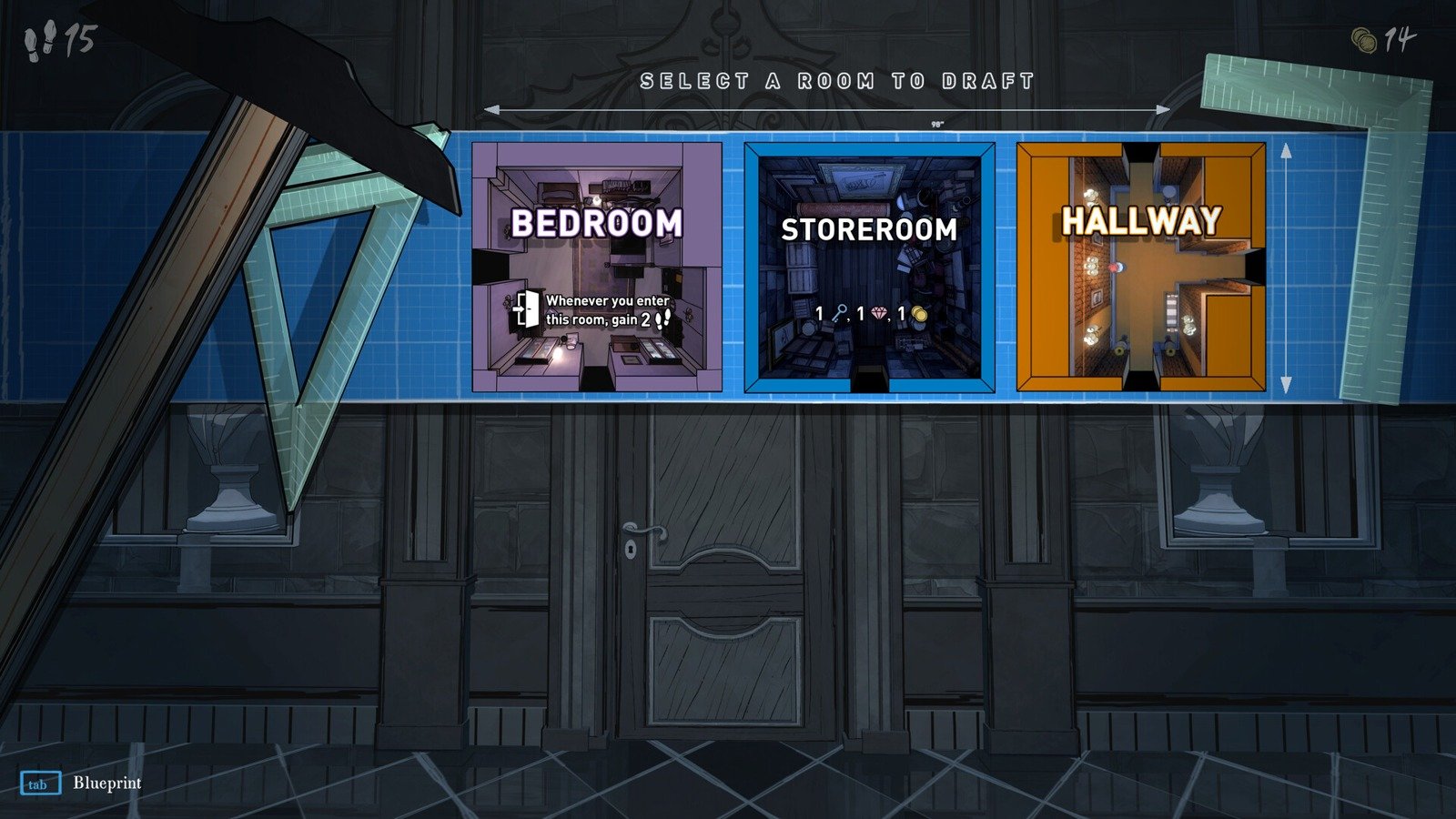
On April 10, 2025, Dogubomb released Blue Prince, published by Raw Fury. It features a mansion whose rooms can be arranged differently while exploring. When opening certain doors, players choose a room from available options, building a route through the mansion.
They must consider connections, resources, and information: much of the room layout resets with each day of exploration, while acquired knowledge and certain persistent changes help in later attempts. This affects access to other areas. The experience mixes puzzles, exploration, and strategic elements.
If Myst asks players to understand mechanisms integrated into a world, Blue Prince also makes spatial layout dependent on player choices. Selecting a room with certain connections may ease access to a later area or block an important path. Investigation and resources make it more complex than simply fitting rooms together.
The Roottrees are Dead
The Roottrees are Dead originated as a free browser game during the 2023 Global Game Jam. The expanded commercial edition by Evil Trout Inc. arrived on January 15, 2025, with a revised interface and Roottreemania, according to its official store page. Documents and clues help players establish family relationships and identities in a fictional genealogical investigation, without requiring geometric pieces or physical mechanisms.
Puzzle, strategy, adventure, sandbox, and immersive sim: what is the difference?
The classifications overlap but emphasize different features.
| Category | Main priority | Examples |
|---|---|---|
| Puzzle | Understanding and solving problems through rules | Tetris, Baba Is You, Portal |
| Adventure | Exploration, narrative, characters, and interaction | Monkey Island, Broken Sword |
| Platformer | Movement and traversing obstacles | Super Mario Bros., Celeste |
| Strategy | Planning and decisions about systems, resources, or opponents | Civilization, StarCraft |
| Sandbox | Freedom to experiment with systems and pursue personal objectives | Minecraft, Garry’s Mod |
| Immersive sim | Multiple approaches through interactive systems | Deus Ex, Prey |
| Rhythm games | Synchronizing actions with timing or musical patterns | osu!, Beat Saber |
These categories can overlap.
Puzzle versus strategy
Planning helps in both, but a structured spatial problem in Sokoban produces different choices from those in Civilization or StarCraft, which involve resources, opponents, and broader systems. That does not prevent puzzles from requiring strategy; the distinction lies in what takes priority and how challenges are organized.
Puzzle versus sandbox
Minecraft allows players to build and set their own objectives; Baba Is You presents levels with specific conditions even though rules can be changed. Experimenting with systems does not make every puzzle game a sandbox. Our Sandbox feature explores the distinction in greater depth.
Puzzle versus immersive sim
Prey lets players use tools and systems in different ways, combining exploration, combat, and character development. Portal structures progression mainly around spatial challenges. Understanding systems matters in both, but their priorities differ, as explained in the section comparing puzzle, strategy, adventure, sandbox, and immersive sim games above.
Puzzle versus rhythm games
Acting quickly is not enough to make Tetris a rhythm game. In Beat Saber, synchronization with musical patterns shapes the actions; in Tetris, arranging pieces remains central even when music is integrated into the presentation. Our Rhythm Games feature explains this difference.
Difficulty, hints, and accessibility
Complexity is not merely a matter of hiding information. Clear rules can create elaborate problems; poor explanations can make a challenge difficult without enabling a coherent discovery.
Introducing a simple rule and then combining it with others allows difficulty to grow from acquired knowledge. Direct tutorials and learning through observation are both viable; clarity of clues matters more than whether instructions are lengthy.
Undoing moves and receiving hints
Restarting, undoing, and receiving hints change the cost of experimentation. Reversing one move allows a hypothesis to be reconsidered; restarting an entire level requires rebuilding the sequence. Gradual hints may unlock progress without immediately giving away the answer. These options vary and are not available in every puzzle game.
Accessibility
Distinguishing colors, reading documents, making precise movements, or deciding under time pressure pose different barriers. Extra symbols, contrast, pauses, and remappable controls can help when available. Not all puzzles are relaxing or provide identical settings. Learning rules and reasoning during play also does not automatically demonstrate general improvements in memory or intelligence outside the game. Describing an experience should not become a promise of cognitive benefits.
Games that shaped the evolution of puzzles
This selection highlights historical references and different interpretations of the genre. It is not a ranking of the best puzzle games.
| Game | Year | Contribution or characteristic |
|---|---|---|
| Sokoban | 1982 | Spatial planning and moving boxes |
| Tetris | 1984 | Arranging falling pieces and clearing lines |
| Boulder Dash | 1984 | Action and spatial reasoning in interactive environments |
| Puyo Puyo | 1991 | Color matching and development into competition |
| Lemmings | 1991 | Real-time problem-solving with limited abilities |
| The Incredible Machine | 1993 | Mechanisms, physics, and cause and effect |
| Myst | 1993 | Exploration and observation integrated with puzzles |
| Shariki | 1994 | Important precursor of the modern match-3 formula |
| Puzzle Bobble | 1994 | Shooting pieces and forming color groups |
| Riven | 1997 | World and mechanisms integrated into exploration |
| Bejeweled | 2000 browser; 2001 commercial Windows edition | Popularizing piece matching on PC |
| Professor Layton and the Curious Village | 2007 | Varied puzzles in a narrative adventure |
| Portal | 2007 | Spatial puzzle-solving through portals |
| Braid | 2008 | Platforming and time manipulation |
| Portal 2 | 2011 | New mechanisms and cooperative campaign |
| The Room | 2012 | Detailed object manipulation |
| Candy Crush Saga | 2012 | Match-3 organized into levels and objectives |
| The Talos Principle | 2014 | Spatial puzzles and philosophical narrative |
| Monument Valley | 2014 | Perspective and architecture as mechanics |
| The Witness | 2016 | Learning rules through observation |
| Return of the Obra Dinn | 2018 | Investigative deduction |
| Baba Is You | 2019 | Rules represented by movable objects |
| The Talos Principle 2 | 2023 | New interactions and philosophical narrative |
| Chants of Sennaar | 2023 | Interpreting fictional languages |
| Viewfinder | 2023 | Images that alter spatial relationships |
| Cocoon | 2023 | Puzzles based on relationships between worlds |
| Lorelei and the Laser Eyes | 2024 | Nonlinear mystery and interpreting information |
| Blue Prince | 2025 | Spatial planning and variable room layouts |
| The Roottrees are Dead | 2025 commercial edition | Deduction based on documents and family relationships |
| Order of the Sinking Star | 2026 | Exploration and combining systems in interconnected puzzles |
Dates refer to original milestones or the specified editions. The sequence shows how different approaches to solving problems came to coexist. Piece-based puzzles did not disappear after Myst. Abstract logic games also continued to be developed after Portal and The Witness. The genre’s evolution was not one formula completely replacing another.
Players may prefer falling pieces and competition, abstract logic, exploring mechanisms, narrative, investigation, language, or programming. Time pressure and interest in cooperation also matter. This variety makes it possible to find a form of discovery that suits the desired pace and interaction, without one universal recommendation.
Puzzle games turn problems into discoveries
A piece, a word, or a clue may seem insignificant until its relationship to everything else becomes clear. Solving a puzzle involves moving from uncertainty to understanding: observing, testing, and recognizing why a solution works. The genre’s history has expanded the ways games create this meeting point between rules and discovery.
About the Author