TERA — The Exiled Realm of Arborea built its identity by bringing MMORPG combat closer to the execution and timing of an action game. Huge monsters, distinct classes, and challenging dungeons shaped Bluehole Studio’s creation, launched in South Korea in 2011 and in Western markets in 2012.
Its journey included beta tests, a subscription model, TERA: Rising, expansions, and publisher changes. The official PC service ended on June 30, 2022; the console version followed a separate path and remains active. This retrospective distinguishes historical PC systems from the verified status of the console game.
Revised October 20, 2026. B135 and its hotfix are documented in current announcements. Week 2, announced October 19 for October 22, was still upcoming on this editorial date.
Nesta matéria
Before TERA: Bluehole Studio and Project S1
Bluehole Studio was founded in March 2007. An Epic Games presentation identifies Byung-gyu Chang as its founder and describes a team with Lineage II veterans. Experience building online worlds supported the ambition to create an MMORPG able to compete internationally.
The game was publicly shown in 2008 as Project S1, with richly detailed environments and characters. Unreal Engine 3 provided the technical foundation. The challenge was to combine visual presentation, large environments, and responsive combat in a shared service for many players; subsequent tests would evaluate how well the team delivered that vision.
The TERA name and publishing agreements
At the January 22, 2009 Hangame Invitational, Project S1 became TERA, short for The Exiled Realm of Arborea. Korean publishing was associated with NHN/Hangame. Separate agreements subsequently brought the game to North America and Europe, with their own operators and regional release calendars.
The historical dispute with NCsoft
The departure of former NCsoft staff was also linked to legal disputes concerning Lineage III materials and information. In August 2012, an En Masse statement reported by the press announced a settlement in the US proceedings while maintaining the company’s position of innocence. That particular settlement was not a universal judgment on every case, nor proof that TERA was a copy of Lineage III.
The controversy belongs to the game’s business origins but does not replace its history.
The First Beta Tests: 2009–2011
The Korean tests from 2009 to 2011 prepared the original release. They were separate from the Western betas of 2012. The selected participant figures below describe planned test sizes, not concurrent users or subscriptions.
The first closed beta took place on August 22–23, 2009, with 200 participants selected by NHN. Its focus was combat: basic attacks, movement, and group encounters, supported by surveys and developer discussions. A second round, held October 30–November 2, 2009, expanded the audience and content, including character creation and regions.
A third Korean closed beta, held February 26–March 7, 2010, was announced for 20,000 selected participants, featuring 11 new hunting zones and three dungeons. Interface, skills, and content were refined. International showcases such as E3 and Gamescom also introduced the project to Western audiences. Later tests evaluated stability and a more complete version of the game’s structure.
South Korea’s open beta began on January 11, 2011. The commercial subscription service launched January 25. The first date is the start of open testing; the second is the paid release. Treating them as one event would confuse an open beta with commercial launch.
The 2011 South Korean Launch
When TERA entered the market, it offered a fantasy world, eight initial classes, several playable races, progression quests, powerful monsters, and group dungeons.
Its business model required a subscription.
The overall structure was familiar: create a character, complete quests, level up, obtain gear, and tackle endgame content. The major difference was how combat worked.
How was it received?
TERA drew significant attention at launch. In its own 10th-anniversary retrospective, KRAFTON reported an initial peak exceeding 200,000 concurrent users.
That is a historical company-reported figure, not an estimate of active players in later years. TERA also received major South Korean awards in 2011, including the top Korea Game Awards honor.
Early interest showed the appeal of the game’s visuals and combat. Attracting players at launch, however, differs from keeping them engaged for years. TERA would need updates, dungeons, competitive goals, and progression systems to sustain its community.
TERA Arrives in the West in 2012
TERA launched in North America on May 1, 2012 through En Masse Entertainment, followed by Europe on May 3, 2012, through Frogster, associated with Gameforge. Each operation had its own closed tests, open beta, and early access before launch. International expansion required localization, support, and infrastructure. Content introduced in Korea did not necessarily reach Western versions in the same month.
That distinction is especially important when discussing class debuts, level caps, and gear overhauls.
In the context of the MMORPG genre’s evolution, TERA stood out for making combat execution central to familiar quests, levels, and groups. Action combat helped set it apart without eliminating the need for engaging content and progression in a persistent world.
The Action Combat That Made TERA Different
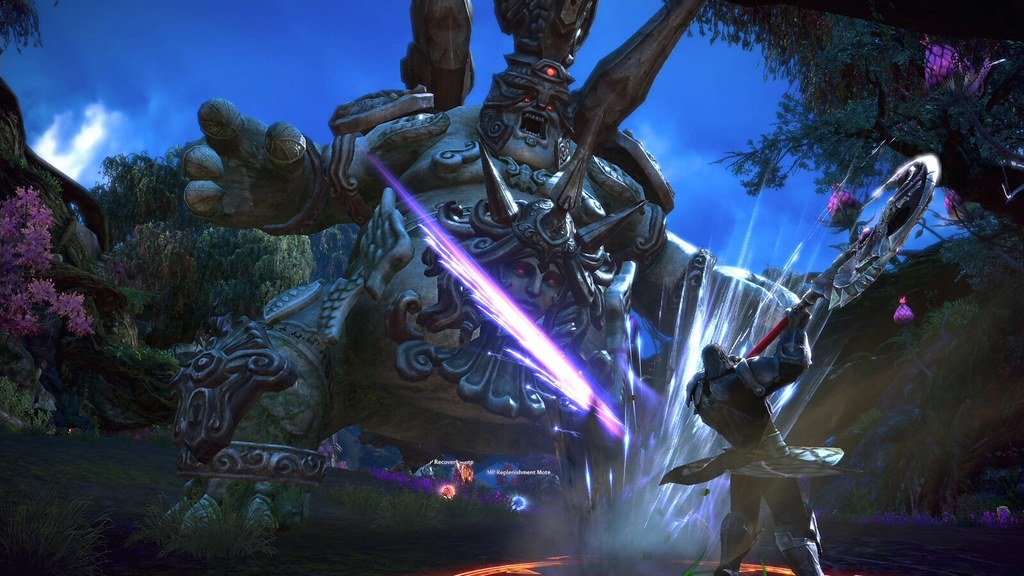
Combat was arguably TERA’s defining feature. Many MMORPGs of the period relied heavily on tab-targeting: choosing an enemy and using abilities that recognize the selected target within range and other rules. TERA took another approach. Players had to aim attacks, watch enemy movement, and hit the space a monster actually occupied.
Aiming was part of fighting
Skills had their own directions, ranges, and areas of effect. Selecting a monster did not guarantee every attack would connect. A moving enemy could leave the strike area; poor positioning could make a powerful skill miss. This created a direct relationship between movement and performance.
Dodging and blocking
Defense demanded active participation. Some classes could evade attacks with correctly timed dodges; others used blocks or defensive abilities. The Lancer, for example, wielded a lance and shield to protect the front line. Success depended not only on holding enemy attention but also on reading attacks and defending at the right moments.
Ability timing mattered
Attacks had different animations and execution times. Powerful skills could require preparation and leave a character exposed. Faster moves exploited smaller opportunities. Certain skills could also be chained into sequences, while class-specific defensive resources sometimes allowed animations to be interrupted or adjusted.
This was not simply about pressing every available button as quickly as possible. Players needed to understand which actions worked together and when to use them.
Tanks, damage dealers, and healers
TERA still used traditional MMORPG roles: tanks controlled enemy attention and protected the group; damage dealers (DPS) capitalized on positioning and attack opportunities; healers and supports kept allies alive. Action combat changed how these jobs were performed.
Healers followed their teammates’ movements and used abilities suited to the group’s positions. Attackers identified safe windows for their skill combinations. Tanks responded to boss animations rather than relying only on a fixed rotation.
Did TERA invent action combat in MMORPGs?
No. Earlier games had explored real-time attacks, positioning, and manual aiming. TERA’s achievement was making this approach a fundamental pillar of a big-budget MMORPG and applying it consistently to regular monsters, bosses, classes, and dungeons. That helped it stand out when traditional targeting systems were widespread.
Its legacy lies not in inventing the concept single-handedly, but in showing how thoroughly it could shape the genre’s experience.
Arborea: A World Born From Two Titans’ Dreams
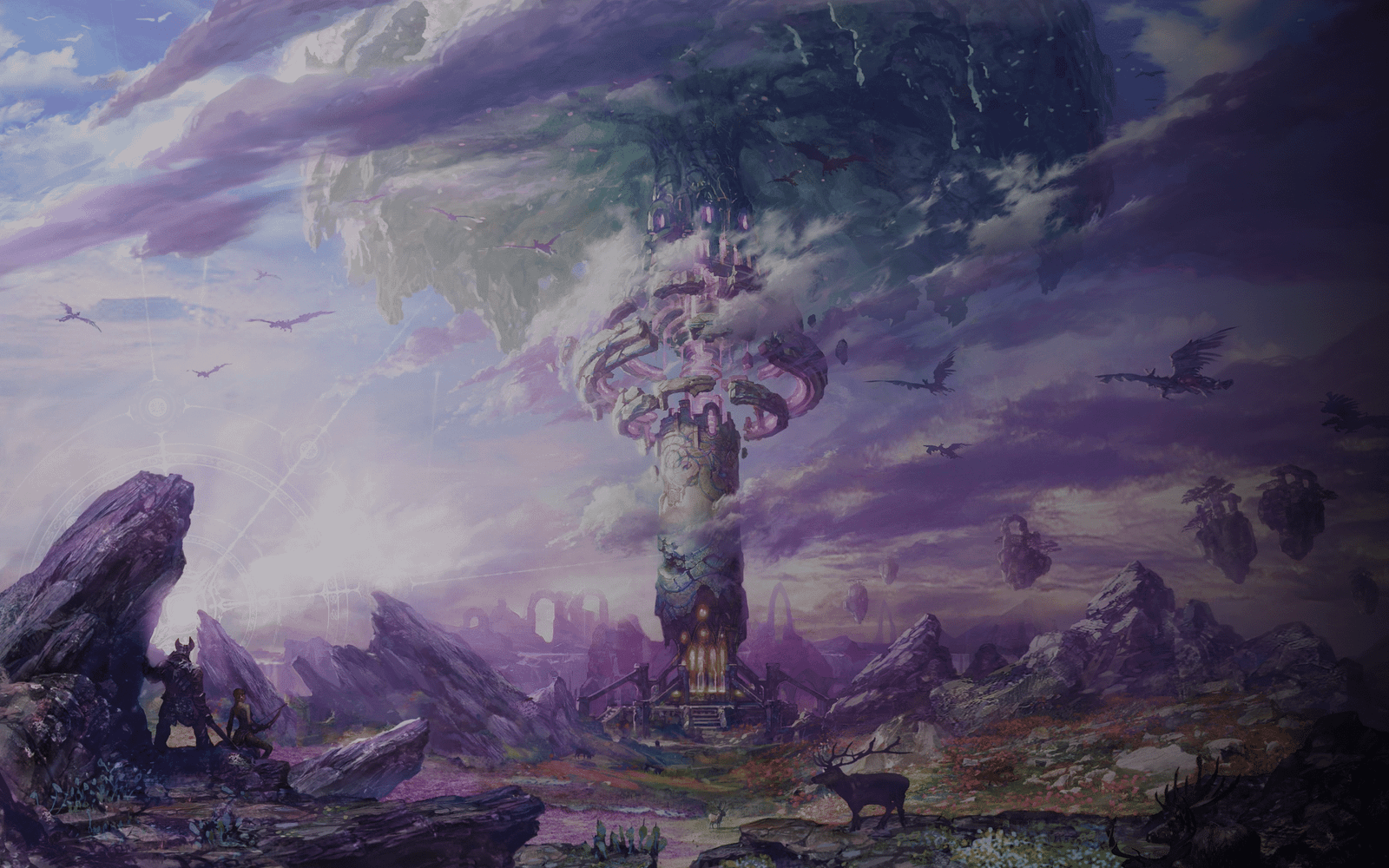
TERA was more than a collection of arenas. According to its mythology, the titans Arun and Shara gave rise to Arborea. They fell asleep, and their dreams formed the world, its inhabitants, and other beings; the titans’ bodies shaped much of its geography. Gods and peoples eventually became involved in conflicts and wars.
The game’s story followed threats to different regions, including the Argons, creatures associated with one of Arborea’s central conflicts.
Major cities
Velika was an iconic hub for adventurers. Allemantheia stood out for High Elf architecture and magical identity. Kaiator had a military appearance, representing peoples resisting dangerous threats. These were not just travel stops: they brought together services, merchants, activities, and social spaces.
Exploration and mounts
Arborea had large connected regions filled with forests, deserts, mountains, strongholds, and monumental buildings. Mounts made long-distance travel easier.
Updates expanded and reworked the map. Some areas gained new stories or purposes; others changed visually or in progression, including Island of Dawn, whose role was transformed over time. The original world remained recognizable, but beginning TERA in 2012 was not the same experience as starting during its later years.
TERA’s Races and Classes
The seven playable races are Human, High Elf, Castanic, Aman, Baraka, Popori, and Elin. They differ in appearance, animation, and racial characteristics. This does not mean every race could select every class in every historical version.
The eight original classes
| Class | Combat style |
|---|---|
| Warrior | Agile dual-sword fighter with dodges |
| Lancer | Lance-and-shield tank focused on blocking |
| Slayer | Heavy greatsword melee attacker |
| Berserker | Heavy-axe fighter with charged attacks |
| Sorcerer | Ranged and area-based magic damage |
| Archer | Bow-based ranged physical damage |
| Priest | Group healing and support |
| Mystic | Healing, support, and utility skills |
Warrior later gained a substantial tanking path through stances and balance changes; it was not exclusively DPS throughout the game’s history. Priest and Mystic both sustained groups but with different tools. Weapons, mobility, and execution distinguished classes that shared a role.
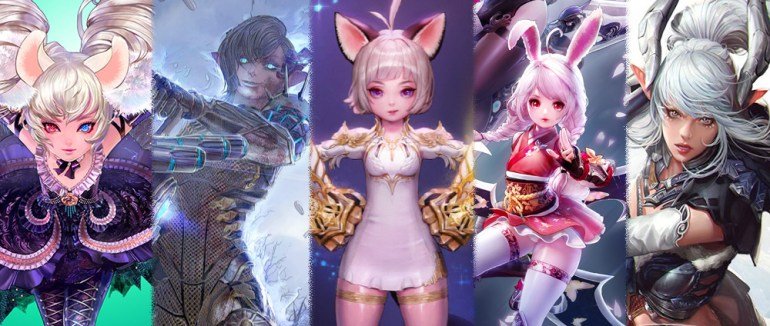
The five classes added later
The years below refer to Western PC introductions, not automatic release dates for Korea or consoles. Restrictions are historical, especially at launch, and do not describe every currently permitted console combination.
| Class / Western PC year | Role and weapon | Historical context |
|---|---|---|
| Reaper — 2014 | Damage; two chained scythes | Linked to Elin characters, with its own introductory area and a prior level-40 character requirement in Europe. |
| Gunner — 2015 | Ranged damage; magical cannon | Reached Korea in December 2014 and North America in May 2015. Initially female characters; Elin Gunner was added later. |
| Brawler — 2015 | Tank; powerfists | Initially female Human only in Europe; more options followed. |
| Ninja — 2016 | Mobile damage; large shuriken | Introduced for Elins, with quick attacks and evasion. |
| Valkyrie — 2017 | Damage; runeglaive | Initially female Castanic; En Masse announced Elin Valkyrie for North America in February 2020. |
The roster therefore grew from eight to thirteen classes. New choices refreshed party compositions but also raised debates about balance and character customization. Availability depends on version and region: an old PC restriction does not establish the console’s current rules.
BAMs: The Giant Monsters That Became TERA’s Signature
BAMs — Big-Ass Monsters — made TERA’s design philosophy immediately visible. Larger and tougher than ordinary enemies, they used leaps, charges, and area attacks. Reading their animations helped players anticipate a strike and respond.
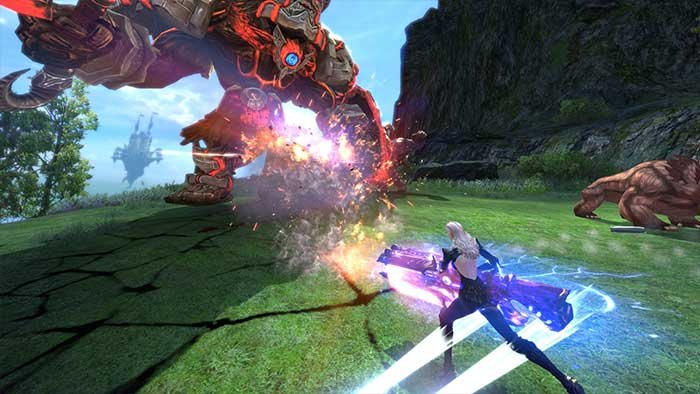
These encounters appeared in open areas and progression content, while dungeon bosses developed similar challenges further. Their size communicated range and direction but also made tracking repositioning essential.
Their placement, difficulty, and rewards changed over the years. Some BAMs helped with learning or gathering materials; others served as advanced challenges. Beyond their size, they made the road to endgame more engaging and offered an introduction to group-boss mechanics.
Dungeons and PvE: The Strength of Cooperative Content
Dungeons were a main endgame activity. Groups cleared monsters and bosses for gear, crafting materials, and other rewards, commonly combining a tank, a healer, and damage dealers. Combat had to work both individually and as a team.
Early dungeons
Progression instances introduced group roles and the importance of movement. Later dungeons grew more demanding as bosses gained dangerous attacks and complex sequences.
Kelsaik and the historic bosses
KRAFTON’s retrospective places Kelsaik in April 2011 and Shandra Manaya in March 2012 on the Korean timeline. Both became memorable encounters during TERA’s early history. These are not Western release dates; international expansion followed in May 2012.
For players mastering action combat, defeating a hard boss could matter as much as the gear it dropped.
Dungeons from later versions
Other PC-era instances included Wonderholme, Bathysmal Rise, Akeron’s Inferno, Dreadspire, and RK-9 Kennel, along with late-life additions and reworks. This is not a list of dungeons all simultaneously available on TERA Console in October 2026.
Some had separate difficulty variants; others were overhauled, temporarily removed, or returned to rotations. It would be inaccurate to present them all as available together throughout the game’s lifespan.
Why mechanics mattered
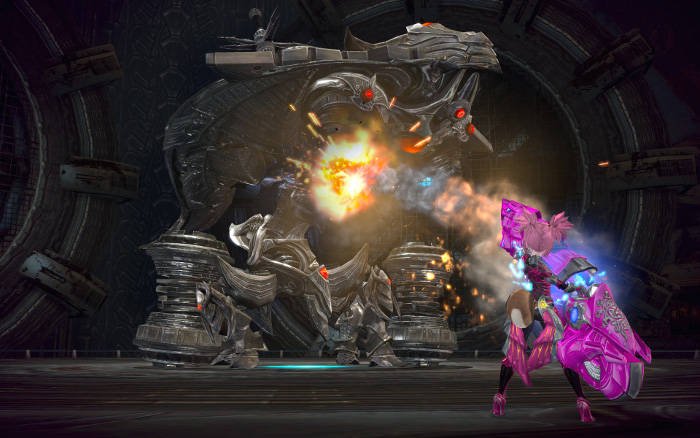
Hard encounters demanded more than high damage. Bosses required dodges in particular directions, coordinated positioning, or immediate responses to telegraphed movements. Each class also had to perform its role properly.
This emphasis on knowledge and practice helped TERA retain a dedicated PvE community despite major changes.
PvP: Duels, Battlegrounds, and Guild Wars
TERA also included player-versus-player combat, although its rules varied by region, server type, and patch. At certain times, some servers favored open PvP while others emphasized PvE; duels and structured battlegrounds were also available.
Open-world PvP
On compatible servers and maps, players could fight outside arenas under the current hostility rules. Such battles could be unpredictable but also prompted complaints about level, equipment, or group-size disparities.
Fraywind Canyon
Fraywind Canyon revolved around objectives and team fights. It was historically associated with 15-versus-15 battles in which teams fought over important positions while facing opposing players and environmental creatures.
Champions’ Skyring
Champions’ Skyring was especially known for smaller 3-versus-3 matches. Group composition, communication, and precise execution were essential. Queues, rankings, and equipment rules varied over time.
Corsairs’ Stronghold
Introduced in Western markets in July 2013, Corsairs’ Stronghold became known for large-scale combat. Its best-known historical mode was 20 versus 20: one side defended a fortress as the other attacked. Ladders, airships, and siege equipment made it very different from small arenas.
Guilds and rankings
Guilds joined organized competitions. Civil Unrest represented a historical phase of group-based faction competition, with objectives and collective structures. Its presence in the former PC version does not prove availability on consoles in October 2026. Some communities focused on competitive PvP; others preferred dungeons.
Battleground formats and rewards changed over time. A mode available in 2015 might have different rules—or be absent—in 2021. Action combat remained central to TERA PvP, but class and equipment balance was an enduring point of debate.
How Did Gear and Progression Work?
Player skill mattered, but so did gear. During the campaign, characters leveled up, unlocked abilities, and collected weapons and armor. At endgame, improving those items became central to tackling more difficult content.
Gear enchanting
Enchanting upgraded weapons and armor by consuming specific materials and resources; its rules changed with patches. At different times, upgrades involved probabilities, costs, and special materials. Some enjoyed the long-term goals; others found repeating content for materials frustrating.
Crystals and Glyphs
Crystals modified equipment properties or performance according to the applicable system. Glyphs customized skills, changing their effects and other combat characteristics. Players could thus develop different approaches within a single class.
Changes to the level cap
For years, the Western game was associated with a cap of 60. Fate of Arun raised it to 65, and 2019’s Skywatch: New Heights extended progression to 70 with new systems. That gave veterans new goals, but older gear also needed replacing or adapting.
The cost of keeping up
Frequent MMORPG updates can make gear progression demanding. Dedicated players may enjoy a new tier of challenges, while those with less time may feel they must repeat activities to regain access to advanced content. That tension followed several of TERA’s item and enchanting overhauls.
2013: TERA: Rising Ends the Mandatory Subscription
On February 5, 2013, TERA: Rising replaced the mandatory Western subscription with free-to-play access to core content, supported by optional purchases and benefits. This lowered the barrier to trying its combat and world.
En Masse’s North American operation used account categories such as Standard, Founder, and Elite. Gameforge’s European operation distinguished free and veteran accounts and offered an optional TERA Club membership. Names, slots, and benefits varied: Elite and TERA Club were not one universally named subscription.
The model combined cosmetic items, services, and convenience. Its effects should be judged according to the period: neither “every purchase bought direct combat power” nor “all monetization was purely cosmetic” accurately captures its history.
In March 2013, En Masse reported more than 1.4 million registered North American accounts following the transition. Cumulative registrations are not active users or subscriptions. Initial reach increased, but this figure does not establish long-term sustainability or prove free-to-play caused the 2022 shutdown.
Expansions and Updates: How TERA Changed Over Time
TERA’s lifespan encompassed far more than its launch and shutdown. New classes, zones, dungeons, equipment systems, progression paths, and activities often changed how characters were played.
2014: Fate of Arun

Fate of Arun arrived in the West in December 2014, expanded the world, and raised the level cap to 65. Northern Arun, including Highwatch, brought quests, dungeons, and daily objectives such as Vanguard Requests. It established a fresh progression phase for advanced characters.
2015–2017: New classes and more variety
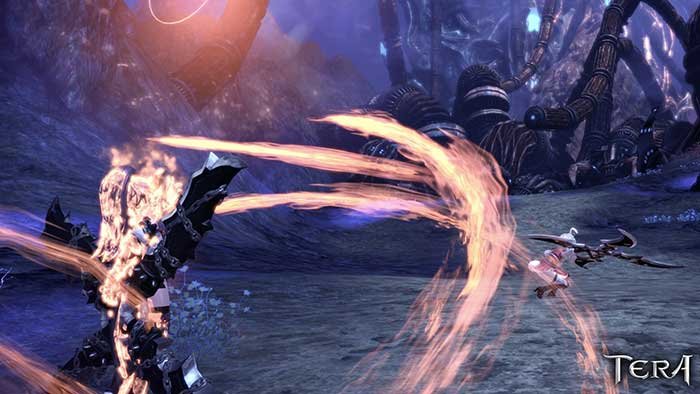
Gunner, Brawler, Ninja, and Valkyrie arrived in different periods alongside new dungeons and gear reworks. There were more ways to deal damage, defend, and support a team, but each class also required balancing. Initial race and gender restrictions sparked debate.
2017–2018: Awakening
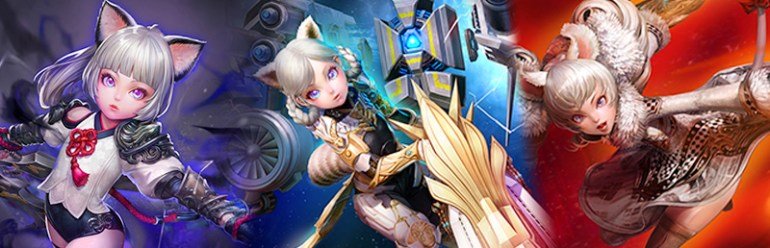
The Korean version began adding Awakening systems in late 2017, giving existing classes new abilities and options. They reached other territories on regional schedules. Awakening expanded skill sets and changed combat sequences, refreshing long-established characters without relying entirely on new classes.
2019: Skywatch: New Heights
Launched in North America on April 9, 2019, Skywatch: New Heights increased the level cap to 70 and added objectives, harder enemies, and skill-progression systems. Its North American date should not be assumed for other regions.
The five additional levels represented more than extra numbers: they extended character growth beyond the former endgame, while increasing the amount of content needed for full progression.
Exodor and the PC’s final phase
Later content added Exodor regions and gear, enhancement systems, dungeons, and advanced progression. North America also received an important 64-bit client update in August 2020; this was not a new game or new engine.
By its final years, the experience differed substantially from 2012. Newcomers encountered systems absent at launch, while veterans had to follow constant changes to rewards and gear.
2020–2021: New operators and late content
North American publishing changed hands in 2020. Bluehole Studio took direct control of the Korean service in 2021. TERA was still receiving dungeons, events, progression changes, and revisits to areas such as Island of Dawn. The decision to end PC development in 2022 did not follow an extended period officially devoid of updates; it was a decision to stop sustaining that development line.
TERA Comes to Consoles in 2018
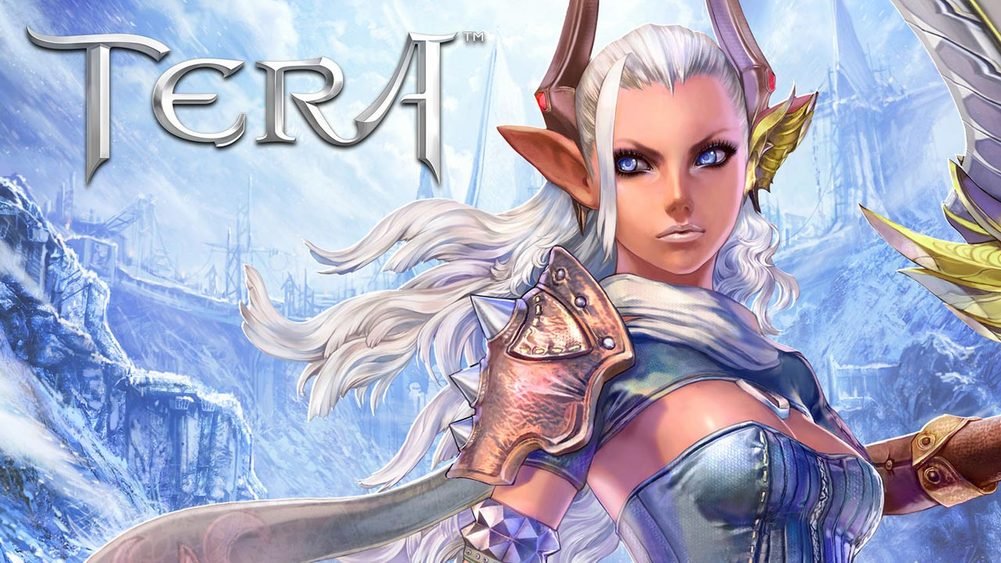
On April 3, 2018, TERA launched free-to-play in the West on PlayStation 4 and Xbox One. Its aiming, dodging, and positioning could translate well to controllers, but bringing a complex MMORPG to consoles required changes.
Controller adaptations
Console controls and menus received major revisions, including a lock-on system to help track targets, controller-friendly menus, organizational options, and social improvements. This did not make combat fully automatic: movement, skills, and defense remained crucial.
Its own development path
The console releases did not follow the PC’s exact calendar. Classes, dungeons, updates, and systems could arrive at different times, with operations becoming increasingly separate.
Crossplay between PlayStation and Xbox
In October 2020, KRAFTON announced crossplay for November across PlayStation and Xbox, including cross-generation compatibility. Shared activities were possible in dedicated channels, subject to commercial restrictions and an option to use platform-specific channels. This was not a universal character transfer between versions.
KRAFTON also mentioned PS5 and Xbox Series X as platforms continuing the previous experience, not wholly new native releases. The Xbox listing includes Xbox One and Series X|S; PlayStation still lists a PS4 game playable on PS5 through backward compatibility. Crossplay did not merge every platform store, currency, or marketplace.
This independent console path became especially important after 2022.
The TERA Community: Guilds, PvP, and Brazilian Players
Guilds organized dungeons, PvP, and social gatherings. Players shared Glyph builds, gear setups, and strategies; creators documented fights and patches. Brazilian players participated on international servers and in their own channels, which does not prove the existence of official Brazilian servers or operations.
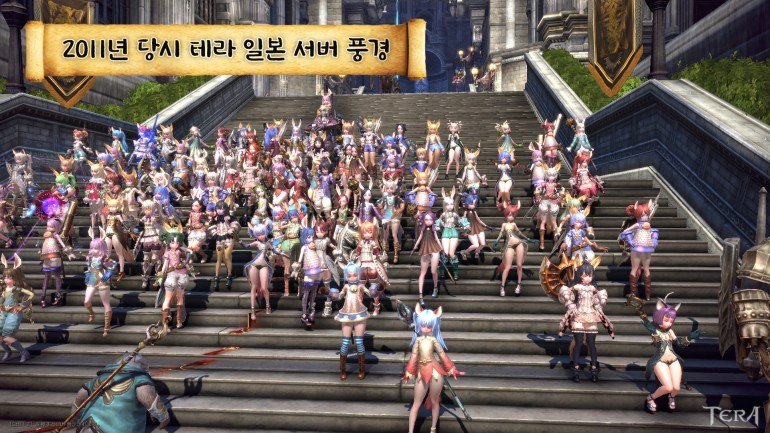
Remembering a boss defeated together could be as meaningful as its rewards. Class changes, gear revisions, and removed content altered group routines. Community accounts help explain the game’s longevity but are not a uniform measure of everyone’s experience.
Decisions That Divided Players
TERA sparked repeated debate about balance, gear, monetization, and performance. New classes changed team composition; enchanting took time and materials; store changes raised questions about paid benefits. Overhauling or retiring favorite dungeons could also disappoint players.
As an early-2010s live service aged, action combat became less unusual, while expectations for content and accessibility grew. Improvements such as the 64-bit client kept the service operating without replacing its engine.
This is historical context, not an officially established breakdown of shutdown causes. There is no complete public evidence to assign precise responsibility to retention, competition, costs, or monetization, nor evidence that Unreal Engine 3 single-handedly ended the PC service.
En Masse’s closure in 2020 was an important but separate event: the PC game kept running. The publisher transition and the development shutdown two years later must not be confused.
2020: The Closure of En Masse Entertainment
En Masse was central to TERA’s North American launch, localization, operations, and community. When the publisher announced its closure in 2020, players faced uncertainty over their accounts and characters.
Gameforge takes over American servers
Gameforge took over North American TERA with an account-migration process. According to the official Steam migration FAQ, En Masse servers closed on November 9, 2020, and Gameforge’s North American servers were scheduled to open November 12. Players had until December 18, 2020, to complete the announced migration.
This publisher transfer did not allow character movement between North American and European servers. The aim was to preserve characters, gear, and some progression under the new service rules.
Migration had limits
Certain legacy items and benefits required conversion or could not be transferred completely. Premium currencies, subscriptions, and account details followed different rules. Crucially, official PC TERA continued after En Masse closed. That was a 2020 operator change; the overall PC shutdown occurred in 2022.
What happened in Korea?
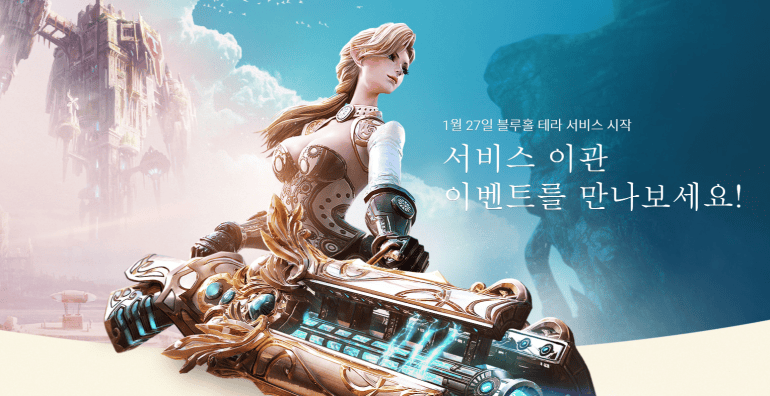
Bluehole Studio began operating the South Korean service directly on January 27, 2021, after Nexon’s earlier operation. The developer celebrated TERA’s tenth anniversary and planned activities for returning and new players, illustrating how operations were still being reorganized late in the game’s life.
April 2022: The Decision to Shut Down PC TERA
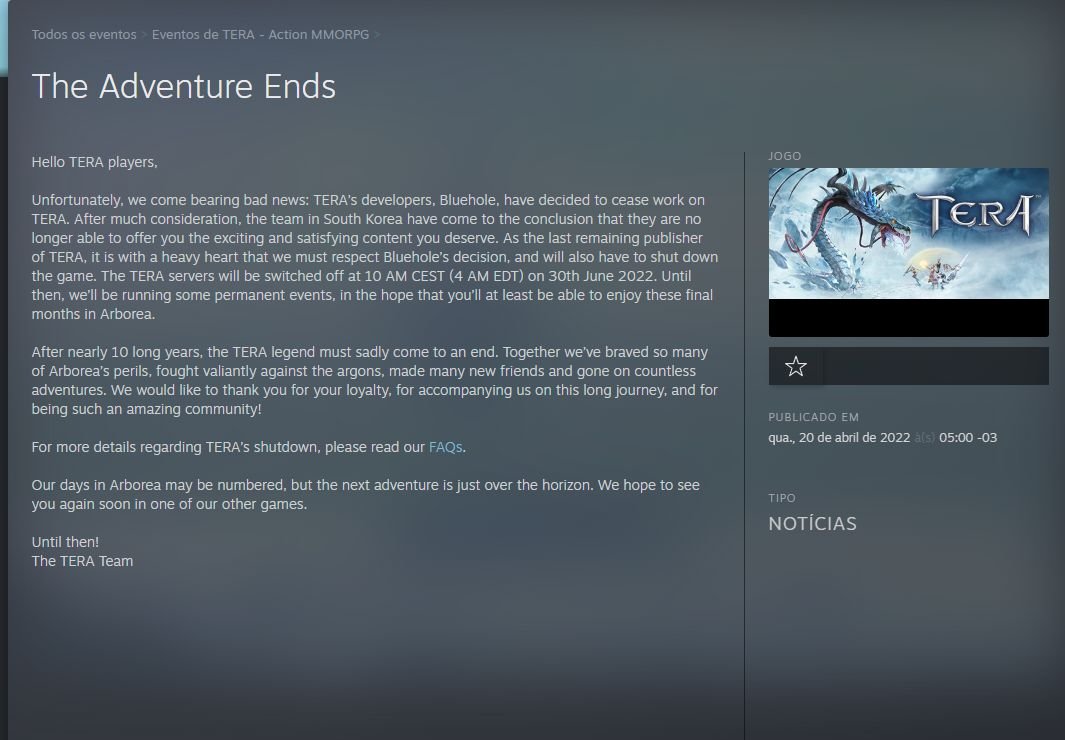
On April 20, 2022, Gameforge published The Adventure Ends. Bluehole had decided to discontinue PC development, explaining that it could no longer deliver the content it wanted and would redirect resources to other projects. Gameforge stated it could not maintain the service without continued developer support. That is the documented official explanation.
The shutdown FAQ set the closure for June 30. New registrations and purchases of Tera Thalers or TERA Club would end May 31, 2022; existing currency could still be spent before the shutdown.
There was no transfer of discontinued PC characters to consoles, unlike the 2020 North American publisher migration. No other official PC platform was available to receive those accounts. Purchases did not receive blanket refunds; users with long-running TERA Club memberships extending beyond June 30 were directed to payment support to request partial refunds afterward.
These were historical PC closure policies, not current console policies. Farewell events revisited content. Unverified theories about player decline, technology, or monetization should not replace the documented explanation.
June 30, 2022: Official PC TERA’s Final Day
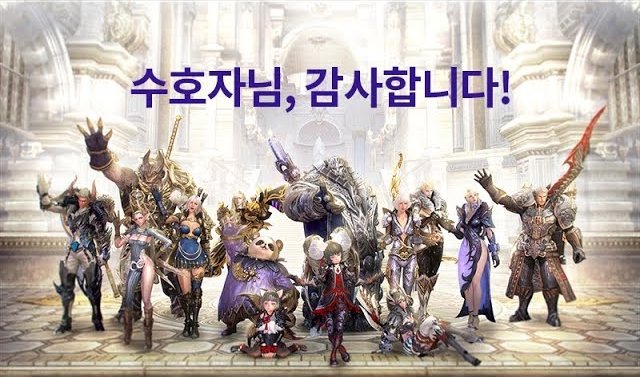
Gameforge’s servers were scheduled to go offline on June 30 at 10:00 a.m. CEST (4:00 a.m. EDT). Korea had its own time zone and announcements; the shared date should not be treated as one worldwide shutdown hour.
The final maintenance notice, announced June 28, marked the farewell. On July 1, KRAFTON published TERA: LAST QUEST, thanking the community and looking back on Arborea.
Once servers shut down, characters, guilds, and achievements became inaccessible in that service. Keeping the installer did not preserve the shared world. Videos and documents preserve its history, while the console operation remains separate and did not automatically receive PC characters.
Is TERA Really Gone? The Game’s Status in 2026
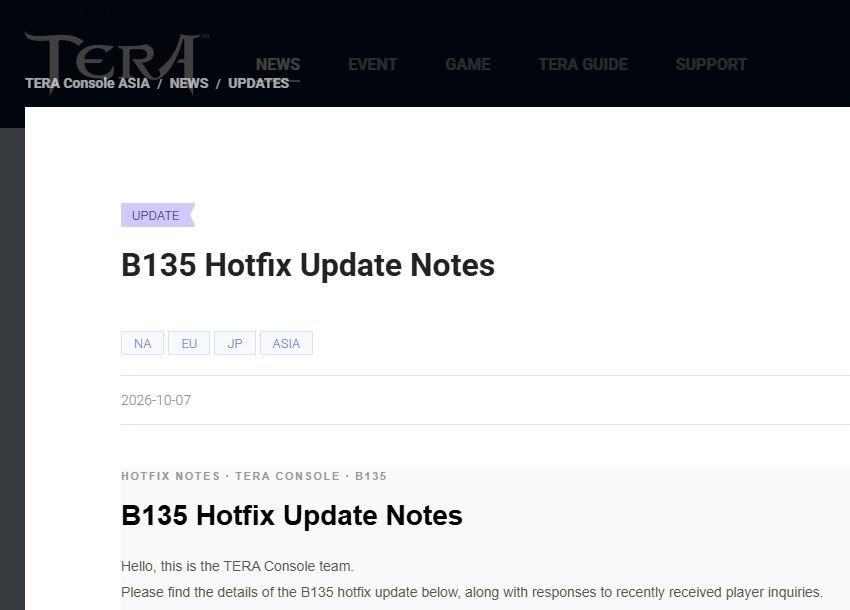
TERA Console was officially active on October 20, 2026. PlayStation and Xbox operations continued receiving content, fixes, and maintenance through the official console website. Bluehole Studio, part of KRAFTON, develops and publishes this line independently of the former Gameforge PC service.
The original console platforms are PS4 and Xbox One, with support on later hardware. Brazilian PlayStation and Xbox store listings show free access and optional purchases; the PlayStation page identifies a PS4 game playable on PS5 through compatibility, with English and Spanish text rather than Brazilian Portuguese. These listings do not establish Brazilian servers or a separate native version for every current console.
B135 and its hotfix: documented changes
The October 5 B135 notes cover Corrupted Skynest (Hard), Item Level requirements, and an Akeron’s Inferno (Hard) raid sharing entry allowances with Wonderholme. Rewards and Vanguard Requests were also reviewed. New-player group bonuses now applied below 15 completions, with specific benefits for designated dungeon brackets.
The values 950 and 1,000 refer to Item Level, not character level. HARD I and HARD II have their own costs and rewards for eligible dungeons; Corrupted Skynest (Hard) has particular conditions. These difficulties cannot automatically be applied to every instance.
B135 adjusted gear, tank and healer attributes, and Glyph cooldown-reduction calculations, which became multiplicative after gear-based reduction. Warrior also gained tank-queue access without the extra entries normally awarded to that role.
The October 7 hotfix adjusted Anger immunity, scaling ranges, HARD I/HARD II values, Jump Gear, and Vanguard Requests in Corrupted Skynest (Hard). The notes still acknowledged outdated drop-guide information and investigation into Brawler defense. October 8 maintenance was announced for B135.01. Acknowledged issues must not be treated as resolved without later confirmation.
Announced October 19: Week 2 scheduled for October 22
The B135 Week 2 announcement, published October 19 and scheduled for October 22, 2026, was the latest found at the editorial cutoff. It was not yet live on October 20. Planned changes included Priest, Mystic, Warrior, and Brawler adjustments; Anger immunity, event buffs, and dungeon changes. The Brawler Perfect Parry timing-window fix was still described as a future change, not a completed one.
PC and console remain separate situations
Official PC service has been shut down since 2022. Old PC gear, mechanics, and dungeon rotations do not establish what was available on consoles in October 2026, and no general official transfer to console followed the PC shutdown.
Community PC initiatives are not an official KRAFTON relaunch. As of announcements consulted through October 20, no TERA Console shutdown had been announced. What was verified was the separately maintained console operation, with its own history and rules.
Timeline: TERA’s Key Milestones
| Year / date | Event |
|---|---|
| 2007 | Bluehole Studio founded |
| 2008 | Project S1 publicly unveiled |
| January 2009 | Project S1 renamed TERA |
| August 2009 | First Korean closed beta |
| October–November 2009 | Second Korean closed beta |
| February 26–March 7, 2010 | Third Korean CBT, announced for 20,000 selected participants; international demonstrations that year |
| January 11, 2011 | Korean open beta begins |
| January 25, 2011 | Commercial launch in South Korea |
| May 1, 2012 | North American launch |
| May 3, 2012 | European launch |
| February 5, 2013 | TERA: Rising becomes free-to-play |
| 2014 — Western PC | Reaper and Fate of Arun; level cap rises to 65 |
| 2015 — Western PC | Gunner and Brawler added; Gunner had reached Korea in late 2014 |
| 2016 — Western PC | Ninja added |
| 2017 | Western PC Valkyrie; Korean Awakening starts in December |
| April 3, 2018 | PS4 and Xbox One release |
| April 9, 2019 — North America | Skywatch: New Heights raises the cap to 70 |
| 2020 | En Masse closes; North American service migrates to Gameforge |
| 2020 | PlayStation–Xbox console crossplay |
| January 27, 2021 | Bluehole takes over Korean operation directly |
| April 20, 2022 | PC shutdown announced |
| June 30, 2022 | Official PC servers shut down |
| 2022–2026 | Console service continues and receives updates |
| October 5–19, 2026 | B135 October 5, hotfix October 7, maintenance October 8; Week 2 announced October 19 for October 22 |
Certain class and feature dates reflect their best-known international milestones. Some changes reached Korea before the West.
TERA’s Legacy for MMORPGs
TERA helped popularize action-oriented combat in big-budget MMORPGs. BAMs, diverse classes, and cooperative bosses showed how execution could transform an established formula of levels, gear, and groups. TERA did not invent that approach alone, but it made it a defining feature of its identity and learning curve.
Its journey also illustrates the difference between creating a memorable system and sustaining an online service over many years. Updates must provide fresh content, balance, and progression; a developer’s decision to close one product line can make a decade of characters and social relationships inaccessible.
Videos, documents, and memories preserve parts of a shared world’s history but cannot fully reproduce it. TERA’s contrast is particularly clear: official PC service ended in 2022, while consoles remained active in October 2026. Its story encompasses both realities without denying the closure or assuming every version ended together.
About the Author