Slay the Spire 2 em acesso antecipado: cartas e energia orientam as decisões do combate. Imagem de divulgação: Mega Crit.
Imagine facing an enemy while your health is running low. You have five cards in your hand: two attacks, one defense card, one that draws more options, and another that strengthens future strikes. You cannot play them all with the energy available. Attacking might end the fight, but if the damage falls short, you will be exposed. Drawing additional cards might uncover the answer, with no guarantee of finding anything useful.
That situation is familiar to Slay the Spire players, yet it represents only one way card games work. Magic: The Gathering uses creatures, spells, and resources in duels; Pokémon and Yu-Gi-Oh! developed their own rules and traditions; Hearthstone was designed for digital play; Balatro turns poker-inspired hands into scoring challenges.
A card game is a category in which cards play a central role in the rules, actions, or objectives. It includes competitive battles, single-player campaigns, cooperation, arranging sequences, and storytelling. Its evolution begins with physical decks, moves through early electronic adaptations, and reaches digital TCGs and roguelike deckbuilders. To understand the genre, we must look at what players do with the cards rather than merely how they look.
Updated October 22, 2026.
Nesta matéria
What defines a card game?
Cards can represent creatures, attacks, abilities, equipment, resources, or events. They may also retain traditional ranks and suits. In Solitaire, the challenge is to arrange cards according to particular conditions; in Magic and Hearthstone, cards drive confrontations; in Balatro, they form hands and interact with scoring modifiers. Combat and custom decks are not universal requirements.
Some games establish the deck’s contents in advance. Others let players choose cards from their collection before a match or develop their deck during a campaign. Slay the Spire follows the latter approach: adding, removing, or upgrading a card changes the possibilities of future draws. Looking only for a duel between two people is therefore not enough to recognize a card game.
Simply displaying cards in the interface is not enough, either. Football Ultimate Team represents athletes through cards, but its core activity remains playing soccer. Our feature on sports games and their evolution explores that tradition. Likewise, an RPG may display equipment on cards without building its decisions around drawing, hands, effects, and deck construction. The function of cards matters more than their visual format.
From physical decks to cards on computers
Physical card games have existed for centuries in different parts of the world. They developed systems based on matching, comparing ranks, scoring, competing over rounds, and arranging cards individually. Many use a deck with a known composition, shuffled and dealt according to established rules. This tradition predates both video games and modern collectible card games.
TCGs expanded the importance of selecting cards with unique effects to build a strategy. Instead of everyone using the same ranks and suits, each participant can choose combinations from their own collection. Magic consolidated a particularly influential formula, but did not invent card games in general or every kind of collecting.
Computers added automatic dealing, effect resolution, and connections between players. If a card strengthens all creatures of a particular type, software can recalculate their attributes without requiring participants to track each modifier by hand. This reduces bookkeeping and enables effects that would be difficult to reproduce physically. Automation does not eliminate decisions, however: understanding costs, possibilities, and consequences remains central.
Microsoft Solitaire, Klondike, and Hearts
Electronic adaptations of solitaire, poker, and bridge existed before Microsoft Solitaire. Its milestone was popularization on Windows: the program was included with Windows 3.0 in 1990 and used the Klondike variant. Microsoft’s retrospective documents this history.
Players organized cards by rank, color, and position with a mouse. Dragging cards also helped people learn graphical interfaces. Windows later included other examples, such as Hearts, while different computers continued offering traditional card games. This history shows that digital card games did not begin with collectible online duels.
Magic: The Gathering and modern TCGs

In 1993, Wizards of the Coast released Magic: The Gathering, created by Richard Garfield. Custom decks, resources, creatures, spells, and different paths to victory became a reference point for trading card games. The official Wizards timeline follows that evolution.
An important part of the strategy happens before the opening draw. Two players with similar collections can build different plans: one might use cheap creatures to apply pressure immediately; another might favor defenses and removal to survive until more expensive threats become available. Choosing cards means deciding how a deck should function, what resources it needs, and how it will answer opponents.
Magic uses mana produced by sources and subject to quantity and color requirements. White, blue, black, red, and green have distinct identities, although no color performs just one function across every card. Color combinations and strategies depend on the format’s rules. A creature may become more valuable when protected by another card; an efficient spell might still be a poor fit for the chosen plan.
Shandalar, Magic Online, and Duels of the Planeswalkers
MicroProse released Magic: The Gathering for PC in 1997. Its Shandalar campaign combined exploration, duels, and collection development. Rather than simply reproducing standalone matches, it made cards part of a digital adventure. It was a particular adaptation, distinct from later platforms.
Magic Online, released in 2002 and known as MTGO, developed online matches, competitive formats, and its own digital economy. The Duels of the Planeswalkers series pursued another direction, using tutorials, campaigns, and prepared decks to introduce newcomers to the rules. These experiences are not interchangeable: interfaces, deckbuilding options, and available card pools vary across products and editions.
Magic Arena and the 2026 updates
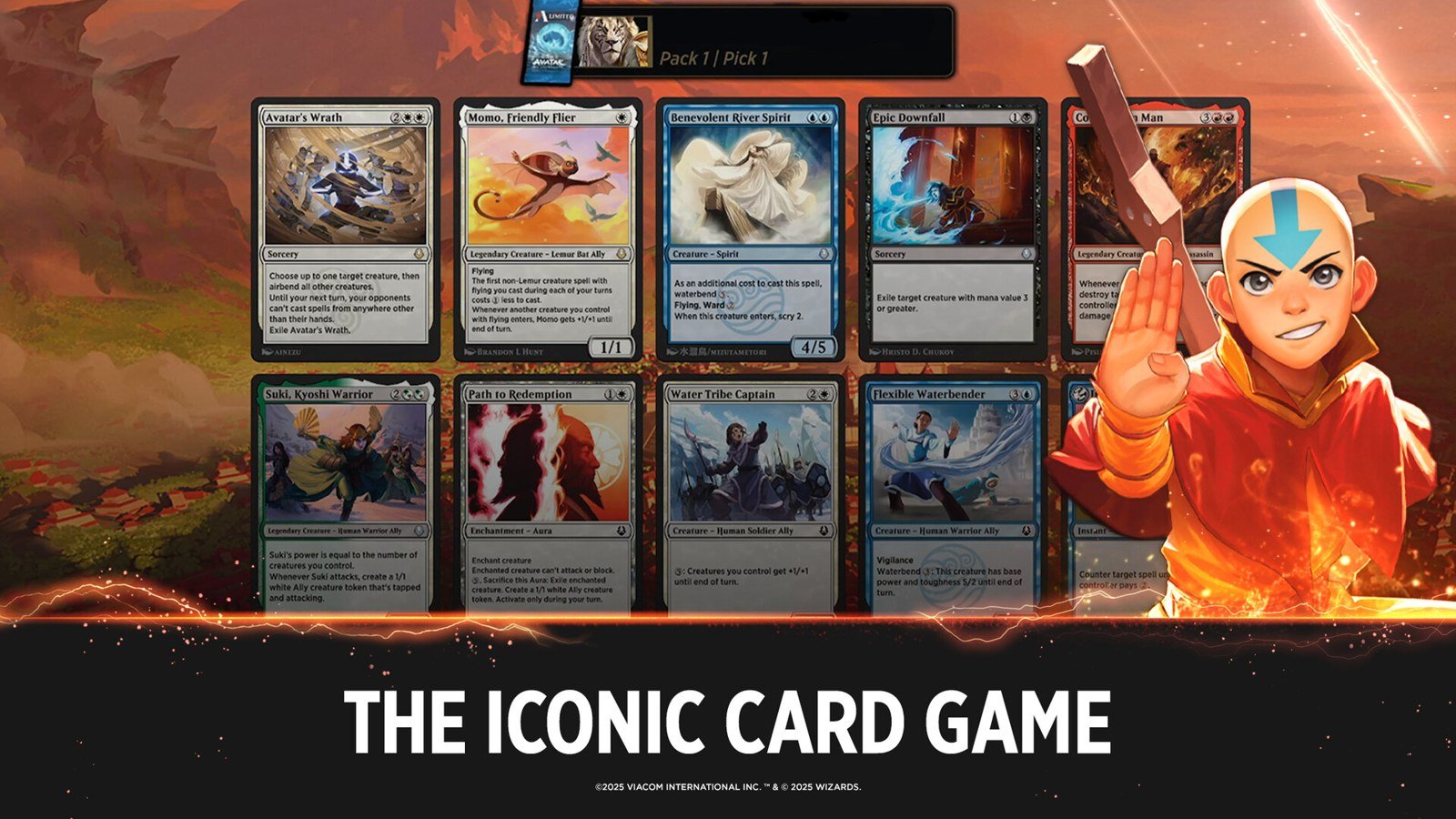
Magic: The Gathering Arena entered public testing in 2018 and officially launched in 2019. Its interface uses animations and automated resolution, but its collections and formats do not match the entire physical catalog or MTGO. Owning cards on one platform does not mean transferring them to another or finding identical ways to play.
By October 2026, Reality Fracture was available, as recorded in the official October 5 notes. The digital release Alchemy: Reality Fracture arrived on October 13 with 31 cards specific to that environment, according to Wizards’ announcement. The main set and Alchemy content do not share exactly the same distribution and rules across every medium.
Wizards also announced the future removal of the Alchemy format on February 2, 2027, explained in its State of the Formats. As of October 22, 2026, that change had not taken place. It did not mean shutting down Magic Arena: digital Alchemy cards would remain on the platform and could be legal in other formats subject to their rules and restrictions.
Pokémon: from the physical TCG to Game Boy
The Pokémon Trading Card Game began in Japan in 1996. Its rules combine Pokémon, Energy cards, and Trainer cards. Attacks can require specific Energy, while other cards search for resources, support evolution, or change game conditions. Under traditional rules, taking Prize cards is one of the elements determining victory.
Japan received Pokémon Trading Card Game for Game Boy Color in 1998, followed by releases in other markets. The video game combined duels, computer-controlled opponents, collecting, and progression through an adventure. It was more than a substitute for a match at a table: the adaptation created its own journey of learning and collection-building.
This history explains why one franchise may offer several digital experiences without each faithfully reproducing the physical TCG. Before comparing decks or cards, identify which game and which format are being discussed.
Pokémon TCG Live: closer to physical competitive play

Pokémon TCG Live follows rules and formats related to the traditional physical TCG, with deck construction and online matches. Its official website introduces the platform. Access to cards and modes depends on the service’s conditions; players should not assume that every historical collection is usable in every format.
During the 2026 rotation, the Standard format changed on Live on March 26, ahead of in-person implementation on April 10. Regulation marks, eligible reprints, and restrictions matter more than assuming legality from the expansion name alone. The platform also gained the Strategy Challenge mode in 2026, with its own conditions; the official June community letter describes its schedule and deck-editor improvements.
Pokémon TCG Pocket: collecting and different battles
Pokémon Trading Card Game Pocket, launched October 30, 2024, was developed for mobile devices by Creatures and DeNA in collaboration with The Pokémon Company. It emphasizes digital collecting, card art, and streamlined battles. Its battle decks have 20 cards, whereas the traditional physical TCG uses 60; Energy and scoring also work differently.
In the October 15, 2026 letter from the producers, changes were announced for a new series later that month. These included more widely spaced pack cycles and collection and battle improvements. At the editorial reference date, they were plans in development and subject to change, not features that could all be described as already available. Live and Pocket offer related but non-interchangeable experiences.
Dual Fusion was announced on October 20, 2026, introducing dual-type cards such as Mega Mewtwo X ex and Mega Greninja ex. The official Portuguese schedule lists October 29; the US announcement specifies October 28 at 6 p.m. PDT, which corresponds to October 29 in other time zones. On October 22, the new cards were not yet available.
The app’s second anniversary is separate from the physical TCG’s 30th anniversary: the physical 30th Celebration set released in September 2026 belongs to a different product.
Yu-Gi-Oh!: summons, effects, and digital adaptations
Yu-Gi-Oh! originated in the manga by Kazuki Takahashi, published beginning in 1996. Its duels developed their own identity, and Konami’s Official Card Game debuted in Japan in 1999 before expanding internationally. Monsters, Spells, and Traps form the basis of a long-standing tradition of deck construction and chains of effects.
Its resources differ from those in Magic and Hearthstone: there is no equivalent universal mana budget. Summons may require tributes, materials, or particular conditions. A card might summon a monster whose effect searches for another option, which in turn enables another summon. The sequence’s usefulness depends on restrictions and opportunities for the opponent to respond, not only on the printed power of each monster.
Forbidden Memories, World Championship, and Duel Links
Early Duel Monsters adaptations experimented with their own rules. Forbidden Memories, first released in Japan in 1999 for PlayStation, became known for fusion systems and duels that do not fully reproduce today’s competitive rules. World Championship handheld entries came closer to the rules and card collections of their respective periods.
Duel Links, initially released in 2016, developed adapted digital duels associated with Speed Duels and other formats. Its field, card pool, and match conditions differ from more extensive experiences. An older edition should not be judged as if it used exactly the same card list and rules as a current product.
Master Duel and competitive formats

Yu-Gi-Oh! Master Duel reached consoles and PC on January 19, 2022, with mobile versions following later. It features deckbuilding, online duels, and a Solo Mode presenting strategies and stories connected to certain cards. Konami’s official website describes the free-to-start model with optional purchases.
Master Duel is not identical to Duel Links, nor must it use the same Forbidden and Limited lists as every physical event. Each environment has its own permitted card pool and competitive rules. Understanding these differences prevents players from expecting a strategy to transfer between platforms unchanged.
TCG and CCG: collecting does not guarantee unrestricted trading
TCG means Trading Card Game, an expression associated with collectible cards that can be traded; CCG, Collectible Card Game, emphasizes collecting. These closely related terms have commercial and community usages without a perfectly uniform boundary. Magic, Pokémon, and Yu-Gi-Oh! represent physical traditions that combine collecting, deckbuilding, and trading.
In digital versions, however, a TCG label or inspiration does not guarantee direct trading or resale. Platforms may employ crafting, in-game currencies, rewards, and trading restrictions. MTGO, Arena, Live, and Pocket each have their own conditions. A digital collection does not automatically allow cards to circulate the way physical cards can.
It is also useful to separate appreciation of artwork from strategic purpose. A card may be sought for its illustration, character, or special edition without being the best choice for a particular deck. Its gameplay value depends on the rules; collecting involves other interests. Neither measure turns one card into a universal answer for every match.
Hearthstone: digital duels and distinct modes
Officially released by Blizzard Entertainment on March 11, 2014, Hearthstone uses the Warcraft universe for a card game of its own. Its digital interface automatically handles effects and presents attacks and summons through animations. Its importance lies in popularizing this modern formula, not in inventing digital card games.
In a traditional duel, players select a hero associated with a class, bring a deck, and spend mana crystals to play minions, spells, and other cards. A card costing eight mana can be powerful yet unavailable during the opening turns. The deck must survive until it becomes playable or follow another plan, such as pressuring opponents early with lower-cost cards.
Standard uses permitted sets under its rotation rules; Wild includes a larger history of cards, subject to its restrictions. Arena organizes selections and matches under separate conditions rather than the traditional process of building from a personal collection. Historical modes should not be presented as currently active merely because they once existed.
Battlegrounds and the state of the game in October 2026

Introduced in 2019, Hearthstone Battlegrounds displays cards but chiefly belongs to the auto battler tradition. Players recruit units, arrange a composition, and watch automated battles. Our Auto Battler feature explores the difference in depth.
Reign of the Black Empire launched October 20, 2026, as confirmed by Blizzard’s release announcement and the official Hearthstone patch notes. The expansion brought 135 collectible cards, the Old Gods, the Assemble keyword, and Titan-forged. By October 22, that content was available. This does not make it mechanically equivalent to Battlegrounds, which still centers on arranging compositions and watching automated encounters.
Gwent: managing cards across rounds

The Witcher 3: Wild Hunt (2015) featured Gwent as an activity within an RPG. Its success encouraged the standalone Gwent: The Witcher Card Game, fully released in 2018 after testing. The adaptation changed cards, rules, and structure; it is not an identical reproduction of the minigame.
Managing rounds is a key characteristic. Winning the first round with nearly all your strongest cards may leave few options for the next. Saving resources may let you sacrifice one round to contest the remaining ones more effectively. The decision differs from simply maximizing immediate points: a card’s value also depends on when it is played.
In October 2023, patch 11.10 marked the final developer-produced content update before GWENTfinity. The Balance Council allows the community to vote on certain card power and cost changes under defined conditions. The official announcement distinguishes this approach from conventional new expansions. The change did not automatically shut down the servers.
Legends of Runeterra: regions, responses, and PvE adventures
Released by Riot Games in 2020, Legends of Runeterra uses champions and regions from the League of Legends universe, but it is a card game rather than a MOBA. Regions have their own identities and interactions, and players combine cards according to deck construction rules. Champion abilities are adapted to those systems instead of directly reproducing their real-time arena controls.
Action timing matters. Players compete for opportunities to attack, act, and respond, unlike systems where one player performs an entire turn almost without the other’s intervention. Developing a threat too early may invite a counterplay; waiting may preserve resources while surrendering initiative. The order of decisions is part of the strategy.
The Path of Champions offers single-player adventures against computer-controlled opponents, with champion development, rewards, and roguelite elements. In 2024, Riot announced increased priority for this PvE experience and reduced focus on traditional competitive play. That does not turn the card game into League of Legends or mean every previous system has disappeared.
On October 7, 2026, update 7.10 added Shen to The Path of Champions and introduced a new constellation for Kindred. Those are different additions, not two entirely new champions in the overall game. The official update archive documents this continued focus on adventures and progression.
How do decks, hands, resources, and effects work?
An illustrative duel loop is: prepare a deck, draw cards, assess resources, perform actions, resolve effects, and adjust the plan. It helps explain many games but should not be applied literally to Solitaire, Balatro, or any experience without conventional duels. Victory can depend on life totals, points, rounds, or specific objectives.
A deck contains the cards used under a game’s rules. A hand holds the cards currently available: possessing a card in your collection or deck does not mean you can play it immediately. During a match, drawing usually means moving a card from a reserve to your hand, not paying money for it. Discard piles, graveyards, exile zones, and other areas serve different functions in each game. Some cards return to the deck; others can be retrieved only through particular effects.
Costs and action order
Mana, energy, tributes, and materials restrict options in different ways. In Slay the Spire, three energy points do not let you play cards costing two, one, and two together without an additional effect. The challenge is to select the most useful combination of actions, not simply the strongest individual card. Magic and Hearthstone both use the word mana, but their sources work differently.
Order can change an outcome. If one card strengthens the next attack, using it after attacking wastes the opportunity. Opponents’ responses add another layer: Magic uses priority and resolution; Yu-Gi-Oh! uses chains of effects; traditional Hearthstone offers less direct intervention during the opponent’s turn. Knowing the sequence helps explain why a move produced a given result.
Synergies, combos, and consistency
A synergy is a beneficial interaction between elements. One card generates a resource, another consumes it, and a third rewards its use. A combo usually refers to a more specific combination or sequence, sometimes enabling a win condition. The ideas are related but are not necessarily synonymous. No combination guarantees success if its pieces never reach your hand or the opponent has an answer.
Shuffling introduces uncertainty. Repeating useful functions in a deck, drawing extra cards, or searching for specific pieces can improve consistency depending on the rules. Adding cards indiscriminately can dilute a plan, although some games reward larger decks. Luck and skill coexist: strong decisions work under several possible results rather than assuming an ideal draw every match.
Deckbuilding, deck construction, and Dominion’s milestone
Deckbuilding has broad uses in video games. In tabletop discussions, a distinction is often made between preparing a deck before playing (deck construction) and developing the deck during the game. Magic, Hearthstone, and Yu-Gi-Oh! often begin with a prepared deck; Slay the Spire makes changing the deck part of progression. Explaining the structure matters more than declaring every informal use of the term incorrect.
Dominion, designed by Donald X. Vaccarino and released in 2008, consolidated an influential in-game deckbuilding model. Players begin with basic cards and acquire others that become part of later draws. Investing in an economic card may improve future purchases; buying victory points may move a player closer to winning without increasing their ability to act. The timing of the choice matters.
Dominion did not invent all deck construction. Its influence comes from popularizing a particular structure across physical and digital games. Deckbuilding should also be distinguished from a build, which combines choices of skills, equipment, and other systems. Cards and relics can form a build in Slay the Spire, while Diablo and Path of Exile develop character strategies without depending on cards.
Slay the Spire and the rise of roguelike deckbuilders

Developed by Mega Crit, Slay the Spire entered Early Access in 2017 and fully launched on January 23, 2019. Players choose a character, follow routes through battles, events, and shops, and build a deck over a run. Defeat normally ends that journey, while what the player learns can help on later attempts.
Its popularity helped establish the modern roguelike deckbuilder, although it did not single-handedly invent the combination of cards and roguelike features. Our article on Roguelike and Roguelite explores the different forms of restarting, variation, and progression that can coexist with card mechanics.
Energy, enemy intents, and reward decisions
During a battle, observing an enemy’s intended action helps decide whether to attack, defend, or prepare for the next turn. Spending every energy point on damage may be correct if it ends the fight; if the enemy survives, having no block may cost health needed later. The immediate outcome must be considered alongside the rest of the run.
New cards and relics develop a strategy. A relic that rewards a particular sequence can make a modest card more useful than a powerful standalone option. Taking every reward does not always strengthen a deck: additional cards may also reduce the frequency of the pieces you need. The game connects random draws, route choices, economy, and combinations rather than making progression solely about increasing attributes.
Slay the Spire 2 in October 2026

Slay the Spire 2 entered Steam Early Access on March 5, 2026. It retains cards, relics, and repeated runs while adding characters, encounters, and systems. One significant addition is co-op for up to four players, with opportunities to collaborate and multiplayer-specific cards, as explained in Mega Crit’s official announcement.
At the editorial reference date, the game remained in Early Access and should not be described as a finished version 1.0. Content and balance may change during that period. The sequel does not erase the original’s value: the two have different development statuses and sets of systems. For players interested in solo runs or playing as a group, those differences are more meaningful than assuming an automatic replacement.
Monster Train: cards and positioning across three floors

In 2020, Shiny Shoe released Monster Train, combining deckbuilding with defending the Pyre on a train. Units and enemies occupy different floors, so position influences who takes damage and how opponents advance. An effective card played in the wrong place may contribute less than one suited to that floor’s encounter.
Imagine a durable unit and another specialized in damage. Positioning the first to absorb attacks can protect the second, but surviving enemies may still climb. Players must assess several defensive areas, floor capacity, and when to invest resources. Cards, upgrades, artifacts, and clan combinations widen these choices.
The system shares objective defense with other genres but is not simply a traditional tower defense game. Our Tower Defense article describes that other structure. Here, card draws, deck composition, and developing a run remain central.
Monster Train 2, released May 21, 2025, added clans, enemies, cards, and systems such as equipment and rooms that modify floors. Its official Steam page describes these additions. The sequel keeps vertical battles while offering enough mechanical differences that the two editions should not be treated as identical.
Balatro: turning poker hands into scores

Balatro, created by LocalThunk and published by Playstack on February 20, 2024, uses traditional playing cards and poker-inspired hand rankings, but does not simulate conventional wagering between competitors. The goal is to exceed scoring targets through combinations, modifiers, and progression over a series of runs.
Players make hands to overcome challenges called blinds. Jokers can increase chips or multipliers or reward particular conditions. A strategy based on playing pairs repeatedly might benefit from a Joker associated with that hand; another may emphasize discards, suits, or other situations. A move’s value depends on how its effects combine.
Changing the deck and arranging Jokers affect consistency and future scores. Recognizing a pair or straight is only the beginning: shop purchases, upgrades, and activation order can turn the same hand into very different results. Balatro shows how familiar rules can support a distinct card game without reproducing the physical game that inspired it in full.
Inscryption: cards in service of a story
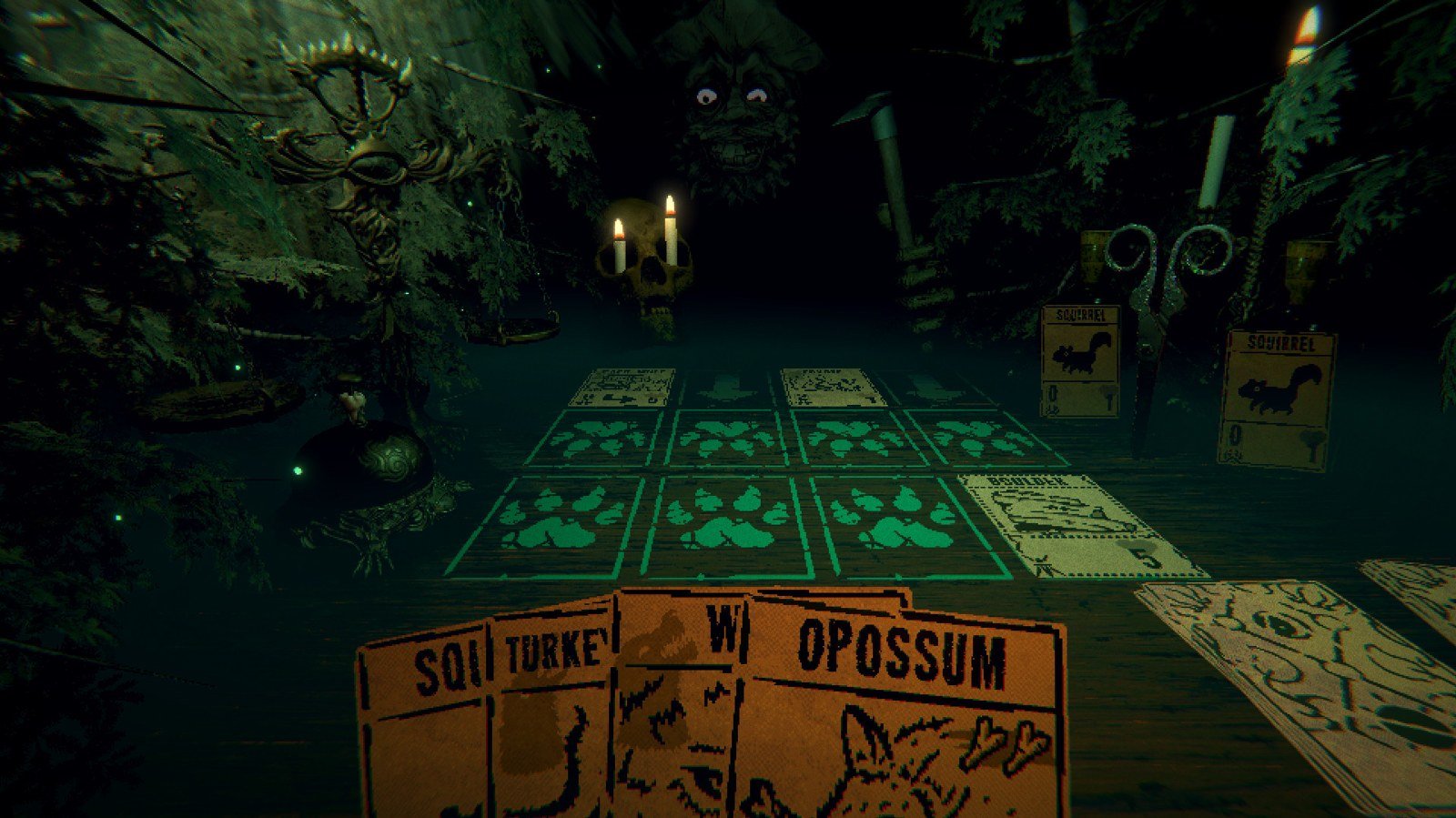
Released October 19, 2021, Inscryption was developed by Daniel Mullins Games and published by Devolver Digital. It blends cards, exploration, puzzles, and mystery in a presentation far removed from conventional competitive duels. Discovery is part of its appeal, so explaining its mechanics need not spoil the story’s biggest surprises.
Creatures have their own attributes and costs; certain moves require resources or sacrifices. Deciding what to play means watching threats and card arrangements. Yet the game is not merely a string of disconnected battles. Paying attention to the surroundings and the narrative is part of its structure.
That combination connects certain moments to the problem-solving covered in our Puzzle feature, without making every single-player card game a puzzle. Inscryption is defined by the relationship between its card systems, atmosphere, and discovery.
Other ways to combine cards and runs
Klei’s Griftlands combines deckbuilding, narrative decisions, and separate systems for negotiation and combat. Across the Obelisk uses heroes with different roles and cooperative play: choosing cards involves considering how party members interact rather than strengthening just one character.
Wildfrost (2023) emphasizes positioning and countdowns that determine when units act. Attack order can make a placement dangerous even when its numbers look favorable. Roguebook organizes exploration and combinations between heroes; Vault of the Void offers another relationship between preparation, information, and deck changes. These are distinct interpretations, not merely new art pasted over Slay the Spire rules.
In Cobalt Core (2023), cards also help control a spaceship. Movement affects exposure to incoming fire, bringing deckbuilding together with spatial decisions. The category can combine cards with positioning, storytelling, or group management without demanding the same maps or reward systems from every title.
Dicey Dungeons (2019) offers a useful contrast: it features skill choices and progression across runs, but dice are central to its actions. Sharing structures with deckbuilders is not enough to make every dice game a card game. What organizes the decisions must be identified.
Marvel Snap and the struggle for three locations

Released by Second Dinner in 2022, Marvel Snap adapts Marvel characters into short digital duels. Its traditional structure uses three locations with different effects and asks players to win a majority of them. Concentrating all power in one location may not be enough: spreading resources and reading environmental restrictions are important parts of a plan.
One location may favor a certain card cost; another may limit later plays. A card with strong numbers can be less useful than an option that reaches the area you need. This use of space differentiates Snap from systems in which the objective is simply to add up power on a single board.
The Snap mechanic also lets players raise the stakes in cubes, with the option to retreat. Reading the situation and managing risk therefore supplement card play. Short matches do not mean no planning, nor do all formats last exactly the same amount of time.
In October 2026, the official website listed the Vampires vs. Zombies season, the October 15 balance adjustment, and the October 20 patch. These were seasonal content and balance changes, not an initial launch or permanent rules across every version.
Archetypes, metagame, and competitive formats
Community terms describe deck plans but do not establish one universal classification. Aggro aims to apply pressure early; Control answers threats and seeks advantage in longer games; Midrange combines efficient cards and adapts to the matchup. Combo relies on particular interactions; Tempo values efficient plays and keeping initiative; Ramp accelerates resources to reach expensive options sooner.
These labels make sense in certain duels but should not automatically be applied to Solitaire or Balatro. The same deck may change its approach depending on the opponent, pressuring a slow strategy or preserving responses against a fast threat. Understanding how a plan intends to win matters more than memorizing its archetype name.
The metagame, or meta, emerges from permitted cards, rules, and community choices. If aggressive decks become popular, counterstrategies may arise. Tournament results, discoveries, and collection access also shape it. The meta is not a permanent list of winning decks determined solely by developers.
Digital balance patches change cards; bans and restrictions limit their use in particular formats; rotations alter eligible sets. A card rotating out of Standard does not necessarily disappear from every other mode. Magic, Hearthstone, Pokémon, and Yu-Gi-Oh! use different structures, so a deck must respect the specific format in which it is played.
Collections, expansions, monetization, and mobile devices
An expansion generally adds content; a season may organize events, rewards, and competitive periods. New cards can strengthen older interactions or reduce their role without automatically making every older card useless. For beginners, the collection available and the format rules are just as important as the total number of existing cards.
Platforms use different business models. Some let players start for free and grow collections through rewards, packs, and in-game resources; others sell a premium experience in which gaining cards is part of progression. Slay the Spire, Balatro, and Inscryption do not use the same acquisition structure as major competitive services. That does not mean every premium game is universally free of expansions or add-ons.
Optional purchases have different effects depending on the system: acquiring cards may speed access to strategies, while other offers are cosmetic. Examine how each game distributes content rather than assuming all card games monetize the same way. A digital card is tied to its platform’s terms and is not automatically equivalent to a tradable physical object.
On phones, tapping and dragging cards make interaction convenient, but smaller screens demand legibility. Hearthstone and Master Duel adapt information-heavy systems; Pocket focuses on collecting and its own matches; Snap organizes decisions across three locations. Accessibility and strategic depth can coexist, just as short matches can still demand difficult choices.
How card games overlap with other genres
Cards can represent skills in many different systems. Classification depends on their role within the overall structure, not merely on camera perspective, match length, or turn-based play.
| Category | Central characteristic | Examples |
|---|---|---|
| Card Game | Cards are fundamental components of the rules | Magic Arena, Hearthstone |
| Roguelike / Roguelite | Repeated runs and different forms of resetting and variation | Hades, Slay the Spire |
| Turn-Based RPG | Battles and progression organized around opportunities to act | Final Fantasy, Persona |
| Auto Battler | Preparing team compositions for automated battles | Teamfight Tactics, Hearthstone Battlegrounds |
| Puzzle | Understanding and solving problems | Portal, Baba Is You |
| Tower Defense | Building defenses to protect objectives | Bloons TD, Kingdom Rush |
| Board Games | Rules organized around pieces, cards, and other components | Wingspan, Gloomhaven |
In a turn-based RPG, attacking or defending does not necessarily require cards. Slay the Spire uses the hand as its main set of available actions, while Marvel’s Midnight Suns combines ability cards, heroes, and tactical choices. Our Turn-Based RPG feature explores that tradition.
The connection with roguelikes and roguelites concerns how runs are organized rather than replacing the description of card mechanics. Auto battlers emphasize preparation and automatically resolved fights; tower defense emphasizes protecting objectives; puzzles emphasize understanding problems. Sharing planning or characters does not make these systems equivalent.
Boundaries with board games can overlap too. Dominion uses deckbuilding; Wingspan combines cards, resources, and board organization; Gloomhaven connects cards with positioning. The useful distinction is to explain which decisions support each experience, recognizing hybrids instead of enforcing exclusive labels.
Timeline: different paths for card games
This selection combines physical and digital milestones. It is not a ranking of the best games. Years indicate the listed release or phase, and Early Access is distinguished from full release.
| Game or project | Year | Contribution or characteristic |
|---|---|---|
| Microsoft Solitaire | 1990 | Popularized digital solitaire through Windows |
| Magic: The Gathering | 1993, physical | Consolidated the modern TCG |
| Pokémon Trading Card Game | 1996, physical in Japan | Brought Pokémon into collectible cards |
| Magic: The Gathering | 1997, PC | Combined cards and exploration in Shandalar |
| Pokémon Trading Card Game | 1998, Game Boy in Japan | Duels and collecting in a digital adventure |
| Yu-Gi-Oh! Forbidden Memories | 1999, Japan | Historical interpretation of duels in video games |
| Magic Online | 2002 | Digital Magic platform with competitive formats |
| Dominion | 2008, physical | Consolidated deckbuilding during a game |
| Hearthstone | 2014 | Popularized modern digital card duels |
| Gwent in The Witcher 3 | 2015 | Card game incorporated into an RPG |
| Slay the Spire | 2017 Early Access; 2019 full release | Modern consolidation of the roguelike deckbuilder |
| Standalone Gwent | 2018 | Expanded a minigame into its own experience |
| Magic: The Gathering Arena | 2018 open beta; 2019 full release | Modern digital interface for Magic |
| Legends of Runeterra | 2020 | Card strategies in the Runeterra universe |
| Monster Train | 2020 | Cards combined with positioning and defense |
| Inscryption | 2021 | Cards, storytelling, and mystery |
| Yu-Gi-Oh! Master Duel | 2022 | Broad digital adaptation of franchise duels |
| Marvel Snap | 2022 | Short matches and contesting locations |
| Wildfrost | 2023 | Deckbuilding with positioning and action countdowns |
| Balatro | 2024 | Poker combinations transformed into roguelike scoring |
| Pokémon TCG Pocket | 2024 | Digital collecting and simplified mobile battles |
| Monster Train 2 | 2025 | Expanded card systems and vertical combat |
| Slay the Spire 2 | 2026, Early Access | Continued the formula with new systems and co-op |
Physical TCGs, digital solitaire, narrative campaigns, and deckbuilders continued to coexist. The timeline shows an expansion of possibilities, not a claim that newer formats rendered everything before them obsolete.
How to choose and what challenges to expect
Players looking for duels and changing metagames can explore Arena, Hearthstone, Master Duel, or Live; those who enjoy collecting on mobile will find a different approach in Pocket. For single-player adventures, Slay the Spire, Balatro, Inscryption, and other deckbuilders offer distinct priorities. Cooperation also exists, as Across the Obelisk and Slay the Spire 2 demonstrate. Playing with cards does not determine the number of participants.
Common challenges include learning rules and symbols, understanding interactions, managing unfavorable hands, and keeping up with formats. Large collections broaden strategies but can make entry more demanding. Small interfaces and dense text also create accessibility barriers; explanations and organizational tools vary from title to title.
Online services can change modes, support, and availability. GWENTfinity, Runeterra’s PvE focus, and Pocket’s announced plans illustrate different circumstances: community-led maintenance, a shift in development priorities, and future announcements are not equivalent. These distinctions help players choose an experience that suits them without promises of indefinite support.
Card games are decisions built one card at a time
From traditional decks to competitive services and modern campaigns, card games turn cards into rules and choices. Their diversity does not require enormous collections, mandatory fighting, or one universal way to structure turns.
Sometimes the best move is to spend a resource immediately; at other times, it is to preserve a card, protect a unit, retreat, or prepare a combination for later. A simple card may gain a new function when paired with the right effects and conditions. The genre evolves through this range of competitive, solo, cooperative, narrative, and scoring-based experiences—not simply by putting more cards into a collection.
About the Author