PoE (2023): armaduras cosméticas Chronomancer. Arte conceitual oficial: GGG.
Two Rare helmets can serve very different purposes. One has higher Armour; another has less Armour but also grants Life and Resistances. If Fire Resistance is your immediate problem, the second may be the better upgrade. An Energy Shield build may need an entirely different base. Rare does not automatically mean good, Unique does not always mean better, and a Normal base is not necessarily worthless.
This Path of Exile equipment guide explains how to read bases, requirements, Item Level, rarity and modifiers in PoE 1. Practical examples compare weapons, accessories and Body Armour while distinguishing an immediate upgrade from crafting potential and resale value.
Reviewed October 26, 2026 — Path of Exile 1, patch 3.29, Curse of the Allflame. The official patch index listed 3.29.3b as the latest numbered update checked for the original review. Relevant 3.28 changes and Legacy items in Standard are explained separately. Hypothetical examples are not item drops, trade quotations or ZAUS.GG gameplay tests. PoE 2 has different rules.
Nesta matéria
Item layers, bases, and requirements
Equipment combines information from different systems. Basic defenses belong to the base; affixes may roll randomly; other effects come from specialized systems. Separating these layers prevents counting an implicit as a suffix or reading a requirement as a bonus.
| Information | What to check |
|---|---|
| Base Type | The underlying item class and its basic properties |
| Rarity | Normal, Magic, Rare or Unique structure |
| Item Level | Eligible affixes, together with base and other conditions |
| Requirements | Character level and attributes needed to equip it |
| Implicit | Property supplied by the base or a special system |
| Explicit | Explicit modifiers, including affixes |
| Modifier Tier | The affix range, distinct from its actual roll |
| Quality | Improvement to particular properties |
| Sockets and Links | Gem slots and connections |
| Special states | Restrictions and opportunities such as Corrupted and Fractured |
Not every item uses every layer. An ordinary ring does not have the same socket setup as Body Armour. Identify the item type, its actual benefits and whether they work for your build before considering price or crafting.

The base type determines properties that exist before random affixes: a weapon’s base damage, speed, critical chance and range; the Armour, Evasion or Energy Shield of protective gear; requirements, ordinary implicit, socket limits and eligible modifiers. Two Rare swords with similar affixes can still behave differently if one base has greater physical damage and the other attacks faster. Local modifiers scale from those different starting points.
An appropriate Normal base with sufficient Item Level may be worth crafting even with no affixes. A weaker base covered in irrelevant Rare modifiers may be less helpful. However, crafting potential does not guarantee a price or make the white item ready to equip.
| Equipment category | Examples | Main considerations |
|---|---|---|
| Melee weapons | Swords, Axes, Maces, Claws, Daggers | Damage, attack speed, critical chance, skill compatibility |
| Ranged weapons | Bows | Damage, speed, projectiles, requirements |
| Caster weapons | Wands, Sceptres, Caster Staves | Spell Damage, Cast Speed, gem levels and build-specific effects |
| Shields | Shields | Block, defenses, implicits, affixes |
| Helmets | Helmets | Defenses, Life, Resistances, skill modifiers |
| Body Armour | Body Armours | Defenses, sockets, links, special modifiers |
| Gloves | Gloves | Defenses, Attack Speed, attributes, special effects |
| Boots | Boots | Movement Speed, defenses, Resistances, requirements |
| Rings | Rings | Implicits, Life, Resistances and useful affixes |
| Amulets | Amulets | Attributes, gem levels, build effects |
| Belts | Belts | Life, Resistances, flask effects, attributes |
| Quivers | Quivers | Offensive/defensive modifiers and special properties |
| Jewels | Passive-tree Jewels | Effects on passives, skills and attributes |
This is not an exhaustive list. Strength bases often provide Armour, Dexterity bases Evasion, and Intelligence bases Energy Shield. Hybrid bases combine those defenses, but attribute requirements are not bonuses: requiring 100 Strength does not grant 100 Strength. A Witch may equip Strength gear or a Marauder Intelligence gear if all requirements are met. Removing a ring that supplied Intelligence may disable a gem or another item, so check requirements after accounting for the removed piece.
Item Level, Required Level, and checking on PC
| Concept | Meaning | Practical use |
|---|---|---|
| Item Level (ilvl) | Level assigned to this particular copy | Restricts eligible affixes; does not guarantee them |
| Required Level | Minimum character level to equip | Works alongside attribute requirements |
| Drop Level | Minimum level associated with generating the base | Helps identify where the base can occur |
An item can have ilvl 84 and Required Level 68 without contradiction. Item Level contributes to which modifiers may generate; Required Level limits equipping it. Special item sources can have their own generation rules. Ilvl 86 does not guarantee T1 affixes, a high price, or modifier pools from unrelated item categories.
To inspect an item on PC:
- Open your inventory; enable Advanced Mod Descriptions in interface options if necessary.
- Hover the item and hold Alt under the default controls.
- Read Item Level, requirements, affix names, tiers and numerical ranges separately.
Alternatively, pick up the item on your cursor, open chat and type /itemlevel to inspect that held item. Merely hovering is not the same action; see the client command list. Hover and press Ctrl+C to copy item text into a tool. Ctrl+Alt+C was also used for advanced copying, but in 3.29 GGG states that copied item text is already in the advanced format. On controller or console, use the interface’s advanced-description command rather than assuming PC shortcuts apply.
How Item Level restricts affixes
A desired tier requires a compatible base, sufficient ilvl, access to the relevant modifier group and no blocking state. Influence and special crafting may change available pools. Higher ilvl increases eligibility, not the probability of automatically receiving a perfect modifier. Check level, groups and weights with technical tools before spending.
Rarity: Normal, Magic, Rare, and Unique
| Rarity | Conventional color | Usual structure |
|---|---|---|
| Normal | White | No ordinary random explicit affixes; base properties remain |
| Magic | Blue | Up to one prefix and one suffix |
| Rare | Yellow | Up to three prefixes and three suffixes |
| Unique | Brown/orange | Item identity and designated modifiers |
These are limits on conventional affixes, not the number of tooltip lines. Jewels and special categories have exceptions; ordinary Rare Jewels, for example, normally have up to four affixes. A Unique may enable an essential interaction, while another build benefits more from a Rare with Life, Resistances and attributes. Six useless affixes are not inherently better than four useful ones.
Affixes, implicits, tiers, hybrids, and modifier groups
Affixes are explicit modifiers divided into prefixes and suffixes. On a hypothetical eligible Rare, the prefixes could provide Life, a defense and another compatible effect, while suffixes provide Fire Resistance, Cold Resistance and Strength. Actual eligibility depends on the item and modifier groups: Life is not a universal prefix in every system. If all three suffixes are occupied, a spare prefix does not permit adding another ordinary Resistance suffix through the Crafting Bench.
An implicit might come from the base (such as a Ruby Ring’s Fire Resistance) or a special system. An explicit is a different layer; +72 to maximum Life and +35% to Fire Resistance could be explicit affixes on an eligible ring. Unique items have their own explicit effects, not the ordinary random-Rare generation process.
| Modifier type | Uses an ordinary prefix/suffix slot? | Interpretation |
|---|---|---|
| Base implicit | No | Property inherent to the base |
| Ordinary prefix/suffix | Yes | Uses the corresponding slot |
| Crafted Bench affix | Usually yes | Needs compatible available space |
| Fractured affix | Yes | Locked, but still occupies its slot |
| Enchantment | No | Separate system-specific layer |
| Eldritch implicit | No | Exarch/Eater implicit on eligible gear |
A crafted affix describes how it was added; Fractured identifies an affix locked against many changes. Neither is another rarity. Learn which layer your currency operation changes: rerolling affixes is not the same as replacing an implicit.
Tiers versus rolls: many conventional groups use T1 for their strongest tier; some special systems label them differently. A hypothetical Life tier with a +70–89 range can roll +74 or +87, both in the same tier. This is illustrative, not an assertion that such a tier exists on a particular base. A conventional Divine Orb rerolls eligible numerical values within their applicable ranges; it does not automatically promote T3 to T1.
Hybrid modifiers and counting affixes correctly
One hybrid modifier can supply more than one stat—for example, increased Physical Damage and Accuracy Rating may be part of a single weapon affix even if displayed on two lines. Conversely, several different affixes can contribute to the displayed damage. Use advanced descriptions to identify modifier names, tiers and groups before deciding whether an Exalted Orb or Bench craft has space.
Mod Groups express incompatibilities: modifiers from the same group generally cannot coexist under the ordinary rules. Mod Tags describe categories such as Attack, Caster, Fire, Cold, Lightning, Life and Mana. Two modifiers sharing the Fire tag are not automatically mutually exclusive: tags and groups do different jobs. Confirm the specific pool, weights and restrictions before choosing Fossils or another method.

On the Apocalypse Harness screenshot, Apocalypse Harness is the Rare name and Leather Belt the base. Requires Level 45 is a requirement; the separate +26 to maximum Life is its implicit. Armour, regeneration, Mana and Resistances appear as explicit properties. The promotional tooltip lacks advanced affix names, ilvl and tiers, so it cannot prove any modifier is T1 or reveal hybrid-slot counts. This is also the item shown in the featured-image example.
Local versus global modifiers
A local modifier changes the item’s own properties. Local increased Physical Damage modifies a weapon’s damage and is already included in the displayed Physical Damage range. A global modifier applies to the character or eligible skills according to its wording and conditions. Strong local weapon damage may improve attacks using that weapon but does not automatically improve a conventional Spell with its own base damage.
The distinction extends to Critical Strike Chance: base weapon critical chance, local increases, Global Critical Strike Chance, Critical Strike Chance for Spells and Critical Strike Multiplier are different values. Multiplier changes eligible critical hit strength, not critical hit frequency. Check whether your skill is an Attack or Spell, whether it uses weapon damage and which conditions apply. When calculating pDPS from displayed weapon numbers, do not apply local physical increases a second time.
Attack weapons: pDPS, eDPS, and comparison limits

The official Spinesnatch Fleshripper tooltip shows 97–152 physical damage and 1.20 attacks per second. Its physical weapon DPS before Abyss Jewel conditions is (97 + 152) ÷ 2 × 1.20 = 149.4 pDPS. It also has six Abyssal Sockets: the effects of inserted Jewels must be assessed for the build, not assumed in that basic number.
Compare Physical Damage, Elemental Damage, Attacks per Second, Critical Strike Chance, weapon range and requirements. Maximum hit alone is not DPS. In a hypothetical weapon with physical damage 100–200 and 1.50 attacks/s, average physical damage is 150 and pDPS is 225. For an independent hypothetical elemental weapon with Fire 20–40, Cold 10–30 and Lightning 1–49, the averages are 30, 20 and 25, so eDPS = (30 + 20 + 25) × 1.50 = 112.5. Do not add physical damage to this elemental figure or use a Spell’s own base damage in the weapon calculation.
Weapon DPS is not build DPS. Gems, supports, passives, Ascendancy, conversion, critical hits, enemy defenses and combat conditions matter. Some attacks prioritize elemental damage or special mechanics over physical pDPS.
Spell weapons and caster itemization in 3.29
Many Spells scale through Spell Damage, Cast Speed, gem levels, Spell Critical Strike Chance and Added Damage to Spells, according to the skill. Consider two hypothetical weapons: A has 450 pDPS with no useful Spell properties; B has 60 pDPS but gives applicable Spell Damage, Cast Speed and gem levels. A physical attack may prefer A; a conventional Spell may benefit more from B. Certain skills explicitly interact with weapon properties, so always confirm their rules.
Patch 3.29 also changed bases: Demon’s Horn, Opal Wand and Tornado Wand now have increased Spell Damage implicits instead of their former added damage effects; existing copies did not automatically change. Caster Staves gained additional tiers for levels of Spell Skill Gems of a damage type: the top tier now reaches +4, formerly +3. Lower tiers can occur earlier and more often. Spell/Fire/Cold/Lightning Damage prefixes on Staves and added spell-damage pools were expanded; conventional increased elemental damage suffixes were removed from caster weapons and Bench options. Higher Cast Speed tier frequencies changed, and new Spell Critical Strike Chance and attack/spell Block modifier groups appeared, including some Bench crafts. Check current tables rather than older assumptions in the official 3.29 patch notes.
Armour pieces: defenses, attributes, and purpose
| Defense | Basic role | Incorrect assumption to avoid |
|---|---|---|
| Armour | Mitigates physical hit damage; effectiveness depends on hit size | Reduces all damage universally |
| Evasion Rating | Helps avoid eligible attacks | Automatically avoids all Spells |
| Energy Shield | Normally protects Life, with recharge and exceptions | Always behaves as extra Life against every source |
Hybrid bases include Armour/Evasion, Armour/ES and Evasion/ES. A build relying on Evasion and Spell Suppression might benefit less from a numerically higher-Armour chest than from the appropriate Evasion base. Evaluate defenses alongside Life, Resistances, recovery, Quality, affixes, gem requirements and socket setup; see the resistances and defenses guide.
Boots, gloves, helmets, and Body Armour
| Slot | Common priorities, depending on the build |
|---|---|
| Boots | Movement Speed, Life, Resistances, attributes, defenses, eligible Suppression |
| Gloves | Defenses, Resistances, Attack Speed, attributes, eligible Eldritch implicits |
| Helmets | Life, Mana, defenses, Resistances and gem/skill modifiers |
| Body Armour | Defenses, Life, special affixes and maintaining sockets/links |
Movement Speed often improves mobility, but special builds differ. The best piece is the one whose actual gains outweigh lost attributes, Resistances, gem links and interactions. A larger Armour number does not automatically make the character safer.
Rings, amulets, and belts: assess the whole build

The Pariah in the official screenshot is a Unique Unset Ring, not an example of Rare affixes. The Unset Ring base has a socket, and this Unique’s effects depend on socket color. Rare-ring comparisons appear later.
| Base | Relevant ordinary implicit |
|---|---|
| Ruby Ring | Fire Resistance |
| Sapphire Ring | Cold Resistance |
| Topaz Ring | Lightning Resistance |
| Amethyst Ring | Chaos Resistance |
| Diamond Ring | Global Critical Strike Chance |
| Moonstone Ring in 3.29 | 7–10% increased Cast Speed |
The base implicit matters before you inspect Rare affixes. A newly generated Moonstone Ring no longer uses its former Maximum Energy Shield implicit; existing Standard copies were not automatically updated and can retain the historic effect. Compare with PoEDB’s Moonstone Ring record. For eligible ring Unveil/Bench options, patch 3.29 replaced the combined Mana and Reduced Mana Cost modifier with Mana and increased Mana Cost Efficiency. This is not a global removal of all reduced-mana-cost sources.
Amulets can solve attribute requirements, add Life, Resistances, gem levels or offensive multipliers. Anointments from Blight/Oils can grant Notables on eligible amulets, but Talismans cannot receive Anointments in 3.29. Evaluate what you lose as well as what you gain.
Belts can contribute Life, Resistances, defenses, attributes and flask modifiers. A Leather Belt provides Life through its implicit; a Stygian Vise has an Abyssal Socket for an eligible Abyss Jewel. Compare the belt and inserted Jewel together. Under the 3.29 loot changes, new Stygian Vises come exclusively from Abyss. Abyss Jewels likewise primarily come from Abyss, with a documented rare exception in Abyss biomes of Delve. That does not make Stygian Vise best for every build.
Quality, sockets, and links in 3.29
Conventional weapon Quality improves local physical damage; Armour-piece Quality improves applicable Armour, Evasion or Energy Shield. Special systems may change limits or effects. Raising a Wand’s physical weapon damage through Quality does not automatically improve a Spell that ignores it.
In 3.29, higher gear Quality also increases the chance of non-white sockets when using Chromatic and Tainted Chromatic Orbs. That neither creates additional sockets nor guarantees six links.
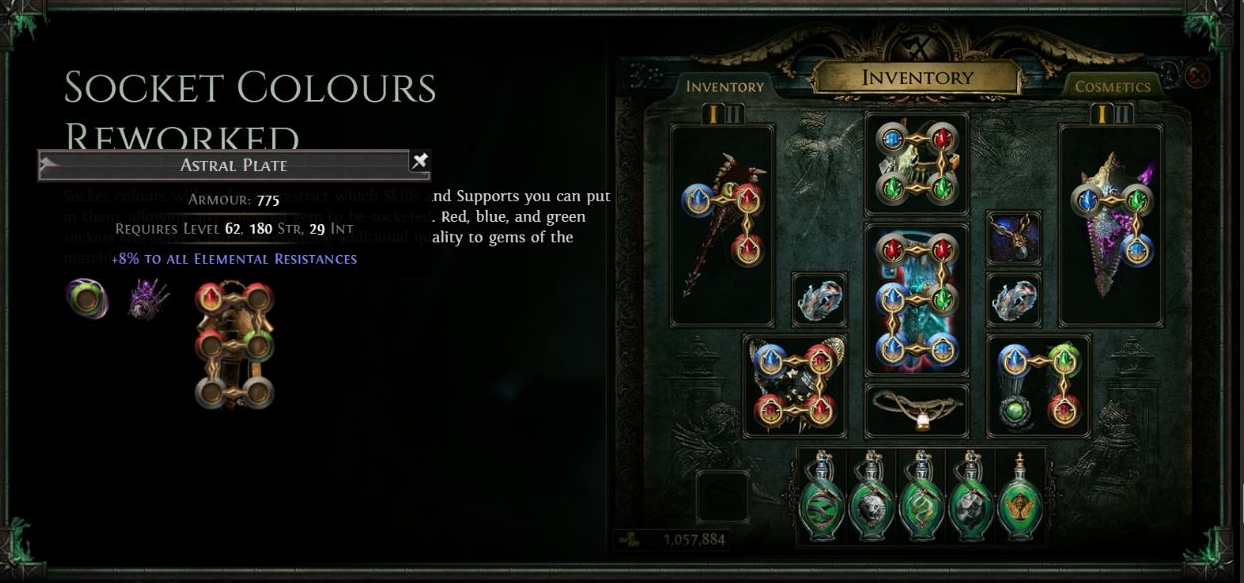
Gems can now be placed in sockets of any color. Sockets generate white by default with chances for red, green or blue; higher ilvl increases the non-white chance, and color distribution still relates to attribute requirements. A red, green or blue socket matching its gem color grants +10% gem Quality. A green gem works in a white or red socket, but gets the bonus in green. This is not universally +10% damage: the effect depends on that gem’s Quality stat.
| Operation | Effect in 3.29 |
|---|---|
| Jeweller’s Orb | Rerolls socket count; added sockets are white, including Bench sockets |
| Orb of Fusing | Rerolls links between sockets |
| Chromatic Orb | Rerolls colors and guarantees at least one non-white; Quality raises non-white odds |
Six sockets are not automatically six-linked. Supports still need correct links and compatibility. There is no need to force four blue sockets merely to place four blue gems. See the skill gems and links guide and the 3.29 notes.
Corrupted and Mirrored: understand restrictions
Corruption can come from Vaal Orbs, drops and other systems. Depending on the item and operation it can alter implicits, values, sockets and other properties. Corrupted is not inherently better or worse. It restricts normal crafting, although specialized operations such as certain Tainted currencies and eligible Bench options exist. That does not make every conventional currency usable. Before buying a corrupted item, ensure that it already meets your build’s needs or can still be altered through a compatible, affordable method.
Patch 3.29 revised corruption implicits and socket-color outcomes. Patch 3.29.3b fixed the generation of Minimum Power Charges on shields and amulets and a duplicated Minimum Frenzy Charges chance. Older probability tables may therefore be misleading; see the maintenance notes.
Mirrored means a mirrored copy, a separate state from Corrupted. It imposes crafting limits, is not a new rarity, and does not prove that every item can be copied using any duplication method. Inspect affixes, requirements and gem layout before purchasing items in either state.
Fractured, Influenced, Eldritch, Synthesised, and Veiled
| System | What it changes | Key caution |
|---|---|---|
| Fractured | Locks an affix against many compatible changes | Still occupies a prefix/suffix; base and tier matter |
| Traditional Influence | Opens special affix pools | Eligibility does not guarantee the desired affix |
| Eldritch | Adds Exarch/Eater implicits | Item-category and compatibility restrictions |
| Synthesised | Special Synthesis implicits | Acquisition changed in 3.29; Legacy exceptions |
| Veiled | Concealed modifier revealed through Unveil | Specific origins and unlocks |
| Crafted | Affix obtained through a crafting method | Needs space and meets restrictions |
Fractured: an affix stays locked
A base with a Fractured Fire Resistance affix can undergo compatible operations that change other affixes while preserving the locked one. The Fractured suffix still occupies a suffix slot. Good tier and useful base can make it a project candidate; neither the state nor an attractive color proves resale value. Patch 3.29 changed Fractured Fossil: it now fractures one random modifier and cannot be used on Influenced or already-Fractured items. It no longer follows old guides describing duplication. This does not make its requirements the same as a Fracturing Orb; check the Resonator and operation first.
Traditional Influences
Shaper, Elder, Crusader, Hunter, Redeemer and Warlord enable distinct affix groups. An Influenced item need not have rolled any exclusive modifier; access to a pool is not evidence of a good item, synergistic affixes or sale value.
Eldritch implicits and Dominance
Eldritch implicits from The Searing Exarch and The Eater of Worlds apply to eligible helmets, gloves, boots and Body Armour subject to their rules. They are implicits, so they do not fill normal prefix/suffix slots. The relative strength of the two implicits determines Dominance, used by particular Eldritch operations. Traditional Influence and Eldritch do not combine freely. Some eligible Fractured items, however, can carry Eldritch implicits: always verify compatibility for the exact project.
Synthesised: in 3.29, the ordinary generation of non-Unique Synthesised items was removed, with the documented exception involving corruption of Synthesis Uniques into Rare. Harvest’s craft to turn an item Synthesised was removed; the Bestiary recipe for rerolling a Synthesis implicit now applies only to eligible Uniques. Existing Legacy bases may remain in Standard, but they do not reopen old methods. Restrictions on Fracturing Orbs, Fractured Fossils and Reflecting Mists still matter for pre-existing Synthesised items, even where currency text no longer calls them out.
Veiled and Crafted: modifiers associated with Betrayal may need Unveil through Jun Ortoi; eligible reveals can unlock Bench recipes. The pool depends on the item’s category and origin. Bench-crafted explicit modifiers generally occupy normal affix slots. Check available prefix or suffix, group compatibility, unlocked recipe, item state and price. For ring options changed in 3.29, use Mana and Mana Cost Efficiency, not the old combined Mana/Reduced Mana Cost choice. See the special bases and influences guide — PT-BR link pending EN version.
Talismans, Enchantments, and Anointments
Enchantments form a special layer rather than ordinary prefixes/suffixes; Anointments are another mechanic (including Blight) applied to eligible items. In 3.29, Talismans gained special enchantments instead of their old special implicits. Newly generated Talismans are not Corrupted by default, cannot receive Anointments, and their native enchantment cannot be removed through the Bench. They are amulets, but not every standard amulet operation applies.
In regular play, Talismans may come from appropriate Red Beasts or Bestiary Bosses. Other non-Unique sources were restricted to documented exceptions such as Divination Cards and Thane Jorgin rewards; Unique Talismans have specific Bestiary sources instead of the general pool. Ruthless follows its own acquisition rules. Old bases remain possible as Legacy items in Standard, not normal new drops. Some recipes were replaced by Talisman-specific ones, such as fracturing an affix on a Rare Talisman with at least four modifiers, or two with at least six. Verify the present item state rather than applying a recipe intended for an old corrupted copy.
Vestigial: understanding the Legion transformation
Legion introduced a special upgrade path for eligible Uniques. Enshrouding Crystals, obtained from Legion Generals in maps, can mark an eligible Unique armour piece as Enshrouded. The crystals do not drop in the Domain of Timeless Conflict. In the Domain, place the prepared item into one of the Crystals of Permutation, kill monsters to charge it, and interact with the crystal once fully charged. The transformation gives a different Unique of the same item class with a Vestigial implicit inherited from the original item.
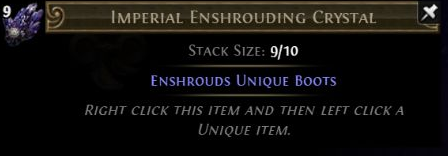
The screenshot’s Imperial Enshrouding Crystal explicitly says “Enshrouds Unique Boots.” It prepares eligible boots; it is not the resulting Vestigial item. Crystal categories have their own compatibility rules; do not infer that this interface can transform all weapons or jewelry. ZAUS.GG did not perform this operation in the review.
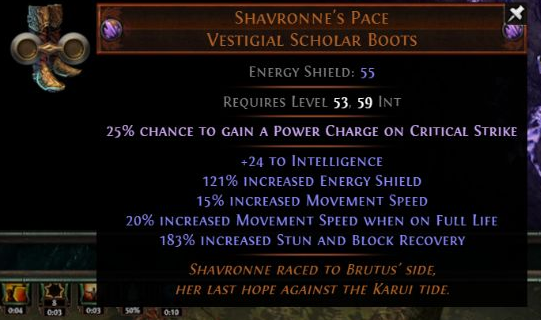
To judge the result, examine the new Unique and the inherited implicit. Shavronne’s Pace in the screenshot illustrates the Vestigial/Power Charge outcome. This is not Fracturing, traditional Influence or normal Rare generation. A full Legion planning guide would need to cover base selection and risk separately.
Compare within your build: two Rare rings and a Normal base
Identify whether the main skill is an Attack or Spell, whether it uses weapon damage, which damage types it deals and its necessary conditions. Minion, Totem, Trap and Mine are additional mechanics, not a single mutually exclusive alternative to Attack/Spell. Check Life/ES, Resistances, mitigation, Evasion, Suppression, Block, recovery, attributes and any sockets/links you would lose. The first build guide can help establish priorities.
The following values are hypothetical; they are not a complete tooltip, verified tiers or market prices.
| Property | Ring A | Ring B |
|---|---|---|
| Maximum Life | +60 | +45 |
| Fire Resistance | +35% | +20% |
| Cold Resistance | +30% | — |
| Strength | +25 | — |
| Increased Damage | — | +15% |
| Intelligence | — | +30 |
If you lack Fire and Cold Resistance, A may solve a more serious defensive problem. If those are capped and your skill benefits from the modifier, B deserves testing. If you need Intelligence for a gem, B may enable it, but remember any lost Strength. 15% increased Damage is not automatically 15% more Damage; its contribution depends on existing increases and eligible skill mechanics. Neither ring automatically wins on DPS or price.
Normal base versus Rare
Suppose a high-ilvl Normal base fits your crafting goal while a lower-base Rare has useless affixes. Neither may be ideal to equip immediately. The white base could be the better crafting starting point—after checking implicit, requirements, ilvl, modifier pool, item state, costs, alternatives and demand. Being a potential project does not mean the item is valuable or ready to wear.
Step by step: assess a dropped Body Armour
Imagine finding a Rare Body Armour in maps. The original article consolidates a fifteen-point evaluation into eight related steps; you can assess most of them without equipping the item.
- Identify base and rarity. Determine Armour, Evasion, ES or hybrid defenses. Rare describes the affix structure, not quality.
- Check requirements, ilvl and item states. Separate equipping requirements from Item Level. Consider attributes lost from removing your current piece; identify Corrupted, Fractured, Influence and other restrictions.
- Separate layers. Read base implicit, potential Eldritch implicits and enchantments. Do not count these as conventional affixes.
- Inspect advanced mods. Identify prefixes/suffixes, hybrid modifiers, tiers and rolls; check modifier groups and truly open slots before assuming the Bench can add something.
- Read defenses and Quality. Distinguish base defense from local improvements and Quality. High Armour alone does not replace Life/ES, Resistances and recovery.
- Check gems, sockets and links. Preserve your main skill and compatible supports. In 3.29, any socket color accepts a gem, but links and the Quality bonus from matching colors still matter.
- Compare all gains and losses. Review Life/ES, Resistances, Armour/Evasion, attributes, special effects and sustain. Simulate unclear interactions in PoB. Even six T1 modifiers must be useful together; compare costs with a ready-made alternative.
- Choose a purpose. Equip for a real upgrade; save for a concrete goal; craft only when eligibility and cost make sense; sell if demand exists; otherwise vendor or discard. No price is guaranteed.
Crafting potential and commercial evaluation
Consider base, Item Level, implicit, special states, valuable affixes to preserve, open slots, modifier compatibility and the cost of required steps. Compare this projected expense with buying the finished item. A Fractured Fire Resistance base is useful only if the base and locked affix suit an actual build and justify the effort. A special implicit may warrant keeping an item even when current explicit affixes are poor, but only with a plausible use.
For operations see the currencies guide — PT-BR link pending EN version — and beginner crafting guide — PT-BR link pending EN version.
Researching prices
Identify league/mode, base, ilvl, rarity and special states. On official Trade, search for several listings with genuinely comparable core affixes, tiers, rolls and combinations, then filter for secondary properties. Consider build popularity, supply and liquidity: an exceptionally low listing may be an outlier, and an asking price does not prove a completed sale. The item pricing and sales guide and trade/Faustus/economy guide are PT-BR links pending EN translations. This article provides no current price for its hypothetical items.
Tools: simulate, inspect affixes, and search listings
Path of Building Community: open or import your build and compare a candidate item with your equipped one. Check attributes, gems, damage relevant to your skill, Life/ES, Resistances, recovery and defenses. Verify Configuration and maintainable buffs; an unrealistic setup produces misleading comparisons. See the Path of Building guide.
Craft of Exile: inspect pools, groups, tags and crafting possibilities. Select PoE 1, the correct base, Item Level and states before simulating. Technical possibility does not prove the craft is affordable or profitable.
PoEDB and PoE Wiki: technical item and modifier references; check their update date and game mode. Their content does not automatically grant permission to reuse third-party images.
Official Trade: filter listings by league, base, ilvl, rarity, affixes, values, states, sockets, links and asking price. Trade is operated by GGG; PoB, Craft of Exile, PoEDB and the Wiki are community projects. Use each tool for its own question: build impact, affix eligibility or comparable offers.
Patch changes and Legacy items
3.28 — Mirage and 3.29 changes
| Change | Implication for evaluating items |
|---|---|
| Sockets and Quality in 3.29 | Any gem fits any socket; RGB match grants +10% Quality but links still matter |
| Moonstone Rings and Wands | Newly generated implicits changed; Standard may retain Legacy copies |
| Caster Staves and related affixes | Check current gem levels, damage, critical chance, Cast Speed, Block and Mana Cost Efficiency pools |
| Fractured, Synthesised and Talismans | Fossil now fractures; Harvest Synthesis removed; new Talismans have enchantments/restrictions |
| Legion and corruption | Vestigial adds a new layer; corruption implicits changed and received corrections |
Legacy items and maintenance
A patch can affect all copies, only newly generated items, or allow some historical numerical rolls to be updated with a Divine Orb. The specific patch note governs each case: Divine does not universally replace old implicits, affixes or mechanics. Patch 3.29.3b addressed Minimum Power Charges and duplicate Minimum Frenzy Charge corruption outcomes. Refer to primary notes for 3.28 — Mirage, 3.29 — Curse of the Allflame and the patch index. Drop-rate and Modifier Tier Rating changes are not guarantees of market value.
Troubleshooting and item-evaluation checklist
| Recurring mistake | What to verify |
|---|---|
| “Unique, high ilvl or six affixes must be good” | Actual build function, base, synergy, tier and demand |
| “The item appears to have an open slot” | Prefix/suffix, hybrids, group, recipe and state; implicits do not use ordinary affix slots |
| “More physical weapon damage improves any skill” | Attack vs Spell, local/global effects and conditions; weapon DPS is not build DPS |
| “One stat improved, so my build improved” | Lost Resistances, Life/ES, attributes, recovery, gems and links |
| “An old tutorial should still work” | Patch 3.29, system, league and possible Legacy copy |
| “The listing price proves the item’s value” | Comparable listings and liquidity; asking price is not an executed sale |
Before deciding what to do with a drop, identify its base, rarity, requirements and ilvl; separate implicits, affixes, states, tiers, groups and tags; test useful effects against everything lost on replacement; read Quality, sockets, links and current restrictions; and make an explicit choice to equip, save, craft, trade or discard. A properly configured Loot Filter helps decide what deserves inspection, not whether the item is actually good.
Read the item before deciding
You do not need to memorize hundreds of affixes. You do need to recognize the base, separate requirements from benefits, and understand what your build actually uses. A missing Resistance can matter more than an offensive bonus; a low-pDPS weapon can be better for a Spell. Use the advanced tooltip, compare all gains and losses and only then choose the item’s destination.
Image credits: official Curse of the Allflame / PoE 1 3.29 promotional material by Grinding Gear Games (GGG), including faithful screenshots/crops with no changes to numbers. No open image license is asserted. These images show visible bases, rarity, requirements and properties but do not replace the full advanced tooltip with ilvl, affix slots and tiers. Open originals at full size for detailed reading.
About the Author